- Democratic Process: An Introduction
- Characteristics of the Democratic Process
- Challenges in the Democratic Process
- Reforms and the Future of Indian Democracy
Introduction
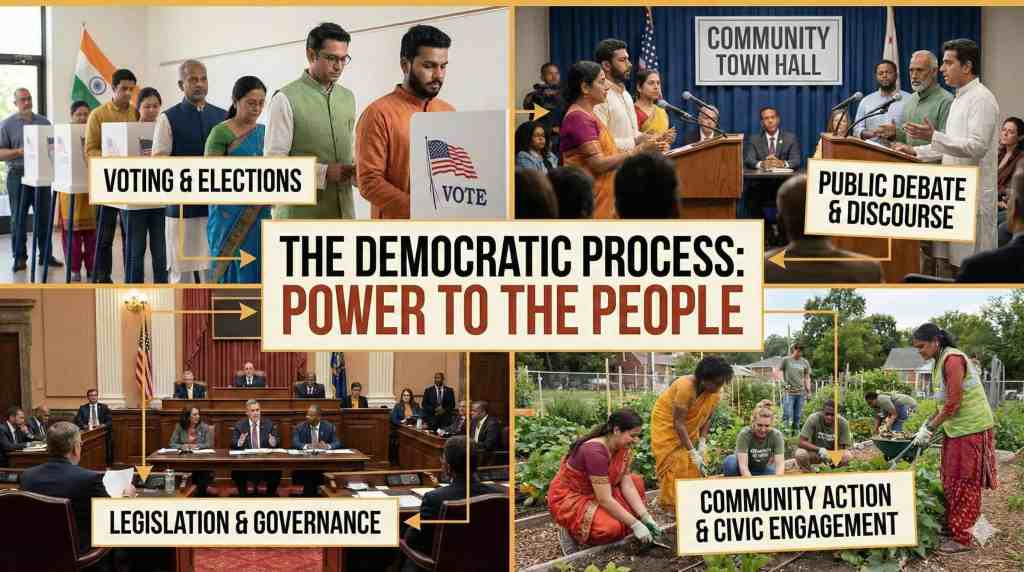
The democratic process refers to the system through which a country’s people participate in governing themselves, typically by electing representatives who make decisions on their behalf. It involves a set of political activities, institutions and principles that ensure power is derived from the consent of the governed.
The democratic process in India stands as a testament to the country’s commitment to the ideals of freedom, equality and popular sovereignty. It is a process that goes far beyond the mere act of casting a vote, it embodies the continuous interaction between the people and their government, shaped by centuries of cultural diversity and historical struggles for justice and representation. In this vast and pluralistic society, democracy functions as the mechanism through which individuals from different backgrounds whether defined by language, religion, caste, gender or region can come together to give their opinions and influence the nation. The democratic process provides the framework that allows the people to elect their leaders and hold them accountable, ensuring that those in power remain responsive to public needs and aspirations.
This process is dynamic and reflects the changing realities of Indian society. It offers a peaceful means for resolving conflicts and disagreements through dialogue and elections, rather than through violence or authoritarian rule. Even when political differences are sharp or social divisions run deep, the democratic process acts as a unifying force, reinforcing the belief that every citizen has an equal stake in the country’s future. It also promotes political education and awareness, encouraging citizens to stay informed about governmental policies, public issues and the performance of elected officials. As a result, democracy in India nurtures a politically conscious populace that participates actively in civic life, not only during elections but through ongoing engagement in social and political movements, debates and community initiatives.
Moreover, the democratic process in India has been shaped and strengthened by its constitutional framework, which guarantees fundamental rights and liberties that support free expression and political participation. These rights empower citizens to criticize their leaders, demand transparency and seek justice when necessary. Institutions such as the judiciary and free press act as watchdogs, ensuring that the democratic process is not undermined and that the government remains answerable to the people. Decentralization of power has further deepened democracy by empowering local communities to govern themselves in matters affecting their immediate environment. This grassroots democracy enables citizens to directly influence decisions regarding development, resource management and welfare programs, making governance more accessible and accountable.
Despite its many strengths, the democratic process in India faces significant challenges that test its resilience. Social inequalities, economic disparities and historical prejudices sometimes limit equal participation, while electoral malpractices and political corruption pose threats to the integrity of the process. Additionally, the rise of identity politics and polarization can create divisions that challenge democratic unity. Nevertheless, the ongoing commitment of the Indian people to democratic values, combined with continuous reforms and active civil society involvement, works to address these issues. The democratic process in India is therefore a living, breathing system that grows and adapts with each election cycle, each social movement and each new generation of citizens committed to the idea that the government should always reflect the will of the people.
In essence, the democratic process in India is not merely a political mechanism but a vibrant social institution that shapes the nation’s identity and future. It embodies the promise of equal opportunity, justice and participation for all citizens and serves as the primary means by which India aspires to realize its ideals of liberty and fraternity in practice. The ongoing engagement of millions of Indians across the country in this process is what continues to make India a strong democracy, capable of facing challenges and nurturing hope for a better, more inclusive society.
Characteristics of the Democratic Process
India’s democratic process is a remarkable example of inclusive governance in the world’s largest democracy. Rooted in the principles of universal adult franchise, constitutional safeguards and regular elections, it ensures that diverse voices from every region, caste, religion and community find representation. Supported by a strong framework of political institutions, India’s democracy thrives on pluralism, active citizen participation and decentralization. Despite challenges, following characteristics collectively uphold the rule of law, maintain checks and balances and enable the peaceful exercise of political power, making India’s democratic system resilient and dynamic:
1. Universal Adult Franchise: India’s democracy is firmly grounded in the principle of universal adult franchise, which grants every citizen aged 18 and above the right to vote. This inclusivity ensures that political participation is not restricted by caste, religion, gender, education or economic status. The extension of voting rights to all adult citizens reflects the democratic ideal of equality and empowers marginalized communities, including women, Scheduled Castes and Scheduled Tribes, to have a voice in the political process. Universal suffrage is a vital tool for social integration and political empowerment in India’s diverse society.
2. Regular and Periodic Elections: A fundamental feature of India’s democratic process is the conduct of regular and periodic elections. At the central level, general elections to the Lok Sabha take place every five years, while state legislative assemblies and local bodies also hold elections on fixed schedules. This regularity ensures that governments remain accountable to the electorate and provides citizens with the opportunity to renew or withdraw their mandate. The peaceful conduct of these elections has been a significant achievement for India, reinforcing political stability and democratic legitimacy.
3. Multi-Party System: India’s political landscape is distinguished by its vibrant multi-party system. Multiple national parties compete alongside numerous regional parties, which reflect the country’s vast cultural, linguistic and social diversity. This pluralism enables different social groups, regional identities and ideological perspectives to find representation within the democratic framework. The presence of several parties promotes political competition, encourages coalition-building and offers voters a variety of choices, strengthening democratic responsiveness and inclusiveness.
4. Constitutional Framework: The democratic process in India operates within the framework of the Constitution, which is the supreme law of the land. The Constitution enshrines fundamental rights such as freedom of speech, equality before the law and protection against discrimination, all of which provide a foundation for democratic governance. It also outlines the structure, powers and functions of various political institutions and safeguards the democratic process through checks and balances. The constitutional framework thus ensures that democracy is not merely procedural but also substantive in protecting citizens’ rights.
5. Independent Election Commission: An independent Election Commission is central to India’s democracy. Established as a constitutional authority, the Election Commission supervises and conducts elections impartially, ensuring that the electoral process is free from bias, coercion and malpractice. It regulates political parties, monitors election expenditure and enforces the Model Code of Conduct to maintain the integrity of elections. The Commission’s autonomy and effectiveness have earned it widespread respect and are key reasons why India’s elections are considered credible and transparent.
6. Separation of Powers and Checks and Balances: India’s democratic process is supported by a clear separation of powers among the legislature, executive and judiciary. This division prevents the concentration of power in a single institution and enables each branch to check and balance the others. The legislature makes laws, the executive implements them and the judiciary interprets them while protecting constitutional rights. Such a system is vital to preventing authoritarianism, ensuring accountability and maintaining the rule of law within a democratic setup.
7. Decentralization and Local Governance: Democracy in India extends beyond the national and state levels to include decentralized governance through Panchayati Raj institutions in rural areas and Municipalities in urban centers. These local bodies allow citizens to participate directly in decision-making processes affecting their communities. Decentralization promotes grassroots democracy, empowers marginalized groups and facilitates more responsive and accountable governance. It also promotes development tailored to local needs, strengthening democratic participation at every level.
8. Active Citizen Participation: In India, democracy is not confined to voting but includes vibrant citizen engagement through civil society organizations, advocacy groups and social movements. Citizens actively participate in public debates, demand accountability from political leaders and use mechanisms such as public interest litigation to address governance issues. The free press plays a crucial role in informing the public and scrutinizing power. This active participation enriches democracy by promoting transparency, inclusiveness and responsiveness.
9. Rule of Law: The democratic process in India is underpinned by the rule of law, which mandates that all individuals and institutions are subject to laws that are fairly applied and enforced. This principle protects citizens against arbitrary actions by the state and ensures that rights and freedoms are upheld. The judiciary plays a pivotal role in enforcing the rule of law, providing remedies for violations and maintaining the constitutional order. The adherence to rule of law is essential for sustaining democratic governance and protecting civil liberties.
10. Pluralism and Political Competition: India’s democracy thrives on pluralism and political competition, reflecting the country’s immense social and cultural diversity. Various religious, linguistic, caste and regional identities find political expression through different parties and movements. This diversity encourages healthy competition and debate, enabling democracy to accommodate multiple voices and interests. Political competition compels parties to be responsive to voters’ needs and promotes innovation in policy-making, thereby strengthening democratic governance.
In conclusion, India’s democratic process is a vibrant and resilient system shaped by inclusive universal suffrage, regular elections and a dynamic multi-party framework rooted in a strong constitutional foundation. Supported by independent institutions like the Election Commission and an empowered judiciary, India ensures checks and balances that safeguard democracy. Decentralized local governance and active citizen participation further deepen democratic engagement across diverse social groups. Despite challenges, India’s pluralistic society and political competition continuously strengthen its democratic fabric, making it the world’s largest and one of the most enduring democracies, committed to upholding equality, justice and political freedom for all citizens.
Challenges in the Democratic Process
India’s democratic process is one of the largest and most complex in the world, reflecting the country’s vast diversity and pluralistic society. Rooted in a constitutional framework that guarantees universal suffrage and regular elections, India’s democracy strives to uphold principles of fairness, representation and accountability. However, despite its robust structure, the democratic system faces significant challenges that affect its smooth functioning and inclusiveness. Issues such as electoral malpractices, underrepresentation of marginalized groups, political polarization and misinformation pose serious hurdles. Understanding following challenges is crucial to strengthening India’s democracy and ensuring that it truly serves the aspirations of all its citizens:
1. Electoral Malpractices and Corruption: Despite stringent laws and vigilant monitoring by the Election Commission of India, electoral malpractices persist in various forms. Vote buying, where candidates or party workers offer cash, gifts or promises of employment to voters, remains a widespread concern, especially in rural and economically backward regions. Intimidation tactics, including threats of violence or social boycott, are used to influence voter behaviour. Additionally, the use of muscle power by criminal elements linked to politics undermines the safety and freedom of voters. Such malpractices damage the credibility of elections, erode democratic values and skew the representation away from genuinely elected leaders.
2. Influence of Money Power in Elections: The increasing cost of election campaigns, including expenses for rallies, advertising, transportation and vote mobilization, has transformed politics into a highly expensive endeavour. Candidates often resort to soliciting funds from business groups, wealthy individuals or even illegal sources. This dependence on money can lead to corrupt practices post-election, as elected representatives may feel obligated to serve the interests of their financiers rather than the public. This financial barrier also discourages honest and capable candidates without deep pockets from contesting elections, thereby limiting democratic participation to the affluent.
3. Underrepresentation of Marginalized Communities: While the Indian Constitution provides for reservation of seats in Parliament and state legislatures for Scheduled Castes (SC), Scheduled Tribes (ST) and Other Backward Classes (OBC), social and economic inequalities continue to limit their political empowerment. Many members of these communities face barriers such as illiteracy, poverty, lack of political networks and social discrimination. Moreover, political parties sometimes nominate token candidates from these groups rather than genuinely empowering them. The result is that policymaking often neglects the specific needs of marginalized sections, perpetuating structural inequalities.
4. Low Representation of Women: Despite women constituting nearly half of India’s population, their political representation remains disproportionately low. Patriarchal societal norms, gender-based violence, lack of financial resources and limited access to political networks discourage many women from entering politics. Additionally, family responsibilities and social pressures often restrict women’s public engagement. While some states have implemented reservations for women in local governance through Panchayati Raj institutions, a similar bill for parliamentary and state assembly reservations has yet to be fully enacted, limiting their presence in higher decision-making bodies.
5. Voter Apathy and Low Electoral Participation: Voter turnout in India shows significant regional variation, with certain states regularly witnessing low levels of electoral participation. Several factors contribute to this trend, including widespread disillusionment with political leaders perceived as corrupt or ineffective and a growing sense among citizens that their individual vote has little impact. Poor voter awareness and civic education also play a role. In many areas, logistical barriers limit access to polling stations. In conflict-prone regions, threats of violence and intimidation further suppress voter engagement. As a result, elected governments often represent only a fraction of the population, thereby weakening democratic legitimacy and accountability.
6. Communalism and Identity-Based Politics: India’s vast diversity of religions, castes and ethnicities makes it susceptible to identity-based politics, where political parties or groups mobilize voters along communal or caste lines. While such politics can sometimes empower marginalized groups, it often leads to communal tensions, polarizes society and occasionally sparks violence or riots. Politicians may exploit religious or caste sentiments to consolidate vote banks, diverting attention from critical governance and development issues. This undermines the secular and inclusive principles enshrined in the Constitution and threatens social harmony essential for democratic stability.
7. Political Polarization and Regionalism: The rise of intense political rivalry and regional aspirations has resulted in polarization that complicates governance. Political parties often adopt divisive rhetoric to consolidate their bases, reducing cooperation and constructive debate in legislatures. Moreover, some states demand greater autonomy, special economic packages or even separate statehood, leading to tensions with the central government. Such regionalism can fragment national consensus on important policies and delay reforms. The lack of inclusive dialogue often results in political deadlock, hampering development and governance.
8. Weak Governance and Administrative Challenges: The democratic process does not end with elections, it requires effective governance and administration to translate mandates into development. However, India faces significant challenges such as corruption within bureaucracy, politicization of administrative appointments, slow decision-making and inefficiencies in service delivery. Frequent interference by politicians in administrative affairs undermines meritocracy and accountability. These issues frustrate citizens’ expectations and erode trust in democratic institutions. Furthermore, poor implementation of welfare schemes and infrastructure projects reduces the benefits of democracy for the common people.
9. Judicial Delays and Legal Complexities: The judiciary acts as a guardian of democracy by resolving election disputes, safeguarding rights and checking abuse of power. However, India’s judicial system is burdened with a massive backlog of cases, leading to years-long delays in adjudicating election-related litigations or corruption cases against politicians. Such delays weaken the deterrence against electoral fraud or malpractice. Additionally, complex legal procedures and lack of access to legal aid particularly affect marginalized voters and candidates, limiting their ability to seek timely justice. This slow legal process can cause democratic deficits by delaying corrective action.
10. Spread of Misinformation and Media Bias: The explosion of social media and digital platforms has revolutionized political communication but also created new challenges. Fake news, rumours and propaganda often spread rapidly, influencing voter perceptions and fomenting communal or political tensions. Certain media outlets may display partisan biases, sensationalize news or prioritize political interests over objective reporting. The digital divide means that vulnerable or rural populations can be disproportionately misled. Efforts to regulate misinformation face the delicate balance of protecting free speech while ensuring truthful discourse. This environment complicates voters’ ability to make informed decisions, a vital component of a healthy democracy.
India’s democratic process, while strong and expansive, faces significant challenges that test its strength and inclusiveness. However, India’s vibrant civil society, independent institutions like the Election Commission, an active judiciary and continuous reforms help address these obstacles. Strengthening political accountability, promoting inclusive representation, enhancing voter awareness and combating misinformation remain crucial. With persistent effort and citizen engagement, India’s democracy can evolve to better reflect the aspirations of its diverse population and uphold its constitutional ideals.
Reforms and the Future of Indian Democracy
Political institutions and democratic processes are the backbone of India’s vibrant democracy. Rooted in the Constitution, these institutions ensure governance through law-making, administration and justice, while enabling citizen participation. However, challenges such as corruption, criminalization of politics, social inequalities and governance inefficiencies threaten democratic ideals. To sustain and deepen democracy, India requires following continuous reforms aimed at electoral transparency, judicial efficiency, decentralization, inclusion and technology adoption:
1. Electoral Finance Reform: The role of money in Indian elections has grown exponentially, with candidates spending vast sums on campaigns. This often results in candidates relying on wealthy donors, corporate funding or illicit sources, which can corrupt political priorities. Electoral finance reforms aim to make political funding transparent and accountable by introducing mandatory disclosure of donations, capping campaign expenditure and restricting cash donations. The introduction of electoral bonds was intended to increase transparency but has been criticized for opacity, prompting calls for better regulation. Strengthening enforcement agencies to monitor and penalize violations is crucial. A more transparent system would reduce undue influence, encourage grassroots candidates and restore public confidence.
2. Combating Criminalization of Politics: A significant number of elected representatives in India face serious criminal charges, including violent and corrupt practices. This undermines the democratic ideal of clean governance. To address this, reforms include mandating quick and special courts for fast-tracking cases involving politicians, automatic disqualification of convicted candidates and stricter norms for candidate eligibility. Political parties also need to be held accountable for nominating candidates with criminal backgrounds, perhaps through legal provisions or electoral incentives. Public awareness and voter education campaigns encouraging voters to reject such candidates can also pressure parties toward reform.
3. Strengthening the Election Commission: The Election Commission of India (ECI) plays a pivotal role in conducting elections impartially. To ensure it continues to function effectively amid increasing political complexities, reforms suggest giving the ECI greater financial independence, clearer powers to disqualify candidates for malpractice and protection against political interference. Expanding its capacity to conduct voter education and use advanced technology can improve electoral participation and transparency. Additionally, setting up institutional checks to preserve the ECI’s autonomy during appointments and tenure safeguards democratic elections.
4. Judicial Reforms to Ensure Timely Justice: India’s judiciary is overwhelmed with millions of pending cases, leading to delays that erode citizens’ faith in justice. Reforms focus on increasing the number of judges at all levels, improving court infrastructure and using technology to digitize records and enable virtual hearings. Promoting alternative dispute resolution mechanisms such as mediation and arbitration can reduce court burdens. Ensuring access to justice for marginalized groups through legal aid and awareness programs strengthens democracy by making rights meaningful for all. Transparency in judicial appointments and accountability measures can maintain judicial independence and credibility.
5. Empowering Local Governance: Decentralization via Panchayati Raj and urban local bodies is fundamental to bringing governance closer to citizens. Despite constitutional provisions, many local bodies remain under-resourced and lack administrative autonomy. Reforms include ensuring adequate and timely fiscal transfers, enhancing capacity-building for local officials and elected representatives, and improving citizen participation through public hearings and social audits. Encouraging women’s participation through reservations has shown positive outcomes, but more efforts are needed to empower marginalized communities. Digitization and e-governance tools can improve service delivery and transparency at the local level.
6. Promoting Inclusive Political Participation: Indian democracy strives for social justice by promoting the participation of historically marginalized groups. Affirmative action through reservation policies for Scheduled Castes, Scheduled Tribes, Other Backward Classes and women has increased representation but gaps remain, especially in higher legislatures and political parties. Structural barriers like poverty, illiteracy and social discrimination limit participation. To overcome these, reforms suggest enhanced political education, leadership training programs and measures to ensure safe and enabling environments for women and minorities. Encouraging political parties to adopt internal quotas and promote diversity is also necessary.
7. Political and Electoral Education: An informed electorate is essential for a healthy democracy. Integrating political and civic education into school and university curricula helps cultivate a democratic mindset from a young age. Public awareness campaigns, often led by the Election Commission and NGOs, inform citizens about voting rights, the electoral process and the importance of participation. Media literacy programs combat misinformation, fake news and political propaganda. Encouraging critical thinking and debate in society empowers voters to make decisions based on policies rather than identity or populist appeals, strengthening the democratic process.
8. Leveraging Technology for Transparency and Participation: Technology has transformed India’s democratic processes, improving accessibility and efficiency. Electronic Voting Machines (EVMs) have sped up voting and counting but raise concerns about security, leading to calls for voter-verifiable paper audit trails (VVPATs) to enhance trust. Online portals for voter registration, grievance redressal and polling station information have made participation easier, especially for marginalized and remote populations. Social media offers platforms for political engagement but also spreads misinformation, necessitating regulatory frameworks that balance freedom of expression with accountability. Blockchain and AI technologies hold future potential for transparent elections.
9. Enhancing Accountability and Transparency: Trust in democracy depends on holding politicians and officials accountable. Strengthening anti-corruption institutions like the Lokpal and Vigilance Commissions, enforcing stricter asset and criminal record disclosures by candidates and penalizing corrupt practices are critical steps. Promoting transparency through the Right to Information (RTI) Act empowers citizens to demand accountability. Civil society, investigative journalism and social audits play vital roles in exposing malpractices. Institutional reforms to ensure independent oversight and regular audits can reduce corruption and promote good governance.
10. Promoting Democratic Culture and Social Cohesion: Institutions alone cannot sustain democracy without a democratic culture. India’s diversity necessitates promoting tolerance, mutual respect and peaceful co-existence. Educational reforms and public discourse should emphasize values of pluralism and secularism. Encouraging dialogue between different communities and political groups helps reduce polarization and build consensus. Civil society organizations, cultural initiatives and media play key roles in reinforcing democratic norms. Addressing social inequalities and economic disparities reduces grievances that can destabilize democracy. Strengthening democratic culture ensures resilience against authoritarian tendencies and populist pressures.
India’s democracy, stands at a critical juncture where comprehensive reforms are essential to address challenges like corruption, criminalization and social exclusion. Strengthening electoral processes, empowering local governance, enhancing judicial efficiency and promoting inclusive political participation will reinforce democratic foundations. Embracing technology thoughtfully and promoting a democratic culture of tolerance and accountability are equally vital. With sustained reforms and active citizen engagement, India can deepen its democratic ideals, ensuring governance that is transparent, just and representative of its diverse population. The future of Indian democracy depends on continuous evolution and the collective commitment to uphold its constitutional values.
References and Readings:
Democratic Politics, by NCERT
Indian Democracy, Edited by Suhas Palshikar, https://amzn.to/4q2uPU5
Political Science: Volume 2 — Indian Democracy, by ICSSR
Indian Parliamentary Democracy, by U.N. Gupta, https://amzn.to/48NNhbZ