- Introduction
- The Concept of Political Socialization
- Meaning of Political Socialization
- Characteristics of Political Socialization
- Factors of Political Socialization
- Agencies of Political Socialization
- Functions of Political Socialization
Introduction
Political parties play a crucial role in mobilizing masses for various forms of political engagement, such as strikes, protests, rallies, and demonstrations, as well as encouraging political participation, like voting and the selection of leaders. They contribute to shaping and reinforcing existing political beliefs and attitudes, and also introduce new ones through a process known as political socialization.
As defined by the Oxford Dictionary of Sociology, political socialization is the method through which individuals are introduced to a political system. It involves gaining knowledge about political symbols, institutions, and procedures, understanding one’s role as a member of the polity, and internalizing the values and ideologies that underpin the entire political structure.
In essence, political socialization encompasses the acquisition of political culture, formation of political attitudes, and the development of behavioural patterns related to politics. This includes not only learning about the prevalent beliefs within a society but also embracing the political system within which one exists.
Political parties engage in political socialization through two primary methods:
- Reinforcement of Existing Political Culture: One approach involves reinforcing the prevailing political culture, encompassing norms, values, symbols, attitudes, beliefs, and rules that govern a political system. This culture is shaped by the collective history and experiences of its participants.
- Initiation of Significant Changes: Another strategy entails introducing substantial alterations to existing political attitudes and beliefs, as well as fostering the adoption of new patterns within the political culture.
To facilitate political socialization, political parties often conduct formal training programs for their members. These sessions feature lectures delivered by experienced leaders and renowned ideologues, distribution of relevant literature pertaining to the party’s ideology, and screening of films aligned with their principles.
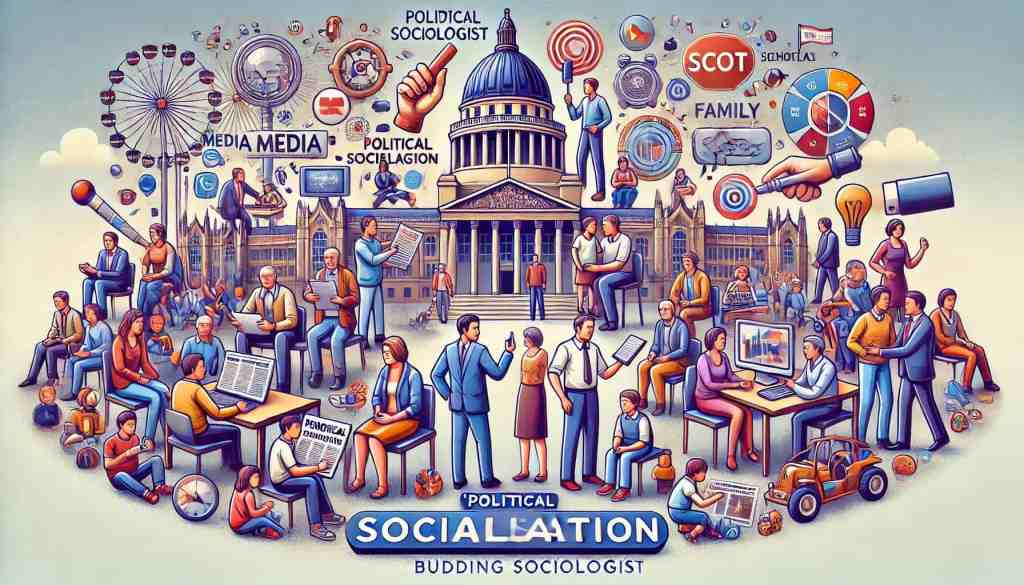
Typically, the process of political socialization begins in childhood, often unconsciously. Children acquire knowledge about political parties, including their symbols and slogans, within the family environment. This learning continues as children progress through school. By the time they complete their education, individuals have typically developed political attitudes that influence their behaviour in adulthood.
Subsequently, this learning process persists through exposure to audio-visual mass media, which reinforces early socialization. Consequently, family, school, and media emerge as primary institutions shaping an individual’s political socialization.
The Concept of Political Socialization
Understanding political socialization is crucial for comprehending how political culture develops within diverse societies, and how the political values, beliefs, and attitudes of individuals persist across generations. These ideologies are transmitted to new generations through various agents of political socialization.
Even as members of a group pass away, the political culture of that group endures through its new members. These individuals imbibe the political values and beliefs of their society from childhood, perpetuating them into the future. In essence, political socialization entails the continual process of learning, internalizing, and perpetuating political values.
Meaning of Political Socialization
Political socialization refers to the gradual assimilation of individuals into the political fabric of their society, encompassing the understanding of its values, principles, and ideologies. It entails the acquisition of knowledge about the political system, fostering a sense of belonging within the community, and shaping one’s political identity and choices as a citizen.
From this perspective, political socialization emerges as an ongoing process wherein individuals internalize political attitudes and behaviours over their lifetime. It operates within the broader framework of socialization, wherein individuals adopt the norms and customs of their society. The dynamics of political socialization are influenced by the social and cultural milieu of the society in question. By engaging in political socialization, individuals become integrated into the political culture, thereby shaping their perspectives on political matters.
Characteristics of Political Socialization
Several key aspects characterize political socialization:
- Political socialization represents the epitome of a society’s political values or culture. It should be noted that any form of education is distinct from political socialization.
- The primary aim of political socialization is to educate individuals within society, fostering their political efficacy to become active participants and to uphold the continuity of societal political values.
- Although early childhood is a crucial period for political socialization, this process extends throughout an individual’s life span, transcending mere infancy.
- Political socialization predominantly occurs through three mechanisms: imitation, instruction, and motivation. While children tend to exhibit a greater inclination towards imitation, adolescents and adults experience a blend of imitation, instruction, and motivation.
- Through political socialization, individuals develop increased support for the prevailing political system, endorse conventional institutions, and bolster the legitimacy of governing bodies.
- Every member of a political society is subject to the ongoing process of political socialization, which shapes their effectiveness as active participants throughout their lives.
Factors of Political Socialization
It’s undeniable that political socialization occurs through specific agencies and factors, yet whether an individual becomes socialized and in which direction depends on various determinants. Key factors influencing the direction of political socialization include:
1. Strength of Socializing Agency: It’s commonly debated that certain socializing influences hold greater sway than others. The family emerges as the initial political socialization agent, impacting children during their formative years. Following closely are educational institutions, particularly elementary and secondary schools, which wield significant influence. These entities are deemed more potent in shaping individuals compared to the media and political parties.
2. Interaction with Socialization Agency: Socialization agencies wield influence over individuals with proximity and interaction. For instance, an atheist lacking religious affiliation would not be shaped by church or shrine interactions, just as an introverted person with limited literacy might overlook the socialization avenues provided by schools and peer groups.
3. Reinforcement System: Socialization tendencies can be influenced by reinforcement mechanisms. An individual equipped with a positive reinforcement system is apt to effectively guide socialization in specific directions, and conversely. This dynamic holds particular relevance within familial and educational settings. When an inclination towards political engagement receives positive reinforcement within the family and school environments, children within these institutions are more likely to undergo successful political socialization compared to environments where such reinforcement is lacking.
4. Period of Socialization: While socialization remains an ongoing process throughout life, scholars concur that individuals’ personalities, beliefs, and attitudes typically solidify before reaching the age of 20. This suggests that socialization is most impactful during early stages of development when individuals are shaping their identities.
Agencies of Political Socialization
The agents of socialization encompass various institutions and frameworks that aid in the integration of individuals into the realm of politics. These agents play a crucial role in shaping people’s political perspectives as they mature, exerting a lasting influence on their political outlook.
Numerous agents contribute to political socialization, extending beyond traditional entities such as Family, Media, Peers, Education, Religion, Race, Gender, Age, and Geography. Essentially, any interaction between individuals can serve as a platform for political socialization.
Taking into account the aforementioned factors, the agents of political socialization can be broadly categorized into two groups:
1. Primary Agents of Political Socialization: The main influencers of political socialization are the initial encounters individuals have during childhood and the ongoing interactions they engage in as they mature. Nearly everyone encounters these influencers, often without conscious choice. These influencers can be categorized into the following subgroups:
1.1 The Family: The family plays a crucial role in shaping individuals’ political and social beliefs, as well as other aspects of their development. It exerts a significant influence on young minds that persists throughout life. Due to its intimate and enduring nature, the family provides an ideal environment for learning and imitation. Since virtually every person is born into a family and undergoes socialization within it, the family holds considerable sway over individual attitudes and behaviours.
1.2 The School: The structured educational system, comprising schools and colleges, is ubiquitous in contemporary society. Schools, akin to families, serve as pivotal agents of socialization, influencing individuals’ development. Many societies intentionally incorporate subjects such as civic education, political history, and government into their curriculum to foster political awareness among citizens. Additionally, activities like national anthem recitations and extracurricular exercises in schools serve to instill specific political values, rendering schools essential conduits of political socialization.
1.3 The Peer Group: According to Aristotle, humans are inherently political beings, naturally inclined to live and interact within social structures. This inclination fosters the formation of peer groups, comprised of individuals of similar or proximate age ranges. Within these groups, social learning occurs through emulation and reciprocal determinism. Peer groups serve as significant influencers in political socialization, as individuals find it challenging to avoid their influence within society. Even within educational settings like schools, where children are socialized, peer group dynamics play a pivotal role, extending their influence beyond the confines of the educational institution.
1.4 Religious Gatherings: Religious congregations serve as a potent force for political socialization in contemporary society, exerting significant influence that is hard to avoid. These gatherings frequently provide platforms for discussions on socio-political matters, both directly and indirectly affecting individuals’ lives. Decisions regarding these issues are commonly made within religious contexts, thereby establishing religion as a significant agent of political socialization.
2. Secondary Agents of Political Socialization: Inherent to the human experience are structures and institutions such as the media and political parties, which aren’t universally shared but rather optional, thereby categorizing them as secondary agents of political socialization. These secondary agents, while present, are deemed less essential compared to primary agencies.
2.1 The Media: The media serves as a potent force in shaping political attitudes and behaviours. It encompasses various forms such as print media like newspapers and magazines, as well as electronic media like radio and television. Nowadays, social media platforms like Facebook and Twitter have gained immense popularity, reaching global audiences rapidly. Across these mediums, political discussions and issues are a daily occurrence. Through these discussions, individuals develop values, attitudes, and beliefs, thereby becoming socialized into the realm of politics and having their political behaviours influenced.
2.2 Political Party: A political party constitutes a structured assembly of individuals engaged in political endeavors, driven by the primary objective of attaining political influence. Affiliation with a political party inherently entails involvement in deliberations and implementation of political strategies. Members of political parties acquire insights into political maneuvers, principles, perspectives, opinions, and convictions, thereby establishing the political party as a potent force in shaping political socialization.
2.3 Gender: Gender has historically played a significant role in political socialization. In the past, patriarchal societies barred women from political participation. Consequently, men and women underwent distinct socialization processes, leading to divergent political beliefs, opinions, and orientations. However, contemporary society has witnessed a shift, with women now actively engaging in political discourse on par with men. This transformation marks a notable evolution in the realm of political socialization, emphasizing gender equality as a crucial secondary influencer.
2.4 Age: Age significantly influences politics in every nation. With the widespread implementation of universal adult suffrage, most constitutions grant voting and candidacy rights to citizens aged eighteen and above. In certain societies where older individuals dominate political engagement, electoral positions are predominantly held by seniors. These diverse practices across societies greatly influence people’s perspectives and attitudes towards politics, highlighting age as a significant factor in political socialization.
Political socialization, facilitated through primary and secondary agencies, plays a crucial role in shaping an individual’s political outlook. These agencies contribute to either systemic or non-systemic changes in people’s lives. Systemic changes involve fundamental alterations in the distribution or exercise of political authority, while non-systemic changes are relatively minor adjustments in political participation and association patterns that don’t disrupt existing power structures. However, political socialization primarily functions as a stabilizing force and tends not to generate systemic change.
Functions of Political Socialization
Following are the functions of political socialization:
1. Inter-generational transmission of Political Values: Political socialization plays a crucial role in upholding a society’s political culture over time. It serves to instill political values and orientation in individuals, a process often referred to as the inter-generational transmission of political norms. In our complex modern world where politics pervades every aspect of life, regardless of direct involvement, the agents of socialization play a vital role in passing down these values and norms from one generation to the next, thus contributing to societal stability.
2. Stability of Polity: Political socialization plays a crucial role in society by passing down values across generations and instilling a sense of political culture. This process is essential for ensuring continuity and stability within society, which in turn facilitates progress across various spheres of life. By serving as a form of role-training, political socialization equips individuals with the essential skills needed for effective political participation and the fulfillment of significant political responsibilities.
3. Creation of Hegemony: Political socialization plays a crucial role in establishing a cohesive social order within a political framework. It facilitates the development of hegemony, which is essential for the stability and progress of any political system. Hegemony, characterized by a nuanced and voluntary acceptance of societal norms and practices, is fostered through political socialization. This process ensures that individuals within a society require minimal external pressure or coercion to adhere to laws and uphold positive values.
4. National Discipline: National discipline plays a crucial role in political socialization as it facilitates the maintenance of order within a political community. It serves to regulate and mitigate instances of disruptive political conduct, ensuring that individuals adhere to societal norms and values, particularly those upheld by the dominant class.
Based on the aforementioned portrayal, it can be asserted that political socialization plays a role in fostering patriotism and nationalism. Individuals who absorb and pass on the political beliefs, principles, and perspectives of their society across generations often develop a strong attachment to them. They perceive themselves as deeply rooted in these values and ideals, and are typically ready to uphold and advocate for them whenever required. This phenomenon, known as patriotism, contributes significantly to both the internal cohesion and external reputation of a nation.