- Dependency Theory of Development: An Introduction
- Dependency as the Product of Expansion of World Capitalism
- Frank’s Theory of Underdevelopment: An Overview
- Understanding Underdevelopment
- The Idea of Andre Gunder Frank
- Basic Elements of the Theory
- The Methodology of the System
- Metropolis-satellite Relationship
- Critical Evaluation
Dependency Theory of Development: An Introduction
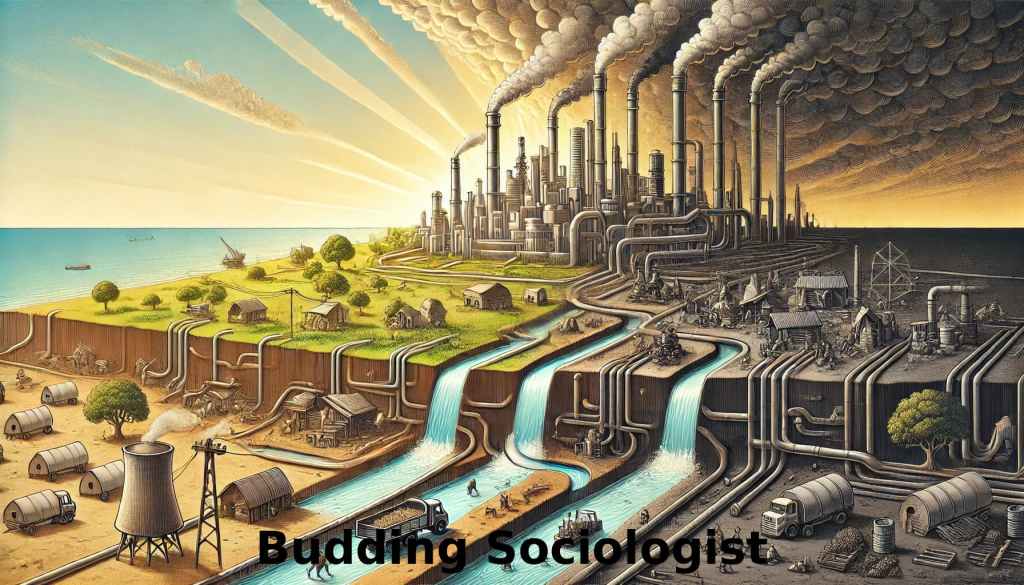
Dependency theory offers an analytical framework for understanding economic underdevelopment, focusing on the perceived constraints imposed by the global political and economic structure. Originally introduced by the Argentine economist and statesman Raul Prebisch in the late 1950s, this perspective gained prominence during the 1960s and 1970s as a counterpoint to modernization and development theories advocated by Western and Marxist scholars. It presents a critical stance toward both Structural and Marxist approaches.
Central to dependency theory is the assertion that underdevelopment stems primarily from the peripheral position of certain countries within the global economy. These underdeveloped nations typically provide cheap labour and raw materials to more advanced economies, which then process these resources into finished goods. Consequently, underdeveloped countries often find themselves purchasing these finished products at elevated prices, thereby depleting their capital that could otherwise be invested in improving their own productive capacities.
The outcome manifests as a relentless cycle perpetuating the economic schism between a prosperous core and an impoverished periphery worldwide. While some moderate dependency theorists, exemplified by Brazilian sociologist Fernando Henrique Cardoso, entertain the notion of developmental progress within this framework, more radical scholars like the German-American economic historian Andre Gunder Frank assert that escaping dependency necessitates the establishment of a non-capitalist domestic economy.
Dependency theory scrutinizes the internal mechanisms of underdeveloped nations, correlating their lack of progress with their placement in the global economic hierarchy. It delves into the intricate interplay between domestic and international structures. This theory attributes the underdevelopment of Third World countries to socio-economic, political, and cultural processes that tether them to developed nations. Underdeveloped countries are labelled as peripheries, contrasted with developed countries as cores, suggesting that understanding and analysing peripheral social phenomena require contextualizing them within the dominant world capitalist system, which is governed by the developed cores.
The core tenet of Dependency Theory posits that the social dynamics within Third World nations are shaped by a persistent state of underdevelopment, a condition stemming from the spread of global capitalism. This underdevelopment, according to the theory, is intricately tied to their reliance on external entities. Dependency theorists commonly assert that the primary cause of underdevelopment is the reliance on capitalist nations for resources and support.
Dependency as the Product of Expansion of World Capitalism
The Dependency Theory offers a broad historical and structural viewpoint, diverging from both Communist and Marxist theories on development and underdevelopment. It posits underdevelopment as a consequence of capitalist expansion, marked by unequal exchanges wherein the Core exploits the resources and labour of the periphery to its advantage. Consequently, the periphery remains in a state of dependency, characterized by their underdeveloped status.
This dependence entails a relationship between the less developed nations and those that are developed, influencing the former’s ability to progress. This relationship is constrained by the ongoing expansion of capitalism. Historically, imperialism and colonialism represented traditional forms of this dependency, while contemporary manifestations take the shape of neo-colonialism, wherein the underdeveloped periphery remains reliant on the developed nations.
Andre Gunder Frank and Wallerstein were instrumental in shaping the dependency theory, highlighting the relationship between the underdevelopment of Third World nations (Periphery) and the dominance of developed economies. They argued that the development of the periphery was hindered by its dependency on the developed core economies, which perpetuated a system that favoured the interests of the latter at the expense of the former. According to them, Third World countries existed as subordinate entities to the developed nations, unable to progress within the capitalist framework. Despite attempts at import-substitution industrialization advocated by development theorists, Third World economies remained stagnant and increasingly reliant on those of the developed world. Dependency theorists contended that the only viable path for underdeveloped nations to achieve development was to dismantle the existing system.
While certain proponents of dependency theory advocated for a socialist revolution to attain their objectives, others leaned towards advocating for liberal reforms. These reforms aimed to sustain a trade equilibrium, enhance bargaining power through regional collaboration, and integrate new methodologies through macroeconomic adjustments. The comprehensive delineation of dependency theory is being expounded upon by scholars, elucidating its various aspects and perspectives.
- Andre Gunder Frank
- Immanuel Wallerstein
Frank’s Theory of Underdevelopment: An Overview
Dependency theory posits that global economic relations are characterized by domination and exploitation, with economically powerful nations exerting control over less powerful ones. This results in unequal development, where some countries progress rapidly while others lag behind. According to Frank, understanding the historical economic and social factors contributing to underdevelopment is essential for devising effective development policies for the majority of the world’s population.
All resources possess inherent potential for utilization by humanity, yet there are instances where only a few nations exploit them, leading to disparities and disputes among nations. Sociologist Andre Gunder Frank delved into this phenomenon extensively through his theory of underdevelopment, aiming to grasp its fundamental significance.
Understand the Meaning of the Theory: Before delving into the subject matter, it’s crucial to elucidate two key terms that are essential for comprehending the theory:
1. Theory: It represents a thoroughly supported interpretation derived via the scientific approach, consistently verified through observation and experimentation.
2. Underdevelopment: Underdevelopment occurs when a country fails to fully utilize its socio-economic resources, leading to slower development compared to neighbouring countries that effectively leverage their capital and technology.
After clarifying two crucial terms, it would be insightful to delve into the historical roots of the theory. Its origins stretch back to the mercantile period spanning the sixteenth to the late eighteenth centuries. While it gained prominence in the 1960s through the work of numerous scholars, inquiries into why certain countries failed to develop had begun much earlier. The prevailing notion was that such countries either lacked the appropriate economic policies or were plagued by authoritarian and corrupt governance.
This hypothesis has endured through colonial, semi-colonial, and neo-colonial eras, serving the interests of capitalist ideology and resulting in direct underdevelopment. The aftermath of the First World War further exacerbated this divide, with capitalist nations flourishing while third world countries found themselves overly reliant on them for growth.
This marked the inception of extensive research into various conceptual frameworks aimed at scrutinizing the development status of nations and their standing relative to others.
Understanding Underdevelopment
It’s imperative to delve deeper into the notion of underdevelopment to gain a clearer comprehension, facilitating a more nuanced grasp of the theory. Underdevelopment encompasses a spectrum of indicators, including a low real per capita income, widespread poverty, limited literacy rates, decreased life expectancy, and inefficient resource utilization. Within an underdeveloped economy, the government often struggles to provide adequate living standards for a significant portion of its populace, leading to widespread suffering and material deprivation. It’s essential to recognize that while underdevelopment is a relative concept, it perpetuates absolute poverty. To grasp the concept of underdevelopment fully, it’s beneficial to explore the following insights:
1. Low Per Capita Income: Most nations classified as underdeveloped exhibit a lower per capita income when compared to their developed counterparts across the globe.
2. Slow Growth Rate of Per Capita Income: These nations are characterized by a low per capita income and a sluggish rate of per capita income growth.
3. Economic Inequalities: In underdeveloped nations, a prevalent characteristic is significant income and wealth disparity. A small portion of society enjoys a substantial share of the national income, leaving a vast majority struggling to meet basic needs. While economic inequality is also present in developed countries, it typically isn’t as pronounced as in underdeveloped ones.
4. Low Level of Living: The standard of living in underdeveloped nations remains depressed due to their low per capita income. This disparity in living standards is starkly evident in the Human Development Index (HDI) compiled by the United Nations Development Programme (UNDP). Developed countries boast significantly high HDI scores, whereas underdeveloped nations struggle with markedly lower ones.
5. Low Rate of Capital Formation: The underdeveloped economies struggle with a slow rate of capital formation primarily because of their low levels of income and pervasive poverty.
6. Backward Techniques of Production: Emerging economies often rely on antiquated technology in their production processes due to limited capital resources. Consequently, there is a reduced allocation of funds towards research and development endeavours.
7. High Growth Rate of Population and Dependency Burden: These nations exhibit a notable trend of rapid population growth coupled with a significant burden of dependency.
8. Low Productivity of Labour: In emerging economies, there’s a notable lack of labour productivity stemming from insufficient skill levels among workers.
9. Underutilisation of Natural Resources: Economies that are still in the early stages of development frequently struggle to maximize the potential of their natural resources due to their constrained ability to effectively utilize them.
10. Large Scale Unemployment: Widespread joblessness is a prominent attribute observed in underdeveloped nations.
11. Dominance of Agriculture: A significant portion of individuals in less developed economies rely on the primary sector for employment opportunities. However, the primary sector remains underdeveloped within these nations.
12. High Incidence of Poverty: Underdeveloped economies often experience a significant prevalence of poverty due to their low per capita income levels.
13. Infrastructural Backwardness: Underdeveloped nations often experience significant deficits in both economic and social infrastructure, reaching levels close to the minimum required for functioning effectively.
14. Low Volume of Foreign Trade: Less developed nations typically export raw materials such as agricultural produce, minerals, and petroleum, while importing finished goods, particularly consumer products. The terms of trade heavily disadvantage these less developed countries.
The Idea of Andre Gunder Frank
Various scholars began to question and investigate the underlying factors responsible for hindering the development of less developed nations. Through their inquiries, they arrived at the consensus that the international system played a pivotal role in impeding growth. Notably, Andre Gunder Frank, a renowned sociologist and economic historian, formulated the dependency theory in response to this global predicament. This theory prompted nations worldwide to reassess their relationships with others, acknowledging the direct or indirect influences on their growth trajectories. Frank’s theory evolved to underscore the dominance of larger nations over smaller ones, inhibiting the latter’s independent progress. This perspective reshaped global discourse, highlighting the dynamics of power and control among nations.
In his article titled ‘The Development of Underdevelopment,’ Frank argued that underdevelopment does not stem from outdated institutions or a lack of capital in regions that have been historically isolated. Instead, he posited that underdevelopment is a product of the same historical processes that have led to economic development and the rise of capitalism.
Frank’s theory suggests that all resources possess inherent potential for utilization by humanity. However, he observed that these resources are often monopolized by certain countries, leading to disparities and conflicts among nations. Frank’s analysis delves deeply into this notion, aiming to elucidate the fundamental significance of underdevelopment.
Frank formulated his theories through an extensive examination of capitalism’s historical impacts. One instance involved analysing inequality and underdevelopment in Latin America during the 1960s. Frank scrutinized the privileged status of cities in the region, tracing their origins to the 16th-century conquests by Spain and Portugal. He argued that during this period, cities economically subjugated the indigenous populations residing in surrounding rural areas.
Frank conceptualized the city as the ‘metropole,’ exerting economic dominance over the ‘satellites’ encircling it. These metropoles, according to Frank, were themselves satellites within the larger framework of European colonial domination. He contended that throughout history, this hierarchical ‘metropolis-satellite’ relationship persisted, with resources continually extracted from satellites and redirected to the dominant metropolis.
He asserted that his examination of the historical trajectories of nations such as Chile and Brazil provided support for this notion. He pointed out that a pattern of ‘satellite underdevelopment’ was conspicuous in these countries’ interactions with Europe, as well as in their internal economic structures. According to him, the ‘satellite metropolis relationship’ manifested itself across different tiers, thus encompassing even the most distant regions of Latin America, all serving the interests of capitalist Western powers.
Basic Elements of the Theory
Underdevelopment can be understood as a condition where there exists an imbalance between available resources and the technology required for their optimal utilization. This imbalance prevents the simultaneous full utilization of both capital and labor. Essentially, underdevelopment arises when the available capital is unable to absorb the workforce completely, leading to productivity levels that do not match the prevailing technological standards in the dynamic sector of the economy. Frank outlines several key elements of this theory as follows:
- A chronological narrative detailing the progression of less developed societies.
- The state of underdevelopment stems from their interconnectedness with more advanced societies.
- Development and underdevelopment are intertwined facets of a singular system.
- Underdevelopment, dependency, and the global system are synonymous within this theoretical framework.
- This theory elucidates the historical narrative of dependency between less developed nations and affluent European counterparts.
The Methodology of the System
The theory suggests various classifications for nations based on their economic status and global influence:
- Core of the Core Nations: Represented by economically affluent and influential countries such as the United States.
- Periphery of the Core Nations: These nations, like Canada, are developed but wield lesser influence on the global stage.
- Core of Periphery Nations: Emerging economies like the BRICS nations possess substantial wealth but lack significant international sway, exemplified by China.
- Periphery of the Periphery Nations: Countries in this category, such as Zimbabwe, are characterized by extreme poverty and minimal GDP per capita.
The issue arises from the reliance on other nations. As per the theory, the global system operates in a manner where core countries primarily serve the economic interests, while the periphery of these nations caters to the economic needs of both the core and other peripheral countries. In this dynamic, the core of periphery countries serves the economic interests of both the periphery of core countries and the core itself. Furthermore, the periphery of core countries directly serves the economic interests of the core countries.
Frank suggests that the global capitalist system encompasses both development and underdevelopment as interconnected facets of the same system. Progress in one region often correlates with the underdevelopment of another. He argues that the world system disregards national borders, organizing countries into a hierarchical relationship between metropoles and satellites. This relationship is characterized by:
Metropolis-satellite Relationship
The concept of the metropolis-satellite relationship delineates a structural dynamic encompassing both spatial and socio-economic dimensions, where a central metropolis wields dominance over a peripheral satellite, primarily through economic mechanisms. Originating from Frank’s analysis, this framework elucidates the flow of economic surplus from less developed regions, often situated in the third world, towards industrialized capitalist nations. This process unfolds as surpluses migrate from rural and provincial areas towards urban and commercial hubs, facilitated by the control exerted by both local and foreign merchants over trade routes.
The surplus goods thus accumulated are subsequently exported to advanced economies, contributing to the continual outflow of surplus wealth, with profits accruing predominantly in the industrialized nations. Consequently, the global landscape can be envisaged as a network of interconnected metropolis-satellite relationships, where each intermediate metropolis serves as both a beneficiary and a transmitter of surplus, eventually becoming a satellite to another dominant center. This framework forms the crux of Frank’s argument regarding the persistence of underdevelopment in satellite regions, which fail to retain economic growth, juxtaposed with the development trajectory of metropolises, which thrive on the absorption of economic surpluses.
The notion has faced criticism due to its merging of spatial and socio-economic processes, its vague definition of economic surplus, its failure to adequately elucidate the mechanisms governing surplus flow, and its oversimplification of the dynamics between Third World and industrial capitalist nations.
This dynamic isn’t limited to the relationship between wealthy Western nations and poorer satellite nations globally; it also manifests within individual countries, where hinterlands supply cities and are exploited by them. Frank posits that in the global economic framework, metropolitan nations thrive by appropriating economic surpluses from satellite nations, thus perpetuating their underdevelopment.
Critical Evaluation
Frank held strong reservations regarding the theories of sociology pertaining to development, modernization, and evolution. Hoselitz, for instance, utilized Parsonian modernization pattern variables to elucidate the developmental process in various countries. However, Frank staunchly believes that neither developed nor underdeveloped societies exhibit the characteristics posited by Hoselitz or Parsons.
Moreover, Frank challenges the theory of diffusion, contending that it erroneously suggests that less developed societies remain undeveloped due to their inability to assimilate changes from the developed world, citing obstacles to development. He argues that economic diffusion fails to instigate significant changes in the Third World. Frank further critiques McClelland and Hagen for disregarding the historical circumstances that have facilitated the establishment of a global economic system in which the Third World predominantly serves to enrich the First World.
While Baran initially introduced the theory of dependency, Frank deserves acknowledgment for popularizing it.
To address the aforementioned issues, Frank formulated a theory. However, over time, this theory has faced criticism from several scholars, with the following points being raised:
- Opponents of the dependency theory contend that it tends to exaggerate the extent of dependency.
- They argue that the theory overly emphasizes economic factors while neglecting crucial political, social, cultural, and environmental aspects that may contribute to underdevelopment in a country.
- Critics also suggest that the dependency theory is excessively pessimistic and lacks realism in its assessment.
- Furthermore, critics argue that the notion of a developing nation severing ties with capitalism and pursuing an independent path is impractical in the context of our interconnected global economy.
Despite receiving criticism, Frank’s ideas and extensive writings continue to be debated and remain influential in understanding the concept of underdevelopment across various disciplines. However, an analysis of Frank’s texts suggests that his theorization revolves around the relationships between production and international forces. Frank addresses these elements to different extents as crucial factors in development and underdevelopment. One notable weakness in Frank’s theory lies in his treatment of how modes of production articulate within a capitalist world structure and the ongoing exploitative forces stemming from this articulation. This weakness results in certain ambiguities operating on two levels: as a series of theses and as contradictions within the capitalist system, both contributing to or generating underdevelopment without explicit alignment between them.
References and Readings:
Sociological Theory, by Ritzer G, https://amzn.to/3Da3pcm
Dependent Accumulation and Underdevelopment, by Andre Gunder Frank, https://amzn.to/4bKrsLw
The World System: Five Hundred Years or Five Thousand?, Edited by Andre Gunder Frank, Barry Gills, https://amzn.to/3FnrAEN