- Introduction
- Classification of Sciences – Prior to Comte
- Comtean Theory of the Hierarchy of Sciences
- Features of Comtean Classification of Sciences
- Hierarchy of Sciences
- Critical Evaluation
Introduction
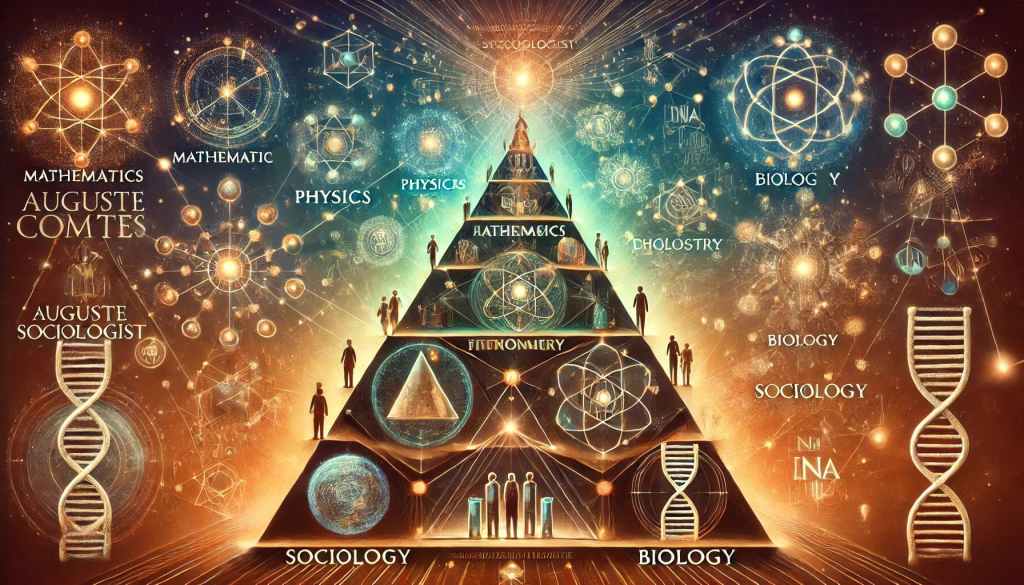
In 1854, Auguste Comte, considered the founder of Sociology, introduced his influential work System of Positive Polity. In it, he outlined his well-known theory of the “hierarchy of the sciences,” which is closely tied to his “law of three stages.” According to Comte, just as humanity advances through specific developmental stages, with each phase building on the achievements of the previous one, scientific knowledge also progresses in stages. However, the rate of advancement varies across different sciences. Comte argued that disciplines reach the positive stage more quickly if they exhibit traits such as generality, simplicity, and independence from other fields.
The hierarchy of the sciences, in Comte’s view, represents the second foundation of positive philosophy, complementing the law of three stages and highlighting their interdependence. This framework examines six fundamental sciences.
- Mathematics
- Astronomy
- Physics
- Chemistry
- Biology
- Sociology
It provides a structure that recognizes the variety within the sciences while maintaining their fundamental cohesion. Comte’s categorization positions him as a pioneer in modern philosophy of science and seeks to avoid the division of knowledge, rather than striving for an impossible uniformity.
Classification of Sciences – Prior to Comte
The idea of categorizing the sciences has deep historical roots. From ancient figures like Plato to later philosophers such as Kant, the study and understanding of science have been central themes in philosophy. However, it took time for the sciences to evolve enough for their distinct characteristics to be recognized, allowing for a clearer hierarchy of their development. This sequence is seen in the way one scientific discipline often depends on another: for example, astronomy relies on mathematics, and chemistry depends on physics. Each field builds upon its predecessor, a concept that Comte famously described as the dependence of higher sciences on the more fundamental ones.
Although Comte is well-known for his classification of sciences, the idea did not originate with him. Historically, many thinkers have attempted to organize knowledge in various ways. Ancient Greek philosophers, for example, divided knowledge into three categories: Physics, Ethics, and Politics. Later, Francis Bacon offered a classification based on human faculties, organizing history under memory, poetry under imagination, and fields like physics and chemistry under reason. Comte’s approach to the classification of sciences, however, brought forward distinct features that set his system apart.
Comtean Theory of the Hierarchy of Sciences
Comte’s second major theory, the hierarchy of sciences, closely aligns with the Law of Three Stages. In the same way that human society evolves through distinct phases, each building on the previous one, scientific knowledge follows a comparable path of development. Nevertheless, various fields of science advance at different speeds.
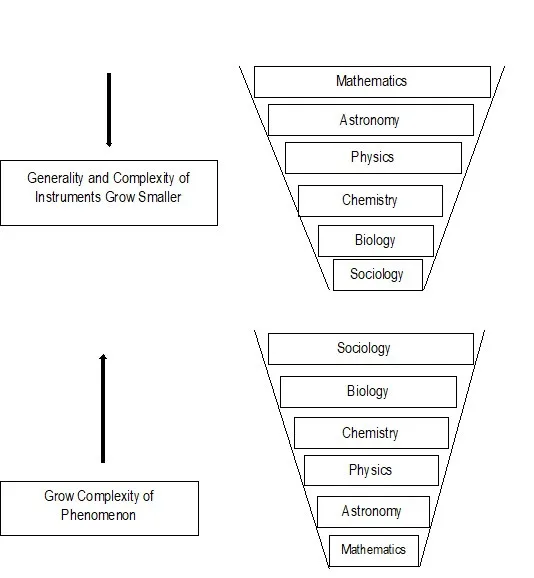
Auguste Comte argued that the development of knowledge progresses sooner in fields that demonstrate greater generality, simplicity, and independence from others. As a result, mathematics, the most general and straightforward of the natural sciences, emerges first. This is followed by physics, chemistry, biology, and eventually sociology. Each of these sciences builds upon the advancements of the ones that precede it, creating a hierarchy where complexity increases and generality decreases.
Sociology, although it has its own unique methodological characteristics, remains closely linked to the earlier sciences, particularly biology, which comes directly before it in the hierarchy. Biology’s holistic perspective, which contrasts with the reductionist approaches of physics and chemistry, focuses on studying organisms as wholes. Similarly, sociology shares this holistic outlook, emphasizing the analysis of the entire social system rather than breaking it down into isolated components.
Comte emphasized the importance of studying society as a whole, much like how biology examines organisms in their entirety, rather than in isolated parts. Unlike the inorganic sciences, which generally advance from simpler to more complex subjects, the study of human beings and society demands an inverse approach. This is because we tend to grasp the larger societal picture more easily than its individual components.
Comte organized the sciences in a hierarchical order, where each discipline builds upon the foundational principles of the one before it and serves as a base for the next.
His classification system followed several key principles:
- The historical evolution and development of the sciences.
- The interdependence between disciplines, with each science advancing based on others.
- A progression from broad generalizations to increasing levels of complexity in the subjects studied.
- The degree to which the phenomena in each science can be altered or modified.
Comte also highlighted the importance of understanding the modifiability of facts, especially in sociology, which deals with constantly changing social realities. He further distinguished the distinct methods used by different disciplines while establishing this hierarchy of the sciences.
Features of Hierarchy of Sciences
Comte’s main goal in organizing knowledge was to establish a foundation for the development of “sociology.” This classification shaped the methods used in sociology and helped link it to other scientific disciplines. His aim was to show that identifying universal principles could help unite various fields of knowledge.
1. Classification Based on the Principle of Increasing Dependence: Comte’s method of classifying knowledge was based on a principle he termed “the order of increasing dependence.” He structured the sciences so that each category rested on the fundamental laws of the preceding one, providing a foundation for the subsequent category. This arrangement follows a pattern of increasing complexity and diminishing generality. In simpler terms, Comte’s idea was that facts across different sciences vary in complexity. Some are straightforward, while others are intricate. The more complex facts rely on simpler ones and are generally applicable. Sciences built upon more complex ones, in turn, depend on simpler sciences. Therefore, each science depends to some extent on another and serves as a basis for yet another. Comte established a sequential order of sciences based on this principle.
He believed that as sciences become more complex, they tend to progress toward a positive stage. According to him, the rate at which a field reaches this stage depends on its generality, simplicity and independence from other disciplines. Mathematics, being the most general and simple among natural sciences, tends to develop first, followed by physics, chemistry, biology, and finally sociology. Each science in this sequence relies on the advancements made by its predecessors, following a hierarchy characterized by increasing complexity and decreasing generality.
2. Hierarchy of Sciences Begins with Mathematics: Comte asserts that mathematics serves as the fundamental tool of cognition. He contends that through the utilization of mathematics, the human intellect gains unrestricted access to diverse realms of thought. Comte emphasizes the paramount importance of mathematics as the primary instrument for exploring natural laws, suggesting that any educational approach devoid of mathematical foundation is flawed, imprecise and unreliable. According to Comte, mathematics holds the highest position within the scientific hierarchy, not merely as one among many disciplines, but as the very foundation upon which all sciences rest. He lauds mathematics as the oldest and most refined of all scientific pursuits, portraying it as the quintessential science responsible for meticulously quantifying the relationships between objects and concepts.
3. The Design of the Hierarchy of Sciences: In the hierarchical structure proposed by Comte, mathematics holds the lowest position while sociology occupies the highest. The hierarchy progresses as follows:
1. Mathematics
2. Astronomy
3. Physics
4. Chemistry
5. Biology
6. Sociology or Social Physics
This arrangement emphasizes that the foundational and self-contained sciences are positioned at the base, while the more intricate and interdependent sciences are situated at the apex.
4. Basis of Hierarchy of the Sciences: In this perspective on the sciences, initially introduced by Comte, there’s a suggested hierarchical arrangement based on complexity. Sciences are positioned in ascending order, wherein those higher up rely on, yet aren’t solely reliant on, the ones beneath them. Consequently, sociology presupposes aspects of the physical and biological realms while also incorporating a distinct “emergent” level of examination that isn’t merely reducible to its foundational disciplines.
5. Sociology at the Top of the Hierarchy: In the framework proposed by Comte, sociology hold the highest position in the hierarchy due to its utilization of the knowledge and methods derived from preceding sciences. It is deemed the most intricate and reliant on the progress of other disciplines for their development. According to Comte, sociology represent the culmination of the positive method, with all prior sciences serving as groundwork for its advancement. Thus, it is placed at the pinnacle of the hierarchy. Sociology, or social physics as Comte termed it, is regarded as the ultimate and most significant science. While it possesses distinctive methodological features setting it apart from earlier disciplines, it remains interconnected with and indebted to them.
6. The Emphasis on Holistic Approach: The holistic approach represents a fundamental trajectory in the advancement of sciences, characterized by a progression towards the positive method. Among these sciences, sociology stands as a pinnacle achievement. This holistic approach begins with the study of biology and reaches its apex in sociology. The biological approach essentially embodies the holistic perspective, as it delves into the examination of organic entities in their entirety. According to Comte, inorganic sciences evolve from simplicity to complexity, while organic sciences follow the opposite path, moving from complexity to simplicity. Consequently, inorganic sciences adhere to an individualistic approach, whereas organic sciences, including sociology, emphasize the significance of the holistic approach.
7. Emphasis on the Organic Unity: Comte emphasized the interconnectedness of society, highlighting the importance of understanding it as a unified whole. He articulated that while in the study of organic sciences, we often understand the individual elements better than the entire system they comprise, the approach is different when studying humanity and society. Similar to how biology cannot fully explain an organ or its function without considering the organism as a whole, sociology must consider the broader social context to comprehend social phenomena thoroughly.
Hierarchy of Sciences
The notion of the hierarchy of sciences suggests that the systematic examination of humanity is logically and scientifically positioned under the broader study of humanity itself. Auguste Comte delineated the sciences as follows:
1. Mathematics: According to Comte, mathematics serves as the foundation of all sciences because it provides the basis for precise measurement, calculation, and analysis. It deals with abstract quantities and relationships. Mathematics can be described as the process of measuring quantities indirectly and establishing relationships between them. Concrete mathematics involves identifying the equations governing natural phenomena through empirical observation. On the other hand, abstract mathematics focuses on deriving conclusions from these equations. For instance, concrete mathematics uncovers the rate of acceleration in a falling object through experimentation, while abstract mathematics derives further insights and solves for unknown variables using the equations derived from such experiments.
2. Astronomy: Comte placed astronomy as the second science in the hierarchy due to its reliance on mathematics and its ability to provide fundamental knowledge about the structure and laws of the universe. Astronomy is the scientific pursuit focused on unravelling the geometrical and mechanical principles governing celestial entities. This discipline relies heavily on observation and reasoning, with the latter playing a more significant role compared to other sciences. Merely relying on sight would not suffice to comprehend the shape of the Earth or the trajectory of a planet. Instead, it is through the meticulous measurement of angles and precise computations of time that we uncover the fundamental laws of astronomy. By observing these immutable laws, humanity emancipates itself from the constraints imposed by theological and metaphysical interpretations of the cosmos.
3. Physics: Physics, or natural philosophy as it was often called in Comte’s time, deals with the study of matter, energy, motion, and the laws governing the physical world. It follows astronomy in the hierarchy. Physics can be described as the exploration of the principles governing the collective behaviour of bodies, with their constituent molecules typically unchanged and often in a grouped state. It encompasses observations that engage all the senses, supported by mathematical analysis and experimental validation. Unlike in astronomy, where human intervention is impractical, in physics, humans actively influence natural occurrences. Its branches include statics, dynamics, thermology, optics, and electrodynamics. Despite its progress, physics continues to grapple with metaphysical interpretations of fundamental phenomena.
4. Chemistry: According to Comte, chemistry studies the composition, structure, properties, and reactions of matter. It is considered by Comte as a science that builds upon physics and deals with more complex phenomena. Chemistry can be described as the exploration of the principles governing the processes of combination and breakdown arising from the molecular interactions of various substances, whether they are natural or man-made. Within the realm of chemistry, there is a heavy reliance on sensory observations and practical experimentation. Despite its focus on empirical investigation, elements of metaphysical thought can still be found within the discipline.
5. Biology: Biology deals with the study of living organisms, their structure, functions, evolution, and interactions with the environment. Comte placed it below chemistry in the hierarchy. Biology encompasses the examination of plant and animal physiology. Physiology, in essence, delves into the understanding of how organic systems interact with their surroundings and operate within them. When organisms are situated in specific environments, they exhibit consistent behaviours, and physiology aims to decipher the intricate interplay among organisms, their environments, and their functions. Observation and experimentation stand as paramount methods in physiological studies, employing various apparatuses to aid in both. Chemistry holds a particularly close association with physiology, as the entirety of life’s phenomena revolves around chemical compositions and reactions, forming the foundation of physiological processes.
6. Sociology: Comte considered sociology, or social physics as he termed it, as the pinnacle of the sciences. Sociology studies human society, social institutions, behaviour, and the laws governing social interactions. Comte believed that sociology would eventually provide the key to understanding and solving social problems, leading to the improvement of society.
In the classification of sciences, each discipline relies on the advancements of its predecessors, following a hierarchy characterized by increasing complexity and decreasing generality. Social sciences, being the most intricate and reliant on the progress of all other disciplines, occupy the apex of this hierarchy. They represent the culmination of the positive method, with all preceding sciences serving as preparatory stages. While sociology possesses distinctive methodological traits setting it apart within this hierarchy, it remains reliant on its predecessors. Particularly, it leans heavily on biology, its closest counterpart in the hierarchy, which is distinguished by its holistic approach. Unlike physics and chemistry, which dissect elements in isolation, biology studies organic wholes, emphasizing organismic unity. Sociology shares this emphasis, advocating for the examination of each element within the framework of the entire social system.
On the basis of above description, it can be stated that Comte’s Positive Philosophy serves as a comprehensive endorsement for the establishment of a science dedicated to understanding society. Comte aimed to establish a philosophical groundwork that would validate all scientific endeavours, using this as a platform to advocate for sociology as a legitimate scientific discipline. Sociology emerged as a novel field with its own unique focus; the study of social systems. These systems were perceived as interconnected entities, wherein individuals could only be comprehended within the framework of their respective societies. Sociology, therefore, entailed investigating the interplay among various components of the social system, encompassing both its nature and diverse manifestations.
In other words, Comte’s hierarchy of sciences reflects his belief in the progression from simpler and more abstract disciplines to more complex and concrete ones. He argued that each science builds upon the knowledge and methods of the sciences that precede it, ultimately leading to a comprehensive understanding of the world and human society.
Critical Evaluation
Although Comte’s theory garnered acknowledgment for its endeavour to systematize knowledge, it encountered notable critique, which can be delineated into several primary arguments:
1. Overemphasis on the Physical Sciences: Detractors assert that Comte’s hierarchical framework disproportionately elevates the physical sciences, such as physics and chemistry, over the social sciences and humanities. Comte’s adherence to positivism favours empirical observation and experimentation, methodologies inherently suited to the study of the physical world. However, this preference overlooks the intricate complexities inherent in human behaviour and societal dynamics, which are central to the domains of social sciences and humanities.
2. Neglect of Subjectivity and Interpretation: Comte’s positivist stance insists that knowledge is derived solely from empirical, observable facts. However, detractors argue that this perspective overlooks the subjective dimensions inherent in human experiences and the interpretive aspects crucial for comprehending phenomena. Disciplines such as the social sciences and humanities frequently engage with subjective realities, cultural intricacies, and historical backgrounds that extend beyond the scope of empirical observation, highlighting the limitations of a purely empirical approach to understanding.
3. Rigid Hierarchical Structure: Comte’s hierarchical framework suggests a strict and linear advancement of knowledge, where each science is presumed to build upon the preceding one in a predetermined sequence. Critics contend that this model oversimplifies the intricate relationships among various fields of study. In practice, disciplines frequently intersect, mutually influence one another, and evolve in nonlinear trajectories. This critique implies that Comte’s hierarchical structure inadequately represents the dynamic and interconnected nature of knowledge generation.
4. Dismissal of Metaphysics and Theology: Comte argued that metaphysics and theology should be excluded from legitimate knowledge since they lacked empirical foundations, aligning with his positivist principles. However, critics contend that this dismissal fails to acknowledge the historical and cultural importance of metaphysical and theological investigations. Furthermore, some critics suggest that Comte’s positivism contains its own metaphysical assumptions, notably the conviction that the universe’s ultimate knowability can be achieved solely through empirical methods.
5. Eurocentrism and Cultural Bias: Comte’s arrangement of sciences exhibits a Eurocentric viewpoint, largely rooted in Western intellectual frameworks. Critics contend that these bias side-lines non-Western knowledge systems and fails to acknowledge the varied methods different cultures employ in seeking knowledge. Additionally, Comte’s hierarchical structure may not sufficiently encompass indigenous, non-Western, or marginalized viewpoints.
6. Social and Political Implications: Critics contend that Comte’s hierarchical conception of sciences perpetuates unequal power dynamics and upholds established social and political hierarchies. They argue that by favouring specific types of knowledge, Comte’s framework legitimizes dominant ideologies while side-lining alternative modes of understanding. This critique emphasizes the necessity for a more inclusive and fair method of generating and sharing knowledge.
In summary, Auguste Comte’s theory of the hierarchy of sciences has undoubtedly shaped the organization of knowledge, but it hasn’t been immune to critique. Scholars have pointed out its biases, simplifications, and shortcomings in comprehensively encompassing human understanding. Nonetheless, Comte’s work persists as a significant influence in philosophical history, sparking ongoing discussions and introspection regarding the essence of knowledge and its structural arrangement.
References and Readings:
Sociological Theory, by Ritzer G, https://amzn.to/3Da3pcm
Sociology by C.N. Shankar Rao, https://amzn.to/41A3Wh4