- Introduction
- Images of Indian Society: Caste
- View of Ambedkar on Untouchability
- Ambedkar on Religion
- Dalit Liberation: Subaltern Approach
- Annihilation of Caste
Introduction
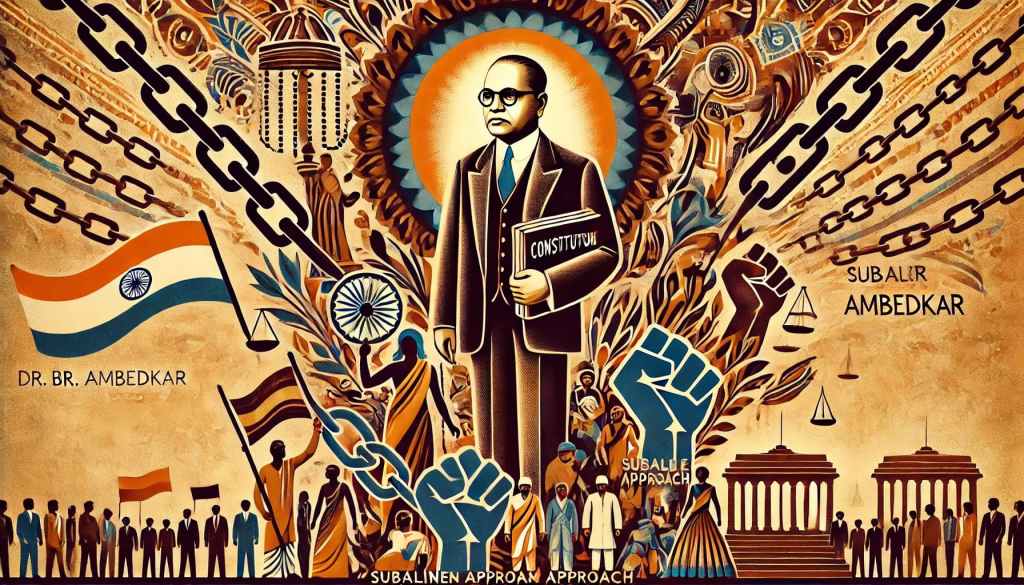
Bhimrao Ramji Ambedkar, a prominent figure in Indian history, served as a catalyst for social change and political reform. Hailing from a Dalit Mahar family in western India, Ambedkar faced discrimination from a young age, shaping his resolve against caste-based prejudice. Rejecting the notion of caste, instilled in him by his father’s adherence to the teachings of Saint Kabir, Ambedkar pursued education with the support of a scholarship from the ruler of Baroda.
His academic prowess led him to study in the United States, Britain, and Germany, earning doctorates in Economics from prestigious institutions like Columbia University and the London School of Economics. Initially embarking on a career as an economist, professor, and lawyer, he later transitioned into politics, dedicating himself to advocating for the rights of Dalits and contributing significantly to India’s independence movement.
Ambedkar’s influence reached its zenith when he chaired the drafting committee for the Constitution of India, ensuring provisions against discrimination and advocating for the representation of marginalized communities. Despite his pivotal role in shaping the nation’s foundational document, Ambedkar faced disillusionment with the government’s lack of commitment to social justice, leading him to resign from his ministerial position.
His commitment to the cause of Dalits was unwavering, culminating in his conversion to Buddhism in 1956, along with a large number of followers, as a symbolic rejection of the entrenched inequalities within Hinduism. Posthumously recognized with India’s highest civilian award, the Bharat Ratna, in 1990, Ambedkar’s legacy endures through various memorials and cultural representations, serving as a beacon of hope for marginalized communities striving for equality and dignity.
Contributions of Dr. B.R. Ambedkar
Dr. B. R. Ambedkar made significant and unparalleled contributions to Indian society, ensuring fundamental civil liberties for its citizens. His tireless efforts aimed at eradicating caste and creed-based discrimination, advocating for religious freedom, and abolishing untouchability were instrumental in shaping a more egalitarian society. Additionally, he championed equal rights for Indian women, striving for their social and economic empowerment. Dr. Ambedkar’s advocacy for reservations in jobs for scheduled castes, tribes, and minorities, along with his relentless pursuit of social equality, exemplify his commitment to ensuring justice and equality for all. Some of his notable contributions include:
Images of Indian Society: Caste
Ambedkar’s understanding of caste and the caste system evolved significantly throughout his writings. Initially, he posited that caste primarily manifested through endogamy, bolstered by exogamy within a shared cultural milieu. He attributed societal ills such as sati, child marriage, and the prohibition on widow remarriage to the caste system.
He argued that when one caste closed its boundaries, others followed suit, leading to the entrenchment of caste divisions. Ambedkar attributed the genesis of the caste system to the Brahmins, who initially isolated themselves socially, thereby fostering a closed-group mentality. Over time, he expanded his analysis to include additional features such as the division of labour, segregation in dining practices, and the principle of birth, which he had previously subsumed under endogamy.
Ambedkar also highlighted the significance of caste nomenclature in perpetuating inequality within the caste hierarchy. He viewed caste as a fundamental aspect of Hinduism, contending that while some reformers may denounce it, the majority of Hindus adhere to caste-based norms as intrinsic to their religious beliefs.
Contrary to Gandhi, Ambedkar supported the concept of the varna system but criticized its misinterpretation as caste, which assigned social status based on birth rather than merit. He noted the historical shift from varnas based on merit to castes based on birth, perpetuating inequality and suppressing social mobility, particularly among the shudras.
Ambedkar advocated for the annihilation of caste as a viable solution to combat its entrenched inequalities. He proposed measures such as inter-caste marriage and dining, although he acknowledged the latter alone was insufficient to foster lasting social bonds.
Additionally, Ambedkar called for the abolition of hereditary priesthood, advocating for an open system where individuals, regardless of birth, could qualify for priesthood based on state-certified merit. He acknowledged the resistance of Hindus to such reforms and, by the early 1930s, relinquished hope for comprehensive Hindu reform, focusing instead on specific legislative initiatives like the Hindu Code Bill to address social injustices.
View of Ambedkar on Untouchability
Babasaheb, hailing from an untouchable caste, intimately understood the pain of discrimination unjustly endured. His efforts were pivotal in addressing such societal injustices in India. The Bahishkrit Hitakarini Sabha marked his initial organized endeavour towards uplifting the untouchables, aiming to empower them through education for a brighter future. Subsequently, he spearheaded numerous public movements and marches, all aimed at fostering equality within society.
Ambedkar’s involvement with the issue of untouchability transcended mere activism; it reflected his profound insight as a scholar, thinker, and advocate. His analysis of the caste system, coupled with his bold proposals for tangible solutions, showcased a comprehensive understanding of the issue. Yet, he acknowledged the inherent challenge in articulating the true essence of untouchability, a reality best grasped through personal experience.
Untouchability, deeply entrenched in the caste system, could only be eradicated through the abolition of caste distinctions, according to Ambedkar. He highlighted the multifaceted disadvantages faced by the untouchables, from the lack of recognition for their talents to systemic barriers preventing their entry into various professions and denying them basic necessities of life.
Historically, untouchables occupied the lowest rung of the social hierarchy and were referred to by various names across different regions, reflecting their marginalized status. This systemic discrimination not only stifled their cultural expression but also denied them basic human dignity. The term ‘Dalit,’ born out of the Ambedkarite movement, symbolizes the ongoing struggle for a more egalitarian society, signifying both political awakening and social consciousness.
Ambedkar pondered over the endurance of the institution of untouchability, distinct from the broader caste system rooted in Brahminism. He recognized the formidable obstacles impeding its eradication, including deep-seated prejudices, vested interests, and the socio-economic disparities perpetuated by the caste hierarchy.
While acknowledging the colonial administration’s efforts to address untouchability, Ambedkar commended the relatively progressive stance of Islam and Christianity, which did not endorse such discriminatory practices. Nevertheless, he emphasized the imperative for untouchables to lead their own struggle, advocating for their organization, education, and activism as the path towards liberation.
Ambedkar on Religion
Ambedkar’s perspective on religion positions him among the esteemed rationalists and humanists globally. He emphasized that religion should primarily be a matter of principle rather than rigid rules. When religion devolves into strict regulations, it loses its essence, extinguishing the responsibility inherent in genuine religious acts. He advocated for the cessation of the absolute authority of religious scriptures to foster a unified and integrated India, citing historical conflicts fueled by such sovereignty.
Attributing the injustices of the Hindu caste system to Hinduism itself, Ambedkar stressed that a true religion should aim at individual upliftment through teachings of empathy, equality, and freedom. He criticized Hinduism for its failure to provide an inclusive environment for the untouchables, depriving them of fundamental rights and opportunities for development. Ambedkar emphasized that religion should serve humanity, not the other way around.
Ambedkar asserted that any religion that discriminates against sections of humanity, denying them basic rights like access to water or entry into places of worship, forfeits its claim to being a genuine religion. He condemned religions that promote inhuman treatment among followers and perpetuate ignorance and poverty. Religion, in his view, could either benefit or harm society, depending on its influence and implementation.
Advocating for a rational approach to religion, Ambedkar called for reform within Hinduism to dismantle the caste system, which he regarded as deeply rooted in religious texts like the shastras and Vedas. He proposed a religion grounded in reason and aligned with political principles, suggesting that critical analysis should be applied to religious study.
In brief, Ambedkar identified three significant flaws within Hinduism:
- Hinduism restricts moral autonomy.
- It emphasizes obedience over individual freedom.
- Its legal framework is unjust, favoring certain classes over others, with little room for revision.
Ambedkar viewed Hindu religious practices as merely a set of rules and prohibitions, arguing that Hindu civilization perpetuated suppression and subjugation. He criticized a society where certain individuals were considered untouchable, their very presence deemed polluting.
Similarly, Ambedkar saw Brahmins not merely as a caste distinguished by sacred threads but as a class monopolizing social wealth. He didn’t define Brahmanism solely as the privileges of Brahmins but as a system that curtailed liberty and equality across all classes, affecting not only social but also economic opportunities. He advocated for a shift in religion, akin to the quest for self-rule, as both were rooted in the pursuit of freedom. Ambedkar rejected the idea of social reform driven by humanitarianism or sympathy, asserting that equal status and treatment were rights, not favours. He urged the oppressed to assert their rights through confrontation, emphasizing that fundamental civil rights were non-negotiable and not to be achieved through pity or charity.
In his work “The Annihilation of Caste,” he presents a series of unconventional suggestions aimed at reforming Hindu society. These include the proposal to bring Hindu priests under state control, mandating them to teach solely from the Veda, the Hindu scripture.
His proposals are outlined as follows:
- Advocating for a single authoritative book of Hindu religion universally accepted and acknowledged by all Hindus. This would entail legally stripping other sacred texts such as the Vedas, Shastras, and Puranas of their sanctity, with dissemination of doctrines from these texts punishable by law.
- Proposing the abolition of the Hindu priesthood, or failing that, removing its hereditary nature. Every individual identifying as Hindu should be eligible for priesthood, contingent upon passing a state-prescribed examination and obtaining certification.
- Invalidating ceremonies conducted by uncertified priests under legal provisions, with penalties imposed on those unauthorized to officiate.
- Placing priests under state jurisdiction, subjecting them to disciplinary measures concerning morals, beliefs, and worship, in addition to being accountable to the regular laws of the land.
- Regulating the number of priests through legal constraints based on state requirements, akin to the procedures observed in the recruitment of Indian Civil Services and other governmental roles.
While Ambedkar vehemently criticized aspects of the Hindu religion, he also recognized its significance for societal cohesion and progress. He disagreed with those who believed religion to be unnecessary, asserting instead that its foundations are vital. He pointed to the Manusmriti as a source of entrenched inequality within Hindu society, arguing that true social change would require replacing its teachings with a more equitable alternative. Ambedkar urged Hindu society to reimagine itself on a more just foundation, a sentiment grounded in his observations of its inherent shortcomings.
Much of Ambedkar’s unpublished work, particularly from the later 1940s, directly addressed Hinduism. He sought to establish society on rational and moral principles, viewing Buddhism as a revolutionary response to the moral decay of Aryan society. Rejecting the varna system, he offered hope to the marginalized and advocated against ritualistic practices and superstition. Through the Buddhist Sangha, he envisioned a movement dedicated to uplifting the common person and establishing a religion based on reason and respect for all individuals.
Dalit Liberation: Subaltern Approach
The concept of the subaltern perspective delves into understanding society through the lens of those who experience various forms of subordination based on factors like caste, class, age, gender, and race. It aims to offer an alternative portrayal of society by amplifying the voices of marginalized groups typically overlooked. This perspective seeks to rebalance power dynamics by spotlighting the agency of the masses vis-à-vis the elites in shaping political and social movements. It acknowledges peasants, tribal communities, and other marginalized segments as active agents in shaping their own histories. Coined by Gramsci, the term “subaltern” denotes groups in subordinate positions.
This perspective underscores the significance of power relations in societies where class divisions may not be as pronounced as in industrialized settings. Key proponents in India, including BR Ambedkar, David Hardiman, and Ranjit Guha, have endeavoured to integrate the perspectives of marginalized communities into discourse on Indian society. Specifically focusing on BR Ambedkar’s subaltern approach, it’s evident that the term “Dalit” emerged as a product of his movement, representing a heightened political and social consciousness among oppressed groups.
Ambedkar pursued a distinctive approach and ideology for the empowerment of Scheduled Castes. He advocated for the creation of an egalitarian social order, recognizing that such transformation was unattainable within the hierarchical structures of Hinduism, which relegated Dalits to the lowest rungs. Emphasizing the importance of Dalit self-assertion, he imparted a mantra of “educate, organize, and agitate” to inspire them to champion their own cause.
Ambedkar’s entry into Indian politics in the 1920s ushered in a new era in the discourse on social reform. He contended that only when the marginalized themselves took up the fight could their grievances be addressed effectively. He believed in the power of self-awareness, asserting that it was the key to empowering individuals to confront societal injustices and challenge the dehumanizing conditions imposed upon them.
He imparted to them a profound universal truth: that liberty is not bestowed as a gift; it must be earned through struggle. He emphasized that self-elevation isn’t bestowed by others’ favor but by one’s own efforts and actions. Ambedkar urged them to fight for their human rights, leading by example through his own activism. By demonstrating his own energy and instilling faith through his actions, Ambedkar motivated others to take action.
Ambedkar recognized the symbiotic relationship between caste and Brahminic Hinduism, which perpetuated discrimination against marginalized communities. He identified the roots of this oppressive societal structure in the sacred texts of Hinduism, which were closely guarded to prevent unauthorized access, punishable as sacrilege. According to Ambedkar, the Vedas, Smritis, and Shastras were tools of oppression used against the untouchables. His subaltern perspective unveiled the true nature of these texts, revealing them as systems designed to deprive untouchables of their basic rights and deny them equal standing in society. He boldly asserted that such a religion, which discriminates against its own people, must be dismantled, and there’s nothing sacrilegious about striving for its destruction.
In addition to challenging Hinduism’s oppressive structures, Ambedkar offered a distinct vision of Indian nationalism, opposing the predominant Hindu nationalist discourse championed by figures like Raja Rammohan Roy, B.G. Tilak, Mahatma Gandhi, and Jawaharlal Nehru.
His conceptualization of nationalism synthesized the collective perceptions and aspirations of the marginalized, presenting an alternative vision known as Dalit-Bahujan Samaj. This ideology, influenced by thinkers like Jyotirao Phule, E.V. Periyuar, and Ramaswami Naicker, challenged mainstream Hindu and Brahminical narratives of Indian nationalism. It aimed to establish a society free from caste and class distinctions, ensuring equality regardless of birth or occupation.
Within this framework, Ambedkar critiqued pre-colonial Brahmanism and its hierarchical caste system, which perpetuated inequality and exploitation. He highlighted how the Brahminical castes exploited productive castes, offering a subaltern perspective that unveiled the complexity of India’s caste-ridden society, often disguised as safeguarding the interests of Dalits.
Annihilation of Caste
Annihilation of Caste delves into the assertion that social transformation must precede political and religious change. It recounts instances of the oppression wielded by upper-caste Hindus over the untouchable community in India. Ambedkar emphasizes the imperative of reconstructing Hindu society, dismantling the caste system, and advocating for the acknowledgment among Hindus that one caste should not dominate another.
Within this narrative, Ambedkar critiques the socialist perspective. While not dismissing socialism outright, he argues that the Indian proletariat cannot effectively unify for a socialist revolution or embrace economic reform due to the enduring presence of caste divisions. As long as caste remains, the ideals of equality, fraternity, and justice will remain elusive.
Regarding freedom, Ambedkar highlights how the rigid caste structure restricts occupational mobility, leading to unemployment and perpetuating inequality. He contends that within Hindu society, the notion of equality is a hollow concept devoid of moral and rational grounding.
Ambedkar further posits that Hindu consciousness is primarily caste-based rather than rooted in a sense of collective identity. Consequently, Hindu history is characterized by defeat and obscurity, as the duty of upholding caste supersedes any broader moral imperative, even leading to the justification of the subjugation of indigenous peoples.
Ambedkar asserts that among all religions, Hindus are the least deserving of respect, attributing this to the efforts of the Brahmins to keep the entire community in ignorance. He suggests that Hindus, who often take pride in not actively seeking converts, must recognize that Hinduism is essentially a stratified system of castes, posing significant challenges for integrating converts into Hindu social structures.
Ambedkar rejects the Chaturvarna and criticizes the Varna system, designed purportedly to safeguard society, for effectively denying Shudras their fundamental rights of physical (military freedom), political (freedom from oppression), and moral (access to education). He highlights the mistreatment of Shudras by the tri-varnas (Brahmins, Kshatriyas, Vaishyas). Moreover, he challenges the notion that the caste system is a universal social phenomenon by emphasizing that in Hinduism, each caste carries religious validation rather than merely being a social construct.
Ambedkar proposed several measures to eradicate the caste system:
- Encouragement of inter-caste marriages.
- Elimination of religious texts that perpetuate caste-based discrimination.
Ambedkar argued that opposition to inter-caste marriages among Hindus stemmed not from a concern for blood purity, but rather from a fear of losing social and political dominance over lower-caste individuals. He advocated for the destruction of scriptures such as the Vedas and Puranas, which propagate social injustice. These texts, he contended, advocate adherence to their rules even when they condone immoral or unethical behavior.
Furthermore, Ambedkar highlighted the caste-centric nature of Hindu society, where loyalty and morality are determined by one’s caste affiliation. He criticized the prevailing tendency to favour individuals based on their caste status rather than their merits or virtues. This bias, he observed, leads to the elevation of less deserving individuals solely due to their lower caste ranking, perpetuating inequality in society.
Conclusion: Based on the aforementioned description, it is evident that Dr. B. R. Ambedkar possessed a diverse range of scholarly attributes. He commenced his journey of aiding the oppressed during the early 1900s, advocating for a society free from exploitation and inclusive of all individuals with dignity and honour. Dr. Ambedkar transcended societal barriers, emerging from humble beginnings to attain significant heights. Regarded as a true emancipator of Dalits, he exemplified extraordinary leadership on a national scale, contributing significantly as a scholar, educator, political philosopher, religious leader, and humanitarian, without comparison among his contemporaries. His contributions mark him as one of the foremost architects of Modern India.
References and Readings:
Annihilation of Caste: The Annotated Critical Edition, by B.R. Ambedkar, https://amzn.to/3XO55z3
The Buddha and His Dhamma, by Dr. B.R. Ambedkar, https://amzn.to/3XLMl3a