- Caste and Politics: An Introduction
- Meaning of Identity Politics
- Identity Politics in India
- Caste-Based Discrimination in India
- Caste as a Factor of Political Socialization
- Caste and Indian Constitution
- Measures to be Taken to Resolve Caste Identity
- Different Stages in the Use of Caste in Politics
- Effects of Caste System on Indian Society and Polity
Caste and Politics: An Introduction
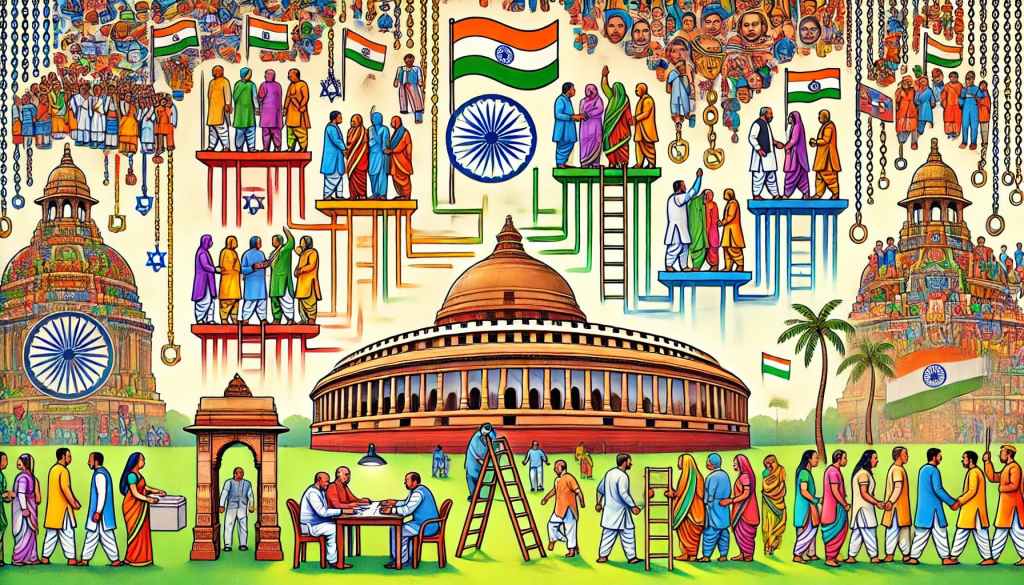
The concept of caste in Indian society delineates social groups primarily determined by birth. This stratification solidified with the emergence of Hinduism, evolving into a fixed and hereditary system. Manusmriti, a prominent Hindu text, delineates the hierarchy, accentuating the inferiority and servitude of lower castes while endorsing the dominance and impunity of upper castes. The lowest castes are told their position stems from past-life transgressions, and severe punishments, including torture and death, are prescribed for offenses like seeking education or challenging a higher caste member.
Even in contemporary times, caste remains a significant aspect of Indian life, albeit with varying motivations for its perpetuation. The upper castes seek to maintain their power by upholding the caste structure, while paradoxically, lower caste groups, while opposing caste-based oppression, sometimes leverage their caste identity for political and social advantage. This duality characterizes modern Indian society.
Originally intended as a reflection of social organization akin to the organs of a cosmic being, the caste system has morphed into a barrier inhibiting individual growth and impeding democratic principles. Indian politics, shaped by cultural diversity, social stratification, and ideological differences, reflects a complex tapestry of influences.
In the Vedic era, the Varna system laid the groundwork for social hierarchy, comprising four classes – Brahmin, Kshatriya, Vaishya, and Shudra – each with specific roles. However, over time, this system ossified into a rigid structure determined by birth, exacerbating societal divisions in contemporary India.
Meaning of Identity Politics
Identity politics encompasses a spectrum of political engagement and theory rooted in the shared experiences of injustice among specific social groups. It involves efforts to address the historical exclusion and marginalization of groups based on inherent characteristics such as ethnicity, gender, sexual orientation, caste, and more. The aim is to achieve empowerment, representation, and acknowledgment for these groups by embracing and asserting the very differences that set them apart, rather than striving for mere equality.
Supporters of identity politics tend to essentialize certain characteristics, cementing group identities around fixed traits like language, culture, ethnicity, gender, and religion. These traits are often perpetuated through language, stereotypes, and institutionalized practices like affirmative action. These core markers differ from associational markers, which define groups based on shared interests rather than inherent attributes.
While some argue that the identity of workers deserves recognition and can also be considered a form of identity politics, the term typically refers to movements centered around specific, localized identities rather than universal ideals. Advocates of identity politics harness myths, cultural symbols, and kinship ties to foster a sense of collective identity and mobilize for recognition.
The study of identity politics gained intellectual legitimacy in the latter half of the twentieth century, particularly during the 1950s and 1960s in the United States. This period saw the emergence of significant political movements such as second-wave feminism, the Civil Rights movement, LGBTQ+ liberation, and Indigenous rights movements, all grounded in claims of injustice experienced by their respective communities.
Identity Politics in India
Caste distinctions are prevalent not only within Hinduism but also in other religious and regional contexts across the Indian subcontinent, such as Nepalese Buddhism, Christianity, Islam, Judaism, and Sikhism. Various reformist movements within Hinduism, as well as Islam, Sikhism, Christianity, and contemporary Indian Buddhism, have contested these practices.
Despite the adoption of a liberal democratic system in India post-independence, community identities remain influential and continue to seek acknowledgment. Scholars like Beteille illustrate how the Indian state has grappled with balancing individual freedoms and communal identities. Bikhu Parekh suggests that the Indian state has recognized numerous self-governing communities, aiming to reconcile the notion of a society of individuals with that of a community of communities, affirming the rights of both individuals and communities. The state’s acknowledgment of specific identities has led many to argue that post-independence India has provided a material basis for identity assertions through its structures and institutions.
In essence, the state actively contributes to identity politics by establishing and maintaining structures that categorize and recognize people based on particular identities. Consequently, identity politics in India encompasses a wide range of dimensions, with language, religion, caste, ethnicity, and tribal affiliation being prominent. However, it would be inaccurate to assume that these identity markers operate independently, as they often intersect and influence one another. For instance, a linguistically homogeneous group may be divided by caste affiliations or religious orientations, or all these factors may be encompassed within a broader ethnic identity.
Caste-Based Discrimination in India
Caste-based discrimination and oppression have deeply entrenched themselves in Indian society, persisting even after independence. This intersection with politics has not only granted formerly oppressed caste-groups political recognition and freedom but has also highlighted the potential of caste as a political asset. Dipankar Gupta has underscored this paradox by contrasting the perspectives of Ambedkar and the Mandal Commission on caste. While Ambedkar aimed to eradicate untouchability through policies like reservations, Mandal viewed caste as a significant political tool.
In Indian society, castes denote social groups determined by birth, characterized by endogamy and often exhibiting shared political inclinations. Additionally, Indian Muslims and Christians are sometimes categorized according to caste, with state governments maintaining official lists based on constitutional provisions. Despite legal equality, social privileges and disadvantages persist, exemplified by terms like “upper caste” and the inclusion of certain communities in the Other Backward Classes category based on socio-economic criteria.
The Mandal Commission served as a pivotal influence in reshaping caste-based identities, laying the groundwork for political and economic empowerment. Prior to its recommendations, upper castes held dominant positions in political and economic spheres. However, the commission shed light on caste-related disadvantages, raising awareness among Dalits.
The caste system, rooted in notions of purity, hierarchy, and difference, has historically oppressed Shudras and outcastes, exacerbating their struggles with poverty, illiteracy, and political marginalization. The Mandal Commission brought this consciousness to the forefront, leading marginalized groups to challenge discriminatory practices constitutionally.
This awakening spurred the formation of caste-based political parties, such as the BJP, predominantly upper caste-led, and the BSP, representing lower castes, alongside others like the SP and left parties. These parties consider caste equations when distributing electoral tickets, utilizing caste-based rhetoric for political gain. Consequently, while caste-based identity in Indian politics fosters democracy to some extent, it also hampers the development of class-based movements.
In summary, it is evident that caste now plays a significant role in both Indian society and politics. This shift has ushered in a new era of organized political engagement, driven by heightened awareness among caste groups. Additionally, new alliances based on caste have emerged, leading to increased mobilization. These developments have not only empowered previously marginalized groups but have also intensified frontline politics, with caste identities taking a prominent role in governance.
Caste as a Factor of Political Socialization
From the moment of birth, an individual born in India is assigned a caste and raised within a specific caste community. This caste affiliation may place them in either a higher caste or one of the lower castes (known as scheduled castes). As they grow, their political beliefs, attitudes, and orientations are inevitably shaped by the influence of their caste group and the pervasive presence of casteism. The values and interests they develop are directly influenced by their caste, impacting their socialization, political perspectives, conscience, and level of participation. Here are some of the effects of caste as a determinant of political socialization:
1. Caste Influences Leadership: Caste considerations often heavily influence ticket allocation, especially among the caste-conscious populations of states such as Haryana, Tamil Nadu, Himachal Pradesh, Bihar, and Andhra Pradesh. In these regions, certain castes tend to produce political leaders. For instance, in Andhra Pradesh, prominent leadership often comes from groups like the Reddys, Karmas, or Valamas, while in Himachal Pradesh, it’s typically the Brahmins or Kshatriyas who assume leadership roles.
2. Political Parties based on caste: In India, numerous political parties align themselves with specific castes, aiming to advance and safeguard the interests of their respective communities. This phenomenon is particularly pronounced among regional parties, which often heavily factor caste considerations into their platforms. For instance, in Tamil Nadu, both the DMK and AIADMK represent non-Brahmin factions. Similarly, the Akali Dal in Punjab is deeply rooted in communal identity, with tensions often arising between Jats and Non-Jats. Caste dynamics play a pivotal role across the political spectrum in India, with parties leveraging caste affiliations to garner electoral support. For instance, the BSP draws substantial backing from Scheduled Castes, while the BJP predominantly enjoys support from non-scheduled Hindu demographics and the business community. Moreover, the leadership of figures like Sh. Kanshi Ram, Ms. Mayawati, Ch. Charan Singh, Karpoori Thakur, and Dev Raj Urs has historically been caste-centric, exemplifying the pervasive influence of caste in Indian politics. Similarly, the leadership of Sh. Laloo Prasad Yadav in Bihar underscores the prevalence of caste-based leadership dynamics.
3. Pressure Groups based on caste: India is home to numerous caste-oriented advocacy groups striving to advance and safeguard the interests of specific castes. These groups exert influence on governments to further their agendas. Examples include the Brahmin Sabha, Rajpoot Sabha, Scheduled Caste Federation, Arya Samaj Sabha, and Sanatan Dharam Sabha, all dedicated to advocating for the welfare of their respective communities.
4. Nomination of Candidates based on caste: The caste dynamic plays a pivotal role in shaping electoral strategies in India. Political parties strategically select candidates based on both the caste of the candidate and the predominant caste demographics of the constituency. This ensures a higher likelihood of garnering votes from constituents of the same caste background. For instance, in regions where Muslims form the majority, parties field Muslim candidates, while areas with a predominant Jat population see Jat candidates being nominated. Interestingly, even ostensibly secular parties such as Congress, Janata Dal, CPI, and CPM factor in caste considerations when choosing their electoral candidates.
5. Voting Behaviour based on caste: During election campaigns, voters are often targeted based on their caste affiliations. Caste plays a significant role in candidate selection and voter appeals. Political parties prioritize caste dynamics, recognizing its influence on electoral outcomes. Candidates frequently seek votes by leveraging caste identities, employing slogans such as “jat ki beti jat ko, jat ki vote jat ko.” These tactics sway voters, prompting them to support candidates from their own caste backgrounds.
6. Caste as Divisive and Cohesive Force in Politics: Caste plays a dual role in Indian politics, serving both as a source of division and unity. It fosters the formation of various interest groups within the political landscape, each vying for power and contributing to an unhealthy power struggle. Simultaneously, it acts as a unifying force among members of specific caste groups, particularly in rural areas where social interactions are confined within small geographical boundaries. Within these communities, caste serves as the primary social identity, both bringing people together and causing divisions.
7. Caste and Organization of Government: Caste holds significant sway in Indian society, exerting influence over political processes and decision-making. Even the restructuring of states is often influenced by a desire to prevent any one caste from gaining undue dominance in a specific region. This dynamic extends to state government policies, with ruling parties leveraging their power to court favour from major caste groups. For instance, the Congress party has historically courted Scheduled Castes as a crucial voting bloc. Regional political entities similarly cater to the interests of specific caste groups within their territories. While the Indian constitution promotes a unified electorate and the ideal of caste-free politics and administration, in reality, caste frequently determines voting behaviour, political engagement, party dynamics, and governmental decisions.
8. Caste Factor in Local Governments: Caste plays a significant role in the functioning of Panchayati Raj and other local self-government institutions. In rural India, caste-based factionalism poses a considerable challenge to the organization and smooth operation of Panchayati Raj. It serves as a crucial channel for communication, representation, and leadership mobilization in rural areas, acting as a bridge between the electoral and political processes.
9. Caste Violence: Political arenas frequently witness the scourge of caste-based conflicts spanning all echelons. Historic caste differentials have evolved into vehement power struggles, permeating society with violence. The subjugation of lower castes by their higher counterparts has metamorphosed into a stark political actuality. This phenomenon reverberates across numerous Indian states, notably Maharashtra, Bihar, Gujarat, and Uttar Pradesh, where caste-based strife pervades both urban and rural landscapes.
10. Social and Political Tensions: The constitutional safeguards designed to protect the interests of scheduled castes remain largely unfulfilled in practice. The presence of caste in politics exacerbates tensions due to the awareness and empowerment of lower castes. Societal divisions persist, with segments categorized into forward, backward, and scheduled castes, among others.
11. Caste in Bureaucracy: Bureaucratic governance is often swayed by caste dynamics, with postings, transfers, and appointments of public officials being significantly influenced by caste affiliations. Presently, administration tends to prioritize the interests of specific castes, despite constitutional assertions of equality. This discrepancy persists even after over seven decades of independence.
12. Caste and Formation of Council of Ministers: When forming their councils of ministers, both the Prime Minister and Chief Minister are expected to ensure representation from various castes within their respective states. Failure to do so often results in pressure from supporters of specific castes urging them to prioritize caste representation. Consequently, ministries perceived as less prestigious are typically allocated to representatives of lower castes, while higher castes tend to secure more significant portfolios. For instance, in Himachal Pradesh, ministries like Social Welfare and Women Empowerment are predominantly entrusted to MLAs from Scheduled Castes, while larger ministries such as public works, energy, and education are often reserved for others.
Caste and Indian Constitution
According to the Indian Constitution, all individuals are regarded as equal, and discrimination based on factors such as caste, gender, or race is prohibited. The Indian Constitution contains several provisions that underscore the significance and impact of caste.
1. Provisions for a Casteless Society: India possesses a remarkable constitution, yet its full execution remains infrequent. The following provisions stem from the earnest endeavours of the esteemed Indian constitution framers, led by Dr. BR Ambedkar:
- Civil Rights Protection Act of 1976
- Prevention of Atrocities against Scheduled Castes and Scheduled Tribes Act of 1989
2. Fundamental Rights – First Right is the Right to Equality: Article 14 of the constitution guarantees equality before the law. Article 15 prohibits discrimination based on religion, race, caste, gender, or colour. Article 16 ensures equal opportunities in public employment. Article 17 abolishes untouchability, while Article 18 abolishes titles.
3. Fundamental Duty: 51A-(e) aims to foster unity and a sense of shared brotherhood among all Indian citizens, regardless of their religious, linguistic, regional, or sectional differences, while also discouraging practices that degrade the dignity of women.
4. Directive Principles of State Policy: The directive principles of state policies outline certain provisions that are voluntary rather than mandatory:
- Article 38 emphasizes the promotion of the welfare of the people by establishing a social order characterized by justice—social, economic, and political—and aims to reduce inequalities in income, status, facilities, and opportunities.
- Article 46 focuses on promoting the educational and economic interests of marginalized communities such as SCs, STs, and other weaker sections of society, with the goal of protecting them from social injustice and exploitation.
- Articles 330 and 332 address reservation of seats in the Lok Sabha and State Assemblies respectively, specifically for members of the SC and ST communities.
Measures to be Taken to Resolve Caste Identity
The elimination of the caste system hinges on a fundamental shift in societal attitudes. Its persistence is largely attributed to widespread illiteracy and ignorance, which foster resistance to social change. Addressing this issue requires a multifaceted approach:
- Reshape reservation policies to prioritize economic status over caste, ensuring assistance reaches all disadvantaged individuals.
- Media should adopt an impartial stance, fostering objective discourse on caste-related issues.
- Eradicate caste-based violence through concerted and well-coordinated initiatives.
- Withdraw recognition of political parties based solely on caste affiliations.
- Politicians must transcend caste politics, prioritizing inclusive governance.
- Reform the education system to embrace secular principles, fostering a more egalitarian ethos.
- Encourage communal harmony in schools through activities like shared meals, promoting inclusivity.
- Revise school textbooks to impart a critical understanding that the caste system is a social construct.
- Promote inter-caste marriage and incentivize such unions to drive social change in future generations.
Based on the preceding discussion, it becomes evident that there exists a significant correlation between caste dynamics and politics, particularly prominent in India, where each influences the other. Caste holds a pivotal position within India’s social framework, extending its influence into various echelons of the political sphere. However, the prevalence of casteism poses a substantial challenge to the principles of democracy. Democracy inherently champions ideals of equality, freedom, and justice, which stand in stark contrast to the divisive nature of caste-based discrimination.
Caste, rooted in birth-based inequality, serves as a divisive factor within Indian politics, often superseding ideological disparities among political parties. Electoral campaigns frequently align along caste lines, and instances of violence during elections often stem from caste-based tensions. Consequently, politics in India has become heavily influenced by caste affiliations, with castes becoming increasingly politicized entities. Yet, the process of democratization holds promise in ushering in leaders from marginalized communities, indicating a desire among the populace for inclusive development and representation.
In order to address these challenges, political leaders must embrace democratization and prioritize the fulfillment of the basic needs of all citizens. Some argue that caste-based politics in India has, in fact, diminished caste differentials and fostered political inclusivity among diverse caste groups. To further this trend, the education system should instill values of equality and solidarity among citizens, essential for fostering national unity. Additionally, governmental efforts should ensure that political practices and systems operate with fairness and equity across all groups, regions, and communities, thus contributing to a more just and cohesive society.
Different Stages in the Use of Caste in Politics
The examination of caste’s role in politics can be divided into two distinct phases:
1. Initial Phase: During this period, politics primarily involves two demographic groups:
- High-caste individuals such as the Reddys (Andhra Pradesh), Patidars (Gujarat), Lingayats (Karnataka), Rajputs and Jats (Rajasthan), Kayasthas (Bihar), and intellectuals with significant social standing.
- Lower-caste populations and the general masses.
The initial phase involves both higher and lower caste groups, encompassing three key elements:
- The hierarchical arrangement within the caste system
- Allocation of economic advantages
- Awareness and identity associated with one’s caste
Moreover, the initial phase can be delineated into three distinct phases:
1. Initial Phase: Initially, the contest for significant power benefits is primarily confined to traditionally dominant castes. These castes wield economic and political influence, though not necessarily numerical superiority. This differs from the concept of a dominant caste.
2. Intermediate Phase: This phase encompasses emerging castes characterized by two key attributes:
- Dissatisfaction, seeking elevated societal roles.
- Aspiration for esteemed positions within society through the acquisition of power.
3. Advanced Phase: This phase witnesses competition not only between ascending and established castes but also within these groups. This marks a stage of caste fragmentation or internal divisions. At the culmination of the initial phase, there emerges intense competition among various caste segments to attain power and prestige within society.
Additionally, the progression of political dynamics unfolds in the following sub-phases:
- Mobilization of the masses in political affairs.
- Emergence of leaders with distinct ideologies and agendas.
Leaders in the second stage exhibit several distinguishing characteristics:
- They tend to be less modernized.
- Their level of education is generally lower.
- They have stronger ties to rural areas.
- They are often imbued with innovative thinking.
- They possess a knack for organizing people effectively.
- They demonstrate a willingness to take risks.
- Local leaders begin to replace Westernized ones.
- Emphasis shifts towards valuing leadership qualities over Western education.
During this stage, three significant developments unfold:
- Factionalism emerges within established caste groups.
- A similar phenomenon occurs within emerging social strata.
- Agreements and coalitions begin to shape the landscape of governance.
The situation arose from the intertwining of fragmentation and coalition along caste lines and identities. This resulted in two notable outcomes:
- Certain caste values underwent alteration to conform to the policies and regulations of political entities, thereby politicizing the value system.
- Additionally, there emerged conflicts over the acquisition of personal power, exacerbating the fragmentation within political parties.
3. Third Sub-Stage: The third stage emerges from a progression of two prior phases, characterized by the erosion of traditional identities and the infusion of new values influenced by education, technology, industrialization, and urbanization. This phase is marked by several key transformations:
- Emphasis shifts towards achieved status over ascribed status.
- Political structures become more diversified.
- Various factors beyond caste begin to influence societal dynamics.
During this phase, the involvement of caste in the modern political landscape undergoes significant shifts:
- Caste experiences fragmentation and internal divisions.
- Caste evolves into a novel mode of societal integration, giving rise to a dynamic system of universalistic-particularistic relationships, notably in the realm of democracy and politics.
Based on the preceding discussion, it can be inferred that political parties leverage caste affiliations for their operations and seek support from these groups to secure electoral victories. Analyzing the three phases mentioned earlier, Rajni Kothari outlines three distinct perspectives on the relationship between caste and politics:
- Some individuals lament the intrusion of caste into politics, advocating for a separation of politics from caste influence.
- Others view political dynamics as reflections of social dynamics, asserting that politics merely mirrors existing social relationships without exerting independent influence.
- There are those who advocate for the autonomy of either caste or politics, or both. Within this category, perspectives vary widely, ranging from progressive economists who denounce any association with caste as regressive, to ideologists seeking to shield caste from political contamination, to political scientists recognizing caste as a significant political force in contemporary India. Social anthropologists, recognizing the political imperative to protect the caste system, argue for the autonomy of both caste and politics. This stance carries several potential implications:
- Caste loses its monopoly as the sole basis of politics.
- Caste becomes a tool for political mobilization and expression.
- Caste exerts a significant influence on the political system.
- Caste concurrently gains newfound strength for fostering new integrations.
- Caste serves as a unifying element, absorbing tensions and frustrations.
- A new elite structure emerges, drawing leaders from diverse caste backgrounds.
- Common secular outlooks are shared.
- Caste associations and institutions emerge, such as caste clubs and conferences.
- Caste federations form, comprising multiple castes with specific interests, such as advocating for reservation facilities.
Effects of Caste System on Indian Society and Polity
While the caste system initially served its intended purposes effectively, over time it deteriorated, transitioning from a mechanism of societal organization to a source of significant harm. India witnessed a series of detrimental effects stemming from this degeneration, including:
1. It Hindered National Unity: The caste system fostered insular sentiments, heightening individuals’ excessive awareness of their own castes. Frequently, caste concerns took precedence over the welfare of the nation. Consequently, the entire system posed a significant obstacle to the notion of national unity.
2. It Stood Against Democracy: The caste system fundamentally contradicts the principles of democracy. While democracy upholds the idea of human equality, the caste system promotes inequality through its hierarchical structure, with Brahmins occupying the highest position and Shudras relegated to the lowest tier.
3. It Resulted in Suppression: The caste system operated on the oppression and marginalization of lower castes by those in higher castes. Shudras faced severe mistreatment, including being barred from public spaces and even having their shadows deemed impure by higher-caste individuals. Mixing or dining with lower castes was strictly forbidden, highlighting the system’s foundation in exploiting those deemed inferior.
4. It Hampered National Development: In the caste system, a select few held the reins of national influence, while others were relegated to serving the higher castes such as the Brahmins and the Kshatriyas. It’s crucial for the nation’s welfare that all segments of society participate in social progress. However, marginalized groups lacked representation and opportunity for advancement in national development efforts.
5. It Resulted in Treachery and Fall of the Hindus: In a society deeply entrenched in caste divisions, the Shudras recognized their limited prospects within the Hindu hierarchy. This realization bred insecurity among them, prompting unity and awareness as they began to advocate for their rights. Despite constitutional provisions, social movements persist, with Shudras still contending with lingering stigma today. The discrepancy between economic status and societal respect for those at the lower rungs of the caste system can fuel resentment and contribute to societal division.
6. Lead to Religious Conversion: At the upper echelons of Hindu society, there is a persistent failure to unify all Hindus. The overwhelming influence of Brahminism has created significant discontent among the Shudras, who have historically been marginalized within Hindu society. Consequently, they have been drawn towards the ideologies and teachings of Islam and Christianity. This attraction has led many Shudras to convert to these new faiths, thereby contributing to the growth of Christianity and Islam in India.
7. It Undermined the Ability of the People: In the caste system, individuals’ status and roles are predetermined from birth, rendering their abilities, efforts, and diligence irrelevant for initiating any change. Embracing one’s hereditary status became obligatory and beyond scrutiny, consequently overshadowing people’s aspirations and capabilities within the caste system.
8. It fostered an illusion of prestige among the upper echelons of society: The upper castes held the belief that they exclusively possessed wisdom, leading them to expect consultation and labour from all other castes. Consequently, this mindset widened the gap between the upper and lower castes.
9. Emergence of a group of individuals who were idle: The Brahmins, positioned at the summit of the caste system, were originally tasked with the responsibility of imparting religious teachings. However, over time, they grew indifferent to their role and failed to dedicate themselves to their duties. Aware that their status within the caste system shielded them from repercussions, they began to rely on the labour of other castes without making any meaningful contributions to society. Consequently, a segment of idle individuals emerged within the Hindu social structure.
10. Responsible for Untouchability: Untouchability represented the most abhorrent facet of the caste system, subjecting individuals to a plethora of social, economic, political, and religious marginalization. Exploited under the guise of religious beliefs, those deemed untouchables endured egregious treatment, denied access to education and forced into unclean occupations. Classified as untouchables, the lower castes faced systemic discrimination, with their children barred from educational opportunities and constrained to menial labour. Restrictions extended to attire, with Shudra women prohibited from emulating the attire of Brahmin women, and access denied to public amenities such as wells, ponds, and places of worship. Enforced by religious dogma and societal norms, these practices coerced adherence to religious dictates and reinforced caste-based segregation.
11. Lower Status of Women: In the hierarchical structure of the caste system, women suffered severe neglect. They were confined to a conservative and traditional role, devoid of opportunities for higher education and participation in public discourse. Particularly in higher castes, women faced additional challenges such as child marriage and the ban on widow remarriage, leading to precarious lives. The societal pressure for bearing male offspring took a toll on women’s physical and mental well-being, exacerbating their situation. Instances of sexual harassment by men from higher castes often went unchallenged due to entrenched social norms, leaving lower caste women vulnerable and silenced.