- Political Processes: An Introduction
- Democracy: An Introduction
- Meaning and Definitions of Democracy
- Features of Democracy in India
- Types of Democracy
- Basic Principles or Requisites of Democracy
Political Processes: An Introduction
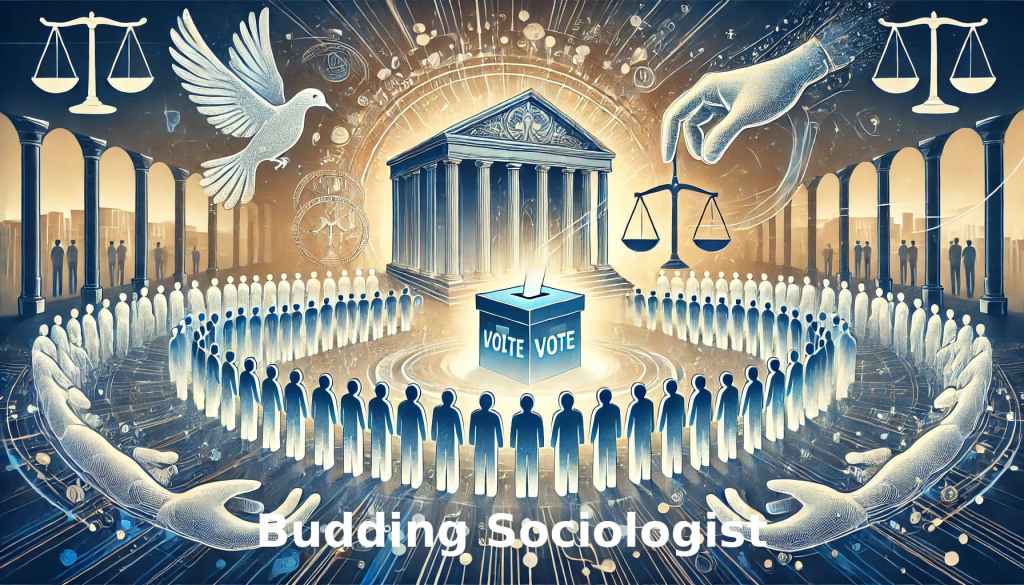
In every democratic nation, the political system plays a crucial role, with the political process serving as the primary tool for analyzing its functioning. This process encompasses the formulation and execution of public policy, often through interactions within society involving:
- Social groups and political institutions
- Political leaders and public sentiment
The political process involves receiving information and cues from the surrounding environment, which are then translated into authoritative actions. It encompasses various factors such as elections, attitudes, voting patterns, political engagement, leadership dynamics, and mass mobilization.
Essentially, the political process is a dynamic, interactive field of study, emphasizing the interactions between governing bodies and their counterparts. It explores the actions taken to achieve political objectives through the utilization of power or engagement in political activities, including organizational efforts, electoral participation, and lobbying.
The concept of the political process was introduced by sociologists, notably Charles Tilly in their work “Political Process in Revolutionary France 1830-32”. It involves the examination of movements or upheavals within a specific domain that alter trends and open up new possibilities. This notion is closely linked to political socialization. As a theoretical framework, the political process encompasses social movements, political opportunities, mobilizing structures, and framing processes as pivotal elements. In the context of political sociology, it is applied to key concepts such as democracy, bureaucracy, power, and authority. In the subsequent sections, each of these concepts is explored in depth, with particular focus here on democracy.
Democracy: An Introduction
Democracy embodies a social structure wherein power is distributed equally among individuals, yet in sprawling societies, engaging every citizen in governance becomes unfeasible. Democratic power structures entail the election of representatives through direct suffrage, empowering them to wield political authority. Pure democracy remains scarce, as the notion of inclusivity inevitably excludes segments of the population. Within democratic frameworks, citizens select leaders through voting, entrusting them to advocate for their interests in deliberations and decisions, typically convened in central national assemblies like parliaments.
India’s democratic political model evolved post-independence. While ancient India is purported to have embraced a democratic ethos (“Ram Rajya”), modern political democracy was absent. Presently, politicians align with parties and secure office through direct elections based on party platforms rather than issue-driven citizen mandates. Consequently, political parties emerge as autonomous centers of influence.
In the 21st century, it’s widely believed that representing citizen interests effectively typically involves a limited number of political parties, often two or three. Crucial to the functioning of democracies are various political processes such as elections and political socialization. Key components of democracy include political organization, competition, and meaningful representation. To establish a genuine democracy, certain conditions are deemed essential:
- Conducting free and fair elections
- Providing voters with authentic choices among candidates and policies
- Ensuring genuine parliamentary authority
- Maintaining a separation of powers between the executive, judiciary, and political branches
- Safeguarding civil rights for all citizens
- Upholding the rule of law and equality before it
- Fostering inter-party competition
- Ensuring real representation of diverse interests
- Promoting a free and responsible media
- Guaranteeing personal freedoms
- Upholding freedom of speech and expression
- Protecting freedom of religion and public worship
- Safeguarding freedom of association and peaceful assembly
In essence, while democracy rests on majority rule, safeguarding minority rights remains integral. Other fundamental aspects include equality before the law, freedom of speech, press, assembly, and protection against arbitrary arrest. Despite broad agreement on these principles, there’s ongoing debate over their precise interpretation and implementation. Political sociologists are actively studying various aspects such as the nature of the state, political socialization, voting patterns, economic systems’ relationship with democracy, and the influence of public opinion manipulation.
Meaning of Democracy
Essentially, democracy signifies governance by the populace. Its origins lie in Greek roots: “demo” meaning people and “kratia” meaning rule, first utilized in 5th century BCE to characterize the political setups of Greek city-states, notably Athens. Democracy, therefore, embodies a system where citizens possess the authority to elect their legislative representatives.
In the Greek view, democracy entails self-governance, where individuals collectively govern. It’s a model where the entire populace or eligible members of a state participate in decision-making, often through elected representatives. Fundamental tenets include freedoms of assembly and speech, inclusivity, equality, consent, voting rights, protection of life, and minority rights.
From this perspective, democracy emerges as a governance framework. A democratic state signifies one where the community holds sovereign authority, retaining ultimate control over affairs and determining the structure of government. Democracy extends beyond governance modalities; it encompasses the selection, supervision, and removal of government. In essence, in a democratic state, citizens possess the right to shape, appoint, and dismiss their government. They exercise these rights through periodic elections, and also express their preferences and concerns through various channels, such as the press.
Features of Democracy in India
Defining democracy proves challenging due to the myriad interpretations, yet certain pillars like legal equality, political freedom, and the rule of law stand out as fundamental components. These ideals manifest in ensuring every eligible citizen is treated equally under the law and enjoys equitable participation in legislative processes. To comprehend democracy fully, it’s crucial to consider the following key aspects:
1. Popular Sovereignty: Democracy thrives on the principle of sovereignty, where individuals wield power. Through democratic processes, citizens select their representatives who are entrusted with the responsibility of making decisions that safeguard the well-being of those who have bestowed upon them their authority.
2. Political Equality: Democracy hinges on the principle of political parity, wherein all individuals, regardless of their caste, creed, religion, race, or gender, are deemed equal under the law and possess identical political entitlements. This notion of equality ensures that every citizen is granted the right to participate in the electoral process through voting.
3. Majority Rules: In a democratic system, the governing body operates based on the support of the party that secures the majority of votes. This majority backing is universally acknowledged, and the party is accountable for making decisions and addressing the various concerns of the populace.
4. Federal: Article 1 of the Indian Constitution characterizes India as a federation of states, commonly referred to as federal. As per our constitutional framework, states possess autonomy, granting them substantial freedom in specific domains while being subject to central authority in others.
5. Collective Responsibility: In India’s democratic system, both at the state and central levels, the Council of Ministers holds collective responsibility to their respective legislative bodies. Every minister shares accountability for the government’s actions, ensuring that no individual bears sole responsibility for any decision or activity.
6. Formation of Opinion: A crucial aspect of democratic governance lies in the establishment of institutions that facilitate the shaping of public opinion on diverse issues. Among these institutions, the legislature stands out as paramount for gauging and articulating public sentiment.
7. Respect for Minority’s Opinion: In a democratic system, while the majority holds sway, minority viewpoints are also honoured. Embracing diversity of opinion is encouraged, as democracy thrives on open discourse and constructive criticism, allowing for thorough examination of proposals. Upholding minority perspectives is crucial, as failure to do so risks the erosion of democracy into authoritarianism.
8. Provision for Rights: In a democratic system, individuals are granted dignity through the allocation of several rights. These include freedoms such as the right to express oneself openly, the ability to form associations or unions, and access to education and cultural opportunities.
9. Rule of Laws: In a democratic system, the principle of the rule of law prevails. This signifies that the law holds the highest authority, unyielding to any individual or group, be it the general public or the privileged class.
10. Rule by Consent: Democracy operates on the principle of voluntary consent rather than coercion. This consent is typically achieved through dialogue, debate, and discussion, allowing for the resolution of issues through collective decision-making processes.
11. Implies open Society: Democracy embodies a society characterized by freedom and openness. Government actions are rooted in public opinion, with various associations, unions, and organizations convened to openly discuss and address issues, seeking solutions collaboratively.
12. Government by Compromise: Democracy functions through the mechanisms of negotiation and concession. It involves the inclusion of diverse perspectives both within and outside of the governing body. The government must navigate through a multitude of ideas, ensuring that various viewpoints are acknowledged and accounted for.
13. Democracy Aims Welfare Government: In many democratic nations, there exists a welfare-oriented government structure. Democracy serves as a potent instrument for achieving comprehensive welfare. Operating as a welfare government, it upholds essential values such as individual freedom, liberty, and dignity.
14. Independent Judiciary: In democratic systems, an independent judiciary is a hallmark feature. The judiciary operates autonomously, free from the influence of the executive or legislative branches. It stands as a separate entity, impervious to interference from any branch of government.
Conclusion: Based on the aforementioned depiction, one can infer that democracy embodies an egalitarian governance model wherein the collective populace of a nation collectively influence public policies, enact laws, and influence governmental actions either directly or indirectly. It necessitates that all eligible citizens possess an equal chance to voice their perspectives. In practical terms, the degree of democracy within a system can be gauged by its proximity to this ideal. While no nation has universally extended voting rights to all its citizens, including minors, the majority of countries presently conduct periodic elections rooted in egalitarian ideals, albeit theoretically.
Types of Democracy
Democracy, despite its complexity, is often categorized by scholars into two primary types. Nevertheless, numerous governments across the globe have implemented various forms of democracy, which can be delineated as follows:
1. Direct Democracy: Pure or direct democracy occurs when citizens themselves directly participate in public decision-making processes, shaping laws and policies collectively without intermediaries. According to Hearnshaw, a truly democratic government is one where the entire community exercises sovereignty firsthand, without relying on representatives or agents. Direct democracy traces back to the ancient Greek city-states and found expression in entities like the Vajji Sangha during India’s Buddhist Periods. However, the complexity and size of modern societies render direct democracy largely impractical. Presently, this form of governance persists in only four Cantons of Switzerland: Appenzell, Uri, Unterwalden, and Glarus.
2. Representative or Indirect Democracy: In representative or indirect democracy, the governing will of the state isn’t directly expressed by the populace themselves but by elected representatives such as MPs and MLAs, to whom they grant the authority of decision-making. John Stuart Mill describes indirect or representative democracy as a system where either the entire populace or significant portions thereof exercise governance through periodically elected deputies. According to Bluntschli, in representative democracy, the people govern through their officials, participating in legislation and overseeing administration through their chosen representatives. This form of government originated in England during the 17th century, and later took root in France in 1830, Italy in 1948, and Germany following the First and Second World Wars. India saw the introduction of indirect democracy in the Minto-Morley Reforms of 1909. Today, this system is prevalent in numerous countries including Japan, Sri Lanka, India, Canada, Australia, New Zealand, the United States of America, Germany, Italy, France, the Netherlands, Denmark, Sweden, Norway, Austria, Belgium, and others.
3. Presidential Democracy: In a presidential democracy, the executive branch holds authority, contrasting with a parliamentary democracy where the legislative branch dominates. Citizens directly elect a president to lead the government in systems like those in the United States and Nigeria. Despite the president’s significant powers, the legislative branch serves as a check on their authority. Comprising the president and their cabinet, the executive branch operates alongside the judiciary and legislature to maintain a system of checks and balances, although the president ultimately holds the highest authority.
4. Authoritarian Democracy: In a system often termed as an authoritarian democracy, power is concentrated in the hands of the wealthy and elite, rather than being truly representative of the populace. While such regimes may mimic the structures of traditional democracies, featuring executive and legislative branches, ultimate control remains in the hands of a select few rather than the citizenry. When governance is primarily executed by a small group of elites, it may be classified as an elite democracy. While examples of authoritarian democracies are limited, Russia is often cited due to its electoral processes and legislative bodies, albeit being dominated by the regime of Vladimir Putin.
5. Religious Democracy: Here, the intersection of religious principles and governance occurs, shaping the foundation of the government. A prevalent instance is witnessed in Islamic democracies, where Islamic laws serve as the framework for policymaking. Leaders in such democracies are mandated to adhere to Islamic teachings, yet they are elected into office by the populace. Countries like Afghanistan and Pakistan exemplify this model, wherein executive, judicial, and legislative branches operate under the guidance of Islamic laws and the Qur’an. Additionally, these nations maintain constitutional frameworks, with representatives elected by the citizenry.
6. Monarchical Democracy: In certain contemporary nations like Britain and Sweden, traditional monarchs, namely kings or queens, still hold the title of constitutional monarchs while the elected government governs. However, their authority is significantly limited by the constitution, which grants power to elected representatives of the populace. These monarchs often serve as symbolic figures representing national identity rather than wielding direct political influence. The majority of modern nations operate under republican systems, where monarchy is absent. Despite this, the adherence to democratic principles is widely professed across both constitutional monarchies and republics alike.
Conclusion: Based on the aforementioned description, it is clear that democracy stands in contrast to communism, as exemplified by the former Soviet Union (and still prevalent in China). Communism was characterized by single-party rule. Following the collapse of the communist regime in 1989, democratization processes have begun globally, particularly in nations formerly under Soviet-style governance. Democracy entails the presence of multiple political parties and the conduct of free and fair elections at regular intervals. In a democratic setup, pressure groups play a crucial role in representing and influencing government decisions. Moreover, in this system, the civil service is perceived as serving the government, while the judiciary is expected to remain independent from political influence.
Basic Principles or Requisites of Democracy
Here are the fundamental principles or prerequisites that should be comprehended or addressed before contemplating democracy:
1. Liberty: Democracy thrives on the principles of liberty and equality, where individuals enjoy extensive freedom and fairness. Criticism is not just tolerated but actively encouraged within this system. For instance, in Great Britain, the government provides financial support to the leader of the Opposition, who also plays a consultative role with the Prime Minister during national crises. Similarly, former Indian Prime Minister Lal Bahadur Shastri sought input from opposition leaders before embarking on talks with President Ayub Khan of Pakistan in Tashkent on January 5, 1966. In contrast, other governance systems such as monarchies, dictatorships, aristocracies, and oligarchies typically exclude both the people and opposition parties from significant national decisions.
2. Equality: Democracy places a significant emphasis on equality, ensuring that there is no discrimination based on factors such as caste, creed, religion, or social status. For instance, India has abolished the practice of untouchability, striving to ensure equal treatment for all before the law and eliminating any privileged class. Achieving political, economic, and social equality is crucial. In India, measures have been taken to eliminate disparities based on caste, religion, colour, and gender, including the introduction of Adult Franchise, allowing all citizens to participate in elections for Provincial Assemblies and the Lok Sabha. Similar efforts to promote social and political equality can be observed in other democracies such as England, Japan, France, Belgium, Holland, Denmark, Sweden, Norway, West Germany, the United States of America, and Italy. However, it’s important to note that political and social equality alone is insufficient without economic equality. Recognizing this, the Indian National Congress, during its Bhubaneswar Session in January 1964, passed a resolution to pursue socialism through democratic means. Presently, earnest endeavours are underway to fulfil this resolution.
3. Fraternity: The success of democracy hinges on a tranquil environment; otherwise, it encounters numerous challenges. In 1954, Jawaharlal Nehru introduced the Panch Sheel principles to advocate for peaceful coexistence globally. Governments, including India’s, alongside several other democratic nations, are actively striving to foster world peace. India’s presidency of the Non-Aligned Movement underscores its commitment to promoting this policy.
4. People as Ultimate Source of Sovereignty: In democratic systems, sovereignty originates from the people, who empower the government. Consequently, regular elections are held to uphold this principle. Examples include India and England, where General Elections occur every five years, and the United States, where they take place every four years.
5. Fundamental Rights to the People: In democratic societies, individuals are bestowed with essential rights to ensure their holistic development. These rights are enshrined in the constitutions of various countries like India, Japan, USA, France, and Italy, acknowledging their significance in fostering individual growth. In England, the protection of rights and freedoms is upheld through mechanisms such as the Rule of Law, Charters, Acts of Parliament, and Judicial Decisions, which evolve over time to safeguard the populace.
6. Independent Judiciary: In any democratic society, it falls upon the judiciary to safeguard the fundamental rights of its citizens. Within India, both the Supreme Court and the High Courts play a pivotal role in upholding the Constitution and ensuring the protection of these rights. Wherever the judiciary lacks independence, the assurance of fundamental rights becomes precarious.
7. State as Means and People as Goal in Democracy: One fundamental aspect of democracy is that the individual serves as a means to an end, while the state represents the end itself. This implies that the state utilizes individuals to further its own interests. In contrast, other types of governance often neglect the importance of individual freedom.
8. Welfare State: Democracy prioritizes the welfare of society as a whole, focusing on the well-being of all its members rather than catering to specific classes.
Conclusion: Based on the aforementioned description, it is evident that despite its flaws, democracy remains a superior mode of governance chosen by numerous nations. In comparison to aristocracy, oligarchy, or dictatorship, democracy is favoured as it provides better prospects and glimpses of hope, particularly by disillusioned and frustrated individuals worldwide. John Stuart Mill, in support of democracy, remarked, “After carefully considering all valid arguments against democracy, I unequivocally concluded in its favour.”