- Introduction
- Functions of Descent Groups
- Types of Descent
- Rules of Inheritance
- Rules of Residence
Descent: An Introduction
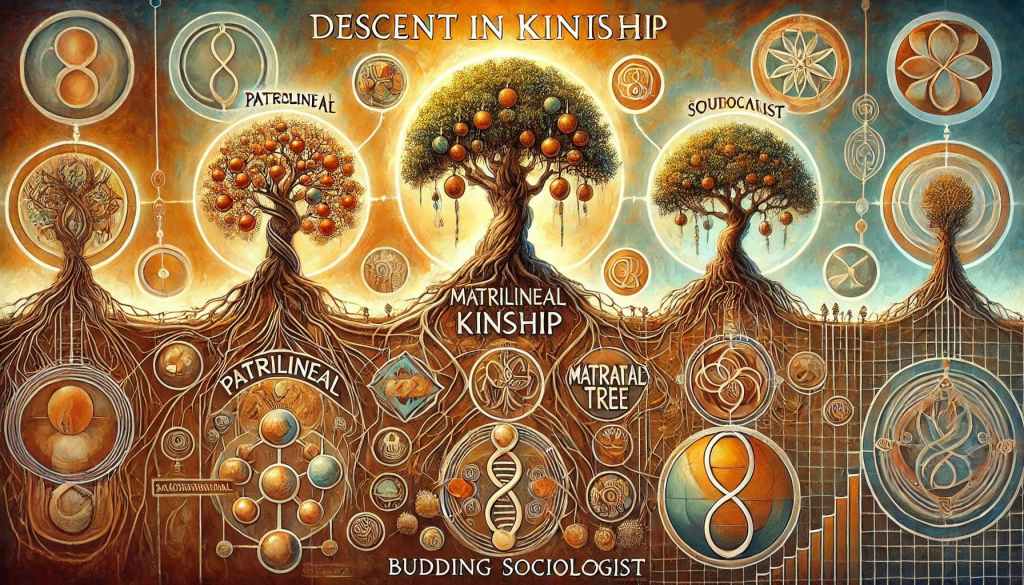
Descent refers to the socially recognized and culturally constructed ways in which lineage and heritage are traced within a community or society. It delineates how individuals relate to their ancestors and determine their family ties, which significantly influences social structure, inheritance rights and group membership.
Descent plays a crucial role in how societies structure kinship, inheritance and social hierarchies. Descent refers to the way individuals in a society trace their lineage and kinship, which significantly impacts social organization, inheritance, family structure and group identity. Understanding descent systems helps sociologists comprehend how different cultures organize themselves and maintain continuity across generations.
Descent systems establish categories for kinship groups based on specific rules and norms that define who qualifies as family and who does not. These systems are pivotal in determining inheritance, succession and the upbringing of children, thus playing a crucial role in transmitting cultural values and property over generations.
Descent systems serve not only to trace lineage but also carry significant social and cultural implications. They influence social connections, affect choices in marriage and establish communal bonds essential for social unity. Additionally, descent rules often intersect with other social institutions like religion, economy and politics, shaping broader societal frameworks and power dynamics.
Anthropologists and sociologists explore descent to comprehend the foundational principles that structure societies and how these principles adapt to societal changes. Economic shifts, migration patterns and evolving gender roles can all impact descent systems, leading societies to redefine norms related to kinship and inheritance. By studying descent, researchers gain insights into the evolution and continuity of social identities and relationships across different historical periods.
Functions
Descent groups play a crucial role by illuminating how social structures and kinship systems are organized. Understanding their functions provides valuable insights into social organization and kinship dynamics. Following are the functions of descent groups:
1. Social Cohesion and Identity: Descent groups play a crucial role in nurturing a deep sense of solidarity and identity among their members. They achieve this by tracing lineage either through matrilineal or patrilineal lines, enabling individuals to define their position within broader social networks and structures. Being part of a descent group typically involves participating in shared rituals, upholding traditions and cherishing collective memories that strengthen interpersonal bonds. This shared sense of belonging, promote social cohesion, mutual support and a unified identity within the group. Across many cultures, descent groups also provide a framework for individuals to comprehend their societal roles and obligations, thereby ensuring cooperation and unity during social and ceremonial engagements.
2. Economic Functions: Descent groups are crucial in managing and distributing resources within kinship. They typically oversee valuable assets like land, livestock and inheritance, allocating them based on descent-related guidelines. This structured management promotes fair distribution and promote economic collaboration within the group. Members often unite in joint ventures or exchange labour, pooling their resources for collective gain. These economic practices are not just functional but also reinforce social bonds and reciprocal relationships among group members, thereby enhancing their economic flexibility.
3. Political Organization: Descent groups play a significant role in shaping political structures by establishing a foundation for leadership and authority. These groups typically assign leadership roles to specific lineages, which in turn influence decision-making and governance processes. Leaders hailing from descent groups often serve as mediators during conflicts, utilizing their authority to settle disputes within the group and with others outside it. This hierarchical arrangement within descent groups contributes to upholding social order and stability, while also enabling coordinated efforts on issues of communal concern or governance.
4. Cultural Transmission: Descent groups function as guardians of cultural legacy, safeguarding traditions, customs and rituals that endure across generations. They play essential roles in imparting cultural wisdom and values to younger members, ensuring the continuance of societal norms and traditions. By engaging in communal ceremonies and rituals, individuals discover their cultural roots and understand their responsibilities within the larger community. This transmission of culture within descent groups reinforces collective identities and nurtures social cohesion, promoting a unified historical consciousness and a sense of belonging among their members.
5. Marriage and Alliance: Descent groups play a pivotal role in overseeing marriage and alliances, shaping rules and customs that govern marital unions based on kinship connections. These regulations are essential for preserving social boundaries and promoting alliances within and between descent groups. Inter-group marriages can strengthen social, economic or political bonds, establishing interconnected networks that foster mutual aid and collaboration. Beyond promoting wider social cohesion, these alliances enhance the resilience and flexibility of descent groups during evolving social change.
6. Legal and Ritual Functions: Descent groups frequently wield authority over customary law, especially concerning matters like inheritance, property rights and legal disputes within their community. They are pivotal in resolving conflicts and upholding norms that regulate social interactions and obligations among members. Moreover, descent groups actively engage in rituals and ceremonies that commemorate life milestones, affirm group membership and maintain cultural traditions. These ceremonial practices symbolize collective identity and unity, promoting social unity and reinforcing interpersonal connections within the descent group.
7. Adaptation and durability: In reaction to shifts in the environment, economy or society, descent groups create adaptive approaches to uphold stability and durability. Their unified structure enables them to coordinate actions in the face of challenges like limited resources or outside dangers. Through pooling resources and expertise, these groups can successfully reduce risks and manage uncertainties, ensuring the welfare and survival of their members. This flexibility not only protects the group’s interests but also encourages inventive solutions and creativity in tackling new issues within their community.
8. Symbolic Functions: Descent groups not only fulfil practical roles but also hold significant symbolic importance in societies. They symbolize expansive kinship networks and relationships, influencing individuals’ perceptions of their societal position and connections with others. Belonging to influential descent groups can give social prestige and status, affecting one’s opportunities and social advancement within the community. Symbolic representations within these groups reinforce societal hierarchies and establish guidelines for social roles and duties, thereby contributing to the stability and unity of the society as a whole.
9. Intergenerational Transfer of Wealth and Knowledge: Descent groups play a crucial role in communities by enabling the transmission of wealth, knowledge and skills across generations. They adhere to specific norms governing inheritance, ensuring that assets like land, property and cultural items are handed down from one generation to next. This process not only safeguards family wealth but also upholds stability in land ownership and economic traditions. Moreover, descent groups pass on expertise in agriculture, crafts and cultural practices, promoting sustainable resource management and the preservation of cultural heritage for future generations.
10. Social Control and Regulation of Behaviour: Descent groups serve a crucial function in maintaining social order by upholding norms and governing behaviour within their ranks. They define standards for conduct, etiquette and ethical behaviour that shape how members interact internally and with others outside the group. Breaches of these norms can lead to disciplinary actions administered either by group leaders or through communal agreement. These measures help to uphold stability and unity within the community, promoting a sense of shared identity and ensuring accountability among all members.
In conclusion, descent groups serve a variety of interconnected roles crucial for comprehending social structures and kinship dynamics in diverse cultures and societies. These roles include fostering economic cooperation, organizing political activities, preserving cultural heritage and symbolically representing their communities. Together, these functions strengthen the unity, and ability to adapt of descent groups within their societal contexts.
Types of Descent
Descent pertains how societies acknowledge biological relationships between individuals over generations. These systems differ worldwide, shaping kinship, inheritance norms and social organization. Following are the types of descent:
1. Unilineal Descent: Unilineal descent refers to a system of tracing kinship and inheritance through only one line of ancestors, either the paternal (father’s side) or maternal (mother’s side) line and can be described as follows:
1.1. Patrilineal Descent: Patrilineal descent is a kinship system where lineage is traced through the father’s line. In such societies, individuals inherit their social standing, property and privileges through their paternal line of ancestors. This system places significant importance on maintaining male lineage continuity, with fathers playing crucial roles in passing down family heritage and identity. Within patrilineal societies, males often hold authoritative positions both within their families and communities.
1.2. Matrilineal Descent: Matrilineal descent is a kinship system where lineage is traced through mother’s line. In matrilineal societies, an individual’s affiliation is based on their mother’s lineage, with inheritance, social standing and descent predominantly determined by maternal ancestry. These systems emphasize the role of mothers and female ancestors in transmitting family identity and property. Maternal relatives often wield significant influence over both family and community matters. Examples of matrilineal descent can be observed in various indigenous African societies, such as the Minangkabau of Indonesia, and among specific Native American tribes like the Hopi, where maternal lineage plays a crucial role in shaping social structure and inheritance customs.
2. Bilineal Descent: Bilineal Descent is a kinship system where individuals trace their ancestry through both their father’s and mother’s side. This system allows individuals to inherit rights, property and obligations from both sides of their family. Bilineal descent can be further divided as follows:
2.1. Double Descent: Descent is traced through both the patrilineal and the matrilineal group with attendant rights and obligations but assigns to each a different set of expectations. For example, the inheritance of immovable materials, such as land, may be the domain of the patrilineage, while the matrilineage controls the inheritance of moveable objects such as livestock. Double descent is a unique kinship system that blends aspects of both patrilineal and matrilineal structures within a single society. This allows for the coexistence of dual patterns of inheritance and social affiliation. In such systems, individuals may be affiliated with distinct descent groups for different purposes. This complex arrangement acknowledges contributions from both male and female ancestors to an individual’s social identity and responsibilities. Examples of societies practicing double descent include; the Nuer people of Sudan and the Iroquois Confederacy in North America.
3. Cognatic: Cognatic descent is a kinship structure where individuals trace their lineage through both their maternal and paternal lines without favouring either one. In cognatic descent systems, individuals maintain connections with relatives from both their father’s and mother’s families. This dual lineage allows for wider support networks and access to resources from multiple kinship groups. The flexibility of cognatic descent enables individuals to inherit property, rights and responsibilities from both parental lines, facilitating complex social alliances and networks. This kinship system is commonly observed in societies where family connections hold significant value and kinship is integral to social organization and personal identity.
4. Ambilineal: Patrilineal and matrilineal systems are both societal frameworks, but individual identity within these systems is defined by specific rules that determine whether a person belongs to their mother’s or father’s lineage. Ambilineal descent offers a more flexible approach, allowing individuals to choose their affiliation from either their maternal or paternal side. Unlike strict patrilineal or matrilineal systems, ambilineal descent enables people to identify with one or both lineages based on various factors, including social status, economic benefits, and personal choice. This system allows individuals the freedom to shift between different descent groups or maintain connections with both, influenced by factors such as inheritance customs and the prestige of each lineage. Ultimately, ambilineal descent enhances relationships with relatives on both sides, creating wider support networks and access to diverse resources.
Rules of Inheritance
The rules of inheritance in descent are the principles that dictate how property, titles and status are passed from one generation to the next within a particular lineage. These rules vary widely across cultures and are typically influenced by the type of descent system in place. Following are the inheritance rules and concepts associated with each type of descent:
1. Patrilineal Descent: Patrilineal descent systems trace lineage and inheritance through the male line, focusing on maintaining property and titles within the male kin group. In most cases the property is divided equally among all the sons but sometimes one son is preferred over other. In that case concept of primogeniture and ultimogeniture are used.
1.1. Primogeniture: In a primogeniture system, the eldest son receives the family estate, titles and duties, typically leaving out other children from substantial inheritance shares. This arrangement aims to maintain the unity and continuity of the estate, securing family wealth and influence. For instance, during medieval Europe, the oldest son would inherit all lands and titles, assuming leadership of the household. This custom prevents property fragmentation, ensuring the family’s economic and social stability by establishing a straightforward succession and concentrating authority in the eldest male heir.
1.2. Ultimogeniture: Ultimogeniture differs from primogeniture by assigning inheritance to the youngest son instead of the oldest. This practice, while less common, is found in certain rural and agrarian societies where the youngest child tends to stay at home longer, often to care for aging parents. For example, in some parts of India, the family farm is traditionally inherited by the youngest son to prevent dividing the land and to sustain familial support systems. Ultimogeniture is rooted in the idea that the youngest son typically remains with the parents into their old age, providing care and assistance. In return, he inherits the family property as recognition for his commitment, ensuring the continuity of family assets and caregiving arrangements.
1.3. Exclusion of Females: Instead of receiving family property through inheritance, daughters typically receive a dowry during marriage. This dowry includes gifts, money or property from their parents. This tradition symbolizes their transition into their husband’s family, which reinforces the focus on maintaining wealth and property within the male lineage. The custom of excluding females from inheritance underscores the priority of passing property and titles down through male descendants, ensuring the continuity of the family name and assets within the male line.
2. Matrilineal Descent: Matrilineal descent systems trace lineage and inheritance through the mother’s line, with property and titles passing through the maternal kin group and can be divided further as follows:
2.1. Maternal Linkage: In matrilineal societies, inheritance follows the maternal line, where property and social standing are transmitted from mothers to their children. This practice typically prioritizes nieces and nephews over direct descendants. Among the Trobriand Islanders of Papua New Guinea, for instance, clan membership and inheritance are dictated by maternal lineage. Maternal uncles assume significant responsibilities, overseeing the administration and distribution of property to their sister’s offspring. This underscores the significance of maternal bonds and guarantees that assets stay within the maternal family group.
2.2. Avunculate Inheritance: In numerous matrilineal cultures, such as among the Akan people of Ghana, property and titles are passed down to a man’s sister’s children rather than his own. This custom ensures that inheritance remains within the maternal lineage. Within the Akan community, for instance, maternal uncles play a crucial role in transferring property and titles to their sister’s descendants. This avunculate inheritance system serves to uphold the matrilineal framework, emphasizing the importance of maternal kinship and the role of maternal uncles in maintaining lineage continuity.
2.3. Female Preference: In certain societies that follow matrilineal customs, daughters have the right to inherit property directly from their mothers or maternal uncles. This practice helps maintain the continuity of property within the maternal lineage. For instance, among the Minangkabau people in Indonesia, daughters inherit assets like land and houses from their mothers. This tradition not only underscores the economic significance of daughters within the family but also ensures they receive resources that contribute to the family’s overall wealth and stability.
3. Bilateral Descent: Bilateral descent systems trace lineage and inheritance through both the mother’s and father’s lines, recognizing both sides of the family and can be divided as further into following sub-parts:
3.1. Equal Inheritance: In bilateral systems, inheritance is usually distributed equally among all children, irrespective of their gender. This practice is prevalent in numerous modern Western societies, where laws frequently require equal inheritance rights for all children, aiming to uphold fairness and gender equality. Such systems ensure that neither gender receives preferential treatment, enabling both sons and daughters to inherit on equal terms. This approach underscores a more equitable approach to family dynamics and property distribution, as observed in countries such as the United States and Canada.
3.2. Flexible Kinship Ties: Individuals have the opportunity to inherit wealth and resources from both their mother’s and father’s sides of the family, which can result in a richer and more varied accumulation of assets. This system of bilateral descent promotes strong bonds with relatives on both sides, promoting a cohesive family network and expanding the support available to individuals.
3.3. Shared Responsibility: In bilateral descent systems, children are entrusted with obligations to both sides of their family, ensuring a fair distribution of care and support across maternal and paternal relatives. This mutual responsibility promotes family solidarity by ensuring resources are equitably shared, promoting mutual support among all family members.
Rules of Residence
Rules of Residence pertain to cultural norms governing where individuals live and how they relate to kinship groups through descent. This concept is crucial for understanding the social and spatial organization of societies, often embodying longstanding cultural beliefs and practices. Residence rules are norms that dictate where individuals or couples are expected to live in relation to their kinship ties, particularly following marriage. These rules carry significance because they mirror broader social frameworks, economic structures and gender dynamics within a society. Following are the various types of residence rules:
1. Patrilocal: Patrilocal, a prevalent residence custom in many traditional societies, involves a married couple living with or near the husband’s family. This practice typically mirrors patriarchal norms where lineage and inheritance follow the male lineage. It entails sons inheriting their father’s possessions and carrying forward the family lineage, thereby upholding continuity and authority within the paternal household. Additionally, patrilocal tends to reinforce gender roles, with women integrating into their husband’s family and assuming roles that support the household economy and social harmony. This tradition also aids in consolidating familial resources and preserving cultural practices tied to male lineage. For instance, in rural parts of India, newlywed women move into their husband’s ancestral home, adapting to new family dynamics while contributing to essential household duties and communal stability.
2. Matrilocal: Matrilocal is a residence pattern in which a married couple lives with or near the wife’s family. This custom is often observed in societies where lineage and inheritance follow the female line, emphasizing the importance of maternal kinship connections. Matrilocal enables women to hold significant positions within their family and community structures by maintaining close ties with their maternal relatives and actively participating in decision-making. In matrilocal societies, children are recognized as members of their mother’s family and inherit property and social standing through their maternal lineage, granting women greater independence and influence over family resources.
3. Neolocal: Neolocal describes a shift from traditional living arrangements where a married couple establishes a new household independent from either spouse’s family. This trend is prominent in modern industrialized societies that emphasize individual autonomy, economic opportunities and evolving societal values. Neolocal enables couples to prioritize personal goals such as careers or education over traditional familial duties, leading to the formation of nuclear families separate from extended kinship networks. This trend reflects broader movements toward urbanization and globalization, where mobility and diverse social connections influence household dynamics.
References and Readings:
Sociology by C.N. Shankar Rao, https://amzn.to/41A3Wh4
Sociology Themes and Perspectives by Michael Haralambos and Martin Holborn, https://amzn.to/4ibTgdY
Kinship Organization in India, by Irawati Karve, https://amzn.to/3FfIRj0
Family Kinship And Marriage In India, Edited by Uberoi Patricia, https://amzn.to/4i0HDqs