Max Horkheimer and T.W. Adorno
- Introduction
- Central Thesis: The Self-Destruction of Enlightenment
- Critique of Instrumental Reason
- Myth and Enlightenment as Dialectical
- Idea of Culture Industry
- Fascism and Enlightenment
- Critical Evaluation of Dialectic of Enlightenment
- Bottom of Form
Introduction
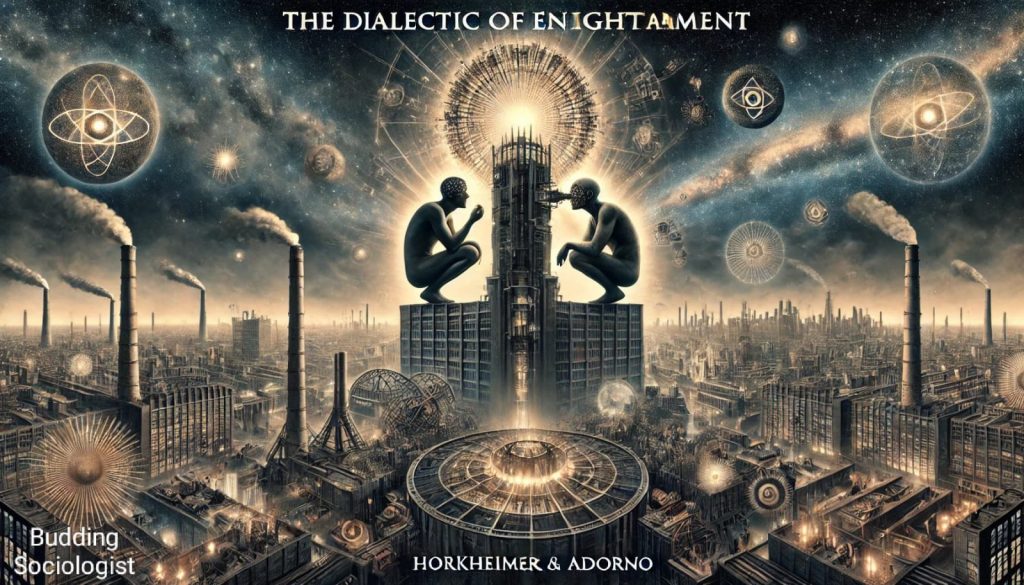
Max Horkheimer and Theodor W. Adorno’s Dialectic of Enlightenment (1944) is a foundational philosophical critique that explores the contradictions and unintended consequences of Enlightenment thought. Originally, the Enlightenment promised human emancipation through reason, science and progress, but Horkheimer and Adorno argue that these ideals have paradoxically resulted in new forms of oppression and control. As key members of the Frankfurt School of Critical Theory, they analyze how the Enlightenment’s focus on reason and rationality has morphed into a system of instrumental reason that prioritizes efficiency over human autonomy, ultimately contributing to societal structures like capitalism, bureaucracy and the culture industry.
The central argument of Dialectic of Enlightenment is that Enlightenment ideals, which sought to liberate humanity from superstition, have instead led to a rationalized society that diminishes individual freedom. Horkheimer and Adorno contend that the move towards universal reason and the rejection of myth and tradition has led to a view of the world where humans are treated as objects to be controlled and manipulated. This shift is evident in the rise of fascism and totalitarian regimes in the 20th century, which the authors see as the byproducts of Enlightenment rationality unmoored from ethical reflection. The mass media and commodified culture, which they term the “culture industry,” further entrench this process, offering entertainment that dulls critical thinking and reinforces the status quo.
Their critique combines Marxist theory, psychoanalysis and critical theory to show how reason, once seen as a tool for liberation, has become a mechanism of domination. They argue that true freedom and enlightenment can only be achieved through a radical societal transformation that redefines the relationship between reason, power and human potential. Dialectic of Enlightenment thus serves as a profound critique of modernity, capitalism and culture, urging a reassessment of how reason has been used to maintain oppressive systems rather than promote human flourishing.
Horkheimer and Adorno’s work delves deep into how Enlightenment ideals were co-opted by capitalist and authoritarian forces, transforming them from tools for human emancipation into instruments of control. They argue that the Enlightenment’s focus on rationality and efficiency has led to “administered” societies, where rationalization dominates all areas of life. They also critique how the Enlightenment, in its rejection of superstition, unintentionally gave rise to a new kind of irrationality, manifesting in the rise of fascism and totalitarianism. According to them, the very reason that was supposed to lead to freedom became a means of rationalizing violence and oppression.
Furthermore, they explore the culture industry, in which cultural products are commodified to maintain social control and prevent genuine critical engagement. Rather than promoting independent thought, the culture industry promotes conformity and passivity. This process, they argue, leads to cultural alienation, where individuals become disconnected from their own capacity for critical thought.
Ultimately, Horkheimer and Adorno call for a rethinking of Enlightenment reason—one that is self-reflective and connected to human freedom. They advocate for a form of reason that resists becoming an instrument of control and instead promote true liberation. In this way, Dialectic of Enlightenment is both a critique of modern society and a call to reclaim the emancipatory potential of reason, which they argue is essential for overcoming the alienation and domination inherent in contemporary culture.
Central Thesis: The Self-Destruction of Enlightenment
Horkheimer and Adorno’s main argument in Dialectic of Enlightenment is that the Enlightenment- once hailed for advocating reason, science and progress- paradoxically holds the potential for its own downfall. The authors contend that while the Enlightenment sought to free humanity from ignorance and superstition, it has ultimately led to a system of control that promote new types of oppression and dehumanization. This phenomenon is referred to as the self-destructive nature of Enlightenment. Following are the key ideas they explored:
1. The Enlightenment’s Original Promise: The Enlightenment was an intellectual movement that began in the 17th and 18th centuries, focused on liberating humanity from ignorance, superstition and rigid doctrines. It emphasized reason, scientific exploration and the belief in progress as key means to empower individuals and transform societies. However, this hopeful outlook overlooked how reason could be harnessed by those in power, potentially turning liberating ideas into tools of control.
2. The Shift Toward Domination: Horkheimer and Adorno contend that the Enlightenment’s focus on reason, gradually transformed into a means of domination. As reason increasingly centered on practicality, efficiency and control, it lost its capacity to critique and emancipate. This shift, which they describe as the “instrumentalization” of reason, resulted in the subjugation of both nature and humanity. Nature came to be viewed as a resource to be exploited and reducing people to mere objects to be managed, governed and subordinated to systems of production and authority. Rather than empowering individuals, rationality became a mechanism for reinforcing inequality, hierarchy and alienation.
3. The Dialectical Process: The authors portray the self-sabotage of the Enlightenment as a dialectical process, where the drive for freedom inadvertently gives rise to fresh forms of oppression. While Enlightenment thinkers aimed to free the world from myths and superstition through reason, they ended up creating new myths, such as unquestioning belief in technological advancement, scientific determinism and economic systems, thereby maintaining control instead of promoting true freedom. This dialectic shows that although the Enlightenment sought to promote liberty, its logic of applying reason universally and mastering nature led to dogmatism and the suppression of diverse viewpoints.
4. Enlightenment as Totalizing: Enlightenment aimed to simplify the world by reducing it to abstract concepts and strict structures, seeking predictability and control. Although this approach led to significant advancements in science and technology, it also marginalized diversity, complexity and personal perspectives. The Enlightenment’s emphasis on reason promoted uniformity, often dismissing alternative or non-rational ways of knowing. This focus on universality over individuality encourages conformity, limits creativity and diminishes the richness of human experience, creating a system where differences are overlooked and critical thinking is replaced by strict adherence to dominant standards.
5. The Role of Power in Enlightenment: Horkheimer and Adorno argue that the path of Enlightenment is inseparable from the workings of power. Initially, reason served as a tool for human freedom, but over time, it became a mechanism of control when harnessed by dominant institutions. In contemporary societies, Enlightenment values such as efficiency, standardization and technological advancement are leveraged to tighten control over individuals. This utilitarian approach to reason detaches it from moral considerations, transforming people into passive subjects in larger systems of governance and production. As a result, rationality shifts from promoting liberation to reinforcing domination and perpetuating social inequalities.
6. Historical Manifestations: The collapse of Enlightenment ideals is evident in key 20th century events and trends. Fascism and totalitarian regimes, such as Nazism, highlight how rational methods (such as propaganda, industrial organization and bureaucratic structures) were harnessed for irrational and destructive purposes, including genocide and repression. In the same way, capitalist economies, driven by the pursuit of efficiency and profit, commodify human interactions, reducing people to mere consumers or workers. The culture industry, through mass media and entertainment, encourages passive conformity and diverts attention from critical social issues. These instances demonstrate that rationality, instead of promoting freedom, has frequently been employed to maintain control and oppression.
7. Enlightenment and Its Self-Reflection: Horkheimer and Adorno contend that the Enlightenment’s failure stems from its lack of introspection. It does not scrutinize its foundational assumptions, limitations or the impact of its logic. Without this critical examination, Enlightenment reason becomes intertwined with structures of control and domination. They advocate for a form of reason that is self-aware, recognizing its connection to power and its ethical duties. This type of reason should embrace complexity, diversity and subjectivity, transcending the restrictive nature of purely instrumental rationality. Only through such self-awareness can the Enlightenment fulfill its initial promise of liberation while avoiding the reinforcement of its inherent contradictions.
On the basis of above description, it can be stated that the Enlightenment, while championing reason, autonomy, and progress, inadvertently laid the groundwork for its own unraveling by cultivating structures of control and commodification. Breaking free from this destructive trajectory requires a renewed, critical engagement with reason- one that moves beyond mere instrumentality and embraces creativity, ethical consciousness, and humanistic values to preserve genuine freedom.
Critique of Instrumental Reason
Instrumental reason is a type of rational thinking that prioritizes finding the most effective means to achieve a specific goal, without considering the moral or social consequences of those objectives. It emphasizes practicality, calculation and control, often at the expense of deeper reflection on values or ethical concerns by focusing on:
- Focus on Means over Ends: In instrumental reasoning, attention is placed on the “how” of achieving a goal, rather than the “why” or “whether” the goal is worth pursuing in the first place.
- Domination as a Fundamental Concept: According to Horkheimer and Adorno, instrumental reason arises from humanity’s historical drive to dominate nature. By reducing nature to something that can be manipulated and controlled, instrumental reason views it primarily as a resource to be exploited and measured.
Horkheimer and Adorno’s critique of instrumental reason plays a pivotal role in their argument in Dialectic of Enlightenment. They perceive instrumental reason as the prevailing way of thinking in contemporary society, one that emphasizes practicality, control and efficiency while sidelining deeper values like ethics, liberty and human flourishing. This critique is part of their larger concern with the self-defeating aspects of Enlightenment rationality. The following are the broader consequences of their theory:
1. The Shift from Enlightenment Reason to Instrumental Reason: The Enlightenment initially sought to emancipate humanity by promoting the use of reason, aiming to free individuals from the constraints of superstition, myth and dogma. However, according to Horkheimer and Adorno, this goal became distorted when reason was transformed into a tool primarily focused on technical and economic efficiency. Instead of encouraging critical thinking and personal autonomy, reason became subordinate to power, serving to reinforce systems of control such as capitalism, bureaucracy and authoritarian regimes. In human relations, this shift led to a dehumanizing effect, where individuals were reduced to mere tools for achieving goals, particularly in a capitalist context where workers were valued more for their productivity than for their inherent dignity.
2. The Ethical Void of Instrumental Reason: Horkheimer and Adorno argue that one of the most concerning aspects of instrumental reason is its lack of ethical consideration. By focusing solely on efficiency and utility, it fails to provide a framework for assessing the morality of its goals. They use fascism, particularly Nazi Germany, as a stark example of the dangers of instrumental reasoning. The Nazis employed highly rational methods such as propaganda, bureaucracy and technological advancements to pursue horrific outcomes, like the Holocaust. This illustrates how the application of instrumental reason without ethical reflection can result in devastating consequences.
3. Consequences of Instrumental Reason: Following are the major consequences of instrumental reason:
3.1 Loss of Autonomy: Instrumental reasoning diminishes individual freedom by promoting conformity to systems that enforce control. This approach transforms people into passive consumers or obedient workers, rather than active contributors in shaping their communities.
3.2 Domination of Nature and Society: The drive for control extends not only to nature but also to human relationships, promoting a world marked by exploitation and inequality. The ecological crisis emerges as a direct result of this mindset, which relentlessly exploits resources without considering the long-term impacts.
3.3 Erosion of Critical Thinking: Instrumental reason discourages the questioning of societal norms, emphasizing practicality over deeper reflection. This mindset cultivates a culture of compliance, where individuals are more likely to accept the status quo rather than challenge its foundational assumptions.
4. Horkheimer and Adorno’s Alternative: Horkheimer and Adorno, though critical of instrumental reason, do not entirely dismiss rationality. Rather, they advocate for a reason that is self-reflective, acknowledging its limitations and ethical consequences. Following are the reason:
- Acknowledge the inherent worth of human beings, nature and cultural diversity.
- Weigh the pursuit of knowledge alongside moral responsibility.
- Oppose reducing life to simple calculations or commodities.
They emphasize the importance of dialectical thinking, which embraces complexity, contradiction and the interconnectedness of means and ends.
In conclusion, the critique of instrumental reason in Dialectic of Enlightenment emphasizes how modern rationality, when solely focused on domination and efficiency, ultimately weakens the principles of freedom and progress it was intended to promote. By revealing the risks associated with this form of reasoning, Horkheimer and Adorno call for a re-evaluation of reason’s role in creating a more equitable and compassionate society.
Myth and Enlightenment as Dialectical
Horkheimer and Adorno’s Dialectic of Enlightenment delves into the complex interaction between myth and enlightenment, arguing that they are not opposing forces but are instead connected through a dialectical relationship. Although the Enlightenment aims to free humanity from myth by substituting superstition with rational thought, it ironically gives rise to new forms of myth. The conflict between myth and enlightenment highlights their interdependence and common characteristics, ultimately revealing the inherent contradictions within modernity. Following are the thematic segments related to dialectical connection:
1. Myth as the Precursor to Enlightenment: The authors begin by positioning myth as the foundation of humanity’s efforts to understand the world. They suggest that myth is not simply irrational or primitive, but rather represents the earliest attempt to explain natural events and create order from chaos. Through stories involving gods, spirits and supernatural forces, myth allowed early humans to interpret their surroundings and address their fears. Horkheimer and Adorno propose that this process of interpreting and categorizing reality is a primitive form of rationality. In this sense, myth is not devoid of reason but instead contains the beginnings of the rational thought that would later be fully developed during the Enlightenment.
2. Enlightenment as the Antithesis of Myth: The Enlightenment arose as a reaction to the perceived randomness and superstitions associated with myths. It aimed to replace mythical explanations with logical, scientific and empirical insights. Through the application of reason, people gained the ability to understand nature in a more systematic way, freeing themselves from the limitations of mythological thought. The period emphasized ideals such as objectivity, progress and control over the natural world. This shift sought to free humanity from ignorance and fear by offering rational explanations of the world.
3. The Return of Myth in Enlightenment: Horkheimer and Adorno suggest that the Enlightenment’s emphasis on reason and scientific objectivity often becomes rigid, turning these principles into modern myths. For instance, the idolization of science and technology as ultimate solutions to human challenges forms a new kind of myth. This process of mythologization is particularly evident when rational frameworks prioritize efficiency and control over ethical concerns, reducing people to mere numbers or tools within bureaucratic systems. They point out this contradiction to demonstrate how the Enlightenment’s pursuit of freedom can unintentionally give rise to new forms of domination and superstition.
4. The Mutual Interdependence of Myth and Enlightenment: Horkheimer and Adorno argue that myth and enlightenment are not entirely separate; instead, they are complexly connected. While enlightenment critiques myth, it actually has its roots in it. The human urge to understand and dominate the unknown, as seen in myths, forms the foundation for rational thinking. Enlightenment evolves from this foundation, refining and organizing the methods of explanation and control. However, as enlightenment matures, it can regress into myth when it becomes inflexible and uncritical. This interplay highlights a cyclical relationship: myth leads to enlightenment and when enlightenment becomes absolute, it gives rise to new myths.
5. The Paradox of Enlightenment: The relationship between myth and enlightenment reaches its peak in what Horkheimer and Adorno refer to as the paradox of enlightenment. The Enlightenment seeks to liberate humanity from fear and control, yet it frequently results in new forms of oppression. This paradox is seen in the progress of industrial and technological advancements, which, while offering some liberation, also contribute to exploitation and alienation. For instance, 20th century totalitarian governments utilized rational, bureaucratic structures to carry out atrocities like genocide. This paradox highlights the risks of blindly trusting reason and emphasizes the need for a more reflective approach to progress.
6. Implications of the Dialectic: The relationship between myth and enlightenment holds significant implications for our understanding of modernity and rationality. Horkheimer and Adorno contend that the Enlightenment must acknowledge and address its own internal contradictions, adopting a stance of self-reflection. They argue that reason should not merely serve as a tool for control, but should instead be directed toward promoting freedom, justice and ethical considerations. They also advocate for a broader view of progress, one that goes beyond technological growth to encompass the well-being of individuals and the environment.
In summary, Horkheimer and Adorno’s examination of the relationship between myth and enlightenment underscores the complex nature of modern rationality. By illustrating how enlightenment both challenges and reinforces myth, they point out the constraints of unchecked reason and advocate for a more thoughtful and ethical approach to knowledge and progress. Their insights continue to be crucial for addressing modern issues, including the rise of technology, the commercialization of culture and the ongoing presence of authoritarianism.
Idea of Culture Industry
The idea of the culture industry, addresses the commercialization, homogenization and mass production of cultural goods in advanced capitalist societies. The term reflects their criticism of how cultural products (formerly a space for creativity, personal expression and critical engagement) have now become commodities meant to control and dull the consciousness of the public. Following are the central elements of their critique of the culture industry:
1. The Culture Industry as a System of Domination: Horkheimer and Adorno argue that the culture industry plays a central role in maintaining social control in modern societies. Rather than being a platform for critical thought or artistic freedom, it functions to manipulate and subdue the population. Cultural products are not created to promote individuality or intellectual growth. Instead, they are crafted to preserve the existing power structures by influencing consumers’ desires, values and beliefs. By inundating the public with entertainment and diversions, the culture industry shifts focus away from vital social, political and economic issues, ensuring that people remain passive and uncritical. In this way, prevailing beliefs and social norms are reinforced and the potential for radical or revolutionary change is limited.
2. Standardization and Pseudo-Individuality: Horkheimer and Adorno argue that one key aspect of the culture industry is the uniformity of cultural products. In an era dominated by mass production, cultural items are designed using predictable templates that maximize their appeal and profitability. This results in a repetitive use of familiar themes, structures and tropes in various forms of entertainment, such as films and music. This predictability in cultural output hinders true creativity and originality. Nonetheless, the culture industry creates the illusion of choice by presenting consumers with the idea that they are selecting individual products but all options are the part of same mass-produced system. This “pseudo-individuality” conceals the underlying conformity within the culture industry.
3. The Profit Motive and Commodification of Culture: The culture industry functions within the framework of capitalism, treating cultural products as items to be bought and sold for financial gain. Horkheimer and Adorno argue that what was once a domain for creative expression and intellectual inquiry has been reshaped into a profit-driven business. Cultural products are no longer created for personal growth or societal critique but are instead designed with the sole purpose of generating revenue. This shift towards commodification results in cultural goods that prioritize commercial viability over artistic quality, meaningful content or social relevance.
4. The Passive Consumer: A key outcome of the culture industry’s dominance is the promotion of passive consumption. Horkheimer and Adorno suggest that instead of critically engaging with cultural products, audiences are encouraged to passively consume them. This passivity is reinforced by the standardized design of cultural goods, which are crafted for easy consumption and emotional manipulation. Rather than provoking thoughtful reflection or encouraging people to question the world around them, the culture industry offers entertainment that provides emotional fulfillment without intellectual or moral depth.
5. True Art vs. Culture Industry: Horkheimer and Adorno differentiate between genuine art and the creations of the culture industry. They contend that authentic art has the ability to stimulate reflection, question societal norms and present fresh perspectives on the world. True art is independent, critical and not influenced by commercial concerns or the need for mass appeal. It provides deep insights into human experiences. On the other hand, products of the culture industry are reduced to simple entertainment commodities, lacking the depth needed to address significant human issues or societal challenges.
6. The Political Implications of the Culture Industry: The culture industry holds a key political function by reinforcing and legitimizing existing power structures in society. According to Horkheimer and Adorno, cultural products are designed to uphold the values and ideologies of the dominant class, helping to sustain political and social control. Instead of encouraging critical thought or challenging authority, the culture industry promotes acceptance of the status quo, promoting conformity and passivity. Through mass media, advertising and entertainment, it encourages consumerism, individualism and materialism.
Horkheimer and Adorno’s concept of the culture industry highlights how capitalism turns culture into a commodity, transforming art into entertainment that reinforces social and political conformity. This passive consumption distracts people from important social and political issues. Despite criticism, their ideas provide a useful framework for analyzing the impact of culture commodification, especially in today’s digital and global capitalist world.
Fascism and Enlightenment
Max Horkheimer and Theodor W. Adorno, in their critique of the Enlightenment, suggest that while the movements promised liberation, it ultimately set the stage for the emergence of fascism in the 20th century. They examine how the rationality and progress championed by the Enlightenment were appropriated to support authoritarian and totalitarian regimes:
1. The Paradox of Enlightenment Reason: Thinkers like Immanuel Kant and René Descartes believed that by using reason, humans could overcome ignorance, superstition and oppression, ultimately leading to political and social liberation. However, Horkheimer and Adorno argue that the Enlightenment’s concept of reason contains a contradiction: as reason is increasingly applied to dominate nature and society, it becomes a tool for control. This paradox lies at the heart of their critique—the very rationality meant to liberate individuals from tyranny and superstition ended up facilitating their subjugation, particularly within the context of modern capitalism and the emergence of fascist ideologies.
2. The Link Between Enlightenment Rationality and Authoritarianism: Horkheimer and Adorno argue that the same rationality that initially helped free humanity from oppressive monarchies and religious control later became a tool for domination. They claim that when rationality is reduced to instrumental reason it becomes disconnected from essential human values like freedom, equality and justice and can be further divided into following two parts:
2.1 Instrumental Reason: The Enlightenment promoted reason as a means to dominate nature and society, which led to the rationalization of control. In contemporary societies, systems like bureaucracy, capitalism, and technology operate on instrumental reason.
2.2 Fascism: Fascism, according to Horkheimer and Adorno, is the extreme application of instrumental reason. Totalitarian regimes such as Nazi Germany used rational tools (like propaganda, mass organization, technological control and bureaucratic management) to achieve irrational and destructive goals, including war, genocide and authoritarianism. For them, fascism is not an aberration of modernity but a natural result of the Enlightenment’s rationalization of power.
3. The Rise of Totalitarianism as a Result of Enlightenment’s Logic: Horkheimer and Adorno argue that totalitarian regimes such as fascism and Stalinism used the very tools of modernity (rationality, bureaucracy and technological progress) to gain control over populations and enforce oppression. These tools, initially designed to improve human welfare, were repurposed by these regimes to serve authoritarian political objectives. Mass production and scientific management, for example, were intended to enhance living conditions but were instead employed to advance political control.
4. The Commodification of Human Beings: Horkheimer and Adorno expand their critique of instrumental reason by exploring how capitalism reduces human beings to commodities. The focus on rationalization, efficiency and productivity under capitalism turns individuals into mere parts of a larger economic system. Rather than being regarded as independent individuals, people are treated as objects to be measured, classified and exploited for financial gain.
5. The Role of Mass Culture in Fascism: Fascist regimes exploited the culture industry to spread propaganda, divert attention from critical thinking and promote values like nationalism, obedience and militarism. The culture industry, by turning culture into a commodity, reflects the principles of fascism. It standardizes cultural expression, stifles individual critical thought and transforms people into passive consumers rather than active, independent citizens.
6. The Dialectical Relationship Between Enlightenment and Fascism: Horkheimer and Adorno argue that Enlightenment thought and fascism are connected through a dialectical relationship, rather than existing in simple opposition. While the Enlightenment aimed to free humanity from oppressive forces, its emphasis on reason and control inadvertently created conditions for new forms of domination.
Horkheimer and Adorno’s critique of fascism and the Enlightenment remains highly relevant today, particularly in the context of current political shifts. They emphasize a crucial point: without critical reflection, modern rationality can be used as a means of control rather than freedom. The reasoned processes behind technological advancements, economic growth and political systems must be carefully scrutinized to prevent them from being exploited by authoritarian regimes, whether these take the shape of fascism, neoliberalism or other forms of totalitarianism.
Critical Evaluation of Dialectic of Enlightenment
The Dialectic of Enlightenment, penned by Theodor Adorno and Max Horkheimer, is a seminal text in critical theory that provides a profound critique of Enlightenment principles, arguing that its rational ideals, which aimed to liberate humanity, paradoxically led to new forms of domination and control. Despite its significant influence, the work has sparked both admiration and criticism. The following evaluation highlights the book’s contributions, as well as its limitations:
1. Strengths of the Dialectic of Enlightenment: Following are the strengths of the dialectic of enlightenment theory:
1.1 Insight into the Culture Industry and Mass Media: One of the most impactful elements of Dialectic of Enlightenment is its analysis of the “culture industry,” a concept that examines how mass media and popular culture are utilized to manipulate public consciousness. Adorno and Horkheimer critique the standardization of cultural products and the passive consumption promoted by capitalist societies. Their observation that the mass production of culture serves to reinforce social conformity rather than foster critical engagement is particularly relevant in the context of today’s digital media, where similar patterns of cultural commodification can be seen across platforms and entertainment industries.
1.2 Critical Reflection on Instrumental Reason: Another key strength of the text is its critique of instrumental reason. The authors highlight the dangers of rationality when it is solely focused on achieving practical goals without considering its broader social and ethical consequences. In an age where technology and bureaucracy dominate, the book’s warning about the potential dehumanizing effects of instrumental reason resonates strongly, particularly in relation to the unchecked power of technology and its role in exacerbating social inequalities and reinforcing authoritarian structures.
1.3 Interdisciplinary Approach and Philosophical Depth: Dialectic of Enlightenment stands out for its interdisciplinary approach, drawing from various intellectual traditions such as philosophy, sociology, psychoanalysis, and history. By integrating ideas from figures like Marx, Freud, Nietzsche, and Hegel, the work provides a nuanced critique of modernity and the contradictions within Enlightenment thought. This makes it an essential text for scholars from diverse fields, allowing it to maintain its relevance across academic disciplines.
2. Criticisms of the Dialectic of Enlightenment: After the description of strengths of theory, following are some points which can be considered for the criticism of the dialectic of enlightenment:
2.1 Pessimism and Determinism: A significant critique of the book is its pessimistic tone. Adorno and Horkheimer argue that Enlightenment thought inevitably leads to new forms of oppression, such as fascism and the culture industry, which many readers find excessively deterministic. By suggesting that rational thought inevitably leads to domination, the authors appear to dismiss the possibility of a more emancipatory use of reason. This outlook has been criticized for leaving little room for hope or practical strategies for positive change, which diminishes the text’s utility for those seeking a vision of social progress.
2.2 Intellectual Elitism and Critique of Mass Culture: Another criticism is the authors’ intellectual elitism, particularly evident in their dismissive attitude toward popular culture. While their critique of the culture industry remains valuable, their view of mass entertainment as inherently passive and devoid of intellectual or critical potential is often considered condescending. Adorno and Horkheimer’s perspective on the masses seems to position them as incapable of meaningful engagement with culture, overlooking the ways in which people may actively reshape and reinterpret cultural forms.
2.3 Lack of Practical Solutions: Despite its comprehensive critique of modern society, Dialectic of Enlightenment is criticized for its failure to offer concrete solutions or pathways for social change. The text is focused on diagnosing the contradictions within Enlightenment thought but provides little guidance on how to move beyond them. Critics argue that this lack of practical suggestions renders the book less useful for activists and those seeking tangible ways to address the issues it raises.
2.4 Idealism versus Materialism: Some have pointed out a tension in the book’s approach, particularly in how it focuses on abstract concepts like “reason” and “myth,” while not fully engaging with the material conditions that sustain these phenomena. While the authors critique the culture industry and the instrumentalization of reason, they do not provide a thorough examination of the capitalist economic structures and social dynamics that underpin these systems. This theoretical abstraction has been seen as limiting, as it does not sufficiently ground the analysis in material realities.
On the basis of above description, it can be stated that Dialectic of Enlightenment remains one of the most critical works in understanding the paradoxes of modernity. Its analysis of the culture industry, critique of instrumental reason, and exploration of the relationship between Enlightenment ideals and totalitarianism continue to provide valuable insights into the complexities of contemporary society. However, the book’s pessimistic view, intellectual elitism, lack of practical solutions, and abstract treatment of material conditions have prompted criticism. Despite these shortcomings, Adorno and Horkheimer’s work has left a lasting legacy in critical theory, offering a powerful framework for understanding the contradictions of modern civilization and the potential dangers of rationality divorced from ethical reflection.
References:
Dialectic of Enlightement: Philosophical Fragments, Edited by Gunzelin S. Noeri, https://amzn.in/d/2JT3Cdo
HORKHEIMER AND ADORNO: DIALECTIC OF ENLIGHTENMENT, by Alfredo Lucero-Montaño, https://philarchive.org/archive/LUCHAA
Negative Dialectics, By Theodor W. Adorno, https://amzn.in/d/3Y8GP9c