- Introduction
- Causes of Dowry
- Impacts of Dowry
- Measures for Eradication of Dowry
Introduction
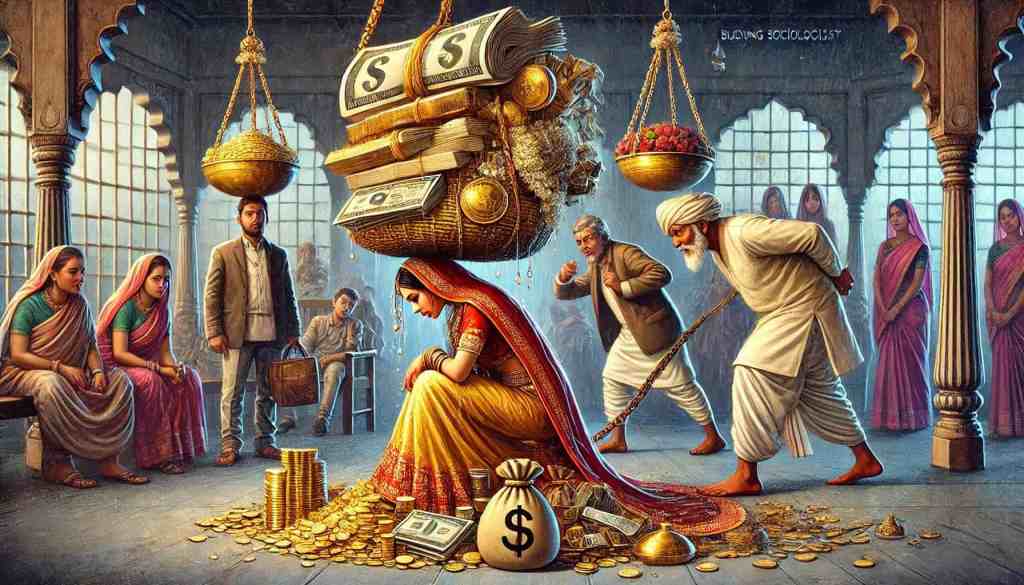
A dowry refers to the transfer of wealth, which could be property or money, from the bride’s family to the groom or his family during marriage. Dowry is generally demanded by the groom’s family. When wealth, property or gifts are willingly given by bride’s family to the bride, then it is called Stridhan. The custom of dowry contrasts with bride price, where the groom or his family pays the bride or her family and with dower, which is property allocated to the bride herself by the groom, remaining under her ownership and control. Dowries are prevalent in patrilineal cultures that typically involve patrilocality, where women are expected to reside with or near their husband’s family.
In other words, dowry is a cultural custom where parental assets, wealth or gifts are transferred to a daughter at her marriage rather than at inheritance. The dowry traditionally serves multiple purposes, including safeguarding the wife from potential mis-treatment by her husband and his family. It acts as a conditional gift, intended to be returned to the wife or her family if the husband mistreats her, divorces her or commits serious offenses against her. Typically consisting of land or valuable metals, this form of dowry is often non-transferable by the husband, though he may utilize and benefit from it during the marriage.
Additionally, in some cultures, the dowry helps the new husband fulfill his marital responsibilities, which is particularly crucial in societies where marriages involve very young individuals. It allows the newlywed couple to establish their household, which they might not otherwise be able to afford. Furthermore, in certain societies, the dowry serves as a financial safety-net for the wife in the event of her husband’s death, functioning as a substitute for her inheritance rights in his estate.
In numerous cultures, dowries traditionally function as a gesture of reciprocity from the bride’s family to the groom’s family, compensating for the expenses associated with the payment of bride wealth. Beyond economic transactions, these exchanges also play a crucial role in formalizing the marriage and strengthening bonds of friendship between the families involved.
In some regions globally, dowry has transformed into a coercive practice, compelling the bride’s family to provide substantial financial or material gifts to the groom’s family. This phenomenon is notably prevalent in countries like India, Pakistan, Bangladesh, and Nepal, where dowry demands can escalate to extreme levels, causing severe economic hardship. Families may incur significant debts or face financial ruin trying to meet these demands. Tragically, when dowry expectations are not met, it can result in violence against women, including harassment, domestic abuse and in the worst cases, dowry-related deaths where brides are either murdered or driven to suicide due to the immense pressure from their in-laws.
The persistence of dowry practices often stems from entrenched patriarchal norms and gender inequality. In many cultures, a woman’s value and the perceived success of her marriage unfairly hinge on the dowry she brings. This not only turns women into commodities but also sustains a cycle of prejudice and oppression. Despite legal efforts, such as India’s Dowry Prohibition Act of 1961, which out-laws dowry demands and acceptance, enforcement remains lax, allowing the practice to continue, sometimes disguised as voluntary gifts.
Causes of Dowry
The causes of dowry are complex, influenced by a combination of cultural traditions, economic conditions and social dynamics. Following are some of the causes of dowry:
1. Historical and Cultural Traditions: Dowry originally facilitated the transfer of wealth within familial and social circles. Its roles included ensuring financial backing for couples and securing the bride’s economic stability in her new home. Gradually, ingrained in cultural traditions, dowry evolved into a symbol of social standing and family prestige. It is ritualistically viewed as a sacred contribution that sanctifies marriage, traditionally believed to usher in prosperity and blessings for the newly married. Despite shifts in societal and economic dynamics, these cultural perceptions have endured, perpetuating the tradition across successive generations.
2. Gender Inequality: Gender inequality plays a crucial role in sustaining the dowry system, particularly in patriarchal societies where men are traditionally seen as the main bread earners while women are expected to manage household duties. This societal framework reinforces the idea of women’s economic dependence, leading to the expectation that dowry is necessary to compensate for their perceived lack of financial contribution. Moreover, in many cultures, a strong preference for male children makes this issue worse. Sons are often regarded as valuable assets who will carry on the family name and provide support in old age, whereas daughters are seen as liabilities who will eventually leave the family. This skewed perspective contributes to the practice of dowry, as it is believed to ensure a desirable marriage for daughters and maintain the family’s social status.
3. Economic Factors: The economic aspects of dowry are complex and multifaceted. For some, dowry serves as a means of ensuring financial stability for the bride, providing her with economic resources that can support her in her new marital environment. This aspect is particularly crucial in societies where women lack access to inheritance or property rights. However, the custom places a heavy financial burden on the bride’s family, often resulting in significant economic hardships or debt. This financial pressure is compounded by increasing societal expectations for extravagant dowries in an age of growing consumerism and higher standards of living. Families may feel compelled to offer substantial dowries to showcase their social standing, perpetuating a cycle of escalating demands and financial stress.
4. Social Status and Prestige: In numerous cultures, dowry is closely linked to social standing and respectability. It functions as a visible demonstration of wealth and familial position, with families employing it to strengthen their image in the community. A significant dowry can raise the social status of the bride’s family, highlighting their financial capability and social networks. This aspect frequently shapes matrimonial unions, where a generous dowry can ensure a more favourable match for the bride, thereby enhancing both her and her family’s social standing. The aspiration to uphold or enhance social prestige through dowry often sustains the tradition, even among families facing financial limitations.
5. Legal and Institutional Factors: Legal and institutional frameworks are pivotal in perpetuating the custom of dowry. Despite its prohibition in many countries, inadequate enforcement often allows the practice to persist disguised as ‘gifts’ or ‘customary practices.’ Limited legal enforcement and insufficient awareness of legal safeguards among the public contribute to the ongoing prevalence of dowry demands. Concerns over social stigma and retaliation discourage families from reporting dowry-related abuses, undermining the efficacy of legal interventions.
6. Educational and Employment Disparities: Educational and job inequalities play a crucial role in perpetuating the dowry system. In societies where women have restricted access to education and fewer job prospects, their economic independence is limited. This situation often leads families to resort to offering dowries to offset the perceived economic burden of the bride. Additionally, disparities in employment opportunities and income between genders further reduce women’s financial resources and bargaining power, making dowry a necessary tool for securing desirable marriages. Consequently, women’s economic dependency continues to reinforce the practice of dowry, influencing their marriage prospects and social status.
7. Peer and Social Pressure: Social and peer pressure play crucial roles in perpetuating the dowry system. In many societies, adhering to dowry customs is viewed as a standard practice, placing considerable expectations on families irrespective of their financial circumstances or personal convictions. Families often feel compelled to meet dowry demands to avoid social stigma and ensure their daughter’s well-being in her new marital environment. This pressure emerges from extended family members, friends and the wider community, creating a formidable barrier for individuals who wish to oppose the tradition without risking social isolation. The fear of societal rejection or being perceived as not upholding cultural norms drives many families to continue the tradition of giving dowry.
8. Family Dynamics and Expectations: Family dynamics and expectations are instrumental in upholding the practice of dowry. Parents often feel compelled to offer a dowry to ensure their daughter’s future security and acceptance into her new family. Moreover, the groom’s family frequently has clear expectations regarding dowry, which adds further strain on the bride’s family to meet these demands. Consequently, dowry transforms into a bargaining tool, used to negotiate improved treatment and status for the bride within her new household. This cycle of familial obligations and expectations perpetuates the dowry system, posing challenges for those seeking to challenge these entrenched traditions.
9. Psychological Factors: Psychological factors such as feelings of insecurity and competition play a significant role in perpetuating the dowry system. Families often worry about their daughter’s marriage prospects and believe that a larger dowry can improve her chances of finding a suitable match. This fear is intensified by the competitive nature among families, leading to a cycle where dowries increase in size. Furthermore, in some instances, dowry is used as a means for the groom’s family to exert dominance over the bride, ensuring her compliance in the marriage. These psychological pressures, coupled with the aspiration to secure the best future for their daughters, drive families to uphold the tradition of dowry.
10. Moral and Ethical Justifications: The rationale behind dowry often stems from a perceived duty to ensure the happiness and stability of daughters in their marriages. Families may consider dowry a moral imperative, believing it ensures a promising future for their daughters. This viewpoint sometimes results in ethical dilemmas, where the potential harms of dowry, such as financial burdens and the risk of exploitation, are disregarded in favour of fulfilling what is seen as a fundamental parental obligation. The conviction that dowry is necessary for a daughter’s welfare and social integration in her marital household sustains the practice, despite its negative consequences.
A thorough comprehension of these factors is crucial for developing successful strategies aimed at combating and eradicating the dowry system. Tackling this problem necessitates a comprehensive approach involving legal reforms, educational initiatives, economic empowerment and cultural shifts to transform long-standing societal norms concerning gender roles and marriage.
Impacts of Dowry
Though historically and culturally significant in many societies, contemporary interpretations of dowry often reveal complex and troubling implications, impacting society economically, socially and psychologically. Following are the impacts of dowry:
1. Gender Inequality and Discrimination: The custom of dowry contributes to ongoing gender inequality by framing women as financial burdens necessitating compensation to mitigate the perceived “burden” they impose. This diminishes women’s intrinsic value and reinforces a cultural preference for male offspring, who are viewed as economic assets eligible to receive dowries. Consequently, the arrival of a girl is often met with apprehension and disappointment, reinforcing societal norms that perpetuate gender bias and inequity.
2. Marriage Transactions: Dowry fundamentally alters the essence of marriage, turning it into a transaction where a woman’s value is judged by the dowry she provides. This transforms the marital union from one founded on mutual respect, love and partnership into a financial transaction, reducing the bride’s worth to monetary terms. Consequently, the sacred and dignified nature of marriage is compromised, overshadowed by financial negotiations.
3. Violence Against Women: The dowry system increases violence against women significantly. When dowry demands aren’t met, it frequently leads to serious consequences such as harassment, physical abuse and tragically, in some cases, dowry-related deaths, which are alarmingly prevalent in certain areas. This violence not only highlights greed and brutality but also underscores entrenched societal norms that tolerate and sustain the mistreatment of women in disputes over dowry, perpetuating a cycle of mistreatment and subjugation.
4. Social Stigma and Isolation: Families who cannot fulfil dowry requests often experience social exclusion and stigma, impacting their position in society and community ties. This exclusion can marginalize them, excluding them from social gatherings and community life, intensifying their feelings of isolation. The societal pressure to adhere to dowry norms reinforces a cycle where challenging the practice becomes difficult due to fear of consequences, perpetuating its continuation.
5. Financial Strain on Families: The pressure to provide a significant dowry places a significant financial strain on the bride’s family. To meet these demands, many families resort to taking on substantial debts or selling valuable assets, risking long-term financial instability. This burden is particularly challenging for lower-income families already grappling with meeting essential expenses. For them, the additional expense of a dowry can deepen their financial difficulties, perpetuating a cycle of debt and economic hardship.
6. Impact on Women’s Financial Independence: The dowry tradition acts as a barrier to invest in girls’ education and career growth, as families often perceive them more as financial burdens than valuable assets. This neglect of educational and professional opportunities for girls keeps them economically reliant and hinders their path to financial self-sufficiency. As a result, women frequently find themselves restricted to roles that reinforce their subordinate status, lacking the means to challenge or break free from oppressive situations.
7. Economic Disparities and Social Inequity: Dowry customs widen economic gaps by enabling wealthier families to meet or surpass dowry demands, thus solidifying their social and economic standing. Conversely, poorer families face challenges in meeting these expectations, deepening economic inequalities. This situation not only sustains social hierarchy but also hampers initiatives aimed at enhancing social mobility and fairness, given that the dowry tradition inherently favours those with more financial means.
8. Emotional and Psychological Trauma: Women who endure abuse linked to dowry demands frequently suffer intense emotional and psychological distress. Persistent harassment and violence can result in serious mental health conditions like depression, anxiety and a feeling of powerlessness. These traumatic experiences leave deep psychological wounds that may endure over time, hindering women from living satisfying lives and perpetuating a cycle of trauma that spans generations.
9. Impact on Family Relationships: The dowry system often causes considerable tension and stress within families. Parents may experience intense pressure and guilt if they cannot meet dowry expectations, which can result in feelings of inadequacy and anxiety. Meanwhile, daughters may perceive themselves as undervalued and unappreciated, reduced to mere dowry assets. These dynamics can severely strain familial bonds, promoting resentment and discord that erode the foundation of family cohesion and solidarity.
10. Skewed Gender Ratio: The cultural emphasis on having male offspring, influenced by dowry traditions, has contributed to an unbalanced gender ratio in numerous communities. This inclination is evident in behaviours like selective abortion based on sex and the marginalization of girls, leading to a notable gender disparity. These discrepancies have profound societal implications, including heightened instances of human trafficking, coerced marriages and elevated levels of gender-related violence. Such demographic disparities create a scarcity of women, intensifying their vulnerability and exploitation within society.
11. Intergenerational Impact: The dowry system creates a continuous cycle of gender bias and economic pressure that affects numerous generations. When children are raised in environments where dowry plays a pivotal role, they often absorb these customs, thus perpetuating the cycle of bias and financial stress. This passing down of dowry-related values and traditions across generations ensures that its harmful effects persist into the future, posing challenges in breaking free from this cycle of inequality and financial difficulty.
12. Legal Challenges: Even though many nations have enacted laws against dowry practices, enforcing these laws is still a major hurdle. Dowry exchanges typically happen in secrecy and the cultural pressure to adhere to dowry customs discourages individuals from reporting such violations. The secret nature of these transactions, coupled with the societal norm of dowry, poses significant challenges to legal efforts aimed at eliminating the practice. This underscores the necessity for stronger legal structures and more effective enforcement mechanisms.
13. Need for Comprehensive Policies: Tackling the problem of dowry necessitates a broad and nuanced strategy that extends beyond mere legal restrictions. Effective solutions should encompass a range of educational and economic initiatives designed to empower women and promote gender equality. This involves efforts to increase awareness about the detrimental effects of dowry, provide support for those affected by dowry-related violence and implement programs that improve women’s access to education and economic resources. These actions are vital for transforming the societal norms that perpetuate the dowry system.
14. Education and Awareness: Educational initiatives play a crucial role in transforming societal perceptions regarding dowry. They raise awareness about the harmful impact dowry has on both individuals and society as a whole. By doing so, these programs can help promote a cultural shift that views marriage as a partnership of equals, rather than a financial arrangement. Furthermore, they equip both women and men with the knowledge and confidence to reject dowry demands and champion fairer practices, paving the way towards a future where dowry is no longer seen as a societal norm.
15. Economic Empowerment of Women: Enhancing women’s economic independence is essential in addressing the dowry system. Programs that offer vocational training, entrepreneurial support and financial services to women can facilitate their journey toward economic self-reliance. By empowering women economically, they are better positioned to oppose oppressive norms, negotiate for improved conditions and assert their rights both within their families and in society at large. This reduces the reliance on dowries as a form of financial security.
16. Community and NGO Initiatives: Local grassroots organizations and non-governmental organizations (NGOs) are crucial in promoting dowry-free marriages and assisting victims of dowry-related abuse. Community-led initiatives are especially impactful, as they utilize local understanding and social connections to promote environments that oppose dowry traditions. NGOs offer essential services, including legal aid, counselling and financial support to individuals impacted by dowry issues. These efforts are instrumental in forming a collective movement aimed at confronting and eventually eliminating dowry practices.
On the basis of above description, it can be stated that the practice of dowry is deeply rooted in many cultural traditions, has significant and multifaceted consequences for both individuals and communities. Tackling the dowry issue necessitates a comprehensive strategy that includes legal reforms, economic empowerment, educational efforts and broader societal transformation. By questioning and altering the social norms that uphold the dowry system, we can strive towards creating a fairer and more just society where people are appreciated for their intrinsic value, rather than for their ability to engage in financial exchanges.
Measures for Eradication
Eradicating dowry, a longstanding social issue deeply rooted in cultural norms and traditions, requires a multifaceted approach involving legal, educational, economic and societal interventions. Following are the measures that can be taken to eradicate dowry:
1. Stringent Laws: To address the widespread issue of dowry, it is crucial to rigorously enforce and strengthen current anti-dowry legislation. These laws should incorporate strict penalties and ensure prompt handling of dowry harassment and dowry death cases. By establishing clear and severe legal implications, it is possible to discourage potential offenders and provide victims with a more effective path to justice.
2. Legal Awareness: Raising public awareness regarding legal rights and the implications of giving or receiving dowry is essential. It is important to conduct workshops, seminars and campaigns aimed at educating both men and women about their legal entitlements. Equipping women with information about their legal options concerning dowry issues can empower them to speak out against harassment and seek justice confidently.
3. Fast-Track Courts: Creating specialized fast-track courts dedicated to handling dowry-related cases can accelerate the dispensation of justice. These courts need to prioritize these specific cases to ensure prompt resolutions, thereby alleviating the lengthy legal proceedings that frequently deter victims from pursuing justice.
4. School Curriculum: Including educational modules in school curricula that highlight gender equality, women’s rights and the negative impacts of dowry is essential. By encouraging critical thinking among students early on about gender norms and stereotypes, we can lay the groundwork for societal transformation and instil values that discourage dowry customs in the future.
5. Community Awareness Programs: It is crucial to involve communities in awareness programs aimed at shifting social attitudes regarding dowry. These initiatives should emphasize the legal ramifications and negative impact of dowry, utilizing local leaders, NGOs and influencers to effectively communicate this message. By rallying community support, these efforts can encourage a unified stance against dowry as a societal practice.
6. Skill Development: Promoting economic empowerment among women via skill development and vocational training is essential. By improving their capacity to earn and participate in household finances, these initiatives lessen women’s financial reliance and diminish the need for dowry as a form of economic security. This economic empowerment significantly contributes to dismantling the economic foundation of dowry demands.
7. Employment Opportunities: Policies that advocate for equal employment opportunities for women play a crucial role in diminishing the reliance on dowry as a financial safeguard. By enabling women to attain financial autonomy, societies can move away from the longstanding tradition of dowry, encouraging marriages founded on mutual respect rather than economic transactions.
8. Financial Incentives: Governments have the opportunity to promote dowry-free marriages by offering financial subsidies or tax advantages. By providing incentives to families and couples who choose not to participate in dowry practices, policymakers can promote a cultural change towards more equal marital customs. These measures can play a crucial role in normalizing and promoting the idea that dowry-free marriages are both socially commendable and economically beneficial.
9. Media Campaigns: Using mass media channels like TV, radio and social media is essential for initiating widespread campaigns against dowry. These campaigns need to focus on educating people about the harmful effects of dowry, highlighting instances of successful marriages without dowry and questioning entrenched societal beliefs that support this practice. Through effective media strategies, these efforts can shape public opinion and encourage a shift in cultural norms.
10. Community Support Groups: Creating support networks for individuals affected by dowry harassment and their families is crucial, as these groups provide much-needed emotional and practical assistance. They offer resources such as legal advice, counselling and a supportive environment where victims can openly discuss their challenges. By empowering victims to advocate for their rights and pursue justice, these community-based initiatives play a pivotal role in addressing dowry-related injustices and promoting strength and solidarity among those impacted.
11. Role of Religious Leaders: Encouraging religious leaders to address the issue of dowry during religious gatherings and ceremonies is essential. By highlighting the principles of love, respect and equality in marriages, these leaders have the power to shape cultural norms and encourage communities to adopt dowry-free practices. Their support holds considerable moral influence and can play a pivotal role in transforming societal perspectives towards fairer marital traditions.
12. Cultural Redefinition: Advocating for cultural narratives that emphasize marriages founded on mutual respect and partnership instead of financial transactions is crucial. By redefining cultural norms, societies can confront and reshape traditional views that uphold dowry as a norm. Promoting alternative cultural paradigms that prioritize emotional connection and shared beliefs helps create an environment where dowry practices can be effectively eliminated.
13. Celebrity Endorsement: Using celebrities and prominent figures to openly oppose dowry and promote marriages without dowry could bring about substantial change. Celebrities have the ability to reach large audiences and influence public opinion. By highlighting their own dowry-free marriages as models, celebrities can motivate others to adopt fairer marital customs and help change societal attitudes.
14. Data Collection: Systematic gathering and examination of data concerning dowry-related incidents are crucial for grasping patterns and evaluating the impact of actions taken. Through compiling thorough data, policymakers can make well-informed choices and customize approaches to tackle the distinct challenges associated with combating dowry practices.
15. Impact Assessment: Regularly assessing the outcomes of implemented anti-dowry measures enables adaptation and enhancement. These evaluations are crucial for determining the effectiveness of campaigns, legal changes and economic initiatives aimed at decreasing dowry-related customs. By identifying effective tactics and addressing areas for enhancement, these assessments support focused and enduring endeavours to eliminate the dowry system.
To effectively eliminate dowry, it is crucial to adopt a multifaceted strategy encompassing legal reforms, educational initiatives, economic empowerment, social awareness programs and cultural transformation. By integrating these efforts across various sectors, societies can promote an atmosphere where marriages thrive on mutual respect, equality and common principles, rather than material exchanges and detrimental customs. This comprehensive approach is vital in bringing about enduring cultural shifts and securing a future where dowry is no longer a prevailing issue.