- Introduction
- Meaning of Economic Sociology
- Evolution and Historical Development
- Theoretical Perspectives in Economic Sociology
- Characteristics of Economic Sociology
- Significance of Economic Sociology
- Key Concepts in Economic Sociology
- Core Areas of Study
- Contemporary Issues in Economic Sociology
- Future Directions in Economic Sociology
Introduction
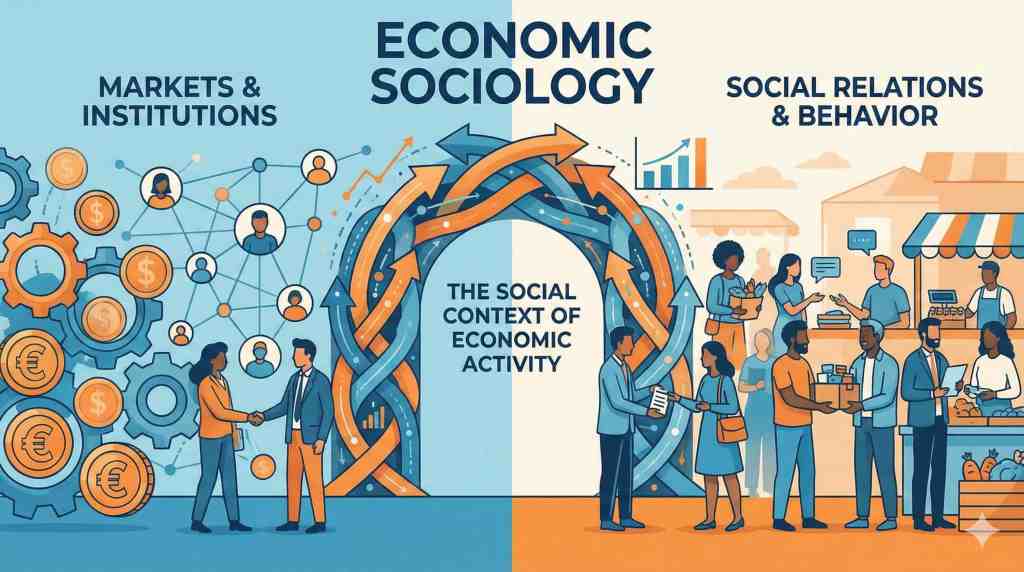
Economic sociology is a core analytical field that explores how economic processes are shaped, sustained and transformed by social forces. Rather than viewing economic behaviour as purely rational or isolated from its context, the discipline emphasizes that markets, production systems, labour relations and financial institutions operate within networks of social norms, cultural values and institutional arrangements. Through this perspective, economic sociology provides a comprehensive understanding of how economic life is embedded in the broader fabric of society.
The intellectual foundations of the discipline were laid by early sociological scholars such as Karl Marx, Max Weber, Émile Durkheim and Georg Simmel. Their contributions established the principle that economic systems cannot be understood without examining power structures, cultural orientations, moral regulations and everyday social interactions. Contemporary scholarship has built on this classical legacy by integrating theories of social networks, institutional dynamics, cultural analysis and global economic transformations. As a result, economic sociology has expanded into a diverse field capable of analysing both traditional markets and emerging digital economies.
A major contribution of economic sociology lies in its ability to explain how social divisions such as class, caste, gender and ethnicity shape economic opportunities and outcomes. It investigates how trust, reciprocity, social capital and collective norms influence transactions and cooperation among economic actors. Moreover, the discipline highlights how institutions provide stability and predictability to economic systems, how cultural meanings guide consumption patterns and how informal networks support or limit market participation.
In an era characterized by rapid globalization, technological change and widening economic inequalities, the relevance of economic sociology has become increasingly evident. The field offers essential tools for analysing global supply chains, financial crises, labour market restructuring and the social implications of digital platforms. By examining the interplay between economic forces and social structures, economic sociology contributes to more informed policymaking, equitable development strategies and a deeper understanding of how economic processes transform everyday life.
Through its interdisciplinary scope and emphasis on the social embeddedness of economic action, economic sociology remains vital for interpreting contemporary economic challenges and guiding efforts to build more inclusive and resilient economic systems.
Meaning of Economic Sociology
Economic sociology is the systematic study of how economic activities are shaped by the social environments in which they occur. It examines the influence of social structures, cultural values, institutional arrangements and interpersonal relationships on processes such as production, exchange, labour, consumption and distribution. By emphasizing that economic behaviour does not occur in isolation but is embedded within broader social contexts, economic sociology provides a deeper understanding of how economies function, evolve and interact with society.
Evolution and Historical Development
Economic sociology has developed as a discipline dedicated to examining how economic behaviour and institutions are deeply embedded in social structures. Its historical trajectory demonstrates a gradual transition from broad philosophical reflections to systematic empirical and theoretical analyses. The following is the outline of evolution from classical origins to contemporary developments:
1. Classical Foundations: The roots of economic sociology lie in the work of early social theorists, whose ideas laid the groundwork for understanding the interrelationship between economic activity and society.
Karl Marx emphasized that economic systems are fundamentally determined by material conditions and class relations. He argued that modes of production shape social hierarchies, political structures and patterns of inequality. His analysis of capitalism, including concepts such as surplus value and class struggle, provided a structural lens for examining the social consequences of economic arrangements.
Max Weber expanded the perspective by highlighting the role of culture and meaning in economic life. His study of the Protestant ethic and the spirit of capitalism illustrated how religious values can influence economic behaviour. Additionally, Weber’s analyses of rationalization, bureaucracy and authority underscored that economic actions are guided not only by self-interest but also by norms, values and institutional expectations.
Émile Durkheim introduced a moral and collective dimension to economic sociology. He proposed that economic activity requires regulation through shared norms to ensure social cohesion. His work on the division of labour demonstrated that economic specialization enhances social integration but also necessitates collective oversight to prevent disorder and social fragmentation.
Georg Simmel contributed a micro-level perspective, focusing on the social significance of money and exchange. He explored how monetary transactions shape interpersonal relationships, individual autonomy and everyday social interactions, highlighting the subtle ways in which economic processes influence social life.
Together, these classical thinkers provided foundational insights into the connections between social structures, culture and economic activity, forming the theoretical bedrock of economic sociology.
2. Emergence of Modern Economic Sociology: The mid 20th century witnessed the emergence of modern economic sociology, characterized by a more systematic and institutionally oriented study of economic life.
Karl Polanyi played a pivotal role by introducing the concept of “embeddedness,” arguing that economic systems are always situated within social, cultural and political frameworks. He challenged the assumption that markets operate independently and emphasized that social norms and institutions regulate economic behaviour.
During this period, research increasingly focused on specific economic arenas such as labour markets, industrial relations, organizational structures and processes of economic development. Key areas of attention included:
- The role of institutions in structuring and stabilizing economic activity.
- The influence of social norms and expectations on economic decision-making.
- The interplay of power, conflict and inequality within economic systems.
By the 1970s and 1980s, economic sociology had established a distinct identity, relying on empirical investigations and theoretical frameworks that contrasted with the individualistic assumptions prevalent in conventional economic theory.
3. Contemporary Developments: Contemporary economic sociology has evolved into a multifaceted field that integrates diverse theoretical perspectives and addresses complex global dynamics.
Network theory, advanced by Mark Granovetter, reinvigorated the idea of embeddedness by demonstrating that social networks, trust and patterns of interpersonal interaction profoundly shape economic behaviour. This perspective has redefined the analytical understanding of market and organizational dynamics.
The effects of globalization have become a central area of inquiry, with sociologists examining how international trade, global labour flows, multinational corporations and transnational governance reshape local economies and social structures. Research highlights the uneven distribution of resources, labour exploitation and structural transformations in production systems.
Cultural sociology has also gained prominence, focusing on how values, beliefs and symbolic meanings shape consumer behaviour, entrepreneurial activity and market differentiation. This approach underscores the social embeddedness of economic choices within shared norms and cultural practices.
Technological innovation is another key focus, with studies analyzing the impact of digital platforms, algorithmic decision-making, gig work and artificial intelligence on labour markets and economic interactions. These investigations emphasize the complex relationship between technological systems and social structures in organizing contemporary economic life.
Overall, contemporary economic sociology extends its analytical scope beyond traditional markets, encompassing global processes, cultural frameworks and technological transformations, thereby offering a comprehensive lens for understanding the complexities of modern economic phenomena.
Theoretical Perspectives in Economic Sociology
Economic sociology draws upon multiple theoretical frameworks to examine the ways in which economic behaviour is shaped by social, cultural and institutional forces. Each perspective provides distinct insights into the interconnections between economic activity and society, highlighting both structural and relational dynamics. The key approaches are following:
1. Marxian Perspective: The Marxian framework emphasizes the structural and conflictual dimensions of economic systems. It posits that economic relations are primarily determined by the modes of production and the distribution of power among social classes. Karl Marx argued that capitalism generates inequality through the extraction of surplus value by dominant classes, influencing social hierarchies, political authority and institutional arrangements. This perspective highlights the significance of class struggle, exploitation and structural conflict in understanding economic processes and social transformation.
2. Weberian Perspective: The Weberian approach focuses on the cultural, normative and interpretative aspects of economic behaviour. Max Weber demonstrated that religious beliefs and ethical values, such as those embodied in the Protestant ethic, played a crucial role in the development of modern capitalism. Moreover, Weber’s analyses of rationalization, bureaucratic organization and authority illustrate that economic activity is guided not only by material incentives but also by meaning, social norms and institutional contexts.
3. Durkheimian Perspective: The Durkheimian perspective emphasizes the moral and normative underpinnings of economic life. Émile Durkheim contended that economic activity is embedded in social cohesion and collective norms, which regulate behaviour and ensure social stability. His study of the division of labour revealed that specialization strengthens social integration but requires regulatory mechanisms to prevent social disorganization and anomie. This approach underscores the interdependence of economic structures and moral frameworks in maintaining societal order.
4. Institutional Theory: Institutional theory explores the role of formal and informal institutions in shaping economic behaviour. It posits that organizations, legal systems and social conventions provide stability and predictability to economic life. Researchers within this tradition analyze how institutionalized rules, practices and governance structures influence market behaviour, organizational strategies and broader economic outcomes. This perspective highlights that economic decisions are both constrained and enabled by institutional environments.
5. Rational Choice and New Economic Sociology: Rational choice theory models individuals as strategic actors who make decisions to maximize personal utility, based on cost-benefit calculations. The New Economic Sociology builds on this foundation by incorporating sociological insights, emphasizing that economic behaviour is shaped by social embeddedness. Networks, norms and institutional contexts influence individual decision-making, bridging the gap between conventional economic models and sociological explanations.
6. Network Theory: Network theory examines how social relationships structure economic activity. It emphasizes that trust, social ties and patterns of interaction significantly influence economic outcomes. By focusing on relational structures, network theory demonstrates how embeddedness in social networks affects access to resources, opportunities, innovation and organizational performance, offering a relational understanding of economic behaviour.
7. Cultural and Neo-Institutional Perspectives: Cultural perspectives highlight the influence of shared values, beliefs and symbolic systems on economic behaviour, affecting consumer choices, entrepreneurial activity and market differentiation. Neo-institutional theory extends the focus on institutions by emphasizing legitimacy, norms and cultural expectations as determinants of organizational behaviour. Together, these approaches underscore the intertwined roles of culture, norms and institutions in shaping economic processes in contemporary societies.
Characteristics of Economic Sociology
Economic sociology is a subfield that explores how economic behaviour and institutions are influenced and structured by social, cultural and institutional contexts. Unlike conventional economics, which often focuses on abstract models and individual rationality, economic sociology emphasizes the embeddedness of economic life within broader societal frameworks.
1. Social Embeddedness: Economic sociology emphasizes that economic actions are deeply embedded in social relationships, cultural norms and institutional frameworks. Individual and organizational choices are influenced by trust, social obligations, reputational concerns and community expectations. Even decisions that appear purely rational or profit-driven are shaped by social context. For example, firms often prioritize long-term business partners over cheaper alternatives to maintain trust, reduce uncertainty and promote cooperation, showing that economic behaviour cannot be separated from its social environment.
2. Integration of Social and Economic Analysis: Economic sociology bridges the gap between economic theory and sociology by demonstrating that economic outcomes emerge from the interaction of market forces and social structures. It challenges the view that economic activity is solely determined by rational choice or competition, highlighting the role of social norms, political institutions, group identities and collective expectations. This approach allows scholars to understand how inequalities, institutional arrangements and power dynamics influence production, distribution and consumption. By combining both disciplines, economic sociology provides a more holistic understanding of how economic systems operate within society.
3. Focus on Institutions: Institutions, both formal and informal, form the backbone of economic life and economic sociology highlights their crucial role. Formal institutions like governments, legal systems and regulatory bodies establish rules, incentives and standards that govern economic interactions. Informal institutions, including traditions, values and unwritten norms, guide acceptable practices and influence behaviour. Studying these frameworks reveals how institutions stabilize markets, reduce transaction costs, shape competition and sustain social order.
4. Attention to Cultural Factors: Cultural beliefs, shared values and symbolic meanings strongly influence economic behaviour. Decisions such as consumption, savings, entrepreneurship and investment are shaped by cultural contexts rather than pure rationality. Consumer preferences may reflect social identity, tradition or moral values, while workplace ethics and collaboration patterns are also culturally informed. Understanding these cultural dimensions demonstrates that economic behaviour is embedded in socially constructed systems of meaning.
5. Recognition of Power and Inequality: Economic sociology acknowledges that economic systems are structured by power asymmetries, unequal resource access and entrenched hierarchies. These disparities affect market participation, decision-making and the distribution of wealth and opportunities. The discipline explores how class, status, gender and social exclusion shape economic outcomes and reproduce structural disadvantages. By examining mechanisms like institutional biases or unequal bargaining power, economic sociology explains how inequality is produced and maintained.
6. Emphasis on Social Networks: Social networks are central to economic sociology because relationships influence opportunities and constraints. Network ties facilitate information sharing, trust building, collaboration and resource exchange, impacting job mobility, entrepreneurship and innovation. Strong ties offer reliability and support, while weak ties provide access to new information and opportunities. Network analysis illustrates how relational patterns shape economic behaviour and the diffusion of knowledge across communities.
7. Multilevel Analytical Perspective: Economic sociology examines phenomena at micro, meso and macro levels to provide a comprehensive understanding. The micro level studies individual decisions and everyday economic practices, while the meso level focuses on organizations, markets and networks. The macro level analyses broader social, cultural, political and economic structures that influence collective outcomes. Connecting these levels clarifies how individual actions interact with organizational and societal frameworks.
8. Historical and Comparative Orientation: Economic sociology situates economic processes in historical and cross-cultural contexts for deeper understanding. It examines how institutional legacies, cultural changes and political developments shape current economic arrangements. Comparative analysis reveals why similar reforms can yield different outcomes in different societies. This perspective shows that economic life evolves over time and across contexts, influenced by historical trajectories and societal differences.
9. Interdisciplinary Approach: Economic sociology draws on sociology, economics, political science, anthropology, history and cultural studies to study complex economic phenomena. This integration enables scholars to use diverse methods, including surveys, ethnography, network analysis and institutional studies. It combines empirical accuracy, interpretive insights and structural awareness to explore how markets, institutions and social actors interact. The interdisciplinary approach allows for a detailed understanding of the multifaceted nature of economic systems.
10. Focus on Dynamics and Change: Economic sociology highlights the evolving nature of markets, institutions and social structures. It studies how globalization, technology, digitalization, demographic shifts and policy reforms transform economic interactions. Changes in work forms, consumer behaviour, production systems and financial practices are analyzed to understand adaptation processes. By focusing on dynamics, the discipline shows how societies respond to change and how new economic challenges emerge over time.
Significance of Economic Sociology
Economic sociology is a vital subfield of the social sciences that explores the interconnections between economic activity and social, cultural and institutional contexts. Unlike traditional economics, which often emphasizes market mechanisms and individual rationality, economic sociology examines the broader societal influences that shape economic behaviour. The following points elaborate on its significance:
1. Understanding Social Embeddedness of Economic Behaviour: Economic sociology emphasizes that all economic actions are embedded within social structures, networks and cultural contexts, meaning that decisions regarding production, consumption and exchange are influenced by interpersonal relationships, trust and social obligations. This perspective enables scholars to understand phenomena such as why businesses rely on personal connections, how reputations influence market participation and why informal norms often govern financial and trade practices, thereby providing a more accurate picture of economic behaviour than purely individualistic models.
2. Bridging Economics and Sociology: The discipline integrates economic analysis with sociological insights, offering a more comprehensive understanding of economic phenomena. By considering social norms, collective behaviour, institutional frameworks and cultural influences alongside traditional economic variables, economic sociology reveals how markets, labour dynamics and organizational practices are deeply intertwined with societal structures. This bridging of disciplines allows for detailed explanations of economic phenomena that cannot be captured by purely economic or purely sociological approaches.
3. Explaining Institutional Influence: Economic sociology underscores the critical role of institutions, both formal, such as legal systems and government regulations and informal, such as customs and social conventions, in structuring economic behaviour. Institutions provide stability, reduce uncertainty and establish rules that govern transactions and organizational practices. By analyzing how institutions shape incentives, constrain choices and guide behaviour, economic sociology helps explain variations in economic performance, the success of policies and the functioning of markets across different social and cultural settings.
4. Highlighting Cultural and Ethical Dimensions: The discipline emphasizes that economic behaviour is not purely driven by material incentives but is shaped by cultural beliefs, ethical norms and shared values. These cultural factors influence consumer preferences, entrepreneurial strategies, investment decisions and market differentiation. For example, societal attitudes toward wealth, risk-taking or social responsibility can significantly affect business practices and economic outcomes, making the consideration of cultural context essential for understanding both local and global economic patterns.
5. Analyzing Power, Inequality and Social Stratification: Economic sociology examines how economic systems are intertwined with social hierarchies and power relations, highlighting how access to resources, opportunities and decision-making authority is unevenly distributed. It provides a framework to analyze structural inequalities and understand the mechanisms through which economic advantages and disadvantages are perpetuated. This perspective is crucial for studying the relationship between wealth, class, social mobility and policy interventions aimed at reducing inequality.
6. Understanding Network Effects: Social networks play a fundamental role in shaping economic outcomes and economic sociology investigates how relationships based on trust, reciprocity and repeated interactions affect the flow of information, resources and opportunities. Networks influence entrepreneurial success, employment opportunities, innovation diffusion and market participation. Understanding these relational dynamics enables scholars and policymakers to identify how social structures facilitate or constrain economic activity and how interventions might strengthen economic networks for greater efficiency and equity.
7. Facilitating Policy and Organizational Insights: Insights from economic sociology are highly valuable for designing effective policies, organizational strategies and institutional reforms. By understanding how social norms, institutional arrangements and cultural expectations shape economic behaviour, policymakers and organizational leaders can create interventions that are socially compatible, sustainable and more likely to succeed. This application extends to areas such as economic development, labour relations, corporate governance and social welfare programs.
8. Informing Globalization and Comparative Analysis: Economic sociology enables the study of economic systems across different historical, cultural and geographical contexts, providing a comparative lens to understand why similar economic policies or market structures produce different outcomes in different societies. This perspective is essential for analyzing globalization, international trade and cross-national variations in economic institutions, revealing how local social norms, governance structures and cultural practices interact with global economic forces.
9. Studying Economic Change and Innovation: The discipline focuses on the dynamic aspects of economic life, exploring how technological innovations, market transformations and social changes interact with institutional and cultural factors. Economic sociology helps explain how societies adapt to new technologies, shift labour practices, reorganize production systems and respond to economic crises, offering insights into the processes that drive economic growth, structural transformation and long-term development.
10. Enriching Interdisciplinary Research: Economic sociology draws on concepts and methods from sociology, economics, anthropology, political science and cultural studies, promoting an interdisciplinary understanding of economic phenomena. This approach enables the integration of qualitative and quantitative methods, theoretical frameworks and empirical research, providing richer, more detailed insights into the complex interactions between social structures and economic behaviour and enhancing both academic knowledge and practical applications in policy and organizational management.
Key Concepts in Economic Sociology
Economic sociology examines the interplay between economic activity and social structures, highlighting how economic behaviours are influenced by relationships, institutions, norms and cultural contexts. The discipline relies on several key concepts to analyze and interpret economic phenomena. The following points provide detailed explanations of these foundational concepts:
1. Social Embeddedness: Social embeddedness refers to the principle that economic behaviour is deeply intertwined with social relationships and networks. Unlike traditional economic theories that assume independent, rational actors, this concept emphasizes that individuals and organizations operate within social contexts that shape preferences, decisions and outcomes. For example, business transactions often rely on trust, reputation and long-term social ties rather than purely contractual arrangements, illustrating that social networks and cultural norms directly influence economic processes.
2. Social Capital: Social capital denotes the resources and benefits individuals or groups derive from their social networks, relationships and community connections. It includes access to information, financial support, mentorship and influence, which facilitate economic action and collective problem-solving. Economic sociology examines how social capital contributes to entrepreneurial success, labour market opportunities, organizational performance and economic development, highlighting the critical role of relational assets in shaping economic outcomes.
3. Trust and Reciprocity: Trust and reciprocity are foundational mechanisms that govern economic interactions and reduce transaction costs. Trust enables parties to engage in exchanges with confidence that obligations will be honoured, while reciprocity promotes mutually beneficial relationships and long-term cooperation. Economic sociology studies how trust and reciprocal behaviour emerge through social norms, repeated interactions and institutional support, influencing market stability, investment decisions and the efficiency of economic networks.
4. Power and Inequality: Power and inequality are central to understanding economic dynamics within society. Economic sociology emphasizes that the distribution of resources, opportunities and decision-making authority is often unequal, creating social hierarchies and systemic disparities. Scholars examine how economic structures reproduce or challenge inequality, how dominant groups exert influence over markets and institutions and how marginalized groups navigate structural constraints, offering insights into the social mechanisms underlying wealth, status and privilege.
5. Institutions and Norms: Institutions and norms constitute the formal and informal rules that govern economic behaviour. Institutions include laws, regulatory frameworks, organizations and governance structures, while norms encompass social expectations, customs and ethical standards. Economic sociology investigates how these structures shape individual and collective behaviour, stabilize economic systems, reduce uncertainty and ensure predictability in markets, illustrating that economic activity is regulated as much by social conventions as by formal contracts.
6. Economic Rationality and Behaviour: Economic rationality and behaviour in economic sociology extend beyond the narrow concept of utility maximization used in classical economics. While rational choice theory assumes that actors make decisions solely to maximize personal gain, economic sociology recognizes that decisions are socially situated and influenced by norms, networks, cultural values and institutional pressures. This broader understanding allows for analysis of behaviour that appears “non-rational” in economic terms but is coherent within social contexts.
7. Markets as Social Constructions: Economic sociology views markets not merely as neutral mechanisms for exchange but as socially constructed arenas shaped by norms, networks, institutions and cultural understandings. Market practices, pricing mechanisms, competition and consumer behaviour are all influenced by social relations and collective beliefs. This concept highlights that markets are contingent on human interaction, shared meanings and institutional arrangements, and that their functioning cannot be fully understood without considering the social processes that produce and regulate them.
Core Areas of Study
Economic sociology investigates how economic activities are shaped, structured and influenced by social relations, cultural meanings, institutional arrangements and power dynamics. The following are the major domains within which contemporary economic sociological inquiry is conducted:
1. Markets and Social Structures: This area examines markets as socially embedded institutions rather than isolated economic systems. It highlights that market interactions are shaped by norms, social relationships, regulatory mechanisms, cultural expectations and patterns of trust. Economic sociologists analyse how social structures such as networks, class positions and institutional rules shape market behaviour, price formation, competition and exchange processes.
2. Labour, Work and Employment: The study of labour focuses on the organisation of work, employment relations, workplace culture and patterns of inequality. Economic sociologists explore how hiring practices, job mobility, occupational identities and working conditions are influenced by social norms, gender roles, class dynamics, informal networks and institutional frameworks. This area emphasises that employment outcomes are never simply economic but reflect broader social forces.
3. Consumption and Consumer Culture: This field investigates how consumption practices are driven by cultural meanings, social identities, lifestyle aspirations and symbolic values. Economic sociology emphasises that consumption is not solely a rational economic act but a socially meaningful behaviour influenced by tastes, status considerations, cultural belonging and the desire for self-expression. It also explores how markets produce and shape consumer identities.
4. Production, Industry and Organisations: This domain analyses how production systems, industrial structures and organisational processes are embedded in social relationships and institutional settings. It includes the study of managerial strategies, workplace hierarchies, organisational culture, interfirm networks and the distribution of authority and power within firms. Economic sociology demonstrates that organisational behaviour and industrial performance are structured by social norms and institutional expectations.
5. Money, Finance and Capital: Here, money and financial systems are viewed as socially constructed structures rooted in trust, legitimacy and regulatory oversight. Economic sociologists study how financial markets operate, how credit systems evolve, how investment decisions are socially influenced and how the financial sector derives power. This field also analyses the cultural meanings of money and the social dynamics underlying financial crises and capital accumulation.
6. Economic Globalization: This area focuses on the expansion of economic activities across national boundaries and the resulting transformations in social and economic life. It examines global supply chains, international trade, labour migration, transnational corporations and global governance structures. Economic sociology highlights how globalisation reshapes local economies, produces new forms of inequality and connects diverse social systems through economic flows and institutional arrangements.
7. Informal Economy: The informal economy encompasses economic activities that occur outside formal regulatory structures. Economic sociologists examine how informal work such as street vending, household labour and unregistered enterprises is organised and sustained through community networks, social norms and survival strategies. This field reveals that informal economies are socially regulated and vital to the livelihoods of many groups, especially in developing contexts.
8. Entrepreneurship and Innovation: This domain explores how entrepreneurial activities and innovation emerge within social contexts shaped by networks, cultural values, institutional environments and community support. Economic sociology analyses how entrepreneurs mobilise social capital, navigate uncertainty and identify opportunities. Innovation is understood as a socially mediated process influenced by collective learning, trust-based relationships and the institutional climate in which firms operate.
9. Economic Development and Social Change: This field studies how economic development is intertwined with long-term social transformation. Economic sociologists analyse how institutional reforms, cultural shifts, political processes and community practices influence development outcomes. This includes examining inequality, urbanisation, demographic change and structural transformation. Development is understood not only as economic growth but as a broader social process shaped by collective behaviour and institutional arrangements.
10. State, Policy and Regulation: This area emphasises the decisive role of the state in organising and regulating economic life. Economic sociologists examine how laws, policies, regulatory frameworks, welfare systems and political institutions shape markets, employment relations and financial systems. This field demonstrates that economic activities are deeply dependent on state intervention and that public policy actively constructs, maintains and stabilises economic structures.
Contemporary Issues in Economic Sociology
Contemporary economic sociology engages with the evolving complexities of modern economic systems, emphasising the interplay between social structures, institutional arrangements, technological transformations and global interconnections. The following are the major concerns shaping current scholarly inquiry in this field:
1. Inequality and Poverty: Inequality and poverty persist as central global challenges shaped by structural disparities in income, wealth, education, gender, caste and regional development. Economic sociology argues that poverty is not merely a result of individual failure but a product of unequal social arrangements that limit opportunities for mobility. It examines how institutions, labour markets and social norms reproduce disadvantage across generations and how welfare systems, social protection policies and inclusive development strategies can mitigate these inequalities.
2. Digital Economy and Technological Change: The digital economy has transformed production, communication and service delivery through automation, artificial intelligence and data-driven technologies. Economic sociology explores how these innovations reshape social relations, create new economic hierarchies and alter the structure of work and consumption. It also highlights emerging challenges such as digital exclusion, algorithmic bias, surveillance capitalism and unequal access to technological resources, all of which influence socio-economic outcomes.
3. Global Supply Chains: Global supply chains link producers, suppliers and consumers across multiple countries, often under the control of multinational corporations. Economic sociologists examine how these networks generate uneven power relations, particularly between core and peripheral economies. They analyse issues such as labour exploitation, environmental consequences, regulatory failures and the dependence of developing countries on export-driven growth. These insights reveal the social foundations of global production and the vulnerabilities inherent in long-distance economic integration.
4. Migration and Labour Markets: Migration shapes labour markets by redistributing skills, labour power and demographic resources. Economic sociology investigates how migrants encounter institutional barriers, discrimination and limited legal protections, which often push them into low-wage or precarious work. At the same time, it emphasises the importance of social networks, community ties and informal support systems in facilitating migrant employment and integration. These dynamics highlight migration as a socially embedded economic process rather than a purely demographic movement.
5. Environmental and Sustainable Economics: Growing ecological crises such as climate change, resource depletion and pollution have made sustainable economic practices a global necessity. Economic sociology contributes by analysing how societies transition toward renewable energy, green technologies, sustainable agriculture and eco-friendly consumption. It emphasises the role of institutions, cultural values and social movements in promoting environmental responsibility and highlights the tension between economic growth and ecological preservation.
6. Financial Crises and Risk: Financial crises expose the social roots of economic instability. Economic sociology examines how speculation, collective expectations, regulatory weaknesses and organisational behaviour contribute to financial bubbles and collapse. It highlights how the perception of risk is socially constructed and influenced by trust, expertise and institutional norms. By understanding these dynamics, scholars can better explain patterns of market volatility and the uneven societal impacts of financial breakdowns.
7. Changing Work Arrangements (Gig and Platform Economy): The rise of the gig and platform economy has led to profound changes in labour structures, replacing stable employment with flexible but insecure work arrangements. Economic sociologists study how algorithmic management, performance ratings and digital platforms reshape authority, control and labour relations. This sector raises critical questions about worker rights, income security, social protections and the classification of labour, making it a major area of inquiry in contemporary economic sociology.
Future Directions in Economic Sociology
The field of economic sociology continues to evolve as societies encounter new economic, technological and institutional transformations. The following future directions highlight emerging areas of scholarly attention and potential research advancement:
1. Advancing Interdisciplinary Theoretical Frameworks: Economic sociology will increasingly integrate insights from behavioural economics, psychology, political science and anthropology. This interdisciplinary approach will help explain economic behaviour as a product of rational calculation, emotional responses, social identities and institutional influences. Such integration enhances theoretical depth and overcomes the limitations of single-discipline models.
2. Studying Digital, Algorithmic and Platform Economies: With digital platforms reshaping markets, the field will examine how algorithms govern pricing, visibility, labour organisation and competitive dynamics. Research will explore the social implications of AI-driven decision-making, digital reputations and platform-mediated work, revealing new power asymmetries between platform owners, workers and consumers.
3. Exploring Globalisation and Transnational Economic Networks: Future scholarship will focus on global supply chains, cross-border markets and international flows of capital and labour. This direction analyses how economic actors adapt when operating across diverse cultural, regulatory and political settings. It highlights the deepening interdependence of economies and the role of transnational networks in shaping development and inequality.
4. Prioritising Sustainability and the Green Economy: Economic sociology will increasingly address the social foundations of environmental sustainability. Research will analyse the transition toward renewable energy systems, green technologies and sustainable consumption. It will also study how states, global agreements and civil society movements influence ecological responsibility and long-term economic change.
5. Investigating Economic Inequalities and New Forms of Stratification: The discipline will continue examining how technological transformation, global markets and institutional structures generate new inequalities. Future work will explore the intersections of class, caste, gender, ethnicity and geography in producing layered economic disadvantages. This perspective emphasises inequality as a structural and relational process.
6. Analysing Institutional Transformation and Governance Reforms: As states, corporations and regulatory bodies adapt to crises and technological shifts, economic sociology will study institutional reforms and their impact on market behaviour, accountability and public trust. This direction recognises institutions as evolving entities shaped by social expectations and global pressures.
7. Expanding Research on Informal and Alternative Economies: Future research will focus on informal labour markets, grassroots enterprises, cooperatives and community-based economic initiatives. These systems often operate outside formal regulations yet play a vital role in social welfare and economic resilience. Studying them broadens the understanding of economic diversity across societies.
8. Emphasising Cultural Contexts and Identity-Based Economies: Economic sociology will pay greater attention to how cultural values, belief systems and social identities shape economic decisions. Research will examine identity-driven markets, including ethnic enterprises, caste-based occupations and gendered labour patterns. This approach highlights how economic behaviour is embedded within cultural meanings.
9. Understanding Technology–Society Interactions in Economic Life: As automation, artificial intelligence and digital tools reshape work and organisational life, future research will investigate how workers, firms and institutions respond. Scholars will analyse technological impacts on employment, productivity, workplace culture and ethical issues such as privacy and algorithmic bias.
10. Strengthening Methodological Innovation and Mixed-Methods Research: Economic sociology will adopt more methodological diversity, combining ethnography, social network analysis, big data methods, experiments and comparative research. Mixed-methods approaches will allow for richer and more comprehensive analyses of increasingly complex economic behaviours and dynamic global processes.
References and Readings:
Economy and Society by Max Weber, https://amzn.to/4pAz3SY
The Great Transformation by Karl Polanyi, https://amzn.to/4aBTnii
Economic Sociology: An Introduction by Jeffrey K. Hass, https://amzn.to/4ppD0dr
BSOC-108 Economic Sociology, by IGNOU, https://egyankosh.ac.in/handle/123456789/77757