- What is Evolutionary Perspective
- Concept of Social Evolution
- Basic Assumptions of Evolutionary Theory
- Types of Evolutionary Theory
- Thinkers of Evolutionary Perspective
- Critical Evaluation of Evolutionary Theory
- Conclusion
Introduction
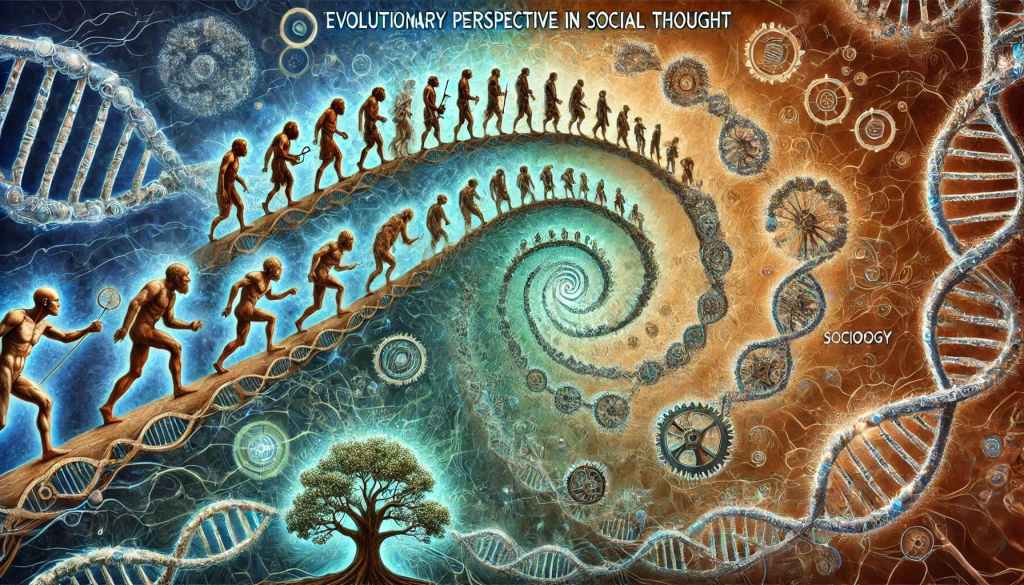
Evolutionary theories propose that societies undergo gradual transformations from simplicity to complexity over time. Early sociologists, starting with Auguste Comte, posited a unilinear progression of human societies, where social change signified advancement towards improvement. They perceived change as inherently positive and advantageous, with the implication that societies would inevitably ascend to higher levels of civilization.
L.H. Morgan delineated three fundamental stages in this process: savagery, barbarism, and civilization. Comte’s conceptualization of the three stages of human thought—namely, theological, metaphysical, and positive—paralleled the basic stages of social change. This evolutionary perspective drew heavily from Charles Darwin’s theory of Organic Evolution.
Adherents of this theory applied it to human societies, contending that they evolved from simplicity to complexity, mirroring the trajectory of Western societies. Herbert Spencer, a British sociologist, took this analogy to its furthest extent, likening society to an organism and applying Darwin’s principle of the survival of the fittest to human societies. He asserted that society progressively advanced from a military to an industrial state, with Western societies thriving due to their superior adaptation to life’s conditions. This perspective, known as social Darwinism, gained widespread traction in the late 19th and early 20th centuries.
Emile Durkheim identified increasing moral density as the driving force behind societal evolution. He observed that societies evolve towards greater differentiation, interdependence, and formal control under the pressure of rising moral density. Durkheim argued that societies transition from relatively undifferentiated structures with minimal division of labour and mechanical solidarity to more complex structures with maximal division of labour and organic solidarity.
Concept of Social Evolution
The notion of social evolution, indicating the potential for societies to undergo change, emerged from pivotal historical events. Firstly, the European colonization of non-White territories, initiated by merchant capitalism and widespread by the seventeenth century, was driven by the Europeans’ expansionist pursuits to accommodate burgeoning populations and support burgeoning industries. Encountering diverse peoples and cultures prompted inquiries into human differences and societal variations. Previously explained through racial hierarchies, Enlightenment-era humanism challenged notions of inherent superiority, rejecting racial inferiority.
Secondly, the American and French Revolutions, alongside ensuing social upheavals, prompted scholars to reconsider societal structures as mutable rather than fixed. These revolutions, particularly the radical changes of the French Revolution, suggested that societies had evolved from prior forms to their current states, fueling discourse on social transformation.
Raymond Aron noted the tumultuous political landscape of 1848-1851, characterized by significant shifts such as the transition from constitutional monarchy to republicanism and subsequently to imperial authoritarianism, highlighting the dynamic nature of societal structures.
Basic Assumptions/Distinctive Features of the Evolutionary Theory
The fundamental premise of this theory posits that societal evolution hinges on change as its defining characteristic. It presumes that the current state of society is a consequence of past transformations. Additionally, it asserts that change is both unavoidable and intrinsic to the natural order. The theory posits that societal or cultural evolution is primarily driven by internal forces. A common thread among evolutionary theories is the belief in continuous improvement, with each succeeding stage surpassing its predecessor. These assumptions can be summarized as follows:
- Change is inherent and inevitable.
- Change occurs gradually and consistently.
- Change progresses sequentially through distinct stages.
- Each subsequent stage represents advancement over the previous one, indicating a progressive evolution.
- Once a stage is reached, it is irreversible.
- The impetus for change is inherent within the entity.
- Change tends towards complexity, moving from uniformity to diversity, and from simplicity to complexity in form and function.
- All societies undergo similar stages of development.
Types of Evolutionary Theory
There are three main types of evolutionary theory:
1. Theory of Unilinear Evolution: The concept posits a linear progression of social change, suggesting that societies evolve in a straight, ordered manner towards a predetermined endpoint. It argues against the repetition of stages, asserting that societal advancement occurs steadily towards greater civilization. Advocates of this model contend that societies consistently improve along a linear trajectory, with the rate of change varying from rapid to gradual. In essence, the linear hypothesis asserts that all facets of society undergo continuous change in a specific direction without deviation or recurrence. The theories proposed by Saint-Simon, Comte, Morgan, Marx, Engels, and numerous other anthropologists and sociologists fall within this framework of unilinear social evolution, as they propose that each society progresses through a set number of stages in a defined sequence. These theories historically held sway within the field of sociology.
2. Universal Theory of Evolution: This perspective, a variant of unilinear evolution, posits that societies don’t necessarily follow fixed stages of development. Instead, it suggests that human culture as a whole has evolved along a specific trajectory. Spencer espoused this viewpoint, contending that humanity has progressed from small to large groups, from simple to complex, and generally from homogeneity to heterogeneity. Anthropologist Leslie White also championed this idea. William Ogburn further expanded on these concepts, emphasizing the role of invention in driving social change. Ogburn introduced the concept of ‘cultural lag,’ asserting that changes in non-material culture, such as ideas and social arrangements, consistently lag behind changes in material culture, such as technology and innovation.
3. Multilinear Theory of Evolution: This contemporary form of evolutionism, known as multilinear evolution, has emerged as a more nuanced and realistic alternative to the simplistic linear and universal models of evolutionary change. Multilinear evolution seeks to accommodate the diverse trajectories of cultural development by recognizing distinct sequential patterns across different cultures or cultural types. Rather than assuming a single predetermined path, this theory acknowledges that change can manifest in various ways, leading to different outcomes. Advocates of multilinear evolution reject the notion of a uniform progression for all societies or for humanity as a whole. Instead, they focus on analyzing specific sequences of development within particular cultural contexts. While acknowledging some broad social trends such as the transition from smaller to larger scale, simpler to more complex structures, rural to urban living, and low to high technology, they emphasize that these transformations can unfold through different routes, each with its own set of implications. This perspective aligns with the episodic approach, which underscores the significance of chance events and unique historical, social, and environmental factors in shaping the course of social change. Later iterations of these ideas, attributed to scholars like Leslie White and Julian Steward, came to be known as neo-evolutionism.
Thinkers of Evolutionary Perspective
Some of the prominent thinkers who used evolutionary perspective in their approach an studies, are being described as follows:
1. Herbert Spencer: The positivist perspective in sociological studies introduced the concept of an organic analogy for society, likening it to a biological organism governed by natural laws. This analogy portrayed society as akin to an embryo, suggesting that just as an embryo grows according to its inherent developmental laws, society too evolves according to its own laws. This idea formed the basis of the unilineal theory of social evolution, which posited that societies progress along a single line, much like species evolving along a singular trajectory. Furthermore, the organic analogy proposed that contemporary societies are descendants of earlier ones, which diversified and branched out over time—a metaphor often likened to a tree. Another facet of this analogy was the application of the concept of natural selection, popularized by Herbert Spencer and his adherents. However, it’s crucial to note that the notion of “survival of the fittest” in social evolution mirrors a misunderstanding, as in biological evolution, “fittest” simply refers to the ability to reproduce, rather than any notion of superiority. In biological terms, the key concept is “descent with modification,” highlighting the interconnectedness of all species and their dependence on one another and the environment for survival. Survival in nature isn’t solely about the ability of a single species to endure, but rather the collective interdependence of all species within an ecosystem, including their access to resources and the prevailing environmental conditions that facilitate survival.
2. August Comte: During this era, Comte formulated his theory of social evolution, observing the transition from theological and military societies to industrial and scientific ones. He envisioned a unified human history progressing towards an ideal and final stage. Comte identified three principal stages in this evolution:
- The theological stage, characterized by attributing societal power to divine entities resembling humans, such as the deities found in ancient religions.
- The metaphysical stage, where abstract and transcendental thoughts prevail, and natural forces are perceived in a more abstract manner.
- The positive stage, marked by a shift towards factual and systematic thinking, relying on direct observation and correlations to explain phenomena.
These stages are not universally inevitable nor uniformly experienced worldwide. Comte also delineated the transition in terms of the classification of sciences, moving from abstract to positivist methodologies. Positivist principles, characterized by objectivity and rationality, initially manifest in simpler sciences like physics, chemistry, and mathematics, before extending to more complex fields such as biology.
Comte defined sociology as the application of the positivist method to the study of society, emphasizing objectivity and rationality. He endorsed the capitalist pursuit of wealth creation as beneficial for future generations. However, his anticipation of industrial society being devoid of war proved incorrect, as Western Europe not only became a focal point for major conflicts but also engaged in colonization.
3. Ferdinand Tonnies: The transition described by the German scholar Tonnies illustrates a shift from Gemeinschaft to Gesellschaft, marking the evolution from rural to urban environments and from intimate, interpersonal relationships to more bureaucratic and formal ones. Gemeinschaft is characterized by close-knit, emotionally rich connections, while Gesellschaft is defined by distant, transactional interactions. Tonnies did not view the progression towards impersonal, complex societies as inherently superior to the cohesive and emotionally fulfilling community life found in simpler societies. Therefore, his conceptualization of societal evolution did not imply a linear path towards improvement. He did not idealize the emergence of industrial urban societies in Europe either.
4. Emile Durkheim: Emile Durkheim’s sociological framework prioritized structural factors over moral or civilizational ones. He posited that simpler societies relied on mechanical solidarity, characterized by a shared likeness among individuals. In these societies, people connected through common descent from a totemic ancestor, fostering cooperation and communal bonds. As societies evolved, specialization in skills and resources emerged, leading to an emphasis on exchange rather than cooperation. This shift marked the transition to organic solidarity, where social organization revolved around rational and instrumental principles. The division of labor became more intricate, necessitating social stratification to manage diverse skills and resource control. Unlike the moral foundation of mechanical solidarity, organic solidarity was driven by pragmatic considerations.
5. Edward B Taylor: In the early 20th century, Edward B. Tylor, based at the University of Oxford, embarked on a theoretical exploration rooted in evolutionism. Tylor not only formulated the initial formal definition of culture but also delineated the trajectory of cultural evolution akin to Comte’s delineation of societal evolution. Tylor conceptualized culture as a singular entity inherent to all humanity, yet grappled with explaining its diverse manifestations worldwide. While eighteenth-century social philosophers primarily examined the evolution of their own societies, anthropology emerged as a discipline concerned with global cultural diversity, particularly focusing on non-Western societies.
Tylor proposed his theory of Unilineal Evolution, which posited three principal stages of cultural development: Savagery, Barbarism, and Civilization. He argued that each stage represented a significant advancement in human history, with transitions such as the adoption of agriculture marking the shift from Savagery to Barbarism, and the acquisition of literacy signifying the transition from Barbarism to Civilization. Tylor viewed culture as a product of human cognition, evolving according to its inherent logic regardless of contextual factors. In this regard, his evolutionary theory followed a positivist methodology, aiming for general laws and remaining independent of specific contexts. Drawing from extensive data collected from diverse sources, Tylor constructed various evolutionary sequences pertaining to different cultural facets, with his sequence regarding the evolution of religion being particularly notable.
6. Lewis Henry Morgan: Lewis Henry Morgan, an influential figure in American social theory, drew inspiration from the evolutionary ideas of his predecessors. His own theory of social evolution, shaped by his extensive fieldwork among Native American communities, ran parallel to established evolutionary frameworks. Morgan posited that original concepts emerge singularly, unfolding organically over time in a logical progression. He identified key pillars of society such as subsistence, law, inheritance, political organization, and family as fundamental ideas shaping societal development.
Morgan structured the trajectory of social evolution into distinct Ethnical Periods, echoing the stages outlined by Tylor: Savagery, Barbarism, and Civilization. However, Morgan’s delineation was more detailed, with each period further divided into lower, middle, and higher tiers. Within each tier, specific modes of subsistence and technological advancements corresponded with progressions in other facets of societal life. Additionally, Morgan, often hailed as the pioneer of kinship studies, proposed a broader evolutionary schema, transitioning from Societas—societies grounded in kinship—to Civitas—territorially and state-based societies—at a macro level.
7. Talcott Parsons: During the middle decades of the 20th century, a group of American sociologists redirected their focus from the dynamics of social change to the study of social stability. Among them, Talcott Parsons emphasized the role of cultural patterns in maintaining societal equilibrium. He proposed that societies possess the capacity to absorb disruptive forces while preserving overall stability, viewing change not as a disturbance to equilibrium but as a catalyst for the emergence of new equilibrium states.
Parsons identified two sources of change: external influences stemming from contact with other societies and internal adjustments required to resolve tensions within the social system. He delineated two processes driving social change.
In simpler societies, institutions are undifferentiated, with a single institution fulfilling multiple functions. For instance, the family may handle reproductive, educational, socialization, economic, and recreational roles. As societies become more complex, a process of differentiation occurs, wherein distinct institutions such as schools and factories assume specific functions previously handled by the family. Integration becomes crucial to connect these new institutions effectively, necessitating the establishment of norms governing their relationships. Additionally, intermediary institutions like law courts may be required to arbitrate conflicts between various components within the system.
8. Pitirim Sorokin: Pitirim Sorokin, in his seminal work “Social and Cultural Dynamics” published in 1938, presents an alternative perspective on social change. Rather than conceptualizing civilizations solely in terms of linear progression or decline, Sorokin suggests they oscillate between two distinct cultural paradigms: the sensate and the ideational. The sensate culture prioritizes tangible, sensory experiences, emphasizing practicality, hedonism, sensuality, and materialism. In contrast, the ideational culture focuses on abstract concepts, spiritual concerns, faith, and ultimate truths, which are perceived through the intellect rather than the senses.
Sorokin posits that these are pure types of culture, and no society fully embodies either exclusively. Instead, societies exhibit varying degrees of both, with cultural development toward one type being met with resistance from the opposing cultural force, leading to a reversal of cultural trends. Excessive emphasis on one type of culture tends to provoke a reaction towards the other. Within this dynamic lies a third type of culture, the “idealistic” culture, which represents a desirable synthesis of the sensate and the ideational. However, Sorokin observes that no society has achieved this idealistic state as a stable condition, as the tension between sensate and ideational impulses perpetuates long-term instability in cultures and societies.
Critical Evaluation of Evolutionary Theory
The concept of evolutionary development, characterized by gradual and continuous progress through stages, faced significant criticism in the last century, both theoretically and empirically. Critics targeted its tendency to generalize historical sequences, impose uniform stages of development, and assume a consistent rate of change. Borrowing from biological evolution, which provided the foundational ideas for social evolution, yielded inadequate explanations.
These criticisms stemmed from a lack of supporting evidence and empirical challenges. The simplistic notion that societies evolve from simple to complex forms based on predominant productive technologies was found to be unjustified.
The emergence of the doctrine of ‘cultural relativity’ hindered attempts at static or cross-sectional generalizations but offered a new framework for understanding common societal features. Moreover, the evolutionary model failed to delineate the systematic characteristics of evolving societies or institutions, as well as the mechanisms and processes driving transitions between stages.
Classical evolutionary theories often attributed change to broad causes such as economic, technological, or spiritual factors, sometimes conflating general trends with specific causes of change. Consequently, the popularity of evolutionary theory has waned, with contemporary theorists like Anthony Giddens criticizing its evolutionary and functionalist approaches to understanding society and social change. Spencer’s optimistic view of progress is viewed skeptically, as growth can also lead to social problems.
Despite its flaws, evolutionary theory retains significance in interpreting social change. Its recent tentative resurgence is linked to a growing interest in historical and comparative studies, although modern sociology tends to approach it with caution or rejection due to earlier uncritical applications by sociologists.
Conclusion
Evolutionism emerged as a product of a positivist perspective on society, aiming for objectivity, but it fell short of adhering to the expected scientific rigor. Its delineation of developmental stages exhibited a clear Eurocentric bias, often idealizing Western society as the pinnacle of civilization.
In the 19th century, evolutionism subtly supported colonialism by providing theoretical grounds, as scholars like Spencer, Tylor, and Morgan suggested that Western cultures had the right to dominate “less developed” or “primitive” societies to guide them toward civilization. This perspective labelled contemporary populations as “primitive” based on the idea that remnants of past stages of development persisted, thus rationalizing colonization. Despite the destructive consequences of colonization, Western cultures were portrayed as constructive and beneficial.
Although the term “Primitive Tribal Groups” has been replaced with “Particularly Vulnerable Tribal Groups” by the Indian government, the term “primitive” still permeates policy discussions, especially concerning initiatives favouring large corporations and infrastructure projects like dams and mining. The legacy of classical evolutionism persists in the Eurocentric models of development embraced by many nations, including former colonies.
In the modern era, many states continue to uncritically pursue a materialistic, profit-oriented version of modernity influenced by 19th-century European thought, particularly exemplified by the United States. The American model now dominates global economic and social paradigms, promoting a biased form of development centered on market-driven capitalism. Evolutionism, akin to racism, has entrenched itself in the collective consciousness, particularly among policymakers, framing development as a unidirectional march toward progress heavily influenced by an American-inspired capitalist ethos. “Backward” is often synonymous with “primitive” in this worldview.
References and Readings:
Social Evolution, by Robert L. Trivers, https://amzn.to/4hmUiTt
Cultural Evolution: People’s Motivations are Changing, and Reshaping the World, by Ronald F. Inglehart, https://amzn.to/4iEXj2x
The Evolution of Human Sociality: A Darwinian Conflict Perspective, by Stephen K. Sanderson, https://amzn.to/41D5tS7
Sociological Theory, by Ritzer G, https://amzn.to/3Da3pcm