- What is Family
- Meaning and Definitions of Family
- Characteristics of Family
- Nature of Family
- Types of Family
- Functions of Family
- Changing Trends of Family
Family: An Introduction
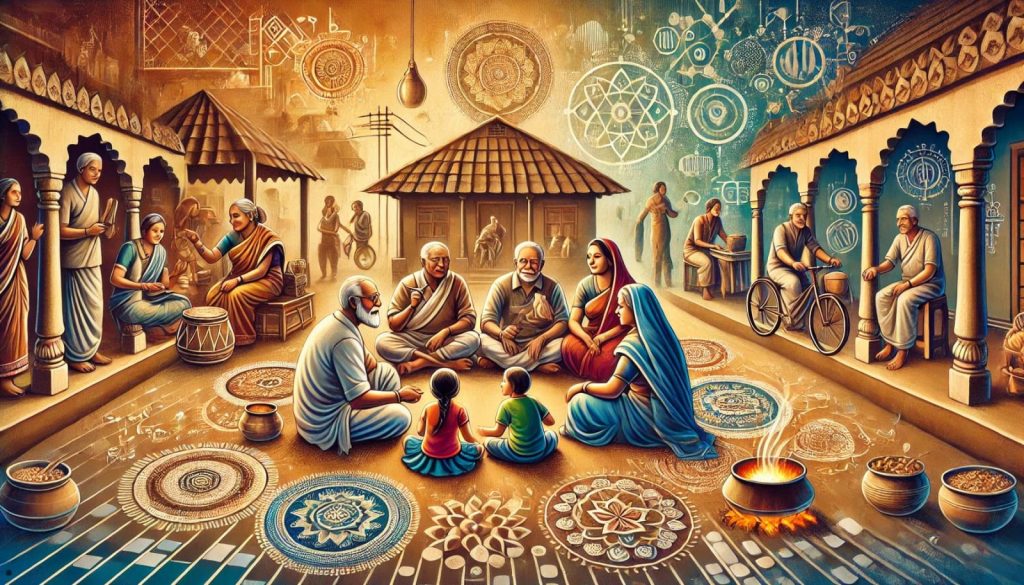
Human society is a complex tapestry woven from diverse groups and institutions, among which social institutions play a pivotal role. These institutions serve as the fundamental framework that shapes society. An analogy often used to describe this framework is that of “warp and woof,” likening it to the threads running lengthwise (warp) and crosswise (woof) in a woven fabric.
Various entities contribute to this societal fabric, including families, clubs, religious organizations, and educational institutions, with families being a prime example. Despite being the smallest societal unit, families hold immense significance. They are widely prevalent, with a substantial portion of the global population living within family structures. As the primary social group, families are ubiquitous and essential for the socialization of individuals. Regarded as the first society for human beings, families are recognized as the initial school of citizenship.
Functioning as a nucleus within society, families are intricately intertwined with the social structure, serving as its backbone. From birth to eventual passing, individuals develop deep emotional ties to their families. Parental care within families imparts early lessons in social responsibility and self-discipline. Essentially, families are not only foundational units but also cornerstones of the broader social structure, occupying a central position in society.
Meaning of Family
The concept of family encapsulates a close-knit domestic group formed through blood ties, marriage, or legal bonds. Serving as the foundational social unit, it plays a crucial role in society, characterized by its simplicity and essential structure. Typically comprising parents and children, the family serves as the primary environment for a child’s upbringing, exerting a significant influence throughout an individual’s life and fostering enduring social connections.
In human societies, the term “family” denotes a group united by biological or marital relationships, aiming to ensure the welfare of its members and contribute to the broader societal well-being. Ideally, families offer stability, organization, and security as individuals navigate their interactions within society. Etymologically, the term “family” finds its roots in the Latin word “familia,” originally referring to household members, including relatives, servants and the estate.
The concept of family, originating in the fifteenth century English language, stems from the Latin word “famulus,” meaning servant, initially referring to a collective residing under one roof, including both blood relatives and household staff. Over time, it evolved to encompass a unit comprising parents, children and sometimes extended relatives sharing a domicile. This institution is characterized by shared living arrangements and reciprocal responsibilities among its members.
Beyond its residential aspect, the family serves as a primary agent of socialization, shaping individuals’ development and values. It holds significance across cultures and historical periods, adapting to various societal contexts from tribal to contemporary settings. Through roles such as nurturing and transmitting cultural norms, the family plays a vital role in the cohesion and development of societies.
Characteristics of Family
The acclaimed Greek philosopher Aristotle famously argued that humans are naturally social creatures and cannot thrive in isolation. The idea of a person living entirely alone is unimaginable. Every day, individuals engage in various social roles, often starting within the framework of a family unit. Among all social groups, the family holds particular significance as the fundamental unit. It is essential to recognize that throughout history, no society, ancient or contemporary, has functioned without a family structure. MacIver and Page have delineated the fundamental traits of the family as follows:
1. A Mating Relationship: The foundation of a family hinges upon the establishment of a mating bond. Once a male and a female engage in a sexual relationship, the family unit is formally constituted. This bond, referred to as a mating relationship within the family, is indispensable for family formation. Acknowledging the inherent importance of fulfilling sexual desires, people enter into such relationships, thereby laying the groundwork for family creation. It’s crucial to understand that this bond may vary in duration, being either temporary or permanent and its dissolution signifies the breakdown of the family unit.
2. A Form of Marriage: Another essential aspect defining a family is the institution of marriage, which formalizes the mating relationship. Marriage takes various forms, from straightforward to intricate, encompassing monogamy, polygamy, group marriage, and other variations. Each family subscribes to one of these forms. In essence, society regulates sexual conduct between individuals of different sexes through marriage, making its presence vital for establishing and maintaining families.
3. Some Rules of Mate Selection: Every household follows particular customs or protocols to build the institution of marriage, which serves as the cornerstone of family dynamics. Mate selection can be guided by parental authority or individual choice, with adherence to rules falling into the categories of endogamy or exogamy. A proper living space is indispensable for familial activities like childbearing and upbringing, necessitating a shared residence where family members can nurture future generations.
4. A System of Nomenclature: Every family is linked to a particular name, acting as a unique marker. The tradition of naming within a family is customary, with newcomers adopting the family name they belong to. Different families may have distinct approaches to determining lineage, often focusing on either the male or female line. Lineage can be traced through the father (patrilineal), the mother (matrilineal), or both (bi-lineal). In Indian Hindu culture, the “Namkaran” ceremony holds great importance as it socially acknowledges the name bestowed upon a newborn within the family.
5. An Economic Provision: Each household must establish an economic system to cater to the varied survival needs of its members, prioritizing financial obligations. Traditionally, it is the duty of the household head to ensure the family’s provisions by pursuing a particular occupation to generate income and fulfill all familial necessities.
6. A Common Habitation: Every family necessitates a communal dwelling to facilitate the upbringing of infants and the nurturing of all offspring. There exist diverse norms dictating the formation of such residences. Upon marriage, a woman might opt to reside in her husband’s parental abode (patrilocal residence), return to her own parental domicile (matrilocal residence), or both partners may agree to establish a new household (neo-local residence).
In addition to the aforementioned traits outlined by MacIver and Page, here are some further distinctive features of family:
1. Universality: The concept of the family is pervasive, found across all human societies. Malinowski underscores that the traditional family unit, consisting of parents and children, is observable in communities spanning from primitive to sophisticated civilizations. This widespread occurrence is linked to essential human requirements such as reproduction, sexual companionship, and communal economic support. Regardless of societal complexity, family units form the cornerstone of social organization. As MacIver observes, “It transcends cultural boundaries, appearing universally across various stages of societal evolution, and even exists among numerous animal species.” Consequently, every person is part of a familial unit in some form.
2. Emotional Basis: The essence of family is deeply embedded in human emotions and instincts, which revolve around connections like partnership, childbirth, nurturing and the affection between parents and offspring. These emotional ties serve as the bedrock of familial relationships, fostering bonds characterized by love, sacrifice and mutual support. Ultimately, the institution of family thrives on emotions such as love, care, empathy, collaboration and companionship, underlining their pivotal role in shaping the essence of every familial unit.
3. Limited Size: The family, acknowledged as the fundamental nucleus of society, serves as a compact social unit. Typically comprising a husband, wife, and their biological or adopted children, it fosters direct, intimate and enduring relationships. These qualities, facilitated by its small size, contribute to the stability of the family institution.
4. Nuclear Position: When it comes to different kinds of social formations, the family plays a pivotal role in priming individuals for interaction within secondary groups, navigating their demands and environments. Acting as a foundation, it fosters the cultivation of various group dynamics, bridging the gap in cultural acumen for infants.
5. Formative Influence: The influence of the family is profound, shaping the personalities of its members. Within the family environment, individual traits are crafted, influenced by its customs, traditions, and norms especially during childhood. Acting as a crucial agent of socialization and control, the family significantly impacts the development of its members.
6. Responsibility of the Members: The family unit embodies a deep-seated commitment to each member’s duties and obligations, fostering a culture where every individual shoulders their responsibilities. This collective accountability is a hallmark of familial dynamics, providing children with invaluable insights into the importance of responsibility and collaboration.
7. Social Regulation: Society embodies a collective of people residing together, emphasizing a communal and expansive viewpoint. It establishes norms and customs to ensure that individuals within a community fulfill vital roles towards each other. The cohesion of broader social connections relies on these roles. For instance, nearly all societies maintain social regulations concerning divorce.
8. Persistence and Change: The family possesses both enduring and evolving qualities. As an institution, it holds a permanent status. Once a couple forms a union and establishes their own household, the family persists, adapting to include new members. Thus, in its institutional sense, the family is regarded as enduring. However, the specific structure of a family is transient and subject to change. Over time, its size, composition, and the roles of its members may shift.
From the above explanation, it is evident that the family represents a unique social institution without parallel. Its indispensability underscores its pervasive influence and importance in society. Irrespective of societal complexities—whether primitive, tribal, intricate or contemporary—we all emerge from and engage in family life to some extent. Acting as the fundamental unit of social cohesion, the family serves as the core around which social structures form, enduring as one of humanity’s most foundational institutions. Indeed, no civilization or society has existed devoid of familial presence. The family assumes a central role in moulding individual identities and is indispensable to the process of socialization.
The Nature of Family
Family represents a foundational social entity crucial for human development and socialization. It consists of individuals united by biological, legal, emotional or social ties. Exploring the nature of family involves considering its diverse dimensions:
1. Biological Dimension: Family typically originates from biological ties, which build essential connections between parents, children and siblings. These bonds are shaped by genetics and inheritance, forming a distinctive lineage that connects individuals across multiple generations. The biological aspect of family is crucial not just for passing down physical traits and genetic attributes, but also for promoting a profound sense of identity and belonging rooted in one’s ancestral background. This dimension of family holds considerable importance in cultural practices and societal norms, impacting how individuals perceive their relationships and their roles within broader society.
2. Legal Dimension: Family extends beyond biological connections to encompass legal relationships like marriage, adoption and guardianship. These legal ties establish formal frameworks that outline the rights and duties of family members. Marriage, for example, binds two people in a recognized partnership that affects property rights, inheritance and social standing. Adoption, on the other hand, establishes a legal parent-child relationship, offering security and a sense of belonging to the child while imposing caregiving responsibilities on the adoptive parents. These legal dimensions play a vital role in structuring familial bonds within society, ensuring the welfare and support of family members.
3. Emotional Dimension: At its core, family revolves around deep emotional ties that unite members through love, care and mutual assistance. These connections define the familial experience, offering comfort, belonging and stability. Families provide a safe haven where individuals can freely express themselves, share both happiness and hardship and seek comfort during difficult times. This nurturing atmosphere nurtures personal development and inner strength, enabling individuals to navigate life’s obstacles and cultivate a robust sense of identity. Emotionally, family serves as a vital support network that sustains its members throughout life’s journey.
4. Social Dimension: Family constitutes a fundamental social institution that moulds societal norms, values and roles. It acts as the best environment for socialization, where individuals grasp the behaviours, customs and traditions crucial for societal integration. Within family interactions, individuals acquire language, social aptitudes and cultural values that shape their conduct and perspectives across different facets of life. Moreover, families contribute significantly to upholding social cohesion by instilling a sense of accountability and civic engagement in their members. The social aspect of family underscores its critical role in shaping social identity and preserving cultural legacy.
5. Functional Dimension: Families play a crucial role in caring for, supporting and nurturing their members. This encompasses meeting children’s emotional, educational and economic needs, ensuring their holistic well-being. Families serve as the foundational environment for early learning and development, where children gain essential skills and knowledge crucial for their future societal roles. Additionally, families provide economic assistance, guaranteeing basic necessities are fulfilled and promote a sense of security and stability. The functional aspect of families underscores their influence in moulding individuals’ capabilities and viewpoints, thereby promoting personal development and societal integration.
6. Dynamic Nature: The idea of family is constantly evolving, mirroring shifts in societal expectations, cultural norms and legal standards. Traditional family models have diversified over time to encompass nuclear families, extended families, single-parent households and blended families. These transformations stem from evolving gender roles, greater mobility and evolving economic circumstances. Family’s flexibility enables it to respond to the evolving demands and complexities of contemporary life, highlighting its flexibility and ongoing significance in society. This adaptability ensures that families remain a crucial source of support and stability amid a rapidly changing world.
7. Cultural and Societal Variations: Family structures and roles exhibit significant diversity across cultures and societies, illustrating the myriad ways human communities organize themselves. For instance, some cultures prioritize extensive familial networks encompassing grandparents, aunts, uncles and cousins, which are integral to daily life and decision-making processes. Conversely, other societies emphasize nuclear family units, concentrating on immediate relatives. These cultural distinctions profoundly impact family dynamics, role allocation and societal expectations, influencing interpersonal relationships within families and their broader community interactions. Recognizing and comprehending these variations are essential for valuing the multifaceted expressions of family life globally and appreciating each family structure’s unique contributions to societal cohesion.
8. Challenges and Transformations: Families in the contemporary era grapple with several obstacles, including economic pressures, evolving gender roles and shifting societal expectations. Financial instability often strains family resources, impacting their capacity to support their members adequately. The evolution of gender roles challenges traditional family structures, necessitating adjustments to new family models. Furthermore, societal shifts regarding marriage, parenting and gender identity are redefining the notion of family itself. Despite these hurdles, families exhibit remarkable resilience and adaptability. They adjust to new realities, evolving to meet the diverse needs of their members while remaining a crucial source of stability and support in society. This ability underscores the enduring importance of families in human life.
In essence, family is a complex blend of biological, legal, emotional, social and practical components. It evolves with societal changes, remaining crucial for individual and community development and well-being.
Types of Family
The family, a fundamental institution found worldwide, showcases diverse structures and arrangements across cultures. Scholars in sociology and anthropology have recognized a range of family types across various cultural settings. These classifications often depend on factors like organization (nuclear or joint), marriage forms (monogamous or polygamous), authority dynamics (matriarchal or patriarchal), and residence patterns. Below, we detail the classification of families according to these criteria.
Types of Family
1. On the Basis of Organisation: In terms of organisation families may be of two broad types:
1.1 The Nuclear Family
1.2 The Joint Family
1.3 The Extended Family
1.1 Nuclear Family: The nuclear family stands as a foundational unit comprising a husband, wife, and their unmarried children. Prevalent in modern industrialized societies, this familial structure emphasizes the close relationships between parents and offspring. Its compact size fosters autonomy, liberating it from elder influence. Widely regarded as the primary and desirable family model in today’s culture, it centers on the spousal relationship, guaranteeing children receive ample care, nurturing, and emotional support from their parents. Financially self-reliant, the nuclear family affords its members increased independence compared to those within extended family arrangements.
1.2 Joint Family: In many cultures, joint families are characterized by multiple generations living together under one roof. They often share communal spaces like kitchens and places of worship, pool financial resources, and manage collective assets. The head of the household typically provides guidance and direction for the family’s affairs. This arrangement fosters a self-reliant community that caters to diverse needs such as economic support, emotional well-being, education, healthcare, and leisure activities. The joint family model is prevalent in several regions, notably in India.
1.3 Extended Family: Extended families, unlike nuclear families, consist of a wide range of blood relatives, including parents, grandparents, aunts, uncles, cousins, and their spouses. These relatives may live apart from each other and come together during holidays or significant events. Essentially, the concept of an “extended family” denotes the fusion of multiple nuclear families through the expansion of parent-child connections. According to Murdock, an extended family involves the integration of two or more nuclear families by extending the parent-child relationship, particularly by combining the nuclear family of a married adult with that of their parents.
2. On the Basis of Authority: The structure of a family can be delineated based on its authority, which may lean towards either a patriarchal or matriarchal model. Let’s delve into each one for a detailed understanding.
2.1. Patriarchal Family: The patriarchal family system is distinguished by the centralization of power within the paternal lineage. Within this framework, the eldest male or father typically serves as the family’s leader, exercising control over all its members. This authority extends to overseeing religious ceremonies within the household and managing the family’s possessions. In a mature patriarchal structure, the patriarch wields unquestioned dominance over his spouse, sons, and daughters.
2.2. Matriarchal Family: The matriarchal family constitutes a domestic arrangement where the primary authority rests with the wife or mother figure. Contrary to patriarchal structures, this model entrusts the mother with the governance of the family. Within such households, women hold the prerogative to officiate in religious rituals, while husbands typically reside within their wives’ familial domains. Referred to interchangeably as a mother-right family or maternal family, this setup involves the passing down of status, surname, and sometimes assets along the female lineage. Currently, this familial paradigm is notably observed within communities such as the Khasi and Garo tribes of Assam and Meghalaya, as well as among the Nayars residing in Malabar, Kerala.
3. On the Basis of Residence: On the basis of residence, following are the types of families:
3.1. Patrilocal Family: When the wife relocates to live with the husband’s family, it is referred to as a patrilocal family.
3.2. Matrilocal Family: Matrilocal residence refers to a living arrangement in which a married couple, after their union, chooses to reside with the wife’s family. In this setting, the husband assumes a secondary role within the wife’s family, and it is where their children also reside.
3.3. Neolocal Residence: When a married couple decides to establish a new and independent residence after marriage, detached from both the bride’s and groom’s families of origin, it is referred to as neolocal residence.
3.4. Avunculocal Family: In this family arrangement, the newly married couple relocates to the residence of the maternal uncle and resides with his son. The Avunculocal family structure is observed among the Nayars of Kerala.
3.5. Matri-Patri Local Family: In a matri-patrilocal family, the groom relocates to the bride’s residence immediately after marriage and resides there temporarily until the birth of the first child. Subsequently, he returns to his family of origin along with his wife and child for permanent settlement. This family structure is observed among the Chenchuas of Andhra Pradesh.
4. The Basis of Descent: On the basis of descent, families may be divided into two types such as patrilineal and matrilineal:
4.1. Patrilineal Family: In a patrilineal family structure, lineage is traced through the father, with property inheritance following the male line. Ancestry and lineage within such families are predominantly defined through paternal descent. These families often reflect patriarchal and patrilocal tendencies, forming a common family model in modern society.
4.2. Matrilineal Family: In matrilineal societies, lineage is followed through the female side, and the passing down of property occurs along the female lineage. Matrilineal systems are observed among various cultures such as the Veddas, certain North American Indigenous peoples, select groups in Malabar, and the Khasi tribe. Typically, these societies exhibit matriarchal and matrilocal tendencies. Moreover, there exist two other forms of family lineage: Bilateral and Ambilineal. In a bilateral system, ancestry is traced through both parents, while an Ambilineal setup permits tracing ancestry through the father’s line in one generation and through the mother’s line in the next.
5. On the Basis of Marriage: On the basis of marriage, family has been classified into two types such as monogamous and polygamous.
5.1. Monogamous Family: A monogamous family consists of one husband and one wife, where one man is married to one woman or one woman is married to one man at a given time. Therefore, a monogamous family is formed by a husband and a wife living together, representing an ideal form of family that is widely prevalent.
5.2. Polygamous Family: Polygamous family occurs when one man is married to multiple women, or one woman is married to multiple men, forming a family structure. Polygamous families are further categorized into two types: polygynous family and polyandrous family.
5.3. Polygynous Family: It represents a familial structure where a man simultaneously maintains marital relationships with multiple wives, cohabiting with them and their shared offspring. This form of family arrangement is observed within Eskimo communities, African Negroes, Muslims, as well as among the Naga and various tribes in central India.
5.4. Polyandrous Family: In this family structure, a woman is married to multiple husbands simultaneously, residing with all of them collectively or with each husband in succession. Polyandrous families can be identified among certain Australian communities, the Sinhalese (Sri Lankans), the Tibetans, and specific Eskimo groups and the Todas of Nilgiri Hills in India.
6. On the basis of In-group and Out-group Affiliation: On the basis of in-group and out-group affiliation families may be either endogamous or exogamous.
6.1. Endogamous Family: Endogamy is the custom of marrying someone within the same group to which an individual belongs. An endogamous family is formed by a husband and wife who are part of the same group, such as a caste or tribe. For instance, in a society characterized by caste distinctions like India, individuals are required to marry within their own caste. When a person weds within their caste group and resides in the same family, it is referred to as an endogamous family.
6.2. Exogamous Family: Endogamy involves marrying within one’s group, while exogamy entails marriage with someone outside the group. For instance, in Hindu traditions, it is customary for individuals to marry outside their kinship group or gotra. A family that comprises a husband and wife from different groups, such as gotra, is termed an exogamous family. In India, marrying within the same gotra is prohibited, necessitating marriage outside one’s own gotra. Similarly, certain tribes observe clan exogamy, requiring them to marry outside their specific group or clan. This practice is prevalent among Indian tribes like the Gond, Ho, Khasi, and others.
7. On the basis of Blood-relationship: Ralph Linton has classified family into two main types namely, consanguine and conjugal:
7.1. Consanguine Family: The consanguine family is structured around the parent-child relationship, emphasizing blood descent. This family type is organized as a descent group through the male line, with a strong concentration of authority. It consists of a core of blood relatives at the center, accompanied by a periphery of wives and other individuals essential for the upkeep of the family unit. These families have the potential to grow significantly in size, and the Nayar family serves as a representative example of this structure.
7.2. Conjugal Family: The conjugal family is centered around the core unit of the husband, the wife, and their children, with peripheral relatives playing a less significant role in the family’s functioning. In this family type, authority and solidarity rest primarily with the conjugal pair, consisting of the husband and wife. Unlike the consanguine family, the conjugal family is more detached from broader kinship connections. The consanguine family, characteristic of agricultural societies, is characterized by its size, stability, security, self-sufficiency, and authoritarian structure. In contrast, the conjugal family, representative of modern societies, tends to be smaller, more transient, isolated, and relatively insecure, albeit with a democratic orientation.
Functions of Family
As a societal institution, the family holds specific responsibilities for both society and individuals. It plays a crucial role in ensuring survival, providing protection and support, facilitating socialization, and contributing to the societal identification of individuals. The family acts as a tool for sexual control and the transmission of culture within society. Various sociologists have categorized the functions of the family in different ways; some of these classifications include:
Kingsely Davis has mentioned four main functions of family. These are
- Reproduction
- Maintenance
- Placement
- Socialisation of the young
Ogbum and Nimkoff have divided the functions of family into six categories These include:
- Affectional functions
- Economic functions
- Recreational functions
- Protective functions
- Religious and
- Educational functions
According to Lundberg, the following are the basic functions of family:
- Regulation of sexual behaviour
- Care and training of the children
- Cooperation and division of labour
- Primary group satisfaction
All above mentioned functions of family given by many sociologists can be categorized in two categories as categorized by Maclver and Page which are accepted universally by almost all scholars:
- Essential Functions
- Non-essential Functions
1. Essential Functions: The fundamental functions refer to those functions that are absolutely necessary for the survival of human beings and are carried out by the core social institution, namely the family, with no other institution capable of fulfilling these functions. The essential functions of the family include:
1.1 Satisfaction of Sex Needs: This represents a vital function carried out by the family. The family is responsible for bestowing a name upon a newborn, and without the family name, an individual may be deemed illegitimate. The natural and biological urge of the sex instinct is an inherent aspect of human beings. Meeting the satisfaction of this instinct necessitates the cohabitation of males and females as husband and wife. The family serves as the exclusive setting where husbands and wives can fulfill their sexual instincts. Through the socially approved institution of marriage, the family addresses and satisfies the sexual desires of both males and females.
1.2 Reproduction: Reproduction is crucial for maintaining the ongoing existence of society, and at the core of this process is the family. A continuing society depends on the biological reproduction of its members. The family stands out as the primary institution for reproduction and the upbringing of children. By regulating sexual behaviour, it establishes a legitimate and responsible foundation for procreation. Additionally, the family ensures the well-being and personal protection of new-borns and children.
1.3 Sustenance Function: The family offers daily care and personal protection to its dependent members, including the elderly and children. It serves as a safety net for individuals during times of crisis, providing protection and shelter to orphans, widows and their children.
1.4 Provision of a Home: Creating a household or providing a home is another indispensable function of the family. It offers a space for husbands and wives to coexist happily. After a day of labour, a man comes home where, in the company of his wife and children, he can alleviate his fatigue. Despite the availability of hotels and clubs for recreation, the home remains a sanctuary where family members find comfort and affection. The home serves as the cornerstone of the family, acting as the gathering point for spouses, the birthplace, and playground for children. The family functions as a psychological relief station where one can safely unwind.
1.5 Socialisation: Man is inherently a social creature, yet he is not born inherently human or social; rather, he attains these qualities through the process of socialization. Socialization denotes the progression by which a developing individual acquires the habits, attitudes, values, and beliefs of the social group into which they are born, transforming into a person. From a societal perspective, socialization is the mechanism through which a society imparts its culture across generations, ensuring its continuity. The family serves as a primary educational unit, offering itself as a tangible embodiment of the cultural process. It represents the initial social environment that shapes and educates the newborn child. According to Mack and Young, “the fundamental socialization of the child occurs within the family, which undertakes the socialization of the individual and passes on the social heritage to future generations.” The family is aptly described as the “transfer point of civilization.” In essence, the family acts as an intermediary between the contents of socialization and the cultural traditions of society, facilitating their transmission to the next generation.
2. Non-Essential Functions: The non-essential functions of a family refer to those activities that could be carried out by alternative institutions or agencies, rendering them less crucial for a family to perform. In essence, these functions are not indispensable and can be fulfilled by other social entities. This implies that other agencies have the capacity to execute these functions on behalf of the family. The subsequent list outlines some examples of non-essential functions of the family:
2.1. Economic Functions: The family functions as an economic entity. In the past, the agricultural family operated as a self-sustaining “business enterprise,” generating everything necessary for its needs. However, the contemporary significance of the family as an economic unit has diminished, given that most consumer goods are now readily purchased from the market. Despite this shift, the family still holds importance as an economic unit in terms of its “consumer’s outlay.” In other words, the modern family primarily serves as a consuming unit rather than a self-sufficient producing unit.
2.2. Property Transformation: The family serves as an institution for the retention and transfer of property. Many families amass various forms of wealth, including land, goods, money, and other assets. The family then passes down these properties through generations.
2.3. Religious Function: The family serves as a focal point for the religious education of children, where they acquire various virtues from their parents. The imparting of religious and moral guidance to children has historically been closely associated with the home. Even as formal religious education has extended to the earliest years, the family remains the foundation for the development of religious ideas, attitudes, and practices.
2.4. Educative Function: The family lays the foundation for all subsequent formal education for a child. It functions as the child’s initial school, where the first steps in learning take place. Under the guidance of parents, a child takes the first lessons, as Mazzini aptly expressed, “between a mother’s kiss and a father’s care.” In the family, a child acquires language skills, behavioural norms, and manners from their parents. Virtues such as love, cooperation, obedience, sacrifice and discipline are instilled in the child within the familial setting.
2.5. Recreational Function: The family offers recreational opportunities to its members, who engage in visits to relatives and collectively enjoy various occasions within the family, deriving pleasure from these shared experiences. However, in contemporary times, recreation is often sought outside the home, with clubs and hotels becoming more prevalent venues for leisure activities.
2.6. Wish Fulfilment: The family extends moral and emotional support to individual members, serving as a defense against social isolation and loneliness, and fulfilling their need for personal happiness and love. Within this framework, the husband offers love, security, protection, and strength to the wife, while the wife reciprocates with affection, tenderness, assistance and devotion.
Building upon the preceding explanation, it can be affirmed that the family consistently addresses specific fundamental functions that are universally significant. According to Kingsley Davis, no other social group possesses the unique combination of significant functions as its primary societal responsibility. While the family has relinquished some functions it historically fulfilled, it continues to be the foremost primary group in society, playing a pivotal role in fulfilling essential functions.
Changing Trends of Family
Over time, the family has undergone a significant shift from a relatively self-sustaining unit to a distinct and compact group of minimal size. In Western advanced societies, the large consanguine family has been replaced by the smaller, independent nuclear family. Similarly, in India, the prevalence of joint families is diminishing, and independent families are on the rise, particularly in urban areas. The functions of the family have experienced notable changes, influenced by the advent of modern industrialism and urbanism, which have introduced new cultural conditions. These shifts have had a profound impact on both the structure and functions of the family. The authoritative norms of feudalism and the religious control of family and marriage have also seen a decline. The changing functions of the family are as follows:
1. Change with Regard to Satisfaction of Sex Needs: Traditionally, the family has been the institution through which the sexual needs of both males and females are satisfied, primarily within the framework of marriage. However, a notable shift has occurred, particularly in Western societies, where there is a growing acceptance of pre-marital and extra-marital sexual relations. The necessity of family formation for the fulfillment of sexual needs is no longer deemed essential. There is an evident decline in the family’s role in regulating sexual behaviour.
2. Change in the Reproduction Function: The function of reproduction within the family is undergoing changes. In Western societies, some couples choose not to have children, reflecting a shift in preferences. Additionally, there are instances where women in Western societies become mothers before marriage or even without getting married. Consequently, reproduction is now considered possible outside the traditional bounds of marriage and family.
3. Change in Sustenance Function: The role of the family in providing sustenance has been assumed by alternative entities. Hospitals and nursing homes now offer superior medical care compared to what families can provide. Government and non-government organizations are actively involved in offering protection and care for the elderly. Individuals requiring medical attention are admitted to hospitals or nursing homes, where they receive care from doctors, nurses and midwives.
4. Change in Socialisation Function: The advent of the industrial system has compelled women to engage in paid work at offices, schools or factories, leaving them with limited time to fulfill their traditional role of socializing with children. Consequently, there has been a diminishing role of the family as a primary agent of socialization. External agencies have gradually assumed the responsibility of the socialization function that was traditionally performed by the family.
5. Changes in Economic Functions: The traditional agricultural family, characterized by its multifaceted economic functions, operated as a self-sufficient “business enterprise.” The home served as a hub for production, distribution and consumption. However, the significance of the family as an economic unit has diminished in contemporary times, with the majority of consumer goods being purchased from the market. The modern family has transitioned from a self-sufficient producing unit to a consuming unit. Certain functions have been outsourced to external entities, such as the preparation of meals being shifted to restaurants and canteens, and some laundering tasks being delegated to external laundries.
6. Changes in Educational Functions: In contemporary times, the modern family has outsourced the educational function to external entities, including nursery schools, kindergartens and Montessori schools. The role of the family in providing education to children has significantly diminished. Additionally, the modern family has shifted the responsibility of vocational education to technical institutions and colleges.
7. Changes in Religious Function: The family traditionally served as a focal point for religious training of children and engaged in various religious activities. However, there is an observable trend where the family is gradually relinquishing its historical role in performing religious functions. The religious activities within the family have notably diminished over time.
8. Changes in the Recreational Function: In the past, the family played a central role in offering diverse forms of recreation and entertainment to its members. However, contemporary recreation is predominantly sought outside the home, with clubs or hotels becoming preferred venues over familial spaces. The recreational function of the family has experienced a considerable decline. External recreational centers, including clubs, cinema halls, parks and others, now provide enhanced recreational facilities to individuals. Consequently, the family is no longer the primary source for the recreation of its members.
Based on the above description, it can be affirmed that there has been a significant transformation in the functions of the family. Numerous responsibilities that were previously shouldered by parents have now been outsourced to external entities. Educational, religious, recreational, and protective functions have been, to a large extent, assumed by schools, churches, government agencies, and commercial recreational entities. In essence, the family has undergone a reduction in its functions, relinquishing many roles it performed in the past. However, this process is gradual and not uniform across all regions. Despite undergoing structural and functional changes, the family retains a distinctive position among numerous institutions. Burgess characterized the modern family as “a unity of interacting personalities.” The contemporary family is more individualized and democratic, with women enjoying elevated prestige and position.
References
Sociology by C.N. Shankar Rao, https://amzn.to/41A3Wh4
Sociology Themes and Perspectives by Michael Haralambos and Martin Holborn, https://amzn.to/4ibTgdY