Mind, Self and Society
- Who is George Herbert Mead
- Mind, Self and Society: An Introduction
- The Mind
- The Self
- The Society
- Stages of Self-Development
- Critical Evaluation of the Theory
Biographical Sketch
| Born | February 27, 1863 South Hadley, Massachusetts, US |
| Died | April 26, 1931 (aged 68) Chicago, Illinois, US |
| Alma mater | Oberlin College Harvard University |
| Era | 20th century philosophy |
| Region | Western philosophy |
| School | Pragmatism |
| Institutions | University of Michigan University of Chicago |
| Influences | Josiah Royce |
| Influenced | Herbert Blumer, John Dewey, Jürgen Habermas, Eugene Halton, C. Wright Mills, Charles W. Morris, H. Richard Niebuhr |
George Herbert Mead, an American sociologist renowned for his contributions to American pragmatism, symbolic interaction theory, and social psychology, holds a prominent place in intellectual history alongside William James, Charles Sanders Peirce, and John Dewey. Dewey himself hailed Mead as an exceptionally influential thinker. Despite his significant impact, particularly in the realms of symbolic interactionism and the development of self through communication, Mead’s recognition was more pronounced outside professional philosophical circles during the mid-twentieth century.
Regarded as a pivotal figure in symbolic interactionism, Mead’s ideas profoundly shaped the field of sociology and social psychology, although he didn’t explicitly label his work as such. His close association with John Dewey fostered a mutual intellectual exchange, with Mead presenting an original theory on self-development through communication, a concept now integral to the scholarship of Jurgen Habermas.
Mead’s intellectual repertoire extended beyond the self and intersubjectivity to encompass a theory of action and a metaphysical perspective emphasizing emergence and temporality. Despite his substantial influence, Mead never published a monograph, though his posthumously compiled work, “Mind, Self, and Society: From the Standpoint of a Social Behaviourist,” remains his most renowned publication, comprised of student notes and unpublished manuscripts.
In the nascent disciplines of psychology and sociology, Mead emerged as a leading pragmatist and a trailblazer in symbolic interactionism, delving into the intricate dynamics of human relationships within societies. Revered as one of the pioneers of social psychology, his legacy endures, shaping contemporary understandings of how social contexts mould individual behaviour. Affiliated with the University of Chicago for much of his career, Mead’s legacy intertwines with the foundational principles of the Chicago school of sociology.
Early Years and Education
George Herbert Mead, born on February 27, 1863, in South Hadley, Massachusetts, hailed from a family entrenched in academia; his father, Hiram Mead, served as a local pastor before relocating the family to Oberlin, Ohio, where he assumed a professorship at Oberlin Theological Seminary in 1870. Mead’s mother, Elizabeth Storrs Billings Mead, was also academically inclined.
Beginning his academic journey in 1879, Mead attended Oberlin College, where he concentrated on history and literature, earning his bachelor’s degree four years later. After a brief stint as a schoolteacher, he ventured into survey work for the Wisconsin Central Railroad Company. Subsequently, Mead pursued studies in psychology and philosophy at Harvard University, though he departed in 1888 without completing a graduate program.
Following his time at Harvard, Mead, accompanied by his friend Henry Castle and Henry’s sister Helen Kingsbury Castle, journeyed to Leipzig, Germany. There, he embarked on a Ph.D. program specializing in philosophy and physiological psychology at the University of Leipzig. However, in 1889, Mead transferred to the University of Berlin to delve into economic theory. Two years later, the University of Michigan extended an offer for Mead to teach philosophy and psychology, prompting him to halt his doctoral pursuits and assume the teaching position. Prior to his tenure at Michigan, Mead tied the knot with Helen Castle in Berlin.
Career
Mead encountered influential figures such as sociologist Charles Horton Cooley, philosopher John Dewey, and psychologist Alfred Lloyd during his time at the University of Michigan. Dewey, who later became the chair of philosophy at the University of Chicago, facilitated Mead’s appointment as an assistant professor in the department of philosophy in 1894. Alongside James Hayden Tufts, they became known as the “Chicago Pragmatists,” shaping American pragmatism. Mead continued to impart his wisdom as a professor at the University of Chicago until his passing on April 26, 1931.
Academic Contributions
Throughout his four-decade career, he maintained a steady output of writing, contributing numerous book reviews and articles on psychology and philosophy. Surprisingly, he never released any of his own books. Following his passing, many of his admirers and students took it upon themselves to publish his work. These writings were compiled into four volumes and archived at the University of Chicago, where they are associated with the field of social psychology.
During his lifetime, he authored approximately 100 scholarly articles, along with various incidental pieces and reviews. This body of work spans a wide range of topics and remains somewhat inaccessible. Notably, a collection titled “Essays in Social Psychology,” comprising writings left behind by Mead, was posthumously edited and published by Mary Jo Deegan in 2001.
Following are some of his great work published after his death:
Collected volumes (posthumous)
- 1932. The Philosophy of the Present
- 1934. Mind, Self, and Society
- 1936. Movements of Thought in the Nineteenth Century
- 1938. The Philosophy of the Act
- 1964. Selected Writings. This volume collects articles Mead himself prepared for publication
- 1982. The Individual and the Social Self: Unpublished Essays by G. H. Mead
- 2001. Essays in Social Psychology
- 2010. G.H. Mead. A Reader
Notable Papers
- “Suggestions Towards a Theory of the Philosophical Disciplines” (1900)
- “Social Consciousness and the Consciousness of Meaning” (1910)
- “What Social Objects Must Psychology Presuppose” (1910)
- “The Mechanism of Social Consciousness” (1912)
- “The Social Self” (1913)
- “Scientific Method and the Individual Thinker”(1917)
- “A Behaviouristic Account of the Significant Symbol” (1922)
- “The Genesis of Self and Social Control” (1925)
- “The Objective Reality of Perspectives” (1926)
- “The Nature of the Past” (1929)
- “The Philosophies of Royce, James, and Dewey in Their American Setting” (1929)
Mind, Self and Society: An Introduction
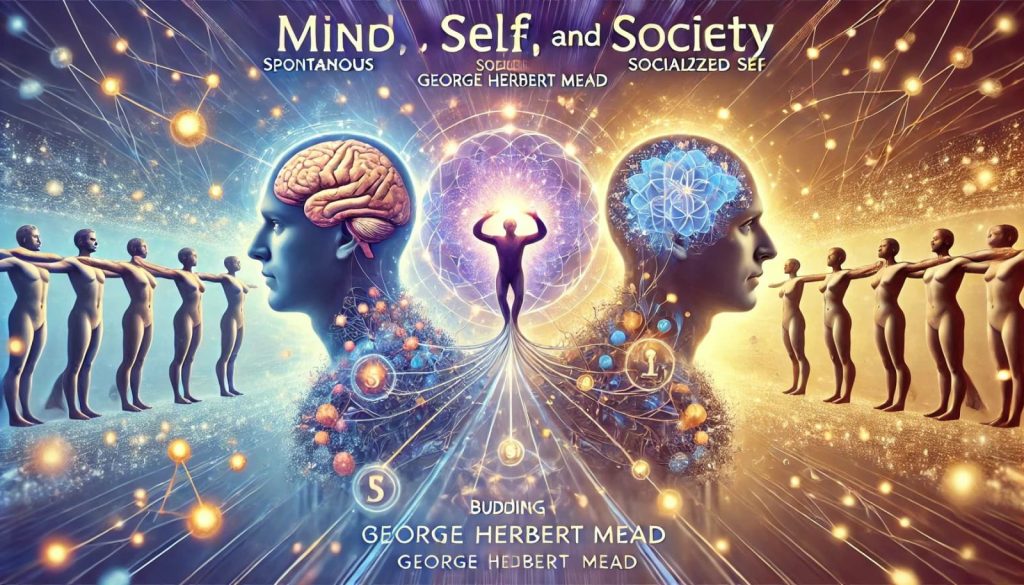
George Herbert Mead’s Mind, Self, and Society is a foundational text that explores the complex relationship between the individual and society through the framework of symbolic interaction. Published in 1934 after Mead’s death, the book is a compilation of his lectures and ideas, curated by his students. It encapsulates Mead’s groundbreaking theories on the development of the self, the role of communication, and the inherently social nature of human consciousness.
In its introduction, the book places Mead’s work within the intellectual traditions of pragmatism and social psychology, offering a lens through which to understand his central premise: that the mind and self are not innate or isolated but are shaped through interactions with others in a social context. Mead challenges the idea that the self is biologically predetermined, proposing instead that it evolves through engagement with the social environment.
Mead also underscores the fundamental role of symbols, particularly language, in shaping thought and facilitating meaningful interaction. Symbols, he argues, are not just tools for communication but are integral to the development of consciousness itself. In Mead’s view, society is not simply a collection of individuals but a dynamic system of interrelationships where individuals and societal structures mutually shape one another. This perspective refutes traditional notions of individual autonomy, emphasizing instead the interconnectedness of people within their social realities.
By portraying the human mind as a socially constructed phenomenon and the self as a product of interaction, the introduction sets the stage for an in-depth discussion of Mead’s key ideas. These include the stages of self-development in childhood, the interplay between the “I” and “Me” within the self, and the concept of the generalized other. The introduction establishes the foundation for Mead’s transformative insights into how humans, as inherently social beings, derive meaning and influence the structure of society through their interactions.
On the basis of above description, it can be stated that through Mind, Self, and Society Mead lays the ground-work for exploring his groundbreaking ideas. It establishes the basis for his core arguments; the mind and self-emerge through social interactions, language and symbols play a crucial role in shaping human thought and communication, and society and individuals are mutually dependent. Mead’s contributions continue to be a foundational element in social theory, providing profound insights into the mechanisms that influence identity, communication, and the structure of social systems. All three aspects; Mind, Self and Society are being described in detail as follows:
The Mind
George Herbert Mead’s conception of the mind emphasizes its social foundations and its evolution through interactions, communication and the use of symbols. Rather than being an inherent or biologically determined feature, the mind emerges as a product of social processes. He saw the mind not as a fixed entity but as an evolving process that develops through social communication. For Mead, the mind emerges through the use of meaningful symbols, like language, which allow individuals to share ideas and think reflectively. This ability to reflect enables people to adopt others’ perspectives, influencing their sense of self and guiding their behaviour within a social context. Mead’s view emphasizes that the mind is inherently social, forming through interaction rather than existing in isolation. Through following explanations, this concept can be understood more accurately:
1. The Emergence of the Mind: Mead argues that the mind is a product of social experiences, stressing that it cannot exist independently of society. This view opposes the idea that the mind is an inherent or entirely individual phenomenon. According to Mead, mental processes emerge through communication with others. It is within social interactions that individuals learn to interpret and react to their surroundings. For Mead, the capacity for thought and reflection is complexly linked to an individual’s involvement in social contexts, as it is through these interactions that individuals gain the necessary tools for thinking.
2. The Role of Significant Symbols: At the core of Mead’s theory of the mind are significant symbols, which include words, gestures and actions that hold shared meanings within a particular community. These symbols are crucial for enabling humans to think abstractly and communicate in a meaningful way. Unlike automatic or instinctual behaviours, which are driven by biological processes, significant symbols allow individuals to predict and respond to the actions of others. For instance, a simple wave of the hand as a greeting is universally understood by both parties as a symbol of acknowledgment or friendliness. This shared interpretation of symbols is essential for the complexity of human social interactions and plays a vital role in the development of the mind.
3. Internalization of Social Interaction: For Mead, the mind is defined by its ability to absorb and process social interactions. This means that individuals can engage in an internal dialogue, envisioning conversations and potential situations before taking action. This reflective ability allows people to consider various viewpoints, evaluate possible consequences and make decisions influenced by social norms. Mead refers to this process as a “mental conversation,” which helps individuals adjust their behaviour in accordance with societal expectations. For example, when confronted with a challenging choice, a person may mentally simulate how others might respond to different actions, using this internalized social feedback to guide their decisions. This process highlights the extent to which the mind is complexly linked to social interactions.
4. The Mind and Language: In Mead’s theory, language plays a crucial role in shaping both the mind and social interaction. He sees language as the fundamental medium through which individuals develop the ability to think and communicate. Through language, people can express their ideas, share meanings and engage in complex social exchanges. Mead goes further to suggest that thought itself is an internal dialogue facilitated by language. This internalized use of language allows individuals to think abstractly, plan and analyze situations systematically. For instance, when faced with a decision, a person often organizes their thoughts using language, even if they are not speaking aloud. This internal verbalization demonstrates how language influences both individual thought processes and social interactions.
5. Distinction from Other Theories: Mead’s concept of the mind presents a stark contrast to traditional philosophical views, particularly the dualism proposed by Descartes. While Descartes separated the mind and body into distinct and independent entities, Mead rejects this separation, instead grounding the mind in social interaction. For Mead, the mind is not a static or isolated entity but evolves through social experiences. Influenced by pragmatism, Mead argues that the mind serves as a practical tool for solving problems and engaging with the social world. It is shaped by ongoing interactions with others, making it flexible and dependent on context.
Mead’s idea of the mind offers a revolutionary perspective on human cognition and behaviour. He argues that the mind develops through social interactions, relying on meaningful symbols for thought and communication. The mind functions as an internal dialogue shaped by social norms and expectations. By challenging traditional dualistic views and emphasizing the importance of language and social interaction, Mead presents a framework that emphasizes the inherent link between individual consciousness and the larger social context.
The Self
In G. H. Mead’s theory, the concept of the self holds a central position and is integral to his sociological framework. Unlike traditional psychological or biological views that treat the self as an inherent or pre-existing characteristic, Mead argues that the self develops through social interactions and communication with others. Mead suggested that the self is not something individuals are born with but rather something that develops through engagement with others. He explained that people form their sense of self by adopting the perspective of the “other,” which helps them see themselves from an external viewpoint. This development occurs in two stages:
- The “play” stage, where children mimic others and assume specific roles
- The “game” stage, where they begin to comprehend and respond to the expectations of a wider community, known as the “generalized other.”
According to Mead, the self consists of two components:
- The “I”, which represents the spontaneous, creative and active part of the self
- The “Me”, reflects societal norms and expectations internalized by the individual
The interplay between these two aspects shapes personal identity and guides behaviour. Mead’s theory highlights that the self is a social construct, shaped by communication and shared meanings within a community. Through following explanations, this concept can be understood more accurately:
1. The Self as a Social Construct: Mead contends that the self is inherently social, meaning it is not an isolated or internal entity but rather one that evolves through relationships with others. The self arises from an individual’s involvement in society and the interactions they have with those around them. It is through these social experiences that individuals come to understand themselves. This process begins early in life and continues as people engage with family, friends and society at large. As a result, the self is both dynamic and relational, constantly shifting in response to new social contexts and evolving interactions. The development of the self, therefore, unfolds within a broader social structure, highlighting that an individual’s sense of identity is inseparable from the people around them.
2. The Two Components of the Self: “I” and “Me”: Central to Mead’s concept of the self is the distinction between the “I” and the “Me,” two interconnected yet distinct aspects of a person’s identity. Rather than being separate entities, these components are dynamic forces that continuously interact with one another, playing a crucial role in the formation of an individual’s sense of self and influencing their actions. Both can further be described as follows:
2.1 The “I”: The “I” represents the spontaneous, creative and impulsive side of the self. It reflects the individual’s immediate, inherent response to situations, acting on personal desires and impulses without being guided by social norms or expectations. This aspect of the self, drives actions that are not predetermined by societal rules, offering room for creativity and unpredictability. The “I” is what enables individuals to make original and independent decisions. It is the force behind novelty and innovation, ensuring that individuals are not passive followers of social norms but active participants in shaping their environment and creating new possibilities.
2.2 The “Me”: Unlike the “I”, which represents the spontaneous and active side of the self, the “Me” refers to the reflective, structured aspect that takes into account societal norms, expectations and roles. The “Me” emerges through the process of socialization, internalizing the perspectives, values and beliefs of others. It reflects how an individual views themselves in relation to society and how they adapt their behaviour to meet the expectations of the larger social group. The “Me” plays a vital role in preserving social order by influencing individuals to align their actions with societal norms and standards. For example, the “Me” prompts someone to behave respectfully in formal settings or adjust their behaviour to fit social expectations. It serves as a guiding force that directs behaviour in ways that are acceptable and consistent with the shared values of society. While the “I” drives personal initiative, the “Me” ensures that actions align with social conventions.
2.3 Interaction Between “I” and “Me”: The “I” and the “Me” are not distinct or opposing forces; rather, they work together in an ongoing process to shape the complete self. The “I” drives action, initiating behaviour, while the “Me” reflects on those actions, assessing them in light of societal norms and expectations. This continuous interaction helps individuals strike a balance between personal expression and social conformity. For instance, when someone decides to speak their mind during a group discussion (the “I”), the “Me” evaluates how others might react and whether the action is socially appropriate. This process of self-regulation enables both individual creativity and social unity. Therefore, the dynamic relationship between the “I” and the “Me” allows individuals to engage with their social environment while maintaining their personal independence.
3. The Role of Social Interaction in Self-Development: Social interaction is fundamental to the formation of the self. According to Mead, the self is not something that develops in isolation but is shaped through significant interactions with others. The development of the self relies on three key processes: communication, role-taking and engaging in games, all of which contribute to this ongoing construction.
3.1 Communication and Language: Language serves as the fundamental means by which individuals engage in social interaction and create meaning. Mead highlights its importance in facilitating communication and influencing the development of the self. Through language, people can articulate their thoughts, share personal experiences and understand the viewpoints of others. This exchange of symbols, such as words and gestures, allows individuals to reflect on their behaviour and receive feedback from others. Communication is inherently reciprocal, with meaning emerging through dialogue in social interactions. As individuals interact, they absorb the responses of others, which helps shape their “Me”. In this way, language acts as a mirror, reflecting back the self and playing a crucial role in the development of self-awareness.
3.2 Role-Taking: A crucial aspect of self-development is role-taking, which refers to the ability to step outside oneself and consider how others perceive and experience the world. This process is key for individuals to grasp different viewpoints and adjust their actions accordingly. Role-taking begins early in childhood, when children engage in imaginative play, taking on roles such as a teacher or doctor. This early stage helps children familiarize themselves with social roles and experiment with various identities. As individuals mature, role-taking evolves into a more complex process, as they learn to consider the viewpoints of several people at once when navigating social situations. It plays a vital role in promoting empathy, as it allows individuals to anticipate others’ responses and needs, promoting smoother social interactions. Moreover, role-taking aids in the development of the “Me,” as individuals internalize societal roles and expectations.
3.3 Play and Game: Mead outlines two pivotal stages in the development of the self: the play stage and the game stage, each reflecting a progression in social complexity and the child’s awareness of their own social identity. Both can be seen as follows:
3.3.1 Play Stage: In the play stage, children engage in imaginative and often unstructured activities where they take on specific roles, such as pretending to be a parent or teacher. At this point, they begin to recognize that others have distinct roles and perspectives, though their understanding remains focused on individual roles and lacks a broader social context.
3.3.2 The Game Stage: The game stage, in contrast, marks a more sophisticated level of self-development. Children at this stage begin to participate in organized social activities, like games or sports, where they must comprehend multiple roles simultaneously and understand the rules that structure these interactions. This stage introduces the concept of the “generalized other,” which represents the broader societal perspective rather than the viewpoints of specific individuals. The development of this concept signals a major shift in self-awareness, as children start to internalize societal norms and expectations that guide their behaviour within larger social frameworks.
4. The Generalized Other and the Self: A crucial aspect of self-development is the concept of the generalized other. This refers to the internalized understanding of the shared values, norms and expectations held by society as a whole, rather than those of any single individual. It embodies the collective sense of how people are expected to behave within a given society. Through social interactions, individuals begin to adopt the perspective of the generalized other, enabling them to assess their actions not only from the point of view of specific individuals but also from the broader societal standpoint. By internalizing the generalized other, individuals are better equipped to navigate complex social environments and ensure their behaviours are aligned with social norms and values.
5. Dynamic and Evolving Nature of the Self: Mead argues that the self is not a fixed entity but a dynamic, evolving process. It is continuously shaped by social interactions and the ever-changing contexts in which individuals find themselves. As people move through different social settings, encounter new roles and form new relationships, their self-concept continues to grow and adapt. This adaptability allows individuals to adjust to novel circumstances, take on new roles and incorporate fresh experiences into their identity. At the same time, there is an element of continuity within the self. Previous experiences, memories and future aspirations all contribute to a stable sense of identity that persists over time. It is through this ongoing process of self-development that individuals can maintain both a sense of continuity and the ability to respond to the evolving demands of society.
In conclusion, Mead’s theory of the self provides a deep and nuanced perspective on human identity, highlighting its inherently social character. The self is not a static or isolated entity but rather emerges from social interactions, influenced by communication, role-taking and the absorption of societal norms. By differentiating between the “I” and the “Me,” and focusing on the role of the generalized other, Mead offers a strong framework for understanding how people engage with their social environment and form a coherent, ever-evolving sense of self. His theory remains influential in fields such as sociology, psychology and communication studies, offering important insights into the dynamic relationship between individual agency and social structure.
The Society
G. H. Mead viewed society as a dynamic and evolving process shaped by human interactions and the exchange of symbols. In George Herbert Mead’s theory, society is not just an external influence on individual behaviour; it is the foundational context that shapes the development of the mind, self and social identity. Mead views society as a continuous and interactive process, where individuals are engaged in constant communication, exchanging and negotiating meanings. These interactions take place within a framework of roles and are regulated by common symbols, language and social norms. Mead argued that society is the product of the interaction between individual agency and collective norms, with language and symbols playing an essential role in navigating social life. His work highlights how personal identity and social structures emerge together through communication, presenting society as fluid and ever-changing. For Mead, both the mind and self, emerge not as inherent traits but as social constructs, formed through active engagement with others in the social world:
1. The Generalized Other: One of the key concepts in Mead’s theory of society is the “generalized other,” which refers to the internalized set of expectations, attitudes and viewpoints of the broader social community. This mental framework embodies the societal norms, values and rules that individuals must learn to follow in order to integrate and function within their society. The generalized other is central to the development of the self. As individuals engage in social interactions, they absorb and internalize these broader societal expectations, which then influence and guide their actions. This internalization process allows people to anticipate how the “generalized other” might think or react in various situations, helping them adjust their own behaviours accordingly. Through this mechanism, the generalized other helps individuals understand their role within the social order, influencing both their behaviour and decisions. For instance, a child learns what it means to be a “good student” by absorbing the behaviours and expectations communicated by teachers, parents and peers. The child then begins to assess their own actions from the perspective of the generalized other, making changes to align with these societal norms. In this way, the generalized other is not just a passive reflection of societal values but a dynamic force that shapes self-awareness and regulates behaviour.
2. Social Interaction as the Foundation of Society: For Mead, social interaction forms the very core of society. Rather than being a rigid and external force that imposes rules on individuals, society is a dynamic and ongoing process shaped by continuous interactions where meanings and symbols are exchanged, negotiated and redefined. In Mead’s perspective, communication, particularly through symbols, is crucial to human interaction. By using language, gestures and other forms of symbolic communication, individuals engage in exchanges that help them interpret each other’s actions, convey intentions and coordinate their behaviours.
This process, which Mead terms symbolic interaction, is essential to the very existence of society. Through such interactions, individuals not only express their thoughts and feelings but also contribute to the construction and refinement of shared meanings that form the foundation of social life. Consequently, society is not a static or unchanging entity, but rather a fluid and evolving system that is perpetually created and re-created through social exchanges. The meanings associated with symbols are not fixed; they are shaped by the ongoing communication between individuals. Each interaction helps build a collective understanding of social reality, making society a constantly evolving and participatory process.
Mead also highlights that individuals are not passive recipients of societal meanings. Instead, they actively participate in the creation and negotiation of these meanings. In social interactions, individuals come to agree on the meanings of symbols and how they should be applied. These shared understandings form the basis of social order. Thus, society is not merely a structure individuals conform to; it emerges from their continuous and active social interactions.
3. The Role of the “I” and the “Me” in Society: Mead’s theory of the self is closely tied to his understanding of society, highlighting the idea that the self is not an inherent or unchanging entity, but one that is formed through social interactions. Central to his theory is the distinction between the “I” and the “Me.” The interplay between the “I” and the “Me” is key to understanding how individuals function within society. The “I” promote creativity and individuality, while the “Me” helps individuals act in socially accepted ways. The tension between these two aspects reflects the ongoing negotiation between personal impulses and social constraints. While society shapes the “Me,” the “I” allows for personal agency and the possibility of social change. This dynamic relationship supports both the stability of social norms and the potential for individual innovation, allowing individuals to influence and transform society even as they conform to it.
4. Society as a Network of Roles: Mead’s view of society highlights the significance of roles. Society is structured around a network of roles, each linked to specific expectations and behaviours. These roles can vary, encompassing familial roles, professional roles and broader societal roles. These roles are learned through the process of socialization and play a key part in shaping how individuals perceive themselves and their relationships with others.
Role-taking is an essential process in the development of the self. This ability allows individuals to grasp the expectations tied to different roles and anticipate how their actions will influence others. This process is vital in aligning behaviour across various roles, contributing to social coordination and order. By engaging in role-taking, individuals can adjust their behaviour to maintain harmony and minimize conflict.
Furthermore, the idea of roles suggests a system of interconnected relationships. Each role is defined in relation to others, meaning that individuals must navigate a network of roles to participate effectively in society. For example, the role of a parent holds meaning only in relation to that of a child. This interdependence necessitates that individuals continuously adjust their behaviour to conform to the roles they occupy and meet the expectations of others within the social framework.
5. The Social Construction of Reality: For Mead, society is more than just a backdrop for human activity; it is the fundamental process through which reality is created. Rather than passively accepting an objective reality, individuals actively engage in shaping and interpreting the world through language, symbols and social interaction. Communication plays a key role in this process, as it allows people to form shared understandings that influence how they perceive and respond to their social environments.
Central to this idea is symbolic interactionism, which explains how reality is socially constructed. Language serves as the primary tool through which meanings are created, negotiated and exchanged. Symbols, words and gestures do not have fixed meanings; rather, their significance arises through their use in social contexts. As individuals interact, they develop a collective understanding of what these symbols represent and these shared meanings guide their actions and interpretations of the world.
This process of constructing reality is dynamic and ever-changing. Meanings are not static but can evolve over time as people gain new experiences and perspectives through ongoing interactions. The construction of reality is not a solitary endeavour; it is a collective process shaped by the continuous reinterpretation and modification of shared symbols and meanings. Thus, society is in constant flux, with the reality it collectively constructs continually shifting in response to the actions and communication of its members.
6. Society and Social Change: While Mead emphasizes the importance of social stability, he also acknowledges the potential for social change. Through continuous negotiation of meanings, reinterpretation of symbols and the questioning of societal norms, individuals and groups have the capacity to drive social transformation. Social movements, emerging cultural practices and evolving communication methods all play a role in this process of change. Since society is based on symbolic interaction, it is sensitive to shifts in how people understand and interpret their surroundings. For instance, changes in language, technological advancements or shifts in cultural values can lead to changes in social structures and relationships. Therefore, while society provides a foundational structure for behaviour, it remains a dynamic entity that can evolve through collective action and social interaction.
Mead views society as a dynamic, evolving process, emphasizing the crucial role of social interaction in shaping the self, mind and social reality. Society is not merely a static environment in which individuals live but the active context through which they develop an understanding of themselves, their roles and their position in the broader world. Through symbolic interactions, role-taking and the internalization of societal expectations, individuals engage with and help shape the ongoing formation of their social reality. Society is a network of relationships, roles and shared meanings that continuously evolves, providing the foundation for both stability and transformation in human social life.
Stages of Self-Development
In Mind, Self, and Society, G. H. Mead outlines the gradual development of the self, emphasizing how it evolves through a series of stages that correspond to increasing complexity in social interaction and the internalization of societal norms. Mead argues that the self is not inherent at birth but instead forms through social engagement. This development occurs in three key stages: the Preparatory Stage, the Play Stage and the Game Stage. Each stage represents a shift in how individuals relate to others, progressing from a self-centered perspective to a more socially interconnected one.
1. The Preparatory Stage (Infancy to Early Childhood): The preparatory stage occurs during infancy and early childhood when children are primarily focused on mimicking the actions of those around them, without understanding the meanings or intentions behind these behaviours. This stage further can be divided into following sub-stages:
1.1 Imitation: During this stage, children imitate the movements, gestures and expressions of important figures in their lives, such as parents or caregivers. However, they do not yet grasp the purpose or significance of these actions. The child’s behaviour is essentially automatic, lacking any deeper symbolic meaning or intent.
1.2 Language Development: Although children begin to acquire language during this stage, they are not yet capable of fully understanding its role in communication or social interaction. Instead, they learn words and symbols by copying the behaviours of others. At this point, the child lacks a defined sense of self and responds mainly to external stimuli. In this early stage, the focus is on replicating behaviours and sounds observed in the environment. This foundational phase plays a crucial role in setting the stage for further development of the self, as it marks the beginning of the child’s engagement with social interactions.
2. The Play Stage (Early Childhood): The play stage typically occurs during early childhood, around ages 3 to 6. At this stage, children start to experiment with different roles by mimicking behaviours of significant figures in their environment, such as parents, teachers or caregivers. They begin to understand that people have distinct roles that influence their actions.
2.1 Role-Taking: In this stage, children engage in imaginative play, where they enact roles they have observed in real life. For example, they might pretend to be a doctor, a teacher or a parent. This process of role-taking helps children develop an understanding of how different actions are connected to specific roles in society, allowing them to grasp the idea that people act according to their societal roles.
2.2 Egocentrism: Although children in the play stage start recognizing that others have roles and perspectives, their understanding is still limited and egocentric. This means that while they can imitate the actions of a mother or teacher, they view these roles mainly through their own experiences and immediate observations. They have not yet fully comprehended the full complexity of these roles or the broader social expectations and rules that govern them.
2.3 Imagination and Social Interaction: The play stage plays a vital role in encouraging creativity, as children explore various roles and experiment with different ways of interacting with others. While they begin to understand that behaviours are linked to specific roles, their grasp of the full depth of those roles is still in its infancy.
The key importance of the play stage lies in the fact that it is the first time children step beyond their own personal experiences, using imagination to simulate and understand the behaviours of others. This marks a critical step in their cognitive and social development.
3. The Game Stage (Later Childhood): The game stage typically starts around the ages of 7 or 8 and continues through later childhood and adolescence. During this stage, children reach a more advanced stage of self-development, where they begin to grasp the complexities of social roles and the expectations associated with them.
3.1 Coordinating Multiple Roles: In the game stage, children begin to engage in organized games that involve multiple players, like baseball, soccer or similar team activities. These games necessitate an understanding of not only one’s individual role but also the roles of others within the game. For instance, in a team sport, a child must comprehend how their specific role connects with and impacts the roles of other players, including teammates and opponents.
3.2 The Generalized Other: A significant milestone in the game stage is the development of the ability to comprehend the generalized other. As children engage in more structured activities, such as complex games, they begin to understand how different roles are interrelated and how their behaviour must align with the established rules and conventions of society. This stage marks a shift, where children start considering not only the expectations of those immediately around them but also the larger, societal norms that govern behaviour.
3.3 Complexity of Social Understanding: During this stage, children begin to recognize the social rules and norms that guide their behaviour and start to assess themselves based on how others might view them. The game stage marks a shift from self-centered play to a more advanced understanding of social interactions and the roles individuals occupy within broader societal structures.
3.4 Reflection on the Self: As children engage with others in structured games, they start to consider their actions and behaviours in connection with the roles they assume. This interaction helps them absorb the values and expectations of the broader community, leading to the formation of a more unified and self-aware identity.
During the game stage, individuals progress from basic role-taking to a deeper comprehension of how their actions align with a broader network of social roles and societal expectations. This phase is crucial for the emergence of social awareness and the formation of self-consciousness.
4. The Evolution of the Self Through the Stages: The self is evaluated through following stages:
4.1 From Spontaneity to Reflection: In the preparatory stage, the self is not yet developed; it operates solely in response to external stimuli. As the child progresses into the play stage, they begin to develop a basic awareness of social roles, though their understanding is still rooted in their own viewpoint. By the time they reach the game stage, individuals gain the ability to take on the perspectives of multiple people, recognizing how these various viewpoints are connected and start to reflect on their behaviour within the broader context of societal norms and expectations.
4.2 Internalization of Social Norms: Throughout these stages, children gradually adopt societal norms and values, which play a key role in the formation of the “me” component of the self. By the game stage, individuals not only reflect on their actions according to the standards of society but also begin to align their behaviour with the expectations of the generalized other, acting in ways that are consistent with the broader social order.
On the basis of above description, it can be stated that Mead’s theory of self-development emphasizes the fundamentally social aspect of human growth and awareness. Starting from the imitative actions in the preparatory stage, individuals gradually move toward a more complex understanding of roles and societal expectations in the game stage. This progression leads to the development of a self that is formed through social interactions and is constantly influenced by these interactions. Each stage serves as a stepping stone, with the play stage laying the groundwork for the more sophisticated role-taking seen in the game stage. Ultimately, this process results in the emergence of a self that is complex, reflective and deeply embedded in social contexts.
Critical Evaluation
George Herbert Mead’s Mind, Self, and Society is a pivotal work that has profoundly shaped the fields of sociology, social psychology, and philosophy. While the theory presents a compelling framework for understanding social interaction and identity, it has also been critiqued for certain limitations. Below is a critical assessment of Mead’s contributions, highlighting the criticisms:
1. Lack of Empirical Evidence: Mead’s work is largely conceptual and philosophical, with minimal empirical validation to support his claims. This lack of systematic research has raised questions about the practical applicability and testability of his theories.
2. Overemphasis on Social Determinism: Critics argue that Mead’s theory leans heavily on the idea that the self is shaped by society, potentially underestimating the role of individual agency. While Mead acknowledges the spontaneity of the “I,” his framework often seems to prioritize societal norms over personal autonomy and creativity.
3. Inadequate Focus on Power and Inequality: Mead’s work largely overlooks how power dynamics, social hierarchies, and systemic inequalities influence social interactions and the development of the self. Contemporary scholars, including critical theorists and feminists, have expanded upon Mead’s ideas to address these dimensions, which are essential to understanding marginalized groups and structural inequalities.
4. Cultural Limitations: Mead’s theory reflects a Western, individualistic perspective that may not fully account for experiences in collectivist or non-Western societies. His emphasis on individuality and the generalized other may not align with cultures where identity and roles are more deeply embedded within communal and interdependent frameworks.
5. Neglect of Emotional and Subconscious Influences: While Mead’s theory excels in analyzing social interaction and rational thought, it pays little attention to emotions, instincts, and the subconscious. Scholars in psychoanalysis and affect theory have critiqued Mead for not addressing these important aspects of human behaviour, which significantly shape identity and relationships.
6. Ambiguity in Core Concepts: Some of Mead’s key concepts, such as the “I” and “Me,” lack precise definitions, making them open to interpretation. This ambiguity has led to varying understandings of his ideas and has posed challenges in applying them to empirical research.
7. Contemporary Relevance and Extensions: Despite these criticisms, Mead’s work remains highly influential, and many of its limitations have been addressed by later scholars:
- Feminist theorists have expanded Mead’s ideas to explore the social construction of gender and identity.
- Critical race theorists have built on his framework to examine how race, privilege, and systemic inequality shape the self and social interactions.
- Postmodernists have critiqued Mead’s reliance on universal concepts like the generalized other, instead emphasizing the fragmented and fluid nature of identity in contemporary society.
Additionally, Mead’s focus on symbolic communication continues to have relevance in studying modern phenomena such as social media, digital interactions, and virtual communities, where symbols and communication play an even more central role.
On the basis of above description, it can be stated that George Herbert Mead’s Mind, Self, and Society offers a profound framework for understanding the relationship between individuals and their social environment. While it has faced criticism for its lack of empirical evidence, cultural biases, and insufficient attention to power dynamics and emotions, its strengths in explaining identity formation, socialization and symbolic communication remain undeniable. By building upon and refining Mead’s ideas, contemporary scholars have ensured that his contributions continue to inform and inspire social theory.
References:
Mind, Self and Society, by G.H. Mead, https://a.co/d/6Vkx4MP
Unit 4, IGNOU Study Material, https://egyankosh.ac.in/bitstream/123456789/90654/1/Unit-4.pdf
Sociological Theory, by George Ritzer, https://amzn.in/d/cq7RdBI