& Dialectical Materialism
- Dialectical Materialism
- Characteristics of Dialectics
- Idealism and Materialism
- Principles of Dialectical Materialism
- Dialectical Method
- Historical Materialism
- Materialistic Conception of History
- Elements of Materialistic Conception of History
- Theory of Historical Materialism
- Epochs in Historical Development
- Critical Evaluation
Dialectical Materialism

Dialectics serves as a method for comprehending the dynamic nature of both the natural world and society. It proposes that everything undergoes continuous change, acknowledging that this change involves inherent contradictions. Rather than a linear progression, dialectics portrays change as punctuated by sudden, intense periods where gradual shifts culminate in qualitative transformations. It’s essentially the logic of contradiction.
While Hegel extensively elaborated on the laws of dialectics, Marx and Engels grounded it in scientific materialism. Trotsky noted Hegel’s prescience in anticipating scientific advancements but criticized his idealistic interpretation. Marx, in contrast, viewed dialectics through a materialist lens, seeing the material world as the basis for thought.
Hegel’s idealism led to an abstract and arbitrary application of dialectics, imposing it upon nature and society. Marx, however, diverged from Hegel by integrating dialectics with material reality. He emphasized the interconnectedness of thought and the material world, rejecting Hegel’s notion of the ideal as separate from reality.
The world presents an intricate tapestry of phenomena, characterized by constant change and causality. Scientific inquiry aims to unravel this complexity, seeking to discern overarching laws that differentiate between the incidental and the essential, allowing us to grasp the underlying forces at play.
The Origin of Materialism- from Francis Bacon to Karl Marx
Francis Bacon’s revolutionary ideas during this era emphasized the infallibility of the senses and the primacy of experience as the foundation of knowledge. Bacon advocated for a rational method of inquiry involving induction, analysis, comparison, observation and experimentation. Thomas Hobbes further developed Bacon’s materialism by asserting that ideas were mere reflections of the material world, emphasizing the inseparability of thought from matter. John Locke later reinforced this materialistic perspective.
The materialist philosophy originated in England eventually spread to France, where thinkers like René Descartes expanded and refined its principles, extending critiques beyond religion to encompass all social institutions and ideas. These French materialists championed reason and provided ideological ammunition for the bourgeoisie in their struggle against the monarchy, contributing to the ethos of the French Bourgeois Revolution of 1789-93.
However, the materialism of this period, starting from Bacon, was criticized for its rigid and mechanistic interpretation of nature, particularly influenced by the dominance of Isaac Newton’s mechanical science in the 18th century. Engels highlighted its limitation in comprehending the universe as a dynamic process of historical development.
Meaning of Dialectics
Dialectics, rooted in the Greek term dialego meaning discourse or debate, originated as a method to uncover truth by revealing contradictions within arguments and resolving them. Ancient philosophers saw the clash of opposing viewpoints as the path to truth, a method later extended to understanding natural phenomena. This dialectical approach views nature as constantly changing and evolving through the interaction of opposing forces. Before Marx and Engels, ancient Greek thinkers like Plato, Zenon, and Aristotle explored dialectical thinking. Heraclitus, around 500 B.C., famously stated that everything is in flux, highlighting the concept of constant change and contradiction in nature.
Modern materialism emphasizes matter over mind, but dialectics offers a deeper understanding. Engels describes dialectics as the study of the general laws governing the motion and development of nature, society and thought. While Marx and Engels acknowledge Hegel’s influence on dialectical thought, they diverge significantly. Marx criticizes Hegel’s idea of “the Idea” as the creator of reality, asserting instead that the material world shapes human thought.
In essence, dialectics opposes metaphysics, with Marxian dialectics grounded in materialism rather than idealism. Marx rejects Hegel’s emphasis on ideas, asserting that the material world, not abstract concepts, forms the basis of understanding.
Characteristics of Dialectics
1. Nature Connected and Determined: In contrast to metaphysics, dialectics views nature not as a random collection of unrelated phenomena but as an interconnected whole. In this perspective, phenomena are not isolated entities but are instead organically linked, dependent on and influenced by each other. The dialectical approach asserts that understanding any natural phenomenon requires considering its relationship with surrounding conditions; without this context, it may lose meaning. Conversely, when examined within its broader context, any phenomenon can be comprehended and elucidated, as it is shaped by its interactions with surrounding phenomena.
2. Nature is a State of Continuous Motion and Change: In contrast to metaphysics, dialectics posits that nature is not static and unchanging but rather characterized by continuous movement, renewal and development. According to this approach, phenomena should be examined not only in terms of their interconnectedness but also in terms of their dynamic nature, including their emergence, evolution and eventual decline. Dialectics prioritizes what is currently evolving and developing over what appears durable but is actually in the process of decline. Engels emphasizes that everything in nature, from the smallest entities to the largest, exists in a perpetual state of flux and motion, undergoing constant change and transformation. Thus, dialectics focuses on the interconnectedness, continuity and movement of things and their perceptual representations, emphasizing the dynamic processes of emergence and disappearance.
3. Natural Quantitative Change Leads to Qualitative Change: In contrast to metaphysics, dialectics views the process of development not merely as a linear progression, where small changes accumulate gradually without leading to significant shifts in quality. Instead, it sees development as a progression from minor, imperceptible quantitative changes to profound qualitative transformations. These qualitative changes do not occur gradually but rather swiftly and abruptly, resembling a leap from one state to another. They are not random but are the natural outcome of a buildup of imperceptible, incremental changes over time. The dialectical approach asserts that development should be understood as a forward and upward movement, not as a repetitive cycle. It involves a transition from an old qualitative state to a new one, a progression from simplicity to complexity, from lower to higher states.
4. Contradictions are Inherent in Nature: In contrast to metaphysics, dialectics asserts that inherent within all natural things and phenomena are internal contradictions, encompassing both negative and positive aspects, past and future, decline and growth. This perspective recognizes the ongoing struggle between these opposing forces, between the old and the new, the dying and the emerging, the fading and the evolving. This conflict forms the intrinsic essence of developmental processes, the transformation of quantitative shifts into qualitative changes. According to the dialectical approach, progress from lower to higher states doesn’t occur harmoniously but rather unveils the contradictions within phenomena, manifesting as a “struggle” between opposing tendencies rooted in these contradictions.
Idealism and Materialism
Across the annals of philosophical inquiry, two prevailing streams of thought emerge: Idealism and Materialism. The Idealistic School of Thought, exemplified by luminaries such as Plato and Hegel, views nature and history as manifestations of ideas or spirit. Central to idealism is the notion that a divine Spirit is the creator of humanity and all material entities. This perspective posits that ideas wield paramount influence over the trajectory of the material world. Accordingly, historical progression is interpreted as a narrative of evolving thought, with human actions stemming from abstract conceptualizations rather than material exigencies. Hegel’s contributions extend this paradigm, positing an independent “Idea” existing beyond individual consciousness and divorced from material constraints. In this framework, religion assumes an integral role within philosophical idealism.
The Materialist School of Thought
Materialist thinkers argue that the material world, perceived through our senses and studied by science, is genuine, with nature or matter taking precedence. They posit that the mind and ideas are products of the brain, emerging at specific stages in the evolution of living matter. Key tenets of Materialism include:
- The material world, observed and understood through empirical means, operates according to its inherent natural laws, devoid of supernatural intervention.
- There exists only one world, the material realm. Thoughts originate from matter (the brain), indicating the inseparability of minds or ideas from material substance. General concepts merely mirror aspects of the material world.
Karl Marx articulated this perspective, stating, “To me, the idea is simply the material world reflected in the human mind, translated into thought forms,” and further emphasizing, “Social existence determines consciousness.”
Idealists, conversely, view consciousness and thought as distinct from and opposed to matter and nature. This dichotomy is deemed artificial, as Marx highlighted the close correlation between the laws governing thought and those governing nature, suggesting that the ideal world merely reflects the material one. Thought derives its categories not from itself but from the external world.
Even seemingly abstract disciplines like mathematics ultimately stem from material reality, not solely from mental abstraction. For instance, the foundation of the decimal system traces back to the fact that humans possess ten fingers. According to Lenin, sensation, thought and consciousness are all manifestations of matter, underscoring the primacy of materialism.
Human beings, integral parts of nature, shape their ideas through interaction with their surroundings. While mental processes are real, they are not independent of nature; instead, they should be examined within their material and social contexts. Marx posited that the ideas formed in the human brain are products of their material life processes, emphasizing that consciousness evolves alongside material conditions.
In summary, Materialism asserts that consciousness and thought are products of the material world, intricately intertwined with the processes of nature and society, thus rejecting any notion of their absolute independence.
Principles of Dialectical Materialism
Dialectical materialism integrates the principles to examine historical and social occurrences. Within this framework, several pivotal dialectical processes are identified:
1. Contradiction and Conflict: Dialectical materialism acknowledges that societies contain inherent contradictions, such as those between different social classes (like the bourgeoisie and the proletariat), conflicting economic interests or divergent modes of production. These contradictions serve as catalysts for conflicts that propel historical transformations.
2. Negation of the Negation: This idea proposes that transformation unfolds through a series of stages: first, by challenging prevailing circumstances (the thesis); then, by encountering resistance or contradiction (the antithesis); and finally, by synthesizing these conflicting elements into a new state. This synthesis then serves as the starting point for further evolution, perpetuating an ongoing cycle of progress and change.
3. Quantitative Change to Qualitative Change: Dialectical materialism recognizes that gradual, incremental changes within a system can accumulate over time, eventually resulting in significant qualitative transformations. For instance, small adjustments in economic relations can build up until they bring about a fundamental shift in the mode of production, ultimately leading to the emergence of a new societal structure.
4. Unity of Opposites: This principle underscores the essential relationship between opposing forces within a system. Dialectical materialism doesn’t see contradictions as isolated or fixed elements but rather as interconnected and dynamic. It emphasizes their unity in dialectics, acknowledging that they shape and define each other, playing a crucial role in shaping social reality.
In practice, dialectical materialism offers a lens through which to examine historical events, societal frameworks and the potential for revolutionary change. Essentially, dialectical materialism provides a fluid and inclusive approach to grasping the intricate and ever-changing dynamics of human societies.
Dialectical Method
Karl Marx’s interpretation of the dialectical method, especially concerning his analysis of capitalism and his envisioning of socialism, offers profound insights into the principles of thesis, antithesis, and synthesis.
1. Thesis: The thesis serves as a reflection of the prevailing circumstances, dominant ideologies or central concepts within a given context, providing a foundational basis for analysis. In Marx’s examination, the thesis represents the established condition within a specific socio-economic framework. Within this context, the thesis encapsulates the dominant mode of production, property ownership arrangements and class hierarchies.
2. Antithesis: The antithesis emerges as the negation or opposition to the thesis. The antithesis challenges the status quo, presenting alternative perspectives, ideas or conditions that contradict or negate the prevailing thesis. These contradictions arise within the thesis itself and are inherent in nature. The emergence of the antithesis can be understood as a reaction to the inherent contradictions and injustices.
3. Synthesis: The clash between the thesis and antithesis instigates a dialectical process marked by tension and conflict, which propels societal evolution. Through this ongoing dialectical struggle, a synthesis emerges. This synthesis embodies a more comprehensive understanding or state of affairs that reconciles the contradictions between the thesis and antithesis. It integrates elements from both perspectives while transcending their limitations, thereby opening pathways to new possibilities and development.
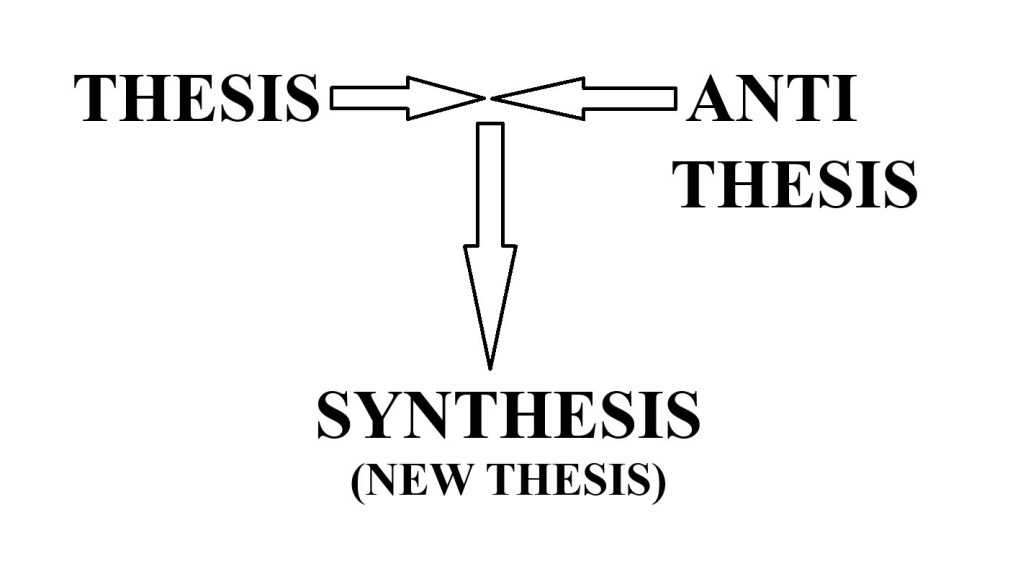
In essence, Marx’s view of thesis, antithesis, and synthesis offers a dialectical lens through which to comprehend the complexities and fluctuations within capitalist society. It underscores the pivotal role of class struggle in steering historical progress and suggests the potential for a revolutionary shift towards a socialist order. This framework emphasizes the capacity of the proletariat to challenge and transcend the inequalities inherent in capitalism, envisioning a future where social and economic justice prevail.
Historical Materialism
(Materialist Conception of History)
Introduction
Historical materialism, originating from Karl Marx’s materialist conception of history, offers a methodological framework for analyzing the evolution of human societies. According to this perspective, a society’s mode of production and the corresponding social relations of production fundamentally shape its organization and development. By examining how societies collectively produce and reproduce the necessities of life, historical materialism seeks to uncover the root causes of societal changes.
Central to historical materialism is the understanding that social classes, along with their interrelationships and accompanying political structures and ideologies, are deeply rooted in the prevailing economic activities of a given society. Marx, as the influential figure behind this school of thought, emphasized the practical application of philosophy to effect tangible changes in society. His vision aimed to eradicate exploitation, inequalities and social injustices by addressing the underlying economic structures that perpetuate them.
Marx envisioned history as a series of class struggles and advocated for the establishment of a classless society, where these conflicts would be resolved, along with broader philosophical dilemmas related to human alienation. His solution to overcoming human alienation involved transformative action to reshape the material conditions of society. In essence, the materialist conception of history serves as both a diagnostic tool, highlighting inherent societal problems, and a roadmap for societal transformation towards a more equitable and harmonious existence.
Materialistic Conception of History
Marx underscores the intrinsic historicity of human existence, positing that it is propelled by material dynamics. Historical materialism, his framework, seeks to elucidate society’s origins and progression through a materialistic lens, delineating the pivotal role of material forces in societal formation and evolution. Central to this understanding is the economic framework of a given society, encompassing the interplay between different social groups and their economic relationships.
Referred to as historical materialism, Marx’s overarching societal concepts revolve around the primacy of material conditions in shaping and advancing society. According to Marx, these conditions primarily consist of the technological means of production, with societal structure and development being profoundly influenced by the dynamics of production forces and relations.
Marx’s theory of historical materialism is inherently historical, tracing the progression of human societies across stages. Its materialistic orientation lies in interpreting societal evolution in terms of its material and economic foundations. Materialism, in this context, asserts that material reality serves as the catalyst for societal change. Historical materialism entails understanding society’s structure as fundamentally rooted in its economic base. Marx’s theory interprets societal history through a materialistic lens, asserting that all societies follow similar historical patterns shaped by their material conditions.
Marx posited a view of unilinear societal evolution, suggesting that each society progresses through distinct stages. He contended that societal histories are constructed upon their material foundations, emphasizing the interconnectedness between economic infrastructure and societal development.
Primitive Communism → Slavery → Feudalism→ Capitalism →Socialism →Communism
Historians have chronicled the progression of history as it unfolds, yet Marx envisioned a future where history guides humanity through distinct stages. In his view, each stage inevitably contains the seeds of its own destruction, paving the way for the emergence of new ones. This process of succession continues until reaching the ultimate stage: communism.
Marx’s theory aimed to dissect all social phenomena by analyzing their roles within the intricate fabric of societal and natural systems. Unlike the metaphysical explanations prevalent in the early writings of Hegel and his adherents, Marx’s approach matured into a sophisticated sociological framework for understanding the formation and evolution of human societies.
Elements of Materialistic Conception of History
Essential elements of Marx’s Materialistic Conception of History encompass:
1. Material Conditions as the Basis of Society: Marx argued that the fundamental framework of society, encompassing production and distribution systems, serves as the cornerstone upon which all other social institutions are constructed. This economic foundation shapes the social, political and cultural aspects of society, forming what Marx termed the superstructure.
2. Class Struggle: At the core of Marx’s ideology lies the notion of class conflict, stemming from the fundamental clash of interests among diverse social classes. Marx observed societies throughout history defined by the ongoing battle between prevailing and marginalized classes, exemplified by the tension between the bourgeoisie (controllers of production means) and the proletariat (labourers) within capitalist frameworks.
3. Mode of Production: Marx delineated various modes of production across historical epochs, distinguished by unique configurations of production relations and ownership structures. These encompass primitive communism, slave society, feudalism, capitalism and socialism. Transformations in the mode of production propel historical progression by reshaping the societal dynamics among different classes.
4. Dialectical Materialism: Marx’s theory of historical materialism stems from dialectical materialism, which blends Hegelian dialectics with a materialist interpretation of history. It posits that historical progress arises from the clash of conflicting forces (thesis and antithesis), culminating in the formation of new social realities (synthesis).
5. Revolutionary Transformation: Marx posited that capitalism harboured built-in inconsistencies destined to precipitate its demise. He foresaw a deepening class conflict within capitalism, ultimately climaxing in a proletarian uprising. This upheaval would usher in a socialist order wherein the working class collectively owns and manages the means of production.
6. Critique of Ideology: Marx posited that the ruling elites employ various forms of ideology, such as religion, morality and culture, to legitimize their authority and uphold the status quo. By employing a materialistic approach, Marx sought to reveal the economic motivations and power structures veiled by these ideological constructs.
Theory of Historical Materialism
Marx’s seminal work “A Contribution to the Critique of Political Economy” (1859) offers a comprehensive elucidation of historical materialism, a cornerstone of his philosophical framework. Central to Marx’s analysis is the primacy of the economic structure in shaping society. He contends that a society’s economic base, characterized by its relations of production, fundamentally determines its legal and political superstructure. These relations of production, in Marx’s view, mirror the prevailing stage of a society’s productive forces.
According to Marx’s theory of historical materialism, all entities, whether animate or inanimate, undergo perpetual transformation. The pace of this transformation adheres to the principles of dialectics. Marx posits that the emergence of new productive forces inevitably clashes with existing relations of production. This clash engenders a state of conflict that prompts societal awareness and a desire for resolution, marking what Marx terms the Period of Social Revolution. Through revolution, conflicting forces are reconciled, paving the way for the establishment of new relations of production rooted in the burgeoning productive forces.
For Marx, the trajectory of human history is delineated by the growth of these productive forces, which constitute the means by which society generates its material conditions of existence. Consequently, Marx’s conception of history, termed historical materialism, underscores the centrality of these evolving forces of material production.
The concepts articulated within Marx’s theory of historical materialism are indispensable due to their cogent analysis of the interplay between economic structures, productive forces, and societal development. Following are some concepts which needs to be understood before understanding different epochs of historical materialism:
1. Infrastructure and Super-structure: Marx proposed that within each society, there exists both an infrastructure and a superstructure. Infrastructure is the foundation on which whole society is based and everything else in the society is depended on it. For Marx that base is economic condition of the society. Hence, infrastructure is the economic condition of society. Conversely, the superstructure comprises of all other aspects of society like ideological, political, cultural, religious etc. that arise from and are influenced by the infrastructure. Marx posited that the superstructure is intricately linked to the economic base, implying that changes in the infrastructure due to technological progress and shifts in economic relations precipitate corresponding changes in the superstructure. Marx viewed the infrastructure as the cornerstone upon which the superstructure is erected. It establishes the conditions of existence and moulds the broader socio-economic and cultural fabric of society.
2. Means of Production: Karl Marx’s theory places significant emphasis on the means of production, which are the essential physical and technological resources required for producing goods and services within a society. These encompass various assets such as tools, machinery, factories, land and natural resources. At the core of Marx’s theory lies the notion that control over these means of production shapes the social relations and power structures within a society. Marx distinguished between two primary classes: the bourgeoisie, who possess and govern the means of production and the proletariat, who are compelled to sell their labour to the bourgeoisie for their livelihood.
3. Relations of Production: Relations of production are intimately linked with the means of production, encompassing the tools, machinery and resources essential for production. He posited that within any society, specific relationships emerge among individuals concerning the ownership, control and distribution of these means. These relationships dictate who possesses and oversees the means of production, who carries out the labour, and how the fruits of labour are apportioned. In the context of capitalism, Marx identified the principal relations of production as those between bourgeoisie, who hold ownership and control over the means of production, and proletariat, who trade their labour power to capitalists in return for wages. Marx underscored the exploitative nature of this arrangement, where bourgeoisie extract surplus value from the labour of proletariat, resulting in class struggle and estrangement.
4. Forces of Production: Labour power denotes the human capability to engage in work. Workers trade their labour power for wages, often dictated by market dynamics rather than the genuine value of their contributions. When labour uses their power and skill to convert raw material into a finished product then it is called as Forces of Production. Marx posited that the evolution of the forces of production serves as a catalyst for historical advancement and societal transformation. Technological breakthroughs and innovations in production have the potential to enhance efficiency and output, theoretically fostering wealth creation.
5. Mode of Production: This concept pertains to how a society structures and conducts its production activities, encompassing both the relationships between individuals involved in production and the means utilized for production. Marx delineated various modes of production across history, each marked by distinct social arrangements and economic frameworks like primitive communism, ancient slavery, feudalism, capitalism and socialism. Each mode is characterized by specific production relationships and prevailing ownership models. According to Marx, the mode of production serves as the groundwork for societal structure, influencing its political, legal and cultural institutions. He posited that shifts in the mode of production, catalyzed by technological advancements and class conflicts, prompt social upheavals and the emergence of new production modes.
Epochs in Historical Development
This leads to a comprehensive framework wherein human cognition is understood through the lens of the societal structures within which it operates. In addition to discussing the forces and relationships of production, Marx also delves into the concept of the mode of production. Consequently, he outlines different epochs of human history characterized by distinct modes of production: Primitive Communism, Asiatic, Ancient, Feudal, Capitalist and Communist mode of production. The detailed description of mentioned modes of production is as follows:
1. Primitive Communism: Primitive communism, marks an early phase in human development characterized by communal ownership and equality. This societal structure, observed in early hunter-gatherer communities, entails shared ownership of resources and production tools among all members. It operates without social classes or private property, with individuals contributing collectively to labour for the common good. Decision-making is typically collaborative and based on consensus, reflecting the interdependence and cooperative nature necessary for survival within the community. Although lacking the complexity and technological advancements of later systems, primitive communism embodies a socio-economic framework based on solidarity and communal unity, offering insights into early human social dynamics and cooperative endeavours.
2. Asiatic Mode of Production: As primitive communism nears its end, a select group of physically powerful individuals begins to assert claims to private property. This gradual erosion of communal ownership marks the demise of primitive communism and the emergence of a new societal order. This mode represents one potential trajectory from classless to class-based societies, likely one of the earliest such transitions. It revolves around primitive communities where land ownership is communal and kinship ties play a significant role in organization. It encapsulates the inherent contradiction of this shift: the coexistence of communal production relations with nascent forms of exploitation and state control.
3. Ancient Mode of Production: Primitive communism gave way to a system of slavery, where those possessing physical, political and material power exerted control over others. This division led to the emergence of distinct classes: the owning class (masters) and the non-owning class (slaves). Over time, Marx observed that land ownership became concentrated in the hands of certain individuals, resulting in widespread deprivation among those left without land. Forced into dependence on landowners for survival, many fell into debt bondage, facing the threat of being sold if they could not repay their debts. Slaves were treated as mere property, devoid of rights and subjected to brutal exploitation. Families were torn apart as individuals were bought and sold, perpetuating a cycle of oppression where masters held absolute authority. However, such oppressive systems inevitably face internal resistance. Slaves and peasants, recognizing their shared plight, often rose up in revolt against their masters, seeking liberation from bondage. This marked the transition away from slavery towards a new stage of social organization.
4. Feudal Mode of Production: In historical narratives, Marx delineated a society characterized by two distinct classes: feudal lords and serfs. The lords, possessing land, leased it out and employed agricultural labourers, who were obligated to pay taxes while receiving wages. Under the feudal system, the nobility, or feudal lords, held authority over the serfs and peasants, collecting taxes and providing protection through their armed forces. Concurrently, a nascent trading and commercial class began to emerge in small towns, benefiting from surplus agricultural production that could be exchanged. This class, distinct from both the nobility and the serfs, derived its wealth from trade rather than taxation or direct involvement in production. Over time, this trading class evolved into the bourgeoisie, which played a pivotal role in challenging the privileges of the aristocracy. As productive forces expanded with the advent of the industrial revolution and the exploration of the New World, the bourgeoisie capitalized on the shift from agrarian to manufacturing economies and brought the next stage.
5. Capitalistic Mode of production: Marx was deeply concerned with a pivotal stage characterized by significant migration from rural to urban areas, a shift marked by the transition of agricultural workers to industrial labour. Within this societal shift, two distinct classes emerged: the owning class (bourgeoisie) and the working class (proletariats). Capitalism is characterized by the complete separation of the means of production, such as land and tools, from the majority of the working class, with ownership concentrated in the hands of a small capitalist elite. Marx posited that the shift from feudalism to capitalism involved a coercive process in which small peasants and workers were forcibly stripped of their means of production, particularly land, by the state.
Marx delineates socialism as the precursor to communism, where equality prevails, individuals stand on equal footing and private property ownership becomes obsolete. Socialism encompasses two ownership models: state ownership and cooperative ownership. Conversely, communism embodies a singular ownership structure—either state or communal ownership—where each individual receives commensurate to their contributions.
6. Communist mode of production: Karl Marx envisioned the communist mode of production as the pinnacle of societal evolution, characterized by a profoundly egalitarian economic structure. This system involves collective ownership of the means of production and the absence of private property. In a communist society, resources and productive assets are owned and managed by the community as a whole rather than by individual capitalists or the state. The core principle guiding this mode of production is the equitable distribution of goods and services: individuals contribute according to their abilities and receive based on their needs, rather than participating in market-based exchanges. The goal is to transcend class distinctions and eradicate exploitation, fostering a society free from economic inequality and social injustice.
Critical Evaluation
Based on the preceding analysis, it can be argued that Karl Marx formulated a scientific theory regarding the progression of history, famously termed historical materialism. He endeavoured to substantiate and establish a scientific foundation for the materialistic ideology associated with him. However, this theory is not without its shortcomings, prompting a critical examination of one of its fundamental tenets. In evaluating the Marxian theory of historical materialism, it is pertinent to consider the following criteria:
1. Historical Materialism is Baseless: The initial criticism suggests that this perspective lacks substantiated evidence, remaining merely theoretical. A historic-philosophical theory ought to draw from contemporary historical evidence, extending its applicability across different epochs. Alternatively, it could derive from past historical events and extend its relevance to both the present and the future. Furthermore, such a theory should be supported by valid scientific, logical or philosophical arguments. However, the theory of historical materialism fails to adhere to any of these approaches.
2. Economic Base is Supreme: Marx delineates society’s economic foundation as its infrastructure, with other aspects constituting its superstructure. This framework suggests a hierarchical relationship wherein the economic base holds sway over and sustains the super-structural elements. Marx’s prior assertions underscore this unilateral dependence, emphasizing the primacy of economic factors in shaping all facets of society. In certain writings, Marx introduces a nuanced perspective on dialectical logic, deviating somewhat from the notion of absolute materialism. He introduces the concept of reciprocal influence, positing a mutual interdependence among various components of nature and society. This theory challenges the notion of unilateral causation, suggesting a dynamic interplay between different elements.
3. Nonconformity of the Basis of Class Ideology: According to the perspective of historical materialism, the superstructure of any era is bound by the limits of its infrastructure. This implies that the knowledge and ideologies of a specific period are inherently tied to that era and eventually become outdated as time progresses, relegated to the annals of history. Concepts, philosophies and religious beliefs emerge in response to the unique circumstances of their time and may not necessarily align with future epochs. However, reality often presents exceptions to this theory.
Contrary to the strict confines of historical materialism, numerous instances demonstrate ideas and theories that transcend their temporal origins. Many philosophies, individuals and fields of study appear to anticipate or exceed the limitations of their era or societal class. Despite being born from the material conditions of a particular age, some ideas retain their relevance and significance throughout history.
4. Independence of Cultural Development: According to the theory of historical materialism, the cultural and scientific aspects of society, just like its political, judicial and religious dimensions, are contingent upon its economic foundation and cannot progress independently. Scientific advancement occurs in tandem with the development of production tools and the economic structure of society. In reality, the progression of production tools doesn’t occur spontaneously; it happens through human interaction with nature and deliberate inquiry. Human scientific and technical progress accompanies this growth and development. The question arises: which comes first, the discovery by humans followed by the creation of tools, or the creation of tools leading to discoveries? The latter seems to be the case. Scientific laws and technical principles are unearthed through human curiosity and experimentation with nature. Without inquiry and experimentation, no scientific or natural laws can be discovered. The only debate lies in whether scientific development precedes the creation of technical tools or vice versa.
5. Historical Materialism Is Self-contradictory: Historical materialism asserts that every idea, theory and moral system is shaped by specific material and economic conditions and thus lacks absolute value. As circumstances change, these ideas lose relevance and must be replaced by new ones. This perspective is considered by some philosophers and sociologists as a universal principle for understanding society. To deny this would imply exceptions to the law, suggesting the existence of independent philosophical and scientific laws unaffected by economic factors. Even if historical materialism is subject to its own principles, its validity would be limited to the period it emerged in, rendering it obsolete in preceding or subsequent eras. Critics notwithstanding, Marxian thought on historical materialism remains a significant contribution to our scientific understanding of societal development. By challenging prevailing idealistic philosophies, Marx introduced a new perspective grounded in dialectical materialism, offering insight into the evolution of societies.
References and Readings:
Sociological Theory, by Ritzer G, https://amzn.to/3Da3pcm
Sociology by C.N. Shankar Rao, https://amzn.to/41A3Wh4
The German Ideology, by Karl Marx, Friedrich Engels, https://amzn.to/4htPqfh
On Historical Materialism, by Friedrich Engels, https://amzn.to/3FBAL4s