- Introduction
- Conceptual Meaning of Human Development
- History of Human Development Theory
- The Human Development Theory
- Mahbub-ul-Haq on Human Development
- Objectives of Human Development
- Amartya Sen: The Capability Approach
Introduction
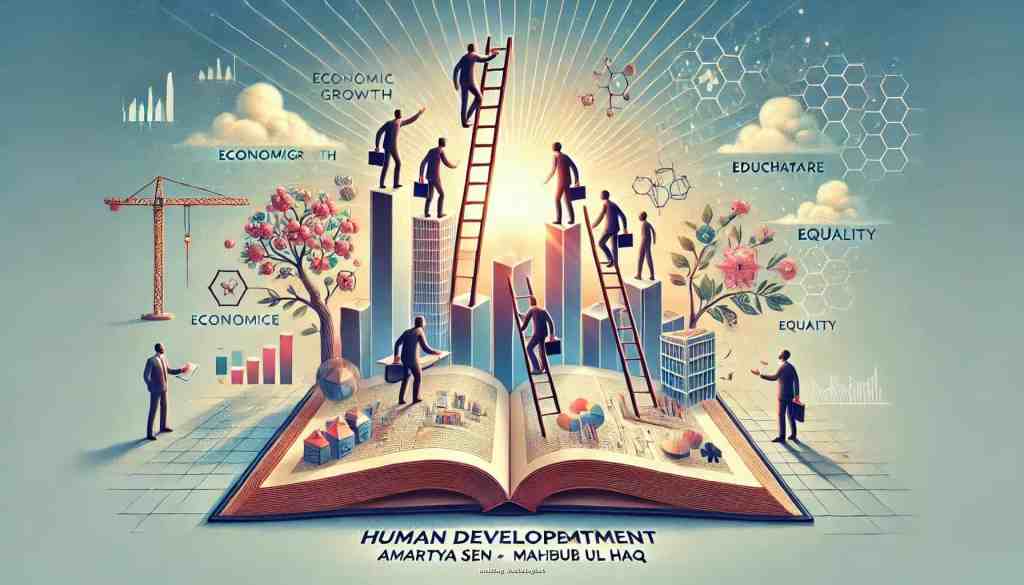
The final years of the twentieth century marked the emergence of a novel perspective on development known as the Human Development approach. This approach gained widespread recognition largely through the initiatives of the United Nations. During this period, planners, policymakers, and intellectuals came to acknowledge that societal advancement remains elusive without the concurrent progress of its individuals, who are the ultimate beneficiaries of development efforts. This realization spurred the formulation of the concept of “Human Development,” which has since become a pivotal metric and tool for advancing societal progress.
Human development is a discipline aimed at comprehending the dynamics of human change across various ages and circumstances. Rooted in the capability approach, it delves into the study of human conditions. The utilization of the inequality-adjusted Human Development Index by the United Nations serves as a means to gauge genuine advancements in human development. This approach diverges from a singular focus on economic growth, instead prioritizing social justice as a means to gauge progress.
The United Nations Development Programme defines human development as “the process of expanding people’s opportunities,” encompassing the ability to “lead a fulfilling life marked by longevity and good health, access to education, attainment of a decent standard of living,” alongside “political freedoms, safeguarded human rights, and various elements contributing to self-respect.”
Conceptual Meaning of Human Development
From this perspective on human development, financial means represent merely a fraction of what individuals aspire to attain. Advancement goes beyond mere accumulation of wealth; it must prioritize the well-being of people. The human aspect of progress underscores the importance of assessing development based on the quality of human life, recognizing individuals as the ultimate assets of nations. Thus, initiatives for development should strive to establish circumstances that empower people to lead satisfying, healthy, and innovative lives.
Human development involves enriching individuals’ freedoms and opportunities while promoting their overall welfare. It underscores the authentic autonomy individuals possess in shaping their identities, choices, and lifestyles. Fundamentally, human development advocates for fostering an environment conducive to individuals realizing their full capabilities and engaging in meaningful, innovative pursuits in line with their aspirations and necessities.
History of Human Development Theory
Human Development Theory traces its origins back to ancient philosophy and early economic thought. Aristotle, for instance, observed that wealth alone does not constitute the ultimate good, emphasizing its instrumental value. Similarly, figures like Adam Smith and Karl Marx explored the notion of human capabilities within their economic inquiries.
The theory gained significant traction in the 1980s, notably through the contributions of Amartya Sen, whose Human Capabilities perspective garnered him the Nobel Prize in Economics in 1998. Among the early economists who played pivotal roles in shaping the modern conception of human development theory were Mahbub ul Haq, Uner Kirdar, and Amartya Sen.
The development of the Human Development Index (HDI) by the United Nations Development Programme (UNDP) emerged from this foundational research, offering a metric to gauge human development. In 2000, Sen and Sudhir Anand further extended the theory to address sustainability concerns.
In the late 1990s and 2000s, Martha Nussbaum, a prominent American philosopher and Professor at the University of Chicago, directed attention towards the human dimension within the theory, particularly emphasizing human emotions. Additionally, a parallel approach drew from psychological needs theories pioneered by figures like Abraham Maslow, known for his Hierarchy of Needs theory. This perspective led to the development of the Human-Scale Development approach by Manfred Max-Neef, a Chilean economist at the University of California, which emphasizes enduring human needs and satisfiers across different temporal and contextual settings.
Anthropologists and sociologists have presented critiques of Human Development Theory, particularly those rooted in neo-classical economics. Scholars such as Diane Elson, Raymond Apthorpe, Irene van Staveren, and Ananta Giri have contributed to this discourse. Elson (1997) suggests a broader perspective on individual incentives in human development. She proposes a shift away from the notion of individuals as solely rational actors making choices based on human capital, to viewing choices as more fluid, influenced by social structures and varying capacities. Elson advocates for a humanistic approach to theory, incorporating factors like culture, age, gender, and family roles into the analysis. These expansions reflect a more dynamic understanding of the theory, echoing the views of Mahbub-ul-Haq and Amartya Sen.
The Human Development Theory
The concept of human development, pioneered by Pakistani economist Mahbub-ul-Haq, began to take shape in the 1970s, particularly in discussions at the World Bank. However, it gained traction as a defined approach when Dr. Haq challenged the prevailing notion that measures like Gross Domestic Product (GDP) adequately captured societal progress. He argued that such measures failed to address the well-being of individuals, particularly those at the lower end of the socio-economic spectrum. Collaborating with Nobel Laureate Amartya Sen and others, Dr. Haq published the inaugural Human Development Report in 1990 under the auspices of the UNDP.
This idea of human development permeated policy discourse throughout the 1970s and 1980s, culminating in the release of the annual Human Development Report by the UNDP in 1990. Subsequently, approximately 100 countries began producing their own National and Regional Human Development Reports, aimed at evaluating the quality of life within their populations and advocating for improvements. These reports utilize data on various aspects of people’s lives, including health, education, nutrition, employment, political freedoms, security, and environmental conditions. By providing a people-centered perspective often overlooked in traditional planning processes, the reports serve to raise political awareness and stimulate public debate on key societal issues.
The forefront figures in the realm of human development theory include Amartya Sen, renowned for his elucidation of the capability approach, and Mahbub-ul-Haq, a Pakistani economist instrumental in advancing this paradigm. Haq spearheaded the development of the Human Development Report and Index, aimed at evaluating global socio-economic progress beyond the confines of GDP-centric assessments. At the heart of human development lies Sen’s foundational concept of capabilities and agency.
Human development theory primarily underscores the pursuit of a fulfilling existence, positing that the essence of development lies in broadening individuals’ choices. These choices are inherently diverse and evolve over time. Often, the true markers of human achievement—such as enhanced access to education, improved healthcare, secure livelihoods, safety from crime and violence, fulfilling leisure activities, political and cultural liberties, and active participation in community affairs—may not be immediately reflected in income or economic growth metrics. Development’s objective is to cultivate an environment where people can lead prolonged, healthy, and creatively enriched lives.
Mahbub-ul-Haq on Human Development
According to Mahbub ul Haq, the theory of human development encompasses a wide array of factors, including economic growth, international trade, fiscal policy, technology, social services, and poverty alleviation measures. He regarded economic growth as just one component of the broader human development framework, which emphasizes several key principles:
- Development should prioritize the well-being of individuals.
- The aim of development is to expand opportunities for all aspects of human life, not just economic prosperity.
- Human development involves both investing in people’s capabilities and creating an environment conducive to their full utilization.
- The pillars of human development include equality, sustainability, productivity, and empowerment, stressing not only economic growth but also its quality, distribution, and long-term viability.
- Human development sets goals for development and explores viable pathways to achieve them.
Central to the concept of human development is the empowerment of individuals and communities, enabling them to make autonomous decisions and shape their own destinies. This approach prioritizes freedom of choice, allowing people to determine their preferred path of development, whether it aligns with cultural traditions, modernization, or material prosperity. Recognizing individuals and social groups as agents of change enables them to define their priorities and pursue the most suitable means to realize them.
Objectives of Human Development
Mahbub-ul-Haq delineated four fundamental principles of human development, outlined as follows:
1. Equity: Built on the principles of justice, impartiality, and fairness, the idea also encompasses distributive justice among various groups. In the realm of human development, our aim is to ensure equity in individuals’ opportunities to lead fulfilling lives. This notion intersects with equality, signifying parity among all individuals within a given sphere. However, in human development, equity underscores the need to address the unequal circumstances faced by certain groups due to various disadvantages, necessitating measures such as preferential treatment or affirmative action. For instance, individuals from economically disadvantaged backgrounds, those with disabilities, women, ethnic minorities, and other marginalized groups might require specific interventions to level the playing field and enable them to achieve comparable capabilities.
2. Efficiency: Efficiency entails maximizing the utilization of available resources. Viewed through a lens of human development, it denotes achieving goals at minimal cost by effectively leveraging human, material, environmental, and institutional resources to enhance capabilities for individuals and communities. It’s crucial to show that the selected intervention yields the greatest impact in terms of enhancing opportunities for people. Efficiency is a fluid concept; what may be efficient at a certain juncture may not retain its efficiency over the long term or in different circumstances.
3. Participation and Empowerment: This principle pertains to the active involvement of individuals and groups in various processes. It emphasizes the freedom to make decisions regarding aspects that impact their lives, the ability to hold others accountable for commitments, and the power to influence community development. For instance, in reforming an education system, human development would involve leveraging the agency of children, parents, teachers, local communities, teachers unions, NGOs, media, education ministry, finance ministry, social movements, advocacy groups, and more. Whether in policymaking or execution, this principle underscores the importance of engaging people at every stage, not just as recipients but as active participants capable of pursuing and achieving objectives.
4. Sustainability: Sustainability entails the endurance of development amidst environmental constraints, yet its scope extends beyond this facet alone. It encompasses the progression of human development across all dimensions:
- Environmental Sustainability: This pertains to the utilization of natural resources to foster development outcomes while safeguarding the interests of future generations.
- Financial Sustainability: It addresses the means by which development is funded without imposing burdens on future generations or destabilizing economic conditions.
- Social Sustainability: This concerns the involvement of social groups and institutions in supporting development endeavours over time, while mitigating disruptive and detrimental influences.
Cultural freedom and the embrace of diversity are also vital values contributing to socially sustainable development. While these principles offer a foundational framework, subsequent chapters delve into a rights-based approach, as well as considerations of justice and accountability, in greater depth. Together, they provide a comprehensive overview of human development pathways.
Amartya Sen: The Capability Approach
Amartya Sen emphasizes that human development involves addressing obstacles through individual and collective endeavours. By doing so, we can enhance well-being and freedom, and foster significant societal transformation. Sen’s influential contributions to welfare economics, social choice, poverty, famine, and development economics have deeply influenced the human development approach. Among his various contributions, the ‘capability approach’ stands out as a pivotal concept, reshaping economic and social sciences paradigms.
In 1979, at Stanford University, Sen delivered the Tanner lectures on human values titled “Equality of What?” In this address, he challenged the notion of measuring equality solely based on marginal or total utility, or primary goods, introducing his concept of capabilities for the first time. Sen elaborated on this concept further in his seminal work, “Inequality Re-Examined” (1992). He posited that an individual’s capability to pursue valued functionings offers a broad framework for assessing social arrangements, presenting a nuanced perspective on equality and inequality. This approach, Sen argued, is both adaptable and thorough, granting dignity to humanity by moving beyond the economic paradigm that often reduces individuals to mere producers and consumers.
The crux of the capability approach lies in advocating for social structures that foster the expansion of people’s capabilities, thereby enhancing their freedom to pursue what they deem valuable in life. Sen suggested that development can be measured by assessing whether individuals enjoy greater freedoms today compared to the past. Similarly, inequality can be gauged by examining the equality or inequality of people’s capability sets. In essence, Sen’s capability approach emphasizes the holistic nature of human beings, acknowledging their emotional and psychological needs. It perceives development as the broadening of individuals’ capabilities, an empowering proposition aimed at improving their well-being by increasing their freedom of choice.
The capability approach provides a structured framework for examining and understanding issues through the lens of individuals’ capacities. Within this paradigm, poverty is construed as the absence of fundamental capabilities. These capabilities may be lacking due to various factors, such as lack of knowledge, oppressive governmental policies, financial constraints, poor health, inadequate education, unforeseen accidents, and more.
Encompassed within the scope of capability theory are myriad influences on human capabilities, including social and political dynamics, gender, various forms of inequality and discrimination, social marginalization, disabilities, environmental factors, personal attributes, and psychological elements. These factors collectively shape human well-being, making the capability approach a comprehensive model for human development. Key aspects of the capability approach include:
1. Functionings: Functionings refer to the array of activities and states that individuals find valuable in their lives. These encompass various aspects of well-being, such as physical health, safety, education, employment, and social connections. While they are influenced by material possessions and income, functionings focus on what individuals can actually do or experience with these resources. For instance, having access to food satisfies the basic need, but the functioning of being well-nourished involves the enjoyment of good health. Ultimately, living standards encompass all valued functionings across different dimensions of life, including survival, health, work, education, relationships, empowerment, self-expression, and cultural participation. Thus, a functioning denotes how individuals utilize the resources available to them.
2. Capability: Capabilities represent the avenues available to attain valuable functionings, embodying one’s autonomy to make choices. It pertains to the liberty to partake in diverse functionings, defined as the various combinations of beings and doings an individual can accomplish. Capabilities comprise arrays of functionings, illustrating an individual’s freedom to pursue different lifestyles and select from potential livelihoods. Essentially, capabilities denote the tangible freedoms a person possesses to pursue a life they deem worthy. To simplify, capabilities encompass both functionings and the liberty to select among them.