- Introduction
- Characteristics of Industrialization
- Phases in Industrialization
- Advantages and Disadvantages of Industrialization
- Role of Industrialization in Social Transformation
Introduction
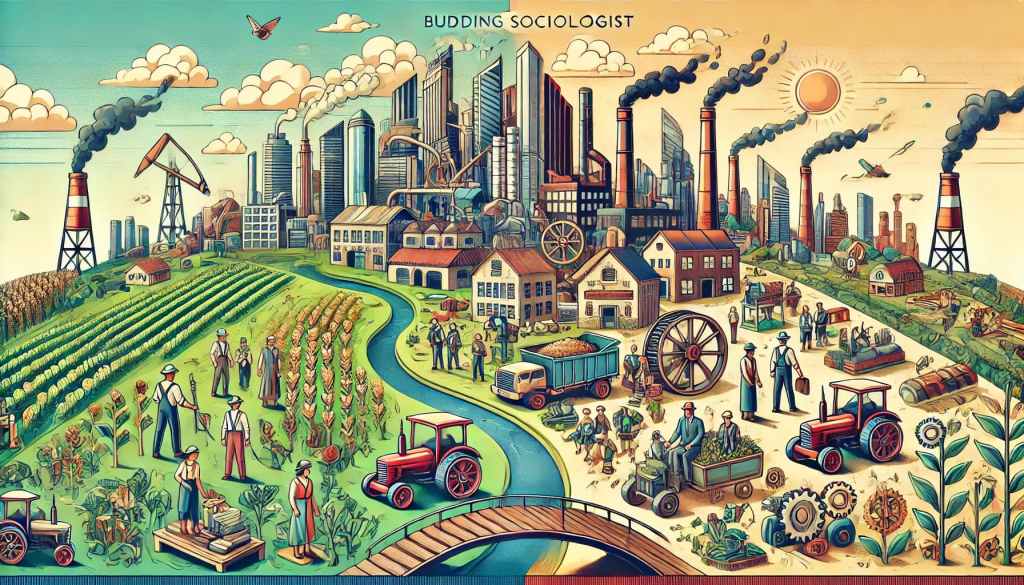
Industrialization represents a pivotal shift in an economy’s focus from primarily agrarian to manufacturing-based. This transition entails the replacement of manual labour with mechanized processes, replacing individual craftsmen with assembly line techniques. In essence, industrialization reshapes the socio-economic landscape, displacing traditional feudal and pre-feudal systems based on birth and social standing. This leads to changes in property ownership, labour structures, and the emergence of new social classes that transcend regional and religious boundaries. The advent of industrialization brings about significant changes not present in pre-industrial societies, including new social dynamics, urbanization, population concentration, and alterations in occupational trends. These changes exhibit distinct features separate from those of traditional agricultural societies, affecting various spheres like politics, education, religion, family, and social stratification.
Essentially, industrialization signifies a significant societal and economic transformation, shifting communities from agrarian to industrial societies through substantial changes in economic structures toward manufacturing. It involves a progressive journey of technological advancements for producing goods and services, characterized by a series of strategic and systematic production changes, leading to the creation and expansion of manufacturing units.
From this explanation, it’s apparent that these definitions illustrate the diverse perspectives on industrialization, encompassing economic, social, and global power dynamics. In essence, industrialization represents various facets of economic modernization. This broader interpretation is justified as sustained economic growth typically entails widespread adoption of manufacturing practices and utilization of manufactured goods.
Characteristics of Industrialization
Industrialization is identified by numerous unique features that bring about changes in economies, societies, and the natural environment. Here are a few fundamental characteristics typically linked with the phenomenon of industrialization:
1. Increased Mechanization: A prominent characteristic of industrialization involves the substitution of manual labour with machinery. This transition is particularly noticeable in manufacturing, where production methods are mechanized to enhance productivity and effectiveness.
2. Rise of Factories: Industrialization results in the creation of factories, which concentrate production capabilities in particular areas. These factories emerge as the principal hubs of manufacturing, bringing about substantial changes to the employment landscape and the shape of urban areas.
3. Mass Production: Mechanization and the emergence of factories have ushered in the capacity to manufacture goods on a vast scale. This capability is made possible by technological advancements and innovations in manufacturing techniques, notably the assembly line, enabling swift production of considerable quantities of uniform products.
4. Urbanization: As factories multiply, urbanization surges in tandem. Rural inhabitants migrate to urban centers seeking employment opportunities in industrial domains, propelling the expansion of cities and altering demographic trends.
5. Economic Growth: Industrialization is commonly linked with swift economic advancement. As production escalates, there’s a heightened accumulation of capital, which is then reinvested into the economy to propel ongoing industrial growth.
6. Shift in Labour Force: There has been a noticeable transition away from agrarian-focused occupations towards industrial employment. The labour force is increasingly moving from predominantly agricultural roles to positions within factories and other industrial sectors.
7. Development of Transportation and Infrastructure: Industrialization requires the establishment of infrastructure such as roads, railways, and eventually airports to enable the smooth transportation of goods and personnel. The transportation sector emerges as vital, playing a crucial role in facilitating the growth of industrial operations.
8. Environmental Impact: The process of industrialization frequently triggers notable environmental transformations, such as pollution and the exhaustion of natural resources. With heightened levels of production and energy usage, there’s usually a corresponding rise in industrial waste and emissions.
9. Social Changes: The advent of industrialization triggers significant societal shifts, encompassing alterations in family dynamics, social hierarchies, and ways of life. Urbanization, the ascendance of a labouring class, and the formation of novel social standards and tensions are integral facets of these changes.
10. Technological Innovation: Industrialization both fuels and is fueled by technological progress. Constant innovation leads to the creation and implementation of new technologies aimed at enhancing productivity and introducing novel goods, thereby sustaining the cycle of industrial progress.
Based on the preceding description, it can be inferred that these attributes collectively illustrate the transformative trajectory of industrialization, a force that has historically reconfigured societies globally, presenting both opportunities and challenges.
Phases in Industrialization
Industrialization is commonly understood as advancing through different stages, marked by distinct advancements in technology, economic arrangements, and societal structures. Although the specifics of these stages may differ based on historical and geographical factors, the following provides a broad outline of typical phases in industrialization:
1. Pre-industrial Phase: During this period, economies are predominantly agrarian, featuring modest technological advancements and relatively low productivity levels. The majority of inhabitants reside in rural regions, where agriculture and craftsmanship are the main occupations. Infrastructure is minimal, primarily serving local necessities, and transportation relies heavily on animal and human labour.
2. Early Industrial Phase: The industrial revolution typically commences with the advent of mechanization, often powered by water and steam. Initially, it is the textile sector that leads this industrialization charge. Small factories start to spring up, aided by the development of canals and enhanced road networks to streamline the movement of both goods and raw materials.
3. Full Industrialization: Characterized by the extensive implementation of technological advancements such as the steam engine, resulting in heightened manufacturing capabilities. The proliferation of diverse sectors such as steel, coal, and machinery, alongside the development of factory systems. The enlargement of railroad networks and telegraph infrastructure, bolstering communication and transportation capacities pivotal for nationwide markets.
4. Mature Industrial Phase: Enhanced manufacturing techniques incorporating heightened efficiency and specialization emerged during this period. This era saw the advent of electrical power and assembly line manufacturing, revolutionizing production processes. Moreover, it marked the ascent of large-scale corporations and the onset of consumer-centric manufacturing approaches. Advancements in transportation, exemplified by the proliferation of automobiles and the construction of paved roads, were accompanied by the expansion of electrical grid systems.
5. Post-Industrial Phase: As economies evolve, they shift away from heavy industry towards service-oriented, information-driven, and technological sectors. While manufacturing retains its significance, it engages a smaller segment of the workforce. There’s a growing emphasis on investing in research and development, bolstering information technology, and nurturing service industries such as finance, education, and healthcare. The reliance on advanced communication infrastructures such as the internet deepens, alongside ongoing enhancements in transportation technologies like air travel and high-speed rail systems.
6. Fourth Industrial Revolution: The current era is marked by the convergence of various technologies, blurring the boundaries between the physical, digital, and biological domains. This convergence encompasses advancements in artificial intelligence, robotics, the Internet of Things (IoT), genetic engineering, quantum computing, and other fields. It entails the development of smart infrastructure, cyber-physical systems, and widespread adoption of digital communication and data analytics.
Given this description, it’s evident that these phases of technological evolution aren’t universally sequential; different regions may undergo them at varying times and rates. Moreover, global trade and technology exchanges can result in some regions bypassing certain phases or experiencing multiple phases simultaneously. The trajectory of industrialization is further shaped by factors such as governmental policies, access to capital, and socio-political circumstances.
Advantages of Industrialization in India
Industrialization can be defined as the deliberate and organized overhaul of production methods, resulting in the creation and growth of manufacturing sites. Particularly for developing countries like India, industrialization plays a crucial role in fostering economic advancement. Acknowledging its significance, the Planning Commission of India has consistently emphasized industrialization since the introduction of the Second Five Year Plan. As a result, the nation has reaped the following benefits from these policies and initiatives:
1. Increase in Per Capita Income: The progress across various sectors leads to a notable increase in production and effectiveness within the country. These sectors create a conducive atmosphere for employing a larger workforce, facilitating the smooth transition of surplus labor from agriculture to industrial sectors, thus broadening domestic income opportunities. It is clear that nations experiencing robust industrial development tend to have higher per capita income levels compared to those with minimal industrial growth. Clearly, industrial advancement plays a significant role in shaping the overall per capita income of a nation.
2. Rise in Capital Formation: The growth of industries typically aligns with an increase in capital accumulation. A considerable amount of investment is necessary to establish industrial enterprises. According to the ‘Big Push’ theory, a substantial injection of investment within a country creates conditions favourable for industrial expansion, thereby driving economic development. It’s evident that the scale of capital accumulation in both public and private sectors plays a crucial role in promoting industrial progress, and conversely, industrial expansion stimulates further investment. Essentially, the proliferation of industries plays a vital role in boosting capital accumulation and investment within the economy.
3. Optimal Use of Economic Resources: Industries showcase adeptness in maximizing a nation’s diverse economic resources, diverging from the agricultural sector. They capitalize on locally plentiful mineral and natural resources, mobilize the workforce, and optimize water and forest assets. Moreover, industries excel in leveraging resources that may not be feasible for other economic sectors to exploit.
4. Generation of More Employment: India faces the dilemma of overpopulation, leading to a considerable segment of its labour force experiencing unemployment. Furthermore, the widespread adoption of modern agricultural techniques during the Green Revolution has contributed to an excess of workers in the agricultural sector. These circumstances compound the unemployment challenge in the country. Nevertheless, the adept execution of industrialization offers a promising remedy. Through the establishment of more industries, the scope for employment widens, absorbing the surplus labour and mitigating the issue of unemployment.
5. Rectifying Balance of Payment Problem: The Indian economy confronts a notable hurdle with its deficit in the Balance of Payments (BOP), where import spending surpasses export earnings, calling for strategies concentrated on both export promotion and import substitution. A nation’s wealth and self-reliance grow as it prioritizes expanding its exports. While agriculture contributes, it’s insufficient to tackle this challenge alone. Therefore, establishing more industries is vital to bolster exports and curtail imports. This dual approach not only tackles the significant BOP deficit but also strengthens the country’s foreign exchange reserves.
6. Agricultural Improvement: India’s economic backbone rests on agriculture, employing around two-thirds of its workforce. However, the sector still operates with antiquated farming techniques, leading to subpar productivity. The introduction of the New Agricultural Policy has spurred the integration of contemporary scientific instruments like tractors, pumps, fertilizers, pesticides, and harvesters, markedly enhancing agricultural output. These advancements are primarily propelled by industrial output. Consequently, there’s an urgent call to bolster India’s industrial sector to sustain the modernization and expansion of agriculture.
7. Helps in Stable Economic Growth: In India, a noticeable disparity and bias exist in the growth dynamics. Over the years since 1966, agriculture has seen significant advancements, while industrial progress has been comparatively sluggish. However, it’s widely recognized that the stability of the economy relies heavily on industrial expansion. Hence, achieving a balanced and sustainable growth trajectory necessitates robust development in both consumer and capital goods industries.
To sum up, it’s apparent that all economies, irrespective of their developmental stage, are actively engaged in initiatives aimed at enhancing human well-being. Central to such efforts is industrialization, which acts as a primary driver of societal change. While industrialization brings about numerous advantages, it also presents challenges that can worsen conditions for both people and the environment, prompting concerns regarding our long-term sustainability.
Disadvantages of Industrialization
Following are disadvantages of industrialization:
1. Difference Between Targets and Achievement: An analysis of targets and achievements across various plans reveals a significant mismatch between them. The rate of progress consistently lags behind the predetermined targets. For example, during the Fifth Plan, the actual growth rate reached only 5.5 percent, which was notably lower than the aimed 7.9 percent. A similar trend is observed in the Sixth Plan, where the attained growth rate was 5.9 percent against a target of 7 percent. Notably, the industrial sector faced challenges in absorbing a larger portion of the workforce. Subsequent plans also demonstrate a persistent disparity between goals and actual outcomes. Consequently, this discrepancy between intended targets and realized results presents a pressing issue for all stakeholders.
2. Rise of Big Houses: Despite the enactment of various governmental measures like the Monopolies and Restrictive Trade Practices Act and licensing rules, there has been a discernible increase in the share of total assets controlled by major corporations in the private sector. This has led to a concentration of economic power among a limited number of entities.
3. Rise in Regional Imbalances: A prominent issue lies in the clustering of industrial growth within specific states like Maharashtra, Gujarat, West Bengal, and Tamil Nadu. These regions account for approximately 80% of the nation’s industrial endeavours, while states such as Bihar, Orissa, and Madhya Pradesh are left with considerably lesser proportions.
4. Ineffective Employment Planning: The nation’s industrialization process faces an additional hurdle stemming from inadequate employment planning. Presently, the emphasis on capital-intensive approaches diverges from the pressing need to embrace labour-intensive methods.
5. Impact on Climate: The impact of industrialization extends across multiple areas, prominently observed in environmental issues like global warming and climate change. Concerns about the detrimental effects of industrial operations on the Earth’s climate have sparked considerable worry among people, resulting in hesitance to endorse companies that contribute to pollution. Moreover, the phenomenon of global warming presents health hazards for both workers and consumers.
6. Socio-economic Disparities: Industrialization has indeed opened up job prospects, yet it has widened the gap in income distribution across various social and economic classes. Wealthier individuals predominantly hold ownership or leadership positions in major corporations, leaving many workers within these organizations to contend with comparatively modest pay. Tackling this inequality necessitates companies to provide attractive salaries and extensive benefits, enabling their employees to achieve financial security and advance in their careers.
7. Occupational Hazards in Industries: Despite the strides made in technology, modern industrial settings continue to present safety challenges for employees, reminiscent of past situations. While advanced machinery has enhanced efficiency in production, it also elevates the risk of workplace accidents when not handled properly. Addressing these dangers requires the implementation of rigorous safety measures, ensuring the availability of suitable protective equipment, and conducting comprehensive training sessions for all staff members.
8. Autonomy in Manufacturing: The inherent characteristics of manufacturing positions frequently constrain chances for personal autonomy and innovative troubleshooting, largely owing to the prevalence of automated procedures. This dearth of self-reliance may result in employee burnout, thwarting retention endeavours and dampening job contentment.
9. Urbanization Dynamics: Throughout history, industrialization has been a catalyst for rapid urbanization, drawing workers to urban hubs near industrial sites. Yet, this population surge has presented numerous challenges, such as food insecurity, increased stress, and declining health. Addressing these issues requires proactive steps from businesses, including flexible work arrangements to ease overtime demands and comprehensive benefits for employees and their families. Prioritizing employee well-being not only improves retention but also cultivates loyalty and dedication to organizational goals.
The passage illustrates how industrialization marks a transition from agrarian to industrial economies. Despite its benefits, industrialization brings drawbacks like heightened pollution and decreased quality of life. It also widens the gap between labour and capital, exacerbating income inequality. Furthermore, it leads to social tensions due to worker migration, separation from families, long work hours, and overcrowding, resulting in health issues from poor nutrition and stress.
Role of Industrialization in Social Transformation
Industrialization plays a pivotal role in driving social transformation and fostering change within societies of varying kinds:
1. Prominent Sector for Economic Growth: Industrialization is a key driver in development plans, lifting economies from inertia. It creates interconnectedness, seen in the prosperity of Western countries and Japan’s evolution into an industrial giant. As articulated by Pt. Nehru, real advancement is tied to industrialization. Worldwide, industrialization has proven transformative, serving as a linchpin for progress in the mid-twentieth century.
2. Synonymous: Industrialization involves the progress of industry, commerce, transportation, energy, agriculture, and mining, alongside other sectors. This advancement promotes holistic development and notably improves living standards. Ultimately, the authentic growth of an economy relies greatly on industrialization.
3. Employment Opportunities: It’s a widely recognized fact that industrial progress has the capacity to greatly increase employment prospects, especially in less developed countries where there’s often a surplus of available labour. This surplus workforce can find new opportunities through industrialization, opening up fresh avenues for economic participation.
4. Raising Productivity: The modern industrial sector is pivotal in bolstering the economy’s productivity, both through direct and indirect means. This elevation is fueled by refined organizational strategies and technological progressions. Moreover, it aligns with the expansion of the service sector, providing an additional impetus to productivity. Additionally, contemporary industry aids agricultural productivity by furnishing it with advanced and scientifically refined resources.
5. Development of Agricultural Sector: Agriculture and industry are fundamental to an economy, interdependent for their growth and continuity. Their mutually beneficial relationship is apparent through several important aspects:
- Mutual exchange of raw materials and resources between agriculture and industry.
- Provision of vital goods to industries, including those necessary for wages.
- Contribution of materials for building economic and social infrastructure within agriculture.
- Supplying essential consumption items to rural agricultural communities.
The fusion of scientific principles and technological advancements within the agricultural sector fosters groundbreaking innovations that enhance the efficiency of industrial products utilized throughout agricultural operations, thus propelling advancements in agricultural technology. As a result, the evolution of agriculture into a modernized industry hinges on robust support from the industrial sector. Crucial agricultural tools like tractors and irrigation systems, pivotal for agricultural advancement, are commonly sourced from industrial sources. The progression of rural industrialization is intricately intertwined with agricultural development, mirroring the symbiotic relationship between a flourishing agricultural sector and sustained manufacturing growth. In summary, the advancement and modernization of both industry and agriculture are interdependent and should be pursued in tandem.
6. Useful for Foreign Trade: The trajectory of international trade transforms in tandem with a country’s journey toward industrial development. Traditionally, underdeveloped nations have leaned heavily on exporting raw materials. Yet, as industrialization advances, trade patterns undergo a transformation. Take India, for example, which witnessed a notable increase in exporting non-conventional goods owing to its industrial expansion.
7. Balance of Payments: Industrialization is crucial for enhancing exports, which in turn contributes to a favourable balance of payments. In the early stages of development, there’s often an unfavourable balance due to the need to import technology, capital goods, and raw materials. However, industrialization enables the creation of export surpluses, which positively impacts the overall balance of payments.
8. Higher Per Capita Income: The efficient administration of natural assets, alongside the adoption of cutting-edge manufacturing methods, stimulates heightened national revenue and individual earnings. Consequently, it creates additional job prospects and enhances overall output, ultimately nurturing the prosperity of the nation.
9. Capital Formation: The progression of industry plays a crucial role in driving capital generation, a key factor in nurturing economic expansion. Industrial advancements result in significant profits and heightened income, consequently enabling greater levels of saving and investment. Japan’s achievement in industrialization can be partly credited to its prominent role in capital formation.
10. Standard of Living and Social Change: A country’s capacity to attain a desirable standard of living is significantly dependent on the progress of its industrial sector. The process of industrialization plays a vital role in lifting underprivileged communities by empowering the creation of top-notch products and services. Furthermore, it promotes workforce mobility, facilitates improved communication channels, encourages educational opportunities, and enhances infrastructure. These combined advancements not only fuel economic expansion but also spur profound social changes within the nation.
11. Useful for Defence: The progress of industrialization significantly contributes to enhancing a nation’s defense capacities. A nation with advanced industrial infrastructure is capable of producing larger quantities of weaponry and munitions, thus strengthening its defence mechanisms.
12. Specialization and Division of Labour: Industrialization involves the organized control of production in business enterprises, characterized by specialization and the division of labour. This specialization relies on modern technology, working alongside human effort to decrease costs per unit and enhance returns. As a result, industrialization promotes overall progress within a country.
Conversations revolving around economic expansion often highlight quantifiable measures, correctly identifying the matter as one centered on augmenting concrete resources to meet human needs and wants. The principal objective of initiatives aimed at industrial advancement is to bolster the availability of goods and services, essential for both national prosperity and societal stability in today’s context.
Yet, the shift toward an industrialized society entails more than merely increasing the range and quantity of accessible products and services. It also heralds fundamental shifts in societal values, cognitive frameworks, and everyday behaviours among its populace. Assessing these non-economic repercussions of development proves challenging, as they defy easy quantification. However, certain markers, such as alterations in social class demographics, the waning influence of traditional social factions, or shifts in migration patterns, may provide glimpses into these transformations.