- What is Industrial Society
- Sociological Understanding of Industrial Society
- What is Industry
- Meaning of Industrial Society
- Characteristics of Industrial Society
- What is Labour
- Classification of Labour
- Meaning of Labour
- Characteristics of Labour
Industrial Society: An Introduction
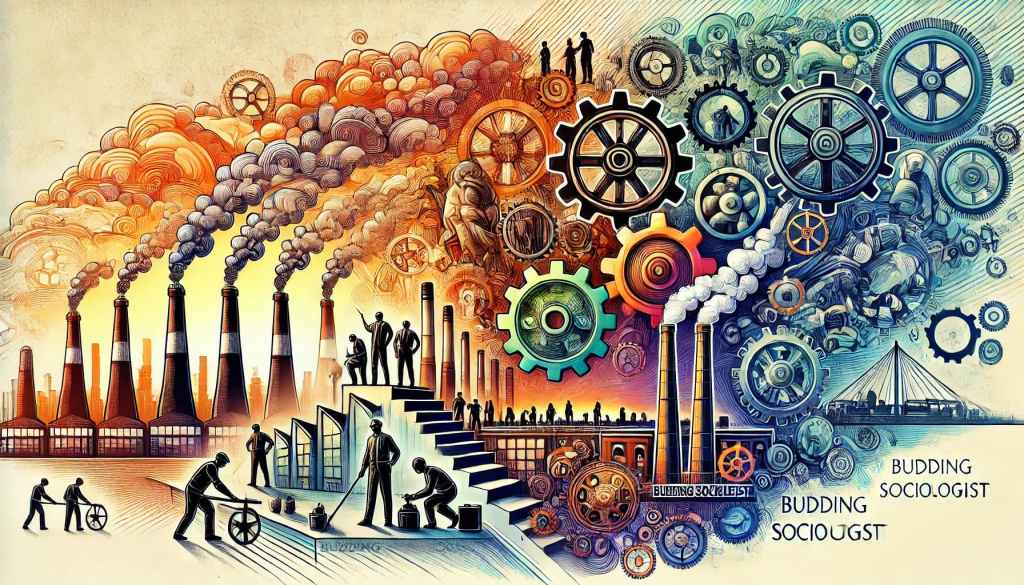
An industrial society refers to a societal framework wherein mass production technologies are employed to manufacture large quantities of goods within factories, constituting the predominant mode of production and societal organization. This entails not only the presence of mass factory production but also the establishment of a specific social structure conducive to such operations. Typically, such societies exhibit hierarchical organization based on class distinctions and feature a rigidly specialized division of labour among workers and factory owners.
Historically, numerous Western societies, such as the United States, transitioned into industrial societies following the industrial revolution that swept across Europe and subsequently the United States from the late 1700s onwards.
The shift from agrarian or trade-centric pre-industrial societies to industrial societies has profound political, economic, and social ramifications. This transition became the subject of early social sciences research conducted by influential figures in sociology, including Karl Marx, Emile Durkheim, and Max Weber.
The transition from rural farming communities to bustling urban areas occurred as agricultural operations became more mechanized, reducing the need for manual labour on farms. This shift was fuelled by the rise of factory jobs in urban centres. With advancements in technology such as mechanical planters and combine harvesters, agriculture underwent significant industrialization, diminishing the reliance on human labour. Essentially, industrialization denotes the transformation from agrarian to industrial societies, characterized by the substitution of manual labour with machinery.
Industrialization involves the establishment and expansion of industrial enterprises, making them more capital-intensive. This process generates employment across various sectors, including industry, agriculture, and services. Consequently, industrialization alters societal and economic structures, impacting living standards and traditional ways of life. Its effects are profound, influencing both individual lives and the broader development of society.
Sociological Understanding of Industrial Society
The study of industries encompasses multifaceted perspectives, including technological, physical, psychological, economic, and sociological angles. Sociology, as the science of societal structures and interactions, delves into social relationships, associations, and institutions, scrutinizing their forms, contents, and systemic configurations through a scientific and empirical lens.
Industrial sociology, a subset of sociology, focuses primarily on human interactions within industrial settings. It explores the dynamics of various industrial organizations and institutions, analyzing their interconnections and relationships with broader societal structures. Understanding industrial sociology is crucial for comprehending the essence of an industrialized society.
The transition from agrarian to industrial societies has captivated the attention of sociological pioneers, rendering this transition a pertinent sociological concept. Karl Marx, in particular, delved into understanding how capitalist economies organized industrial production and how this transition reshaped societal structures and politics from early to industrial capitalism.
After conducting extensive research in industrial societies across Europe and Britain, Marx identified distinct hierarchies of power closely linked with an individual’s role in the production process, delineating class distinctions between workers and owners. He observed that political decisions were often shaped by the ruling class to safeguard their economic interests within the existing system.
Emile Durkheim’s focus lay in understanding the intricate roles individuals play and the diverse purposes they fulfill within complex industrial societies, which he and others conceptualized as a division of labour. Durkheim posited that such societies operated akin to organisms, with various components adapting to changes in others to uphold stability.
Max Weber’s theoretical framework delved into how the fusion of technology and economic structures in industrial societies became pivotal in organizing societal dynamics and individual behaviours. He coined the term “iron cage” to describe the constraints imposed by these structures, limiting free thought, creativity, and individual actions.
In summary, the foundational theories of Marx, Durkheim, and Weber converge in highlighting how in industrial societies, various societal institutions such as education, politics, media, and law serve to bolster the production objectives and profit motives of industries within that society.
The Concept of Industry
In simple terms, the concept of industry involves applying advanced techniques to produce goods and services efficiently. This often means using machines instead of manual labour to enhance production quality, cut costs, and increase output. This shift towards mechanization began during the industrial revolution in the 18th century.
Throughout history, humans have always been industrious, using tools to meet their needs, even though these tools were initially basic. Over time, technology has evolved, leading to more sophisticated tools and machines. Today’s industrial society relies on highly advanced equipment far superior to the simple tools like digging sticks and bows used by early humans for tasks like obtaining food.
Meaning of Industrial Society
Industrial societies are characterized by the utilization of machinery, particularly those powered by fuel, to manufacture goods. This era, marked by the establishment of mechanized factories for production, originated in the 18th century in Britain and swiftly spread globally, as noted by sociologists.
The surge in productivity prompted advancements in transportation, facilitating more efficient product distribution. The owners of these factories amassed significant wealth, while the majority of individuals found employment within them, reshaping societal dynamics.
The ramifications of industrialization permeated various facets of society. Traditional home-based workspaces diminished in prominence as factories took centre stage, altering the familial role in vocational education. The advent of public education, including schools and later mass media, became commonplace. Concurrently, improvements in healthcare led to increased life expectancies among the populace.
The term “industry” finds its roots in the Latin word “industrial,” signifying skill and resourcefulness. It refers to the intricate system of producing goods and services that emerged during the industrial revolution and persists in post-industrial societies.
From preceding description, it becomes evident that the industrial revolution marked a pivotal moment in human history, profoundly shaping societal structures. Before the advent of industries, workers typically procured their own raw materials and tools, operating at small scales. However, the industrial revolution brought about the consolidation of labour under one roof in industrial units, fostering specialization and mass production of quality goods on a large scale. This transformation had profound implications for societal development.
Features of Industrial Society
With the advent of the industrial revolution, societal dynamics underwent a significant transformation. Entrepreneurs, driven by individualistic capitalist ideals, emerged to revolutionize various operations. These visionaries, often ambitious and resourceful individuals, spearheaded the establishment of factories. They efficiently managed raw material procurement, assessed market demands, and centralized production by relocating workers from their domiciles to these industrial hubs. Consequently, profound shifts ensued within the societal framework, giving rise to a novel paradigm known as the industrial society. This new social order is characterized by the following defining traits:
1. Emergence of Modern Family: The transition from the conventional patriarchal family structure to the contemporary industrial family marks a significant characteristic of industrialized societies. In this new setting, the family dynamic has shifted from being merely an institution to fostering companionship. Women are no longer confined to subservience to men but are recognized as equal partners, contributing alongside men in workplaces and industries. Furthermore, the traditional roles of childbearing and child-rearing have evolved, leading to a shift from a collective family outlook to a more individualistic one. In essence, the structure and roles within families in industrial societies diverge significantly from those in agrarian societies.
2. Economic Institutions: The altered framework of economic institutions stands as the second defining feature of industrial society. This era is distinguished by a redefined system governing production, distribution, and exchange. Instead of relying on households, factories emerge as hubs where work is segmented into specialized tasks, underpinned by the principles of capitalism. Central to this system are the institutions of private property, division of labour, pursuit of profit, competitive dynamics, wages, and credit.
3. Occupational Sub-cultures: In industrial society, the intricate division of labour results in the fragmentation of both production processes and factory management into numerous specialized tasks. Within a factory, thousands of individuals are engaged in distinct roles tailored to specific functions. Similarly, managerial responsibilities are segregated, with one individual overseeing raw material procurement, another focusing on plant and machinery maintenance, and yet another handling advertising and publicity, among others. Sociologists refer to these subdivisions as clusters of interconnected occupational specialties organized in hierarchical structures, operating in parallel and distinct from other sets of roles.
4. Segmentalized Roles: In industrial societies, individuals often occupy distinct roles that are segmented. For instance, someone might work as a welder, serve as a religious preacher, fulfill the role of a father, participate in a political group, or be a member of a cricket team. Each of these roles exists independently of the others, without a direct interdependence. Consequently, in such societies, individuals tend to focus primarily on their designated role within the industrial framework, leveraging their specialized expertise for the benefit of the factory or industry they serve, while typically having limited involvement or concern with other segments.
5. Impersonal Relationship: In an industrial society, interpersonal connections often lack intimacy and personalization. This detachment stems from the highly specialized nature of occupations, leading to a sense of impersonality in daily interactions. The division of labour, diverse job roles, and competitive environment contribute to this phenomenon, restricting individuals’ broader social attachments. Additionally, the physical separation of workplaces from residential areas further diminishes familial awareness of each other’s daily routines. Children may be unaware of their father’s comings and goings, simply knowing that he leaves and returns from work. Similarly, spouses may lack detailed knowledge about their partner’s role within the industry.
6. Status to Contract: The transition from a society centered around ascribed status to one focused on contractual relationships is a pivotal aspect in comprehending industrial societies, as outlined by sociologists. Unlike medieval societies, where status was predetermined, industrial societies have dismantled this framework. In such societies, the majority are employed by large organizations where contracts replace traditional status systems. These contracts encompass various aspects such as wages, social security, and unemployment insurance, replacing the previous system of mutual obligations with a contractual one.
7. Social Mobility: In contrast to agrarian societies, industrial societies exhibit greater mobility. This shift from status-based to contract-based relationships is indicative of this increased mobility. Individuals in industrial societies have the opportunity to elevate or diminish their status based on their achievements throughout their lifetime. The influence of caste in determining status diminishes significantly in industrial societies, where individuals are free to ascend to any level in their careers.
8. Position of Women: In traditional agricultural communities, women often have limited economic prospects, primarily restricted to domestic duties and occasional assistance during planting and harvesting seasons. However, the shift towards industrialization has significantly broadened the scope of opportunities available to women. With advancements in education and specialized training, women have increasingly found their place within workshops and factories, breaking free from the confines of household chores. This transition has liberated women, enabling them to participate more actively in broader societal spheres. Today, women hold reserved seats in legislative and other elective bodies, and they excel in both governmental and private sector employment opportunities.
9. Deviance and Anomie: The modern industrial society operates as a vast entity encompassing various subcultures within it. Within this framework, individuals contend with the pressures of competition, perpetually active factories, and a plethora of engagements. Amidst this environment, they navigate intricate rules and regulations set forth by management, which can influence human behavior, often leading to deviant behaviour and a sense of alienation. Unfortunately, this societal structure also correlates with higher rates of suicide and drug addiction.
Conclusion: In summary, the transition to an industrial society has led to significant shifts in institutional frameworks and social norms. Within this context, individuals tend to be highly educated, technologically adept, and economically successful, yet often exhibit a strong focus on individualism. Key characteristics of industrial society include features such as capitalism, exploitation, class tensions, cultural disparities, impersonal relationships, the prevalence of individualistic values, and a mechanized lifestyle, all of which can contribute to mental and emotional challenges. While industrialization presents opportunities for personal advancement and financial prosperity, it may not necessarily equate to inner peace or harmony within the home. Therefore, it is imperative to strike a balance between material prosperity and emotional well-being.
Labour: An Introduction
A labourer refers to an individual engaged in manual work, typically within sectors such as construction and manufacturing. They belong to a category of workers whose primary asset of significant value is their physical effort. Industries that rely on labourers encompass various projects including the construction of infrastructure such as roads, buildings, bridges, tunnels, and railway tracks.
More broadly, labour denotes the combined physical, mental, and social exertion invested in the production of goods and services within an economy. It encompasses the skills, manpower, and services essential for transforming raw materials into finished products and services. Essentially, labour entails the human effort involved in converting natural resources into goods essential for meeting human needs, encompassing both physical and mental contributions.
Professor Marshall’s perspective on labor emphasizes its economic dimension as the productive efforts of individuals, whether through physical or mental means. Similarly, Thomas defines labour as encompassing all human exertions, physical or mental, carried out with the anticipation of some form of compensation. In the context of capitalism, a worker can be understood as someone engaged in hired labour under contractual terms with a capitalist. They dedicate their time to industrial production or systems, adhering to specified instructions for a predetermined duration.
Classification of Labour
The worker may be classified on different bases, which are being described as follows:
1. Classification Based on the Type of Work Done: This categorization relies on the relative allocation of physical and cognitive effort required for different tasks and can be split into two categories:
1.1 Physical Labour: Physical labour involves the exertion of bodily effort by workers to accomplish tasks. Individuals such as rickshaw pullers, tailors, cobblers, and weavers rely on their physical strength or expertise to carry out their work.
1.2 Mental Labour: Mental labour involves the exertion of cognitive effort or the utilization of intellect to accomplish tasks. Occupations such as teaching, accounting, and medicine exemplify roles that require mental labour.
2. Classification Based on the Skill and development: There are three categories they are:
2.1 Skilled Labour: Individuals who have received specialized training or possess specialized knowledge necessary for a particular task are considered experts in their respective fields. These experts are adept at swiftly and effectively addressing problems within their area of expertise. Examples of such professionals include engineers, doctors, and others.
2.2. Semi-skilled Labour: Individuals possessing incomplete training in their specialized fields often demonstrate adeptness in addressing related challenges. Despite their competency, they typically receive remuneration lower than that of fully trained professionals. This situation is evident in occupations such as compounders, masons, and electricians.
2.3 Un-skilled Labour: Unskilled labour typically encompasses individuals tasked with jobs that demand no specialized training or qualifications. These roles can be executed by individuals lacking prior experience or formal training. Compensation for unskilled labour tends to be relatively low. Examples include positions such as security guards, construction site workers, and manual laborers.
3. On the Basis of Training or Academic Achievements: Based on their educational attainment and skills development, workers can generally be categorized into two main groups:
3.1 Professional Labour: Individuals who engage in cognitive activities after undergoing significant training and practice are essential for various professions. These individuals invest considerable time and effort in acquiring professional qualifications, such as professors, doctors, engineers, and others.
3.2 Administrative Labour: Individuals who possess specialized expertise in their respective fields and oversee the activities of other workers. This category includes top-level executives such as managing directors and general managers.
4. Classification Based on the Income Generated: Labour can be categorized into two groups based on its ability to generate income:
4.1 Productive Labour: Productive labour encompasses all forms of work aimed at generating material goods or assets in order to generate income. This type of labour is characterized by positive marginal productivity.
4.2 Unproductive Labour: Labour that fails to contribute to the production of goods and services possesses a marginal productivity of zero in certain instances.
5. Other Types: In addition to these classifications, there exist several other varieties of labour, namely:
5.1 Wage Labour: Employees who receive a predetermined wage rate are commonly referred to as wage laborers, such as those employed in factories.
5.2 Non-wage Labour: Employees who do not receive a set salary, such as self-employed professionals such as lawyers.
5.3 Employed Labour: Workers are involved in the process of manufacturing goods or providing services.
5.4 Unemployed Labour: Labour possesses the capacity to apply physical or mental exertion, yet it is not necessarily involved in the creation of goods or services, nor in providing any particular service.
Meaning of Labour
Understanding the distinctions among the terms “worker,” “labourer,” and “employee” is crucial for clarity.
1. Worker: Worker is a person who works. This work can be anything.
2. Labourer: A labourer is an individual engaged in manual work, typically involving physical exertion. Labour encompasses tasks demanding physical effort and is typically compensated on an hourly or daily wage basis.
3. Employee: An employee refers to an individual engaged under the auspices of a company or government, typically receiving compensation on a monthly basis in the form of a salary. Employees are categorized into regular/permanent and contractual based on their employment status.
Essentially, the category of “worker” extends beyond mere employees, covering a wide range of individuals engaged in labour-related activities.
To elaborate, labour involves both physical and mental efforts expended in exchange for monetary compensation. This encompasses various professions such as factory workers, healthcare providers, legal practitioners, clergy, government officials, and educators. Tasks performed solely for personal fulfilment or joy, without any monetary gain, do not fall under the category of labour.
Characteristics of Labour
A significant portion of industrial workforce comprises individuals who have relocated from rural areas to urban centers to pursue employment across various sectors. These laborers exhibit traits commonly associated with Indian workers.
1. Labour is Perishable: Labor is uniquely perishable among factors of production, as it cannot be stored for future use. When a worker remains unemployed for a day, their labor for that period is irretrievably lost. Unlike other resources, labour cannot be deferred or saved up for another time; it simply perishes. Time lost in terms of labour is time lost permanently.
2. Labour Cannot be Separated from the Labourer: Land and capital may change hands, but labour remains inseparable from the labourer. They are mutually dependent. Consider the analogy of a teacher’s skill in a classroom setting. The teacher’s ability to teach cannot be utilized without their physical presence. This illustrates the essential connection between labour and the labourer.
3. Less Mobility of Labour: In contrast to capital and other commodities, labour exhibits lower mobility. While capital can be readily relocated from one location to another, labor faces greater difficulty in moving from its current locale to other areas. Labourers often hesitate to venture far from their hometowns or places of origin. Hence, labour possesses comparatively limited mobility.
4. Weak Bargaining Power of Labour: The concept of bargaining power pertains to the capacity of buyers to secure goods at the most favourable prices and sellers to maximize their profits by selling goods at optimal rates. For instance, when a labourer trades their services for wages, they are essentially selling their labour, while the employer is purchasing it by offering wages. However, due to the perishable nature of labour and the necessity for labourers to sustain themselves through work, their bargaining power is typically weaker compared to employers. This discrepancy arises from the fact that labourers often lack the ability to store their services and are compelled to accept employment for their livelihood, rendering them with less negotiating leverage than employers.
5. Inelastic Supply of Labour: In a given country and timeframe, the labour supply exhibits inelasticity, indicating its inability to swiftly adjust to changes in demand. Unlike other commodities that can be readily increased or decreased based on necessity, the availability of labour cannot be instantly altered. This constraint is primarily due to the population size, which cannot be rapidly expanded or reduced. Hence, the labour supply remains largely inflexible, unable to respond promptly to fluctuations in demand.
6. Labourer is a Human being and not a Machine: Each worker possesses unique preferences, routines, and emotions, making it impossible to treat them as automatons. Unlike machines, they are not capable of sustained, round-the-clock labour. Adequate rest and leisure become imperative for labourers after a few hours of continuous work.
7. A Labourer Sells his Labour and not Himself: A laborer exchanges their labor for wages, but they do not sell themselves. While the worker provides their services, they still retain ownership of themselves. To illustrate, when we buy an animal, we gain ownership of both its services and its body. However, we cannot claim ownership of a labourer in the same manner.
8. Increase in Wages may Reduce the Supply of Labour: An increase in prices typically leads to an increase in the supply of goods. Conversely, when wages rise, the supply of labourers tends to decrease. To illustrate, in situations where wages are low, entire families may need to work to make ends meet. However, if wage rates increase, the primary earner may choose to work alone while the spouse and children cease their employment. Consequently, the rise in wage rates results in a reduction in the labour supply.
9. Both Beginning and the End of Production: The initiation of production isn’t solely dependent on the availability of land and capital; rather, it necessitates the involvement of labour. Labour serves as the catalyst for commencing production, highlighting its pivotal role in the process. Ultimately, the aim of production is to fulfill human needs and desires. Once goods are consumed, the production cycle concludes. Hence, labour is not only the instigator but also the culmination of production.
10. Differences in the Efficiency of Labour: The efficiency of labourers varies. Some individuals demonstrate higher efficiency levels owing to factors such as their abilities, training, and skills. Conversely, others may exhibit lower efficiency due to factors like illiteracy or lack of knowledge.
11. Indirect Demand for Labour: Consumer goods such as bread, vegetables, fruit, and milk are directly demanded as they fulfill daily necessities. On the other hand, the demand for labourers is indirect; they are sought after for their role in producing goods essential for survival. Consequently, the demand for labourers is contingent upon the demand for the goods they contribute to manufacturing. Hence, labourers are in demand due to their ability to produce other essential goods.
12. Labour Creates Capital: Capital is often viewed as an independent component in the production process, stemming from the remuneration of labour. Through the act of production, labour generates wealth. Capital, then, represents a segment of this wealth employed to generate further income. Thus, it can be deduced that labour holds greater significance in the production process compared to capital, given that capital emerges as a consequence of labour’s endeavours.
13. Labour is an Active Factor of Production: Land and capital are often regarded as inert components of the production process, unable to initiate production on their own. It’s only through the exertion of human effort that production is set in motion. The involvement of human labour marks the commencement of production, rendering it an active factor in the process.
Conclusion: Based on the aforementioned description, it becomes evident that laborers constitute a pivotal element in the production process, without whom the creation of goods or services would be inconceivable. These laborers may possess varying levels of skills, ranging from highly proficient professionals to individuals lacking formal education or living in impoverished conditions. Present-day Indian laborers have undergone significant transformation. They have transitioned from being predominantly rural dwellers to urban residents, equipped with education, expertise, and aspirations for advancement.