- Introduction
- Caste Structure: Traditional Roots and Contemporary Reality
- Caste Structure and Its Influence on Indian Politics
- Class Structure: Economic Hierarchies and Political Power
- Class Structure and Its Influence on Indian Politics
- Intersection of Caste and Class in Politics
Introduction
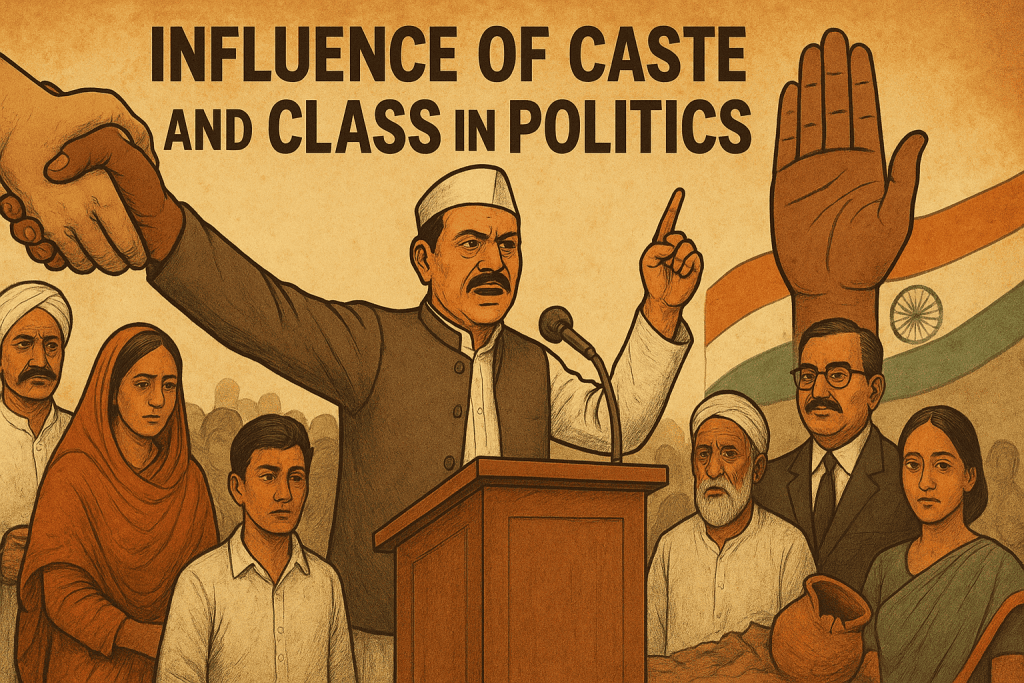
The caste and class structures are two fundamental forms of social stratification that play a significant role in shaping political processes, particularly in Indian society. Caste is a traditional, rigid and hereditary system of social hierarchy, historically rooted in religion and cultural norms. It has governed many aspects of life including marriage, occupation and social interactions. Despite the legal abolition of caste-based discrimination, caste remains a powerful identity in contemporary society, especially in politics. Political parties often rely on caste-based vote banks to mobilize support and leaders frequently appeal to caste sentiments during elections. Caste groups, especially those that were historically marginalized such as; Dalits and Other Backward Classes (OBCs), have increasingly asserted their rights and political presence through democratic means.
On the other hand, class refers to economic divisions based on income, wealth, occupation and access to resources. Class is more fluid than caste and allows for social mobility, although in practice, caste and class often overlap. Upper castes traditionally occupy higher economic classes, while lower castes have historically been associated with poverty and lack of access to resources. In political terms, economic class affects participation and influence. The wealthy and upper-middle classes often exert more influence over political decisions due to their financial contributions, media control and access to political networks. At the same time, the working class and the poor are politically significant as they form a large portion of the electorate and are often the focus of welfare schemes and populist policies.
The intersection of caste and class creates a complex dynamic in Indian politics. Many political leaders rise to power by mobilizing caste identity alongside class-based grievances, particularly among backward and oppressed communities. This has led to the rise of regional parties and identity-based political movements, especially in states like; Uttar Pradesh, Bihar and Tamil Nadu. Caste-class alliances are often crucial for electoral success and parties engage in social engineering to create coalitions of various caste groups. This interplay influences voting patterns, leadership selection, policy priorities and the overall nature of democracy. While caste-based politics has empowered many marginalized groups, it has also led to fragmentation and identity-based polarization. Similarly, class politics, particularly in the form of demands for economic justice and redistribution, plays a vital role in shaping election campaigns and government programs.
In conclusion, caste and class remain deeply embedded in the fabric of Indian politics. While caste continues to function as a source of identity and political mobilization, class serves as a marker of economic interest and inequality. Together, they influence who gets elected, what policies are implemented and how power is distributed in society. Understanding the relationship between caste, class and politics is essential to analyzing the functioning of democracy and the challenges of social justice and equality in India.
Caste Structure: Traditional Roots and Contemporary Reality
The caste system in India is one of the most deeply rooted and historically significant forms of social stratification. Originating during the Vedic period, it was initially structured around four broad varnas which were formed to meet-out four basic need/functions of society as their dharma/duty:
- Brahmins (priests and scholars) expected to perform function of knowledge procurement and dissemination thereof among all four varna
- Kshatriyas (warriors and rulers) expected to perform function to protect, rule and regulate whole society
- Vaishyas (traders and merchants) were expected to perform the function of rearing of all varna, hence expected to make arrangement to meet the livelihood related needs of society
- Shudras (labourers and service providers) were expected to serve all varnas and work for all menial works as their duty/dharma
Outside this structure were the ‘Avarna’ or untouchables, now known as Dalits, who were subjected to severe forms of discrimination and social exclusion. Over time, this varna framework became more complex and localized, giving rise to thousands of jatis or sub-castes, each associated with particular occupations and customs. The system was hereditary and rigid, determining not only one’s occupation but also aspects of daily life such as; food habits, marriage, social interactions and religious practices. Concepts of purity and pollution were central to the system and strict rules governed interactions between different caste groups, reinforcing hierarchy and exclusion.
Despite India gaining independence and adopting a Constitution that guarantees equality and prohibits caste-based discrimination, caste continues to play a significant role in contemporary Indian society. In rural areas especially, caste remains a primary determinant of social relations, economic status and political alliances.
Practices like; endogamy (marriage within the same caste) still prevail and social boundaries often remain intact even in urban and modern settings. Caste-based discrimination, though legally banned, continues in various forms, from social exclusion to economic marginalization and physical violence. Dalits and Adivasis frequently face discrimination in access to public spaces, education, employment and even basic services like water and sanitation. Numerous reports and incidents highlight the persistence of caste-based atrocities and inequalities.
The modern Indian state has responded to these historical injustices through affirmative action policies, commonly referred to as the reservation system. Scheduled Castes (SCs), Scheduled Tribes (STs) and Other Backward Classes (OBCs) are provided reservations in education, government jobs and political representation. These provisions have empowered many individuals from marginalized castes to access opportunities and challenge traditional hierarchies. The implementation of these policies has contributed to the emergence of a growing Dalit and backward-caste middle class, altering the caste-class equation in India.
Caste has also become a powerful force in Indian politics. Political parties frequently mobilize voters along caste lines, forming caste-based vote banks. Leaders like; B.R. Ambedkar, Kanshi Ram and Mayawati have played transformative roles in using caste as a source of political identity and empowerment for historically oppressed communities. Movements led by Dalits and backward castes have challenged upper-caste dominance and demanded dignity, rights and fair representation. In this context, caste-based political mobilization has had both positive and negative consequences i.e. it has enabled representation and visibility for marginalized groups but has also sometimes reinforced caste divisions.
In conclusion, the caste structure in India, with its ancient roots, remains a vital component of contemporary social and political life. While legal and social reforms have made progress in reducing some forms of caste-based inequality, caste identities continue to shape individual experiences and collective behaviour. The tension between traditional hierarchy and modern equality continues to define the realities of caste in India, making it an enduring and evolving subject of sociological study.
Caste Structure and Its Influence on Indian Politics
The caste system in India continues to play a significant role in shaping the political landscape. Despite constitutional efforts to promote equality, caste identities strongly influence voting patterns, political mobilization, leadership selection and policymaking. Political parties often rely on caste-based alliances and vote banks to secure electoral victories, leading to the rise of caste-centric parties and movements. While economic modernization and urbanization have altered social dynamics, caste remains a powerful tool for both empowerment and division in Indian politics.
Understanding its impact is essential to analyzing the structure and functioning of democracy in India which is being described as follows:
1. Historical Legacy: The caste system has its roots in the ancient Hindu Varna system, which categorized society into four broad groups; Brahmins, Kshatriyas, Vaishyas and Shudras. Over time, this evolved into a rigid, hereditary hierarchy involving thousands of sub-castes or jatis. This structure governed not only social interactions but also access to education, occupation and land. The deep historical embedding of caste in Indian society has meant that it continues to shape social behaviour and identity even in modern times. As India transitioned into a democratic nation, these entrenched caste divisions found new expression in the political domain, influencing the structure and behaviour of political institutions and parties.
2. Caste-Based Voting: Caste plays a significant role in determining voting patterns in India. Many voters tend to support candidates belonging to their own caste group, believing they would better represent their interests. This phenomenon, commonly referred to as caste-based vote bank politics, often overrides considerations such as candidate competence or ideology. Politicians, in turn, frequently select candidates not solely on merit but on the basis of caste equations within a constituency. As a result, electoral outcomes in many regions are closely tied to the demographic composition of castes and their collective voting behaviour.
3. Political Mobilization: Political parties in India have strategically used caste identities to mobilize support. This practice intensified during and after the Mandal Commission era (1990s), when backward castes began demanding greater political and economic representation. Mobilization is done through campaigns, community leaders and local networks to build solidarity among caste groups. Parties craft their narratives to resonate with the socio-political experiences of these groups, often promising caste-specific welfare schemes or protection of cultural identity. This tactic has made caste an effective political tool in both state and national elections.
4. Rise of Caste-Based Parties: In many Indian states, regional parties have been formed to represent specific caste interests. For example, the Bahujan Samaj Party (BSP) emerged to voice the concerns of Dalits, while parties like; Rashtriya Janata Dal (RJD) and Samajwadi Party (SP) have championed the causes of Other Backward Classes (OBCs). These parties have challenged the traditional dominance of upper castes in politics by bringing marginalized voices to the forefront. Their rise has also diversified India’s political landscape, giving representation to those historically excluded from the corridors of power.
5. Reservation Policies: The Indian Constitution provides for reservations in education, public employment and political representation for historically disadvantaged groups, including; Scheduled Castes (SCs), Scheduled Tribes (STs) and Other Backward Classes (OBCs). These policies have been crucial in facilitating the political participation of lower castes. For example, certain seats in the Parliament and State Legislative Assemblies are reserved for SC and ST candidates, ensuring their presence in law-making bodies. These measures have empowered marginalized groups, giving them a platform to influence policy and assert their rights.
6. Dalit Assertion: In recent decades, Dalits have increasingly asserted their political identity through movements, protests and electoral participation. Leaders like; Dr. B.R. Ambedkar, Kanshi Ram and Mayawati have played a vital role in shaping Dalit political consciousness. This assertion is not just about political representation but also about reclaiming dignity and fighting against systemic discrimination. Dalit assertion has led to increased visibility of their issues in mainstream politics and has also encouraged other marginalized groups to organize politically.
7. Caste Alliances and Social Engineering: Parties often engage in what is known as social engineering (the strategic building of alliances among different caste groups to consolidate votes). For example, a party might bring together dominant castes like; Yadavs with non-dominant castes such as Kurmis or Dalits to create a winning coalition. This practice is especially common in large, electorally significant states like Uttar Pradesh and Bihar. Such alliances are fluid and often shift between elections, depending on political necessity. They reflect a pragmatic approach to electoral politics, where caste arithmetic becomes central to campaign strategy.
8. Caste and Political Leadership: Caste continues to influence the selection of political candidates and leadership positions within parties. Dominant castes often occupy key roles in national and state politics, reinforcing traditional hierarchies even within democratic institutions. While marginalized castes are now more visible in politics, they are still underrepresented in top leadership positions. Many times, party tickets are distributed based on a candidate’s caste appeal rather than their political qualifications or public service record. This affects not only intra-party democracy but also the overall inclusiveness of the political system.
9. Caste Conflicts and Polarization: Caste has also been a source of social tension and political polarization. Disputes over reservation quotas, land rights or inter-caste relationships sometimes lead to caste-based violence and riots. Political parties can, at times, increase these tensions for electoral gain by appealing to caste sentiments or vilifying rival caste groups. Such polarization undermines social harmony and diverts attention from critical issues like development and governance. Caste conflicts, when politicized, can influence voter behaviour and lead to deeply divided electoral outcomes.
10. Continued Relevance in Modern Politics: Despite modernization, urbanization and the growth of a middle class, caste remains a central force in Indian politics. It influences everything from party structures and electoral strategies to policy-making and governance. The persistence of caste-based inequalities in education, employment and social life ensures that caste continues to be a political issue. Even in urban settings where class is gaining importance, caste identities often shape social networks, political alliances and voter preferences. Hence, caste remains both a social reality and a political instrument in contemporary India.
On the basis of above description, it can be stated that caste remains a deeply entrenched and influential force in Indian politics, shaping voter behaviour, party strategies and leadership dynamics. Despite constitutional safeguards and modernization efforts, caste identities continue to guide political mobilization and alliances, especially in regional and state elections. The rise of caste-based parties and reservation policies has empowered marginalized groups, yet challenges like caste-based conflicts and underrepresentation persist. While economic class and urbanization are gradually impacting political priorities, caste’s social and cultural significance ensures its continued relevance. Understanding caste’s role is essential to grasp the complexities of India’s democratic processes and the ongoing struggle for social justice and political equity.
Class Structure: Economic Hierarchies and Political Power
Class refers to a form of social stratification based on economic factors such as income, occupation, ownership of wealth and access to resources. Unlike caste, which is an ascribed status assigned by birth and cannot be changed, class is an achieved status, which allows for a certain degree of social mobility. In India, the class structure is broadly divided into the upper class, middle class and lower or working class. The upper class includes industrialists, business elites, high-ranking officials and political leaders who possess significant control over economic and political resources. The middle class comprises professionals, small business owners, government employees and white-collar workers. The lower class includes landless labourers, agricultural workers, informal sector workers and the unemployed.
Economic class plays a vital role in shaping political participation and influence. The upper and middle classes, because of their higher levels of education and economic security, are more politically active and better equipped to engage with democratic institutions. They are more likely to access media, understand political processes, fund political campaigns and lobby for their interests. In contrast, the lower classes often lack the resources and knowledge required for active political engagement. However, they are heavily targeted by political parties through promises of welfare schemes, subsidies and other forms of populist support. These schemes, while offering temporary relief, are often strategically designed to win votes rather than address the root causes of economic inequality.
The concentration of political power among the economically privileged is a common feature in many democracies, including India. Wealthier classes often dominate legislatures, policy-making bodies and political parties, leading to a bias in economic policies that favour corporate sectors, urban development and privatization. This elite dominance sometimes side-lines the needs of the working poor, whose issues are reduced to token mentions in election manifestos. Nonetheless, the rise of the urban middle class has also led to new forms of political discourse focused on governance, transparency, development and anti-corruption. This class is particularly vocal in urban politics and digital campaigns and plays an influential role in shaping electoral agendas.
Meanwhile, the lower classes have begun to assert themselves politically through collective mobilization, labour movements and agrarian protests. Many regional parties in India, such as; the Samajwadi Party, Rashtriya Janata Dal and Dravida Munnetra Kazhagam, have emerged by representing the economic and social interests of marginalized and economically backward communities. These parties often combine class-based demands with caste and identity politics, giving voice to those previously excluded from the power structure. The welfare state has also played a crucial role in expanding the political participation of the lower classes by offering schemes like rural employment guarantees, food subsidies and health insurance.
It is important to note that class does not operate in isolation. It intersects with other forms of identity such as; caste, gender, religion and region. For example, a lower-class Dalit woman in a rural area faces a triple burden of economic deprivation, caste-based discrimination and gender-based exclusion. This intersectionality makes it even more challenging for marginalized groups to access political power or economic mobility. Additionally, the class divide in India is also reflected in the urban-rural dichotomy. Urban areas, with their concentration of economic resources and services, are largely dominated by the middle and upper classes, while rural areas continue to host a large population of economically disadvantaged groups.
In conclusion, the class structure in Indian society plays a significant role in shaping the distribution of political power and access to democratic institutions. While the wealthy classes enjoy disproportionate influence over policy-making and governance, the lower classes are increasingly mobilizing to demand their share of representation and justice. Understanding class dynamics is essential to analyzing issues such as political inequality, policy bias, economic reform and the evolving nature of democracy in India.
Class Structure and Its Influence on Indian Politics
Class structure in India plays a crucial role in shaping political power and participation. Unlike caste, which is hereditary, class allows for social mobility but often overlaps with caste identities. The upper economic classes dominate political leadership and decision-making, while the growing middle class influences political discourse with demands for development and good governance. Lower economic groups, though marginalized, are actively mobilized through welfare schemes and populist politics. Understanding the impact of class on Indian politics is essential to grasp the dynamics of power distribution, electoral behaviour and policy formation in the democracy of country and being described as follows:
1. Economic Basis of Class: In India, social class is largely defined by economic factors such as income levels, type of occupation, educational qualifications and the extent of resource ownership. These economic distinctions create clear divisions in society, influencing how different groups access political power and participate in governance. Those with greater economic resources typically have better opportunities to influence politics, while economically disadvantaged groups often remain marginalized.
2. Upper Class Dominance: The political landscape in India has traditionally been dominated by the upper economic class. Wealthy business families, influential industrialists and top bureaucrats often hold key positions of power, both within political parties and government institutions. Their control over financial and social resources allows them to shape policies and political agendas in ways that perpetuate their status and interests.
3. Growing Middle Class Influence: India’s middle class has expanded significantly due to economic liberalization and urbanization. This group, composed mainly of professionals, entrepreneurs and government employees, has become increasingly influential in politics. Their political concerns tend to focus on issues like economic growth, education, infrastructure, anti-corruption measures and good governance, which shape the agendas of many political parties and election campaigns.
4. Political Participation Gap: The ability to participate in political processes varies greatly among different economic classes. The upper and middle classes usually have better access to education, information and communication channels, which equips them to be more politically aware and active. On the other hand, the lower classes often face obstacles such as illiteracy, poverty and social exclusion, which limit their effective political engagement and representation.
5. Populist Politics and Welfare: Politicians in India frequently use welfare schemes and populist measures as tools to gain electoral support from economically weaker sections. Programs providing subsidized food, housing, employment guarantees and cash transfers are often launched or emphasized during elections to attract the votes of lower-income groups. While these initiatives provide immediate relief, they are sometimes criticized for promoting vote-bank politics rather than long-term social development.
6. Class-Based Political Parties: Several regional and socialist parties in India base their political identity and mobilization on class interests. These parties aim to represent the concerns of the working class, farmers and other economically disadvantaged groups. For example, parties like; the Samajwadi Party and Rashtriya Janata Dal have historically garnered support from backward classes and rural poor by addressing their economic grievances and aspirations.
7. Intersection with Caste: In the Indian context, class cannot be understood in isolation from caste. Many lower caste groups also belong to lower economic classes, which compounds their social and political marginalization. This intersectionality shapes voting behaviour, candidate selection and party strategies. Political parties often appeal simultaneously to caste and class identities to build broad-based support.
8. Urban-Rural Divide: There is a pronounced divide in political influence between urban and rural classes. Urban middle and upper classes tend to dominate media, public discourse and policy-making. Meanwhile, rural populations, especially the poor and lower classes, rely heavily on local-level politics such as village councils and caste panchayats. Political mobilization in rural areas often revolves around caste dynamics and government welfare programs.
9. Economic Inequality and Policy Bias: The concentration of political power among economically privileged classes often results in policies that favour business interests and urban elites. This can lead to neglect of issues important to the poor and marginalized, such as land reforms, rural development and labour rights. The economic inequality thus gets perpetuated, as political decisions disproportionately benefit those already in power.
10. Class Mobility and Politics: Economic growth, improved education and affirmative policies have facilitated upward social mobility for some groups, enabling new middle-class constituencies to emerge. These groups bring different political demands, focusing more on governance, entrepreneurship and modern amenities. Their rise reshapes political competition and encourages parties to adopt policies that cater to evolving aspirations, especially in urban centers.
On the basis of above description, it can be stated that the class structure in India profoundly shapes its political landscape by influencing access to power, participation and policy priorities. While the upper and middle classes dominate political leadership and discourse, the lower classes rely heavily on welfare schemes and identity-based mobilization to assert their rights. The overlap of class with caste and the urban-rural divide adds complexity to political dynamics. Economic inequality often leads to policy biases favouring elites, but growing middle-class aspirations and increased political awareness among marginalized groups are gradually transforming democratic engagement.
Intersection of Caste and Class in Politics
The relationship between caste and class in Indian politics is both complex and deeply interwoven. Although caste and class represent two distinct axes of social stratification; caste being primarily based on hereditary and ritual status and class being primarily economic, but they interact continuously, shaping political identities, alliances, leadership and voting patterns. This intersection is especially critical in understanding the socio-political landscape of India, where caste and class boundaries often overlap but also occasionally diverge, influencing political mobilization and representation in unique ways:
1. Historical Overlap and Social Reality: Historically, the caste system in India did not just define social and religious status; it also strongly influenced economic roles and access to resources. Upper castes traditionally controlled land, education, religious authority and commerce, giving them substantial economic and political dominance. Conversely, lower castes were often restricted to menial, low-paying occupations and faced systematic social exclusion. This dual disadvantage (being marginalized both socially and economically) resulted in a rigid hierarchy where caste identity closely mirrored one’s economic status.
2. Emergence of a New Socio-Economic Middle Layer: Over the past several decades, India has witnessed significant social transformations due to factors like; educational expansion, land reforms, affirmative action, urbanization and economic liberalization. These changes have facilitated upward economic mobility for some members of the traditionally marginalized castes, particularly among the Other Backward Classes (OBCs) and some Dalit communities. This has led to the emergence of a new socio-economic middle class that, while economically better off, still carries the social stigma of caste-based discrimination. This dual identity fuels a distinct political consciousness among this group. They demand not only material benefits but also social justice, dignity and political representation. This rising middle class from backward castes plays an important role in reshaping political agendas, often demanding policies that address both economic upliftment and caste-based inequalities.
3. Political Mobilization Based on Caste-Class Alliances: In Indian politics, caste and class identities are often leveraged simultaneously to mobilize voters and create electoral coalitions. Political parties recognize the salience of caste identities but also frame their platforms around economic issues to appeal to broader constituencies. For instance, caste-based parties like; the Bahujan Samaj Party (BSP) have built their core support among Dalits by addressing both caste oppression and economic deprivation. Similarly, parties like the Rashtriya Janata Dal (RJD) appeal to backward castes by linking caste identity with economic justice. This political mobilization often involves “social engineering,” where parties attempt to forge alliances between various caste groups and economic classes to build winning coalitions. By merging caste and class narratives, political leaders can unify diverse sections of society that share economic interests or social grievances, thereby maximizing electoral support.
4. Political Leadership and Representation: The intersection of caste and class has also shaped political leadership in India, where many leaders emerge from marginalized caste groups but also articulate the economic aspirations of their constituencies. Leaders such as; Mayawati and Lalu Prasad Yadav have leveraged their caste identities to challenge upper-caste dominance and mobilize support among socially and economically disadvantaged groups. Their leadership style combines a call for social justice with demands for economic redistribution, ensuring their political base is both socially and economically motivated. These leaders have changed the political landscape by increasing the political representation of lower and backward castes in legislatures and government offices. Their rise has compelled traditional elite parties to rethink strategies and incorporate caste and class concerns more meaningfully into their platforms, democratizing political participation.
5. Divergence Between Caste and Class Interests: Although caste and class often overlap, they can sometimes produce conflicting political interests and affiliations. For example, individuals from lower castes who have achieved economic prosperity may distance themselves from caste-based political mobilization and instead align with parties or groups that protect their newfound economic interests. Within the same caste, disparities in wealth can create internal divisions: wealthier members might favour conservative or status quo politics, while poorer members push for more radical reforms. Similarly, economic classes might not be cohesive in terms of caste identity; the economically poor may belong to different castes with varied political priorities. Such divergence leads to fragmentation within caste groups and class groups alike, complicating political alliances and making the political landscape more fluid and unpredictable.
6. Impact on Policy and Governance: The intertwining of caste and class also profoundly affects policy-making and governance in India. Political parties and governments must navigate the competing demands of different caste and class groups to maintain political support. For example, affirmative action policies, land reforms and welfare schemes often reflect attempts to address the grievances of caste-class coalitions. However, the pressure to satisfy caste-based vote banks can sometimes result in fragmented or contradictory policies, where identity politics overshadows broader developmental goals. Political parties may prioritize short-term electoral gains by appealing to narrow caste or class interests, which can hinder long-term policy consistency and governance reforms. Nevertheless, the active participation of diverse caste and class groups in politics has also broadened democratic representation and accountability.
7. Role of Identity Politics in Social Mobilization: The intersection of caste and class has given rise to identity politics as a prominent feature of Indian democracy. Political parties and social movements increasingly frame their agendas around the recognition and assertion of caste identities combined with economic grievances. This strategy helps marginalized groups articulate their demands for justice, equality and redistribution. Identity politics often galvanizes voters by emphasizing shared experiences of oppression and exclusion rooted in caste and economic disadvantage. While this mobilization empowers marginalized communities, it can also deepen social divisions, creating a competitive environment where different caste-class groups vie for limited political and economic resources.
8. Impact on Electoral Strategies and Voting Patterns: Political parties tailor their electoral strategies by analyzing the caste-class composition of constituencies. Since caste loyalties often influence voting behaviour, parties combine caste appeals with promises of economic benefits such as subsidies, employment or welfare schemes. This creates a complex pattern where voters weigh their caste identity against their class interests. In some regions, caste identity dominates voter choice, while in others, class-based economic concerns may take precedence. The intersection thus shapes not only who votes for whom but also the kind of political discourse and campaigning that parties undertake during elections.
9. Influence on Social Justice Movements and Policy Reforms: Social justice movements in India frequently emerge from the intersection of caste and class oppression. Movements advocating for land redistribution, labour rights, education access and anti-discrimination laws often draw support from those who are marginalized both socially (by caste) and economically (by class). This convergence strengthens demands for systemic reforms and shapes political agendas. For example, the Dalit movement’s push for both social dignity and economic empowerment reflects this intersectional struggle. Consequently, the political system is pressured to adopt reforms addressing structural inequalities embedded in caste and class hierarchies.
10. Challenges of Political Representation and Inclusion: Despite growing political mobilization, the intersection of caste and class presents challenges for inclusive representation. Economically disadvantaged castes often remain underrepresented in key political institutions and decision-making bodies. Additionally, upper economic classes within marginalized castes may dominate political leadership positions, sometimes side-lining the poorest and most vulnerable. This raises concerns about the tokenism of representation, where political gains by caste groups may not translate into meaningful economic upliftment for all members. Ensuring equitable representation that addresses both caste and class disparities remains a major challenge for Indian democracy.
On the basis of above description, it can be stated that the intersection of caste and class profoundly shapes Indian politics, intertwining social identity with economic status. While caste historically determined social hierarchy, economic changes have introduced new dynamics, creating a complex relationship that influences political mobilization, leadership and voter behaviour. This intersection drives identity-based politics, shaping electoral strategies and policy reforms aimed at social justice and inclusion. However, tensions between caste and class interests also generate fragmentation and challenges in achieving equitable representation. Understanding this intersection is essential to grasp the complexities of India’s democratic processes and to promote policies that promote both social equality and economic empowerment.
References and Readings
Caste and Class in India, edited by K. L. Sharma et al, https://amzn.to/49hRhDG
Castes in India: Their Mechanism, Genesis and Development by Dr. B. R. Ambedkar, https://amzn.to/43wcuGh
India’s Power Elite: Class, Caste and a Cultural Revolution by Sanjaya Baru, https://amzn.to/4i8556e
The Modernity of Caste and the Market Economy, David Mosse, DOI: 10.1017/S0026749X19000039
Caste, Class and Vote: Consolidation of the Privileged and Dispersal of the Underprivileged, Suhas Palshikar, DOI: 10.1177/23210230231203792
Caste and Secularism in India: Case Study of a Caste Federation, Rajni Kothari & Rushikesh Maru, DOI: 10.2307/2051039