- What is Kinship
- Meaning and Definitions of Kinship System
- Characteristics of Kinship
- Degrees of Kinship
- Kinship Terminology
- Patterns of Kinship
- Principles of Kinship
- Kinship Usages
- Importance of Kinship
Kinship: An Introduction
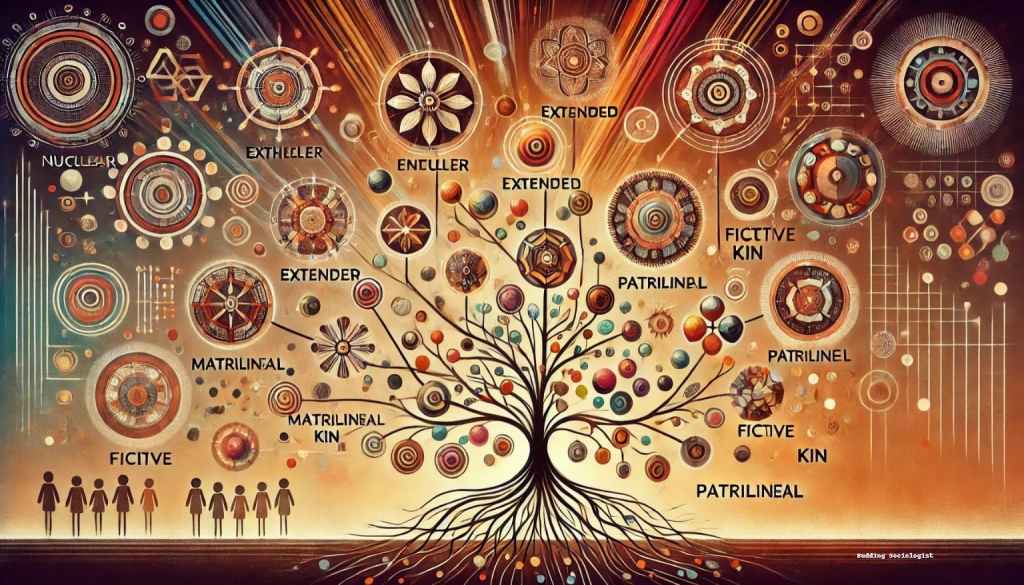
Centuries ago, the renowned philosopher Aristotle articulated the idea that “Man is a social animal,” suggesting that human beings live in society to fulfil essential survival needs. Seeking assistance and reciprocating help for basic necessities such as food, shelter and clothing are integral aspects of communal living. This mutual dependence has been a driving force compelling individuals to form groups, which subsequently evolve into societies. The innate social nature of humans prompts them to establish connections and relationships with others, coexisting with various individuals, including friends, relatives, neighbours and strangers. Within this social framework, individuals are naturally bound by blood ties or marital connections, collectively referred to as kinship.
Kinship, rooted in ties of blood, marriage or adoption, stands as the most universal and fundamental of all human relationships. It serves as a fundamental organizing principle in human society, constituting a core social institution present in every societal structure. This institution plays a crucial role in establishing connections between individuals and groups. In all societies, diverse bonds unite people, with the most fundamental ones arising from the realms of marriage and reproduction. Kinship encapsulates these bonds, encompassing relationships stemming from blood connections (consanguineal) or marital unions (affinal).
Individuals do not exist in isolation within society. Throughout their entire life, they are surrounded by a multitude of individuals, including relatives, friends, neighbours and strangers. The connections he shares with those related to him by blood or marriage vary in proximity, spanning from close to distant. The cohesive force that unites people in a group based on blood or marriage is known as kinship.
Kinship denotes the socially acknowledged relationships between individuals in a given culture, whether recognized as biologically connected or granted the status of relatives through marriage, adoption, or other ceremonial practices. It serves as a comprehensive term encompassing all relationships individuals are born into or establish later in life, all of which are deemed significant within the context of their society.
Based on the above, we can infer that the connections established through marriage or blood relations are termed kinship. Kinship is recognized when two or more individuals share a relationship either through descent or through marriage. Each person is affiliated with two nuclear families—the family of orientation, where one is born and raised, and the family of procreation, established through marriage. The relationships encompassing ancestors, posterity, and successors formed by both these family types collectively constitute kinship.
Characteristics of Kinship
Following are the characteristics of kinship:
1. Socially Recognized Relationships: Kinship extends beyond biological connections, encompassing relationships established through marriage (affinity) and adoption. It represents a structured framework in which societies recognize and formalize connections between individuals, assigning specific roles and responsibilities. For instance, in numerous cultures, adopted children are granted equal status and rights as those born biologically.
2. Universal Phenomenon: Kinship is a universal feature of human societies, though its forms differ across cultures. In some societies, extended families, where several generations live together, are central, while others prioritize nuclear family units. Regardless of these variations, all cultures establish rules to define kinship connections, highlighting its crucial role in structuring social relationships.
3. Regulates Social Behaviour: Kinship defines the standards and anticipated behaviours among family members. It governs the ways individuals should engage with one another, outlines caregiving responsibilities, and determines how authority is allocated within the family unit. For instance, in patriarchal cultures, the oldest male often holds the primary decision-making authority regarding family affairs.
4. Determines Family Structure: Kinship determines whether a society adheres to a patrilineal system (descent traced through the father), a matrilineal system (descent traced through the mother), or a bilateral system (descent traced through both parents). These frameworks shape inheritance practices, living arrangements, and familial responsibilities.
5. Affects Social Status and Identity: A person’s family ties frequently influence their social standing. In societies structured by caste or aristocracy, an individual’s ancestry often dictates their social status, advantages, and career path. Similarly, in contemporary settings, family reputation and background continue to impact one’s sense of identity and access to opportunities.
6. Controls Marriage Rules: Kinship establishes rules that determine who is an acceptable or unacceptable marriage partner. In some cultures, endogamy is practiced, meaning individuals are expected to marry within their own kin group, caste or ethnic community. In contrast, other cultures follow exogamy, requiring individuals to marry outside their immediate kin group. A common feature across all societies is the incest taboo, which universally forbids marriages between closely related family members.
7. Guides Economic and Property Rights: In many cultures, inheritance practices are shaped by familial relationships. In patrilineal communities, property is typically handed down from father to son, while in matrilineal systems, wealth is often passed through the mother’s side of the family. Additionally, kinship plays a significant role in shaping economic and business partnerships, particularly evident in the operations of family-run businesses.
8. Emotional and Psychological Bond: Kinship extends beyond social and economic dimensions, offering emotional stability and psychological comfort. Family members provide affection, care, and a sense of security, particularly during challenging times. In traditional communities, kinship systems function as essential support structures, guaranteeing that individuals receive assistance from their extended family networks.
9. Influences Political and Religious Systems: Kinship is a crucial factor in both governance and religious leadership. In monarchies and tribal communities, authority is frequently inherited, with power being transferred within family lines. Likewise, in various religious organizations, leadership positions are often determined by ancestry, as seen in Hindu priestly families or specific Islamic practices where lineage plays a key role.
10. Dynamic and Adaptive: Kinship, though traditionally grounded, undergoes transformation in response to societal shifts. Factors such as modernization, urbanization and legal changes have significantly altered kinship frameworks. Instances like the growing prevalence of nuclear families, interfaith partnerships, and the legal acknowledgment of same-sex relationships demonstrate how kinship evolves to reflect modern societal dynamics.
Degrees of Kinship
The nature of any relationship between two individuals is determined by the level of closeness or distance inherent in that connection. This proximity or separation within a relationship is contingent upon the specific way in which the individuals are interconnected. On the basis of this, kinship have three degrees:
1. Primary Kinship
2. Secondary Kinship
3. Tertiary Kinship
1. Primary Kinship: Primary kinship refers to direct relations. People who are directly related to each other are known as primary kin. There are basically eight primary kins; wife father son, father daughter mother son, wife; father son, father daughter, mother son, mother daughter; brother sister; and younger brother/sister older brother/sister.
Further, Primary Kinship can be divided into two kinds:
1. 1. Primary Consanguineal Kinship: Primary consanguineal kin are those kin, who are directly related to each other by birth. The relationships between parents and children and between siblings form primary kinship. These are the only primary consanguineal kin found in societies all over the world.
1. 2. Primary Affinal Kinship: Primary affinal kinship refers, to the direct relationship formed as a result of marriage. The only direct affinal kinship is the relationship between husband and wife.
2. Secondary Kinship: Secondary kinship refers to the primary kin’s of primary kin. In other words, those who are directly related to primary kin (primary kin’s primary kin) become one’s secondary kin. There are 33 secondary kins.
Further, secondary kinship can be divided into two more kinds:
2.1 Secondary Consanguineal Kinship: This type of kinship refers to the primary consanguineal kin’s primary consanguineal kin. The most basic type of secondary consanguineal kinship is the relationship between grandparents and grandchildren.
2.2 Secondary Affinal Kinship: Secondary affinal kinship pertains to the primary kin of one’s primary affinal kin. This category encompasses relationships between an individual and all of their sisters-in-law, brothers-in-law, and parents-in-law. In this context, an individual’s primary affinal kin is their spouse, while for the spouse, their parents and siblings are considered primary kin. Consequently, the parents of one’s brother/sister-in-law become secondary affinal kin for the individual. Likewise, the spouse or parents-in-law of one’s siblings become secondary affinal kin for that individual.
3. Tertiary Kinship: Tertiary kinship refers to the primary kins of secondary kin. Roughly 151 tertiary kins have been identified.
Like other two degrees of kinship, tertiary kinship also has two categories:
3.1. Tertiary Consanguineal Kinship: Tertiary consanguineal kinship pertains to the primary consanguineal kin of an individual (parents), their primary kin (parents’ parents), and their primary kin (parents’ parents’ parents). In essence, it involves the relationship between great-grandchildren and great-grandparents, as well as great-grand aunts and uncles, and consequently, the connection between great-grand uncles and aunts and great-grand nieces and nephews. This intricate relationship can be examined from different perspectives—for instance, an individual’s tertiary kins can be considered as the secondary kin of their primary kin (parents), such as the father’s grandparents. This demonstrates that tertiary kin are essentially the secondary kin of primary kin. Another viewpoint reveals that an individual’s tertiary kin can be viewed as the primary kin of their secondary consanguineal kin (grandparents), specifically the grandfather’s parents. This illustrates that tertiary kin can be the primary kin of secondary kin.
3.2 Tertiary Affinal Kinship: Tertiary affinal kinship encompasses relationships involving the primary kin of primary affinal kin, the primary kin of secondary affinal kin, or the secondary kin of primary affinal kin. To illustrate, examples of tertiary affinal kin include one’s spouse’s grandparents, grand uncles and aunts, as well as the spouses or children of one’s brothers or sisters-in-law.
Kinship Terminology
Within the realm of kinship, two primary terms play a crucial role in shaping the social structure. These terms serve a dual purpose, functioning both as forms of address and as points of reference. Regardless of the specific category within kinship, the terminology used to describe interconnected individuals can be categorized into terms of address and terms of reference, distinguishing the roles each term fulfills in the intricate web of social relationships.
- Terms of Address are the ones we use from birth (Ego) to address our kins, such as; Mother or Father.
- Terms of Reference are the ones we use to refer to our kin in the third party; my mother, or my father.
The instances provided highlight that terms of address and terms of reference can share the same identity. Our choice of kinship terms is influenced by our familiarity with the involved relatives, as well as the ages and genders of these relatives. Terms of address and terms of reference are interdependent; the use of “father” or “mother” suggests the presence of a son or daughter, and vice versa.
On the basis of above description, broadly kinship terminology can be divided into two categories:
1. Classificatory Terminology: In a classificatory system, collateral kin—relatives not directly in the line of descent or ancestry of the individual known as “ego”—are grouped together in the same terminological category as lineal kin, who are relatives in ego’s direct line of descent. For instance, in classificatory systems like that of the Iroquois, the father and his brother, as well as the mother and her sister, are denoted by the same term.
In societies with unilineal descent systems, where emphasis is placed on either the mother’s or the father’s line, but not both, ego uses one set of terms for referring to brothers, sisters, and parallel cousins (those traced through a related parent of the same sex, like a father’s brother or a mother’s sister). Another set of terms is employed for cross-cousins (the offspring of a father’s sister or a mother’s brother). This distinction underscores that cross-cousins are not part of the lineage with ego, ego’s siblings, and ego’s parallel cousins, thus highlighting the exogamous nature of marriages between cross-cousins.
2. Descriptive Terminology: In contrast to classificatory terminology, descriptive systems uphold a clear distinction between lineal and collateral kin. For instance, even when belonging to the same generation and gender, a mother and her sister are differentiated. Descriptive systems tend to be prevalent in situations where the nuclear family functions as a relatively autonomous unit economically and socially. Consequently, they are relatively uncommon in ethnographic literature.
Descriptive terms are limited and include father, mother, son, daughter, brother, sister, husband, and wife. To avoid any potential confusion, each term or a combination thereof is used to specify only one relative. In Western societies’ kinship systems, descriptive terms are employed in situations where specific designations for every relative are not available. For instance, uncles on both the father’s and mother’s sides are not distinguished from each other; both are simply referred to as uncles. The differentiation arises due to the use of descriptive terminology, such as “father’s brother” and “mother’s brother.”
Patterns of Kinship
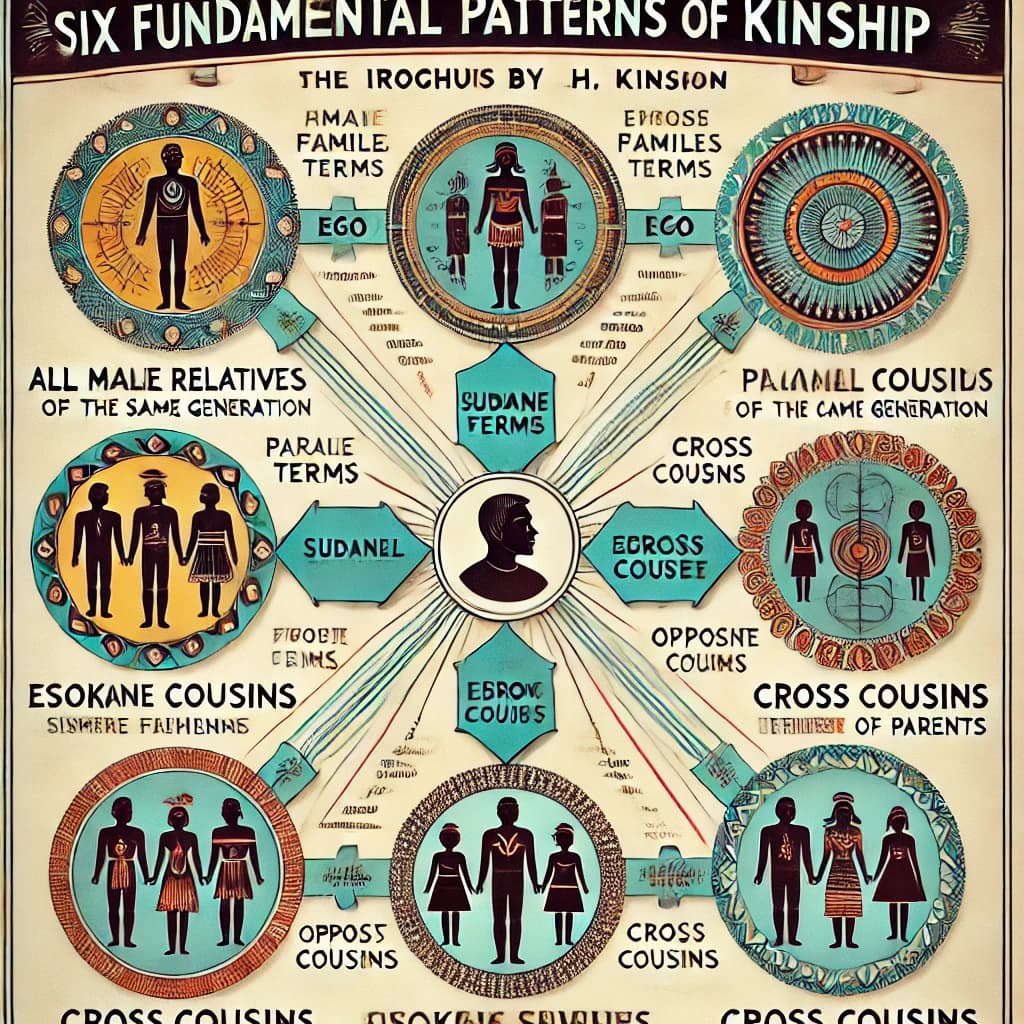
Drawing on prior contributions from both L. H. Morgan and G. P. Murdock, there are presently six fundamental patterns used to categorize kinship, a classification initially developed and outlined by Morgan. In this context, the term “Ego” holds paramount significance in the illustration. Here, “Ego” refers to the individual, actor, or person being regarded as the focal point of interaction. The representation of kinship patterns is articulated as follows:
1. Hawaiian Kinship: Known as the generational system, Hawaiian kinship is a kinship terminology system employed in language to designate family connections. It is the most classificatory, solely distinguishing between sex and generation. Consequently, siblings and cousins share identical terms.
2. Sudanese Kinship: Regarded as the most intricate and detailed, Sudanese kinship ensures that no two relatives share the same term. Siblings and cousins are differentiated, with specific terms for each type of cousin, such as those from the father’s brother, father’s sister, mother’s sister, and mother’s brother.
3. Eskimo Kinship: Combining both classificatory and descriptive terms, Eskimo kinship not only considers sex and generation but also distinguishes between lineal and collateral relatives. Lineal relatives, directly connected by a line of descent, have detailed terms, while collateral relatives, linked by blood but not directly in the line of descent, possess more classificatory terms.
4. Iroquois Kinship: Having both classificatory and descriptive terms, Iroquois kinship, in addition to sex and generation, recognizes distinctions between siblings of opposite sexes in the parental generation. Siblings of the same sex are classified as blood relatives, while those of the opposite sex are considered relatives by marriage.
5. Crow Kinship: Similar to Iroquois kinship but with an added distinction between the mother’s side and father’s side. Relatives on the mother’s side use more descriptive terms, while those on the father’s side employ more classificatory terms.
6. Omaha Kinship: Resembling Iroquois kinship, Omaha kinship further separates between the mother’s side and father’s side. Relatives on the mother’s side have more classificatory terms, whereas those on the father’s side have more descriptive terms.
| Kinship System | Key Features |
| Hawaiian | – Generational system (only sex & generation matter) – Siblings & cousins share the same terms |
| Sudanese | – Most detailed system – Unique term for every relative (no shared terms) – Differentiates all cousin types (father’s/mother’s side) |
| Eskimo | – Mix of classificatory & descriptive terms – Distinguishes lineal (direct descent) & collateral relatives (not direct descent) |
| Iroquois | – Recognizes same-sex & opposite-sex siblings in the parental generation – Same-sex siblings = Blood relatives – Opposite-sex siblings = Relatives by marriage |
| Crow | – Similar to Iroquois but distinguishes between maternal & paternal sides – Mother’s side = Descriptive terms – Father’s side = Classificatory terms |
| Omaha | – Similar to Iroquois but reversed – Mother’s side = Classificatory terms – Father’s side = Descriptive terms |
In summary, the primary criterion for categorizing a system lies in how the Ego employs a single term for various relatives. For instance, Western societies adhere to the Eskimo kinship system, designating the brothers of parents as uncles and their sisters as aunts. In contrast, societies following the Hawaiian classification pattern use the same term for both fathers and mothers. The use of identical terms for different relatives suggests a notable similarity in Ego’s behavior toward them, often indicating potential considerations for marriage.
Principles of Kinship
Kinship can also denote a principle through which individuals or groups are structured into social units, roles, categories, and genealogy using kinship terminologies. Family connections can be explicitly represented (such as mother, brother, grandfather) or abstractly in terms of degrees of relationship (kinship distance). Relationships may be relative, like that of a father to a child, or they can reflect an absolute distinction, such as the contrast between a mother and a woman without children. It’s essential to note that degrees of relationship differ from heirship or legal succession. Many ethical codes recognize the kinship bond as establishing stronger obligations between related individuals compared to those between strangers.
The kinship system is being governed by some of the basic principles which can be called as facts of life. Robin Fox gave four fundamental principles of kinship that are applied universally. These principles are as follows:
1. Women bear children
2. Men impregnate women
3. Incest is tabooed
4. Men exercise control over property
These four principles underscore the fundamental biological foundation on which the kinship system relies. Men and women engage in socially sanctioned sexual interactions after marriage, leading to the birth of children. This establishes blood ties between individuals, and specific terms are employed to acknowledge this relationship (status change) in a socially accepted manner, designating them both as the mother and father of the child. Relationships formed through blood ties are termed consanguineous kinship and individuals of this kind are referred to as consanguineous kins.
Another form of binding relationship arises from the desire for reproduction. This type of connection, emerging from socially or legally defined marital relationships, is known as affinal relationship. Individuals related through this type of kinship are termed affinal kins, and unlike consanguineous kinship, they are not connected by blood.
Kinship Usages
A comprehensive exploration of the kinship system necessitates an examination of diverse behavioural patterns exhibited by various family members. Each relationship entails specific types of behaviour that are socially sanctioned. For instance, the behaviour of a son toward his father is characterized by respect, while the relationship between husband and wife involves expressions of love. The interaction between a brother and sister is marked by affection. These behavioural norms that govern the conduct of different family members are referred to as kinship usages. Some of these usages are the following:
1. Avoidance: In every society, some form of avoidance is observed, indicating that certain kin should maintain distance from each other. Essentially, this implies that they are expected to refrain from interaction, not only avoiding sexual relationships but, in some cases, even avoiding direct eye contact. For instance, in Hindu families, the practice of the purdah system exemplifies the concept of avoidance, where a father-in-law is expected to stay away from the daughter-in-law.
Various explanations have been proposed to understand the purpose of avoidance. Among them, two functionalist perspectives, presented by Redcliff Brown and G. P. Murdock, suggest that avoidance functions to prevent the escalation of conflicts and more serious issues among relatives. A third perspective, rooted in Freudian theory, posits that avoidance represents a form of institutionalized neurotic symptom.
2. Joking Relationship: Contrary to an avoidance relationship, a joking relationship allows individuals to tease or engage in playful banter with each other. This dynamic is evident in relationships like devar-bhabhi (brother-in-law and sister-in-law) or jija-Sali (brother-in-law and sister-in-law), where humour is a central element. This form of joking may range from light teasing to the exchange of banter, including the use of playful or even vulgar references to sex.
3. Teknonymy: The term “teknonymy” originates from the Greek language and was introduced into anthropology by Taylor. In this context, instead of directly mentioning a kin, reference is made through another kin, serving as an intermediary. For instance, in a traditional Hindu family, a wife avoids directly using her husband’s name. Instead, she refers to her husband through the name of her son or daughter, such as “Yadu ke papa” (father of Yadu).
4. Avunculate: This utilization of kinship terms is a distinctive characteristic of a matriarchal system. It elevates the role of the maternal uncle (mama), granting him a significant position in the lives of his nephews and nieces. His responsibilities toward them surpass those of a father, and he holds precedence in their loyalties and claims to property. Among all male relatives, the maternal uncle holds the foremost position.
5. Amitate: In contrast to avunculate, when special significance is attributed to the father’s sister, it is termed as amitate. The father’s sister holds a position of elevated respect surpassing that of the mother. She is acknowledged as the head of the household, responsible for making decisions concerning her brother’s family members.
6. Couvade: This peculiar practice is observed among several primitive tribes, such as the Khasi and the Toda. In this custom, when the wife gives birth to a child, the husband adopts the lifestyle of an invalid alongside his wife. He abstains from engaging in active work and follows a restricted diet. The husband adheres to the same taboos observed by his wife during this period. This kinship practice signifies a profound expression of love between the husband and wife.
Building upon the preceding explanation, it can be affirmed that kinship represents one of the more intricate aspects of cultural systems. Every human community possesses a kinship terminology, a set of terms employed to denote relationships among kin. Kinship systems play a crucial role in conveying significant social information. However, the challenge arises when attempting to unravel the cultural nuances and accurately translate kinship terminology. The conventional European-American kinship system utilizes descriptive terminology, highlighting that the distinction between descriptive and classificatory kinship systems is not absolute. Kinship terms serve the dual purpose of preserving the interpersonal connections within a social system and delineating individuals into distinct generations.
Importance of Kinship
The examination of kinship holds significance for the development of sociological and anthropological theories. Scholars like Pierre Bourdieu, Levi Strauss and Evans Pritchard have formulated various theories based on kinship relations. Despite this, there has been limited substantial research on villages, with most focus directed towards rural areas and social institutions such as villages, castes, and families.
Indian sociologists and anthropologists have delved into the study of kinship relations, concentrating on aspects like villages, castes and families in rural settings. While many have contributed to understanding these social structures, noteworthy contributions to the institution of kinship have been made by a select few, including Irawati Karve, Rivers, and T. N. Madan. The importance of kinship in tribal/rural societies can be understood from the following discussion:
1. Important in Relation to Rural Family, Property and Land: The principal asset of any rural family is land, and as such, it is intricately connected to all family members. Sons, grandsons, and other kin, bound by blood and marriage, share economic interests in the family’s land. In contemporary times, there is a growing awareness among women about their entitlement to an equal share of ancestral property. The women’s emancipation movement advocates for their right to inheritance, emphasizing equal shares in the family’s property. In many studies focused on villages, the relationship between property and kinship is a central topic. Ownership of land not only contributes to the economic well-being of family members but also elevates their social status. Furthermore, political standing is influenced by kinship relations in certain instances. Economic and political privileges are often extended to members of the kin, whether related by blood or marriage. It is essential to note that kinship relations are not exclusive to rural society; they also persist in urban settings. However, the extensive nature of urban communities makes it less likely for kin members to actively participate and gather in family social events.
2. Important for Marriage: In every society, there exist specific rules governing marriage, including endogamy, exogamy, incest taboos, and various restrictions. These regulations apply universally to all family members. Typically, rural communities demonstrate a greater seriousness and adherence to these marriage-related rules. Exogamy, a common practice in many Indian villages, signifies the reluctance of individuals to marry within their own village. However, the strictness of adherence to this rule can vary based on regional customs. Scholars like Irawati Karve and A. C. Mayer, in their studies on kinship, have explored village exogamy. Mayer, specifically in his study on Kinship in Central India, notes instances where village exogamy is violated, though such deviations bring disrepute to the individuals involved. It is important to highlight that Mayer’s research stands as a significant contribution to the ethnography of village life.
3. Kinship is Important to Perform Rituals: The significance and role of kin members are determined by the closeness of their relationships. This importance becomes evident during significant occasions such as cradle ceremonies, marriages and deaths. In a naming ceremony, the responsibility of naming the new-born often falls on the father’s sister. Specific rites and rituals, overseen by the mother’s brother, are integral to the marriages of both daughters and sons. In Hindu weddings, particularly in South India, the daughter’s parents make payments, either in cash or kind, to the son-in-law’s sister, who holds a crucial role in the ceremony. Close kin relatives are expected to offer gifts to the newlywed couples and reciprocally, they receive rewards from both sides (parents of the couple). During times of death, it is customary for kinsmen to observe a mourning period, typically lasting 11 to 14 days, although this duration may vary from region to region.
4. Helpful to Understand Kinship Relations: Significant transformations are underway in various institutions within rural society, including alterations in kinship relations. Noteworthy shifts include a rising demand for women to obtain ownership titles, challenges to traditional marriage norms, and a weakening of traditional regulations regarding divorce. While certain aspects of kinship are diminishing in significance, others are gaining prominence. Kinship now assumes a crucial role in rural politics, particularly in elections for Panchayati Raj Institutions. Instances of favouritism in job distribution are being observed among kinsmen. With the emergence of these new dynamics, kinship may undergo restructuring, adopting new forms and structures.
References and Readings:
Sociology by C.N. Shankar Rao, https://amzn.to/41A3Wh4
Sociology Themes and Perspectives by Michael Haralambos and Martin Holborn, https://amzn.to/4ibTgdY
Unit 8, Kinship, IGNOU Study Material, http://hdl.handle.net/123456789/18843