- Introduction
- Law of Three Stages: Theological, Metaphysical and Positive
- Importance of Law of Three Stages
- Critical Evaluation
Introduction

Across the annals of time, an enduring fascination has persisted with understanding how individuals interact within the societies they inhabit. From ancient philosophical inquiries into social dynamics to the Enlightenment era’s quest for overarching principles, thinkers have grappled with themes of conflict, economics, cohesion and power structures. The early 19th century saw seismic shifts propelled by the Industrial Revolution, increased mobility and evolving employment structures. Concurrently, social and political landscapes underwent significant transformations, especially as empires expanded, exposing many to unfamiliar cultures and societies.
Intellectuals have been instrumental in shaping various disciplines, particularly the social sciences, with sociology standing out prominently. Rooted in the 19th century and Auguste Comte’s pioneering work, sociology flourished across Europe, notably in France, Germany and England. Comte, alongside influential figures like Herbert Spencer, Emile Durkheim and Max Weber, laid the foundations for sociological thought, leaving a lasting impact on the discipline.
Comte’s contribution to sociology extended beyond methodology. For Law of Human Progress, Comte explored the evolution of human cognition, proposing a theory of societal development which came to be known as Law of three stages. Central to his framework was positivism, which suggests that both individuals and societies progress through historical stages towards an ideal state. Comte’s law of three stages of thinking, encapsulates this idea, proposing a gradual refinement of human thought processes over time.
Law of Three Stages
The law of three stages is also known as law of human progress. According to Comte, intellectual development follows a universal law. He posits that knowledge in any field goes through three distinct stages; the theological, the metaphysical and finally the positive stage. Comte is credited as the first to articulate the Law of Three Stages, which became foundational to his philosophy, although its roots can be traced back to thinkers like; R. J. Turgot, Y. B. Vico, and Saint-Simon. This law describes the progression of human thought through history, suggesting that both individual and societal progress pass through these stages. In general, Comte’s law of three stages is a theory of development of human thinking.
Comte’s theory asserts that human cognition and societal advancement traverse three pivotal stages. It not only elucidates the gradual metamorphosis of societal structures but also delineates the evolution of individual consciousness. Central to Comte’s thesis is the notion that the developmental stages of the human mind intricately intertwine with corresponding stages in the societal fabric, encompassing social order, organizational structures, and material circumstances.
From point of view of human cognition, in childhood, individuals tend to hold firm beliefs akin to the theological stage, then transition to a critical, abstract phase during adolescence, comparable to the metaphysical stage, and finally, in adulthood, adopt a more empirical, scientific approach, akin to the positive stage.
Similarly, from point of view of societal advancement, societies evolve through these stages, reflecting the transformation of collective consciousness. The Law of Three Stages not only elucidates the progressive development of society but also highlights the evolution of human thinking, which can be understood in precise way with the help of following illustration:
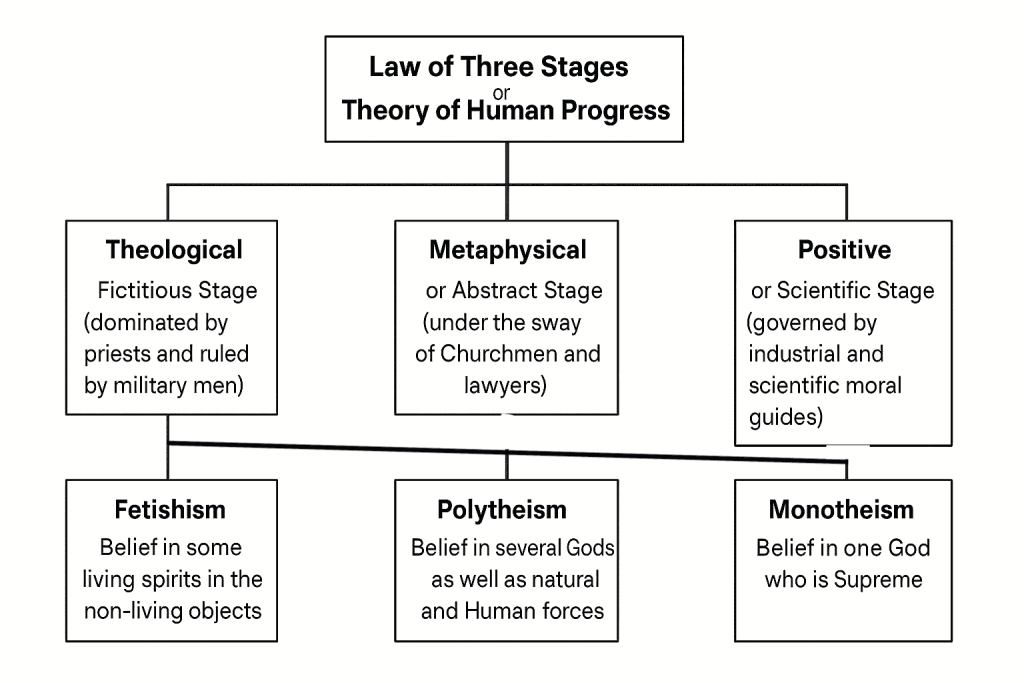
Auguste Comte posited that the development of the human mind mirrors the evolution of individual minds. His focus was primarily on delineating stages in mental development, emphasizing their correlation with corresponding stages in the development of societal structures, social units, organization and material conditions of human existence. The progression of the human intellect aligns with distinct forms of societal organization. Each successive stage of intellectual evolution is deemed superior and more refined than its predecessor.
This era of societal advancement and maturation is commonly referred to the further advance stage as compare to the earlier one and can be divided in following three stages:
- The Theological or Fictitious
- The Metaphysical or Abstract
- The Positive or Scientific
1. The Theological Stage: This initial phase represents the earliest stage outlined in the Law of Three Stages. It delineates the worldview preceding 1300 A.D., as described by Comte. During this phase, all conceptualizations, whether broad or specific, were imbued with a supernatural essence. People believed that all human endeavours were directed and controlled by divine forces. In this era, both the social and physical realms were perceived as manifestations of divine will. Human thought was heavily influenced by theological doctrines, lacking logical and systematic reasoning. The predominant mode of thinking was characterized by non-scientific approach.
Natural phenomena were primarily interpreted through a theological lens during this period. Ordinary occurrences often led individuals to attribute them to divine intervention due to a lack of understanding of natural causes. This tendency to explain natural events as manifestations of divine or mystical forces is termed theological thinking. Variations in weather patterns, such as excessive or insufficient rainfall, were commonly attributed to the favour or displeasure of the gods. Practices like magic and totemism held significant importance in this worldview.
During this period, priests held significant sway. It represented a belief in an alternate realm inhabited by divine forces that governed events in the earthly realm. Essentially, during this theological phase, all occurrences were ascribed to supernatural forces. Comte delineated three sub-stages within the concept of supernatural power, thus dividing the theological stage into distinct phases:
1.1. Fetishism: This initial phase marks the foundational stage within the development of theological thought. It represents a fundamental understanding wherein individuals perceived the presence of divine essence within all objects and entities. This worldview, often referred to as fetishism, encompasses the belief that even non-living objects possess a living spirit. This concept underscores a deep-seated connection between the material world and the divine, shaping early understandings of spirituality and the universe.
1.2. Monotheism: As time progresses, the human intellect undergoes further refinement, leading to shifts and advancements in thought processes. One significant development is the emergence of Monotheism, representing the culmination of the theological stage. Unlike earlier polytheistic beliefs, Monotheism asserts the supremacy of a single deity responsible for governing the universe. The prefix ‘Mono’ signifies ‘one,’ indicating the belief in a singular, all-powerful God overseeing the order of the world. This transition to monotheistic ideals reflects the triumph of rationality over irrational beliefs.
1.3. Polytheism: Compared to earlier sub-stages, polytheism represents a more evolved phase where the human mind undergoes development and thinking patterns undergo a transformation. Polytheism denotes the belief in or reverence for multiple deities. This belief stems from the multitude of phenomena and objects observed, leading to the attribution of divine essence to various entities. Consequently, individuals engage in the veneration of numerous Gods, each perceived to possess specific functions and spheres of influence. The multiplicity of Gods is seen as essential for ensuring divine favour and intervention in human affairs, with the belief that these deities exert control over earthly existence from realms beyond.
2. The Metaphysical Stage: The second stage, spanning roughly from 1300 to 1800 A.D., represents an advancement from the theological stage. In this stage humans start to understand the mechanics and reason behind the occurrence of natural phenomena. It posited that an abstract force or power governed and influenced all worldly events, departing from the notion of a concrete God.
This period saw the rise of reasoning in human thought, leading individuals to abandon the belief that supernatural beings controlled worldly activities. According to Comte, during this metaphysical stage, the human mind substituted supernatural entities with abstract forces, essentially personified abstractions inherent in all things and capable of generating all phenomena. In essence, the abstract principles assumed the role once attributed to supernatural powers. In this phase, the prevailing belief was that an abstract force governed and dictated the course of events in the world, marking a departure from belief in a concrete deity. For example, in case of occurrence of rainfall, people start to understand that the rainfall is the outcome of clouds not of Gods and only when black cloud are in the sky, there is chance of rain.
3. The Positive or Scientific Stage: The culmination of human thought, known as the positive or scientific stage, emerged around 1800 AD. This era heralded a profound belief in the power of science. Rather than seeking absolute causes like God or nature, people focused on meticulously observing and understanding the social and physical world to uncover its governing laws. During this period, the human mind strove to establish causal relationships, grounding scientific knowledge in observable facts gathered through the classification of phenomena. Positivism, a mindset that prioritizes observation and factual analysis, became prevalent.
Auguste Comte emphasized the significance of observing and categorizing facts as the foundation of scientific knowledge. In this paradigm, industrial administrators and scientific experts replaced priests and theologians, with observation reigning supreme over imagination. Theoretical concepts were redefined within a positive, scientific framework, marking a significant shift in societal values and structures. For example, in case of rainfall, now in this stage people understand the whole water cycle and mechanism of rainfall.
On the of basis of above description, it can be stated that the initial phase of cognitive evolution attributes phenomena to supernatural forces or deities. The subsequent metaphysical phase represents a refinement of this perspective, highlighting the role of the human mind in interpreting abstract forces rather than relying on supernatural explanations. In the ultimate stage, individuals observe nature and humanity impartially, seeking to establish objective laws. The three stages are not applicable to whole world at a given time. Different societies can have their own speed through which they pass through these stages. One society can be in metaphysical stage at a given time and other society may already have achieved positive stage.
Importance of Law of Three Stages
There is no doubt the theory of the Law of Three Stages, given by Auguste Comte played an important role to understand human progress. The importance of the theory across the various disciplines can be described as follows:
1. Historical Understanding: Comte’s theory provides a framework for understanding how human thought and society have evolved over time. It helps historians and social scientists analyze the progression from the theological stage through the metaphysical stage to the positive stage. This allows for a deeper examination of historical events, societal norms, and cultural beliefs within the context of human intellectual development.
2. Philosophical Insight: The theory offers philosophical insights into the nature of human understanding and the advancement of knowledge. It raises questions about the interplay between religion, philosophy, and science, and how these domains influence each other throughout history. Philosophers use Comte’s theory to explore concepts such as the nature of truth, the validity of different modes of inquiry, and the development of human thought.
3. Sociological Analysis: Sociologists employ the Law of Three Stages to analyze societal changes and cultural shifts. By identifying which stage a society is in, sociologists can examine its dominant beliefs, institutions, and social structures. This helps in explaining social phenomena such as the decline of religious influence in modern societies or the adoption of scientific worldviews.
4. Educational Framework: Comte’s theory provides a conceptual basis for structuring educational curricula. It underscores the importance of teaching critical thinking skills, scientific literacy, and empirical methods to foster intellectual development. Educators can use the theory to design educational programs that encourage students to move beyond superstition and metaphysical speculation toward evidence-based reasoning and inquiry.
5. Scientific Progress: The theory emphasizes the value of empirical observation and scientific inquiry in advancing human knowledge. It highlights the significance of evidence-based reasoning and systematic investigation in understanding the natural world. Scientists draw inspiration from Comte’s ideas to promote scientific literacy and advocate for evidence-based policymaking and decision-making.
6. Cultural Critique: The theory allows cultural critics to analyze contemporary society and its underlying assumptions. By identifying the dominant stage of thought within a culture, critics can evaluate its strengths and weaknesses. This enables a nuanced critique of societal norms, values, and institutions, fostering discussions about potential areas for improvement and societal progress.
In essence, the theory offers a comprehensive framework for understanding human intellectual development and its implications across various fields of study. Its importance lies in its ability to provide insights into the historical, philosophical, sociological, educational, scientific, and cultural dimensions of human civilization.
Critical Evaluation
Auguste Comte’s classical theory, which delves into the evolution of human thought and societies, has undoubtedly left its mark. However, like many other theories, Comte’s law of three stages has not been immune to criticism over time. These critiques can be outlined as follows:
1. Bogardus suggests that Comte’s theory lacks a fourth mode of thinking, namely socialized thinking. This mode would prioritize the construction of just and harmonious societies. Despite this critique, Bogardus acknowledges Comte’s role in paving the way for the emergence of socialized thinking.
2. Prof. N.S. Timasheff contends that Comte’s law of three stages fails to withstand empirical scrutiny. He argues that the religious approach has not been entirely supplanted by the metaphysical and scientific approaches; rather, there has been a blending and accumulation of all three.
3. C.E. Vaughan criticizes Comte’s theory for its negative and destructive foundation, arguing that it lacks the capacity for constructive action. Vaughan warns that attributing such abilities to the theory can lead to chaos and violence.
4. Max Weber advocates for the study of societal progress from an objective and empirical standpoint, rather than through predetermined philosophical frameworks. He emphasizes the importance of empirical evidence in understanding the nature of societal development.
On the basis of above description, it can be stated that the Law of Three Stages provides a framework for understanding the historical development of human thought and society, highlighting the transition from religious and metaphysical explanations to empirical science as the dominant mode of understanding. It underscores the importance of reason, evidence, and scientific inquiry in advancing human knowledge and societal progress.