- Ethnographic Perspective of MN Srinivas
- SC Dube: An Introduction
- Theoretical and Methodological Approach of SC Dube
- Ethnographic Perspective of SC Dube
Introduction
| Full Name | Mysore Narasimhachar Srinivas |
| Born | 16 November 1916 at Mysore, India |
| Died | 30 November 1999 (aged 83) at Bangalore, India |
| Nationality | Indian |
| Spouse(s) | Rukmini Srinivas |
| Awards | Padma Bhushan (1977) |
| Academic Background | |
| Alma mater | University of Oxford, University of Mumbai |
| Influences | Alfred Radcliffe-Brown |
| Academic Work | |
| Discipline | Sociology, Social Anthropology |
| Main interests | Indian Society, Caste system in India |
| Notable works | The Remembered Village, Indian Society through Personal Writings, Village, Caste, Gender and Method: Essays in Indian Social Anthropology |
| Notable ideas | Sanskritization, Inter and intra-caste solidarity |
M.N Srinivas, born in 1916 in Mysore and passing away in 1999 in Bangalore, stood out as a distinguished Indian sociologist. Hailing from a Brahmin background, his scholarly pursuits primarily focused on caste dynamics, Sanskritization and various related themes.
Completing his doctoral studies in sociology at the University of Bombay, Srinivas embarked on further academic endeavours in the late forties at the University of Oxford. It was during this period that he began to shape significant contributions to the field of sociology, introducing fresh perspectives and ideas.
Methodology of Srinivas
Srinivas approached his sociological research with a unique perspective, diverging from others by eschewing reliance on Western textbooks to study his own country and its people. Instead, he actively engaged in fieldwork and observation, immersing himself in the study of Indian society. In the early 1940s, he conducted extensive fieldwork among the Coorgs, delving into their social dynamics, particularly the unity and interactions among various castes such as Brahmins, Kaniyas, Bannas, and Panikas. He also noted the presence of numerous independent castes in village settings.
Throughout his career, Srinivas focused predominantly on the study of caste and religion, thoroughly examining their various dimensions within society. His research led him to coin terms such as “dominant castes,” “westernization,” “secularization,” and “sanskritization,” all of which emerged as outcomes influenced by the caste system.
Srinivas, hailing from the Brahmin caste traditionally considered superior, devoted himself to the study of the caste system, a topic of immense significance in Indian society. He conducted numerous studies demonstrating the pervasive influence of caste, whether in rural villages or urban centers. To elucidate the complexities of Indian society, he framed his perspective in two distinct categories: the theoretical understanding outlined in books, and the practical insights gained from fieldwork.
Srinivas consistently advocated for a balanced approach, acknowledging the value of theoretical knowledge while emphasizing the paramount importance of firsthand observation. While conventional wisdom found in textbooks provides a foundation, he contended that true understanding comes from immersing oneself in the field, using personal observation and critical thinking to comprehend the intricacies of Indian society.
He stressed the necessity of empirical research, including mathematical and statistical analysis, despite the reluctance of some to engage with these methods. Srinivas championed the examination of specific local contexts, as evidenced by his seminal works on topics such as dominant caste dynamics and conflicts within joint families in rural southern India. His methodological rigor and unique approach yielded invaluable insights, making his writings essential references for sociologists and researchers alike who sought to delve into the complexities of caste in India.
Ethnographic Perspective of MN Srinivas
Srinivas (1916-1999) is celebrated as one of the pioneering sociologists in India’s first generation of scholars. He stands alongside eminent figures like G. S. Ghurye, R.K. Mukherjee, N.K. Bose, and D.P. Mukerji. His notable fieldwork among the Coorgs led to the publication of “Religion and Society among the Coorgs of South India” in 1952. Srinivas regarded the village as a microcosm of Indian society and believed it to be the preserver of traditional Indian values.
His convictions regarding justice, equality, and poverty alleviation were deeply influenced by his hands-on research experiences. Srinivas introduced concepts such as sanskritisation, dominant caste, and various forms of caste solidarities—both vertical (inter-caste) and horizontal (intra-caste)—all revolving around the dynamic nature of caste as a social institution.
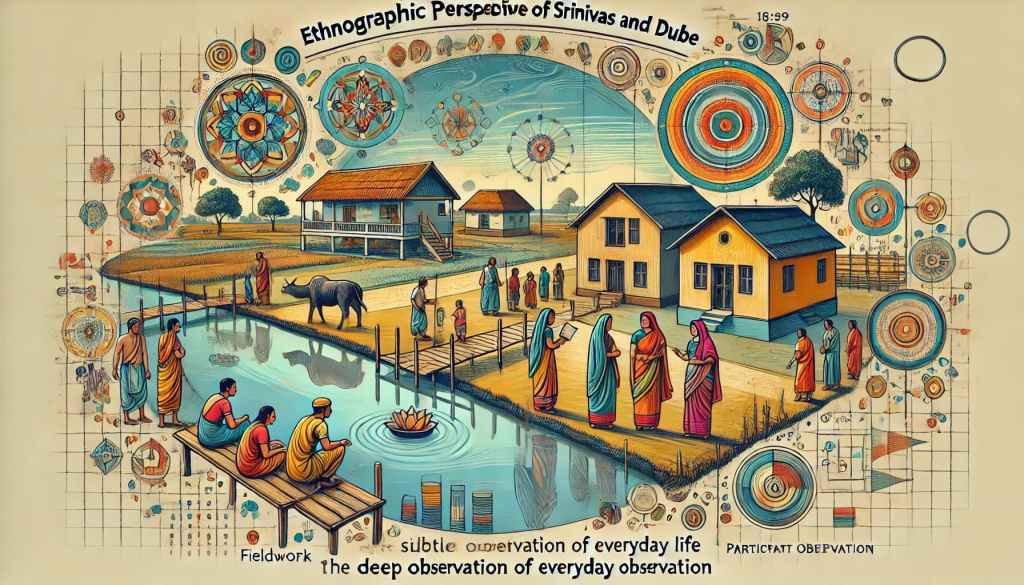
Methodologically, Srinivas staunchly supported ethnographic research grounded in fieldwork. His insights were largely derived from his immersive engagement as a participant observer in rural life across South India.
Srinivas pioneered the practice of making broad sociological observations while also delving into the intricate details of small community dynamics. His approach aimed to comprehend his fellow citizens not through Western academic texts or indigenous religious scriptures, but through firsthand observation, fieldwork, and immersive experiences. Through this methodology, he employed two fundamental concepts to decipher the complexities of Indian society:
1. Book View (Bookish Perspective): The pillars of Indian society rest upon religion, varna, caste, family, village, and geographical dynamics. Understanding these components typically stems from sacred texts or literary sources. Srinivas refers to this understanding as the bookish perspective or book view. He rejects the term “Indology” to describe this approach, finding it inadequate.
2. Field View (Field Work): Srinivas advocates for a methodological approach known as the “field-view,” which emphasizes gaining knowledge about different regions and aspects of Indian society through direct fieldwork. He favours empirical research to comprehend the complexities of Indian society and has chosen to focus on small-scale regional studies rather than constructing overarching theories. In his perspective, fieldwork plays a crucial role in understanding the essence of rural Indian society.
Through this lens, Srinivas has extensively explored various facets of Indian society and culture. His notable contributions include studies on religion, village communities, caste dynamics, and social change. He approaches Indian society as a comprehensive entity, aiming to integrate its diverse groups and their interrelationships, encompassing tribes, peasants, as well as various religious cults and sects. Here are some key insights derived from his ethnographic approach and field-view perspective:
1. Social Change: The theme of social change remains a central focus for Indian sociologists and social anthropologists, persisting both before and after 1950. Srinivas endeavoured to develop a macro-level understanding by synthesizing numerous micro-level observations on processes like sanskritization, westernization, and secularization. Notably, Srinivas revisited a village setting after nearly twenty-five years, offering a longitudinal analysis of social change within that community.
2. Religion and Society: In 1952, Srinivas conducted research on “Religion and Society among the Coorgs of South India,” which inspired the development of the concept of Brahminization. This concept denotes the emulation of Brahmin life-ways and rituals by lower-caste Hindus. Through meticulous field-study, Srinivas utilized Brahminization as a tool to understand shifts in lower-caste rituals and lifestyles. Over time, this concept evolved into the broader notion of sanskritization, operating at a more abstract level.
3. Study of Village: In addition to religion and caste, the third key aspect of Srinivas’ field study is the village itself. Srinivas was inspired to explore Indian villages by his mentor and teacher, Radcliffe-Brown, during his time at Oxford University in 1945-46. Upon his return, he conducted a comprehensive study of Rampura, a village in Mysore, which led him to develop the concept of the “dominant caste.” This study, documented in “The Remembered Village” in 1976, examines the social and economic transformations within Rampura.
4. Views of Caste: Srinivas conceptualizes caste as a segmentary structure. He posits that each caste comprises sub-castes, functioning as units of endogamy and occupation, sharing common cultural and ritual practices, and governed by a central authority such as the panchayat. In addition to these characteristics, Srinivas identifies other significant attributes inherent to the sub-caste system, which are outlined as follows:
4.1 Hierarchy: For Srinivas, the essence of the caste system lies in its hierarchical structure, which organizes hereditary groups in a ranked order. He emphasizes that the clearest indication of this hierarchy is the status of the Brahmins at the top and the untouchables at the bottom. The middle tiers of the hierarchy, meanwhile, exhibit greater flexibility and may encompass individuals occupying intermediate positions.
4.2 Occupational Differentiation: Srinivas observes a strong correlation between caste and occupation, suggesting that caste essentially functions as a structured framework for organizing various occupations. Castes are often identified by the predominant occupations within them, evident in names such as Lohar, Sunar, Kumhar, Teli, Chamar, and others. Furthermore, he emphasizes the existence of a hierarchical arrangement within occupations, where certain roles are perceived as superior or inferior to others.
4.3 Restrictions on Commensality: Srinivas notes that within castes, limitations on attire, language, and traditional practices are evident. Additionally, there exists a hierarchical structure concerning dietary habits, accompanied by regulations on the acceptance of certain foods.
4.4 Pollution: The hierarchical divisions among castes are upheld through the concept of pollution. Srinivas also contends that castes should refrain from encountering anything deemed impure, whether it be an object or an individual. Any interaction with impurity tarnishes a caste’s purity and necessitates purification rituals for the affected caste. In cases of severe pollution, such as when a member of a higher caste engages in sexual relations with an untouchable, expulsion from the caste may occur as a consequence.
4.5 Caste Panchayats: In addition to the characteristics outlined above, each caste is governed by a regulatory body or council known as a Panchayat. Within a village, the elders of each caste collaborate to uphold social order by collectively wielding their influence. Additionally, every member of a caste is accountable to the authority of their caste assembly. This authority may extend beyond the confines of a single village to encompass other villages within its jurisdiction.
Conclusion: Based on the preceding account, it is evident that Srinivas stands out as a prominent figure among the inaugural cohort of Indian sociologists. He employed ethnographic techniques, prioritizing direct observation and engagement with societal dynamics, a methodology often referred to as the sociology of nativity. Srinivas’s study of the Coorg community exemplifies his structural-functional approach, illuminating the intricate connections between ritual practices and social organization within Coorg society. Additionally, his emphasis on fieldwork contributed to the formulation of concepts such as sanskritization, reflecting his nuanced understanding of Indian social dynamics.
S.C. Dube: An Introduction
Shyama Charan Dube (1922-1996) was a prominent figure in Indian anthropology and sociology. He employed the structural-functional approach to analyze Indian village communities, challenging the notion that they were stagnant and unchanging. Dube believed that no single village could represent rural India entirely due to the diversity within cultural contexts. His detailed study of Shamirpet delved into the social, economic, and ritual aspects, as well as family dynamics.
Born on July 25, 1922, in Narsinghpur, Madhya Pradesh, Dube passed away on February 4, 1996, at the age of 73. He obtained his Master’s degree in Political Science from Nagpur University before embarking on research among the Kamar tribe in Madhya Pradesh, focusing on shifting cultivation.
Throughout his career, Dube taught social anthropology and sociology both in India and abroad. He began as a lecturer at Bishop College, Nagpur, and Maharashtra, later joining the Department of Political Science at Lucknow University.
While teaching there, he authored a book on Kamar and deepened his understanding of anthropology through collaborations with D.N. Majumdar, aiding in the early stages of the journal Eastern Anthropologist. Subsequently, he transitioned to Osmania University, Hyderabad, assuming the role of a reader and succeeding Von Furer Haimendorf in the Department of Sociology.
He furthered his academic pursuits at the School of Oriental and African Studies (SOAS) and the London School of Economics, engaging with scholars such as Raymond Firth, whose insights contributed to shaping his work on the “Indian Village.” Proficient in both English and Hindi, Dube was known for his eloquence.
Dube left Osmania University to serve as Deputy Director at the Anthropological Survey of India in Nagpur, later becoming a Professor of Anthropology at the University of Saugar in Madhya Pradesh. He held various influential roles, initially advising the National Institute of (Rural) Community Development.
From 1972 to 1977, he served as Director at the Indian Institute of Advanced Studies in Shimla. In 1975-76, he presided over the Indian Sociological Society, and from 1978 to 1980, he served as Vice-Chancellor of Jammu University. Between 1980 and 1993, he held the ICSSR National Fellowship and held significant positions within UNESCO and the UN. Additionally, he chaired the University Grants Commission.
Theoretical and Methodological Approach of S.C. Dube
S.C. Dube, hailing from Lucknow, played a pivotal role in his examination of the evolving villages of India. His subsequent writings continued to delve into India’s social fabric with a broad perspective, emphasizing the importance of precise theoretical formulations and empirical validation. For instance, his works such as “The Study of Complex Cultures” (1965), “Explanation and Management of Changes” (1971), and “Contemporary India and its Modernization” (1974) exemplify this approach.
Dube’s academic pursuits were marked by an interdisciplinary approach and a penchant for fieldwork. His ability to view issues from various angles showcased his multidimensional personality. He advocated for a more encompassing framework for understanding the intricacies of Indian culture. Employing a deductive-positivistic methodology, he focused on scenarios where no change was presumed in modern India or where Indian villages remained unchanged, thus contributing to a nuanced understanding of the Indian social landscape.
Dube’s seminal publication, “Indian Village,” released in 1955, marked a significant milestone in post-1950 literature by providing the inaugural comprehensive portrayal of a village’s social fabric. Through his characteristic clarity of expression, Dube illuminated the rural social structure and institutions, setting a precedent for descriptive-exploratory studies across various macro-settings. However, the work lacked analytical depth and failed to introduce alternative conceptual frameworks for the study of Indian rural society.
Dube’s burgeoning interest in rural studies was largely spurred by the Government of India’s adoption of the Community Development Programme (CDP). This transition underscored a shift from an emphasis on ‘structure’ to ‘change’ within India’s villages, as evidenced in his subsequent groundbreaking work, “India’s Changing Villages” (1958).
Ethnographic Perspective of S.C. Dube
SC Dube’s methodology seamlessly blends anthropological fieldwork techniques with historical analysis. Drawing from the ethnographic tradition, he employs observation and interviews to delve into Indian village communities. Through a structural-functional approach, Dube conducts significant studies that illuminate various aspects of these communities.
1. Tribal Society: Dube conducted research on the Kamar, a Scheduled Tribe from Madhya Pradesh, as a component of his doctoral studies. His initial publication on the Kamar in 1951 presents a comprehensive examination of this tribal community in central India. Employing ethnographic methods, Dube meticulously analyzed the Kamar society, contributing to what is now recognized as a seminal work within the fieldwork tradition in India.
2. Village Study: Dube’s 1955 publication on Indian Village stands as a significant milestone in the exploration of Indian society. This work offers valuable insights into Indian societal structures from a structural-functional perspective, marking a notable interdisciplinary endeavour. Dube posits that no Indian village exists in isolation; rather, each is inherently interconnected within a broader social framework and integrated into a structured political entity.
In his ethnographic examination, Dube emphasizes that individuals are not solely members of village communities; they also identify with broader affiliations such as caste, religious groups, or tribes that span across multiple villages. These larger units possess distinct organizational structures, wield authority, and enforce sanctions within their respective territories.
3. India’s Changing Villages: Dube’s interest in rural studies blossomed, greatly influenced by the adoption of the Community Development Programme (CDP) by the Indian Government. With the initiation of CDPs in India, Dube engaged in ethnographic research for his project, resulting in a seminal book on Indian Village, which garnered widespread acclaim. Subsequently, Dube embarked on evaluating the CDP through the Cornell (India) Project in the Saharanpur district of western Uttar Pradesh. His findings culminated in the publication of “India’s Changing Villages: Human Factors in Community Development” in 1958, establishing Dube as a respected authority on planned change and development. This influential work meticulously delineates the social and economic fabric of Indian villages.
3.1 Social Structure: Dube posits that village social structures are founded upon caste, inter-caste relations, and inter-village organization. Within these structures, castes maintain endogamy, and there exists a perpetual social divide between them. Typically, individuals of higher castes refrain from accepting food from those of lower castes. Moreover, each caste monopolizes and sanctifies its occupation through religious means. Dube observes a cohesion among individuals of different castes due to shared values and duties. In village settings, Hindus and Muslims form distinct groups, each preserving its own socio-religious identity. Village internal affairs are regulated by socio-religious institutions (places of worship) and administrative bodies (Panchayat). Dube notes that women engage in five pivotal activities: domestic chores, agricultural work, participation in festivals and ceremonies, managing affairs related to birth, marriage, and death, as well as involvement in village administration and politics.
3.2 Economic Structure: The primary economic roles and activities of the major caste groups within the village are traditionally delineated. Agriculture stands out as the predominant and shared occupation among all villagers. Additionally, they rear cattle and other domestic animals for sustenance, such as cows and she-buffaloes for milk production. Poultry farming is practiced by all segments of the village populace except the Brahmins and the Komatis. Furthermore, activities like hunting, fishing, gathering fruits, medicinal herbs, roots, tubers, and barks are pursued. Villagers also partake in various non-agricultural professions, including pottery, carpentry, blacksmithing, barbering, laundry services, and general household duties.
4. The Levels of Living: The analysis delves into the various tiers of societal existence, encompassing status diversity within the community, living standards, occupational distribution concerning both work and dietary habits. The author acknowledges six key factors influencing status differentiation: religious and caste affiliations, land possession, financial prosperity, governmental roles, village structure, age, and unique personality traits.
5. Categorization of People: Dube classifies individuals into four distinct categories based on their perceived standard of living: wealthy, comfortable, average, and impoverished. Additionally, factors like housing type, possessions, clothing, and adornments are considered when distinguishing between people’s standards of living.
6. Trends and Change: In present-day India, there exist numerous paradoxes marked by intriguing contrasts. Amid widespread poverty, pockets of affluence shine brightly. While spirituality is celebrated, the affluent class, comprising the wealthy and influential, often exhibit levels of extravagant consumption that raise ethical concerns. During the pre- and early ‘Jagir’ era in Shamirpet village, interactions between villagers and the state administration were minimal, primarily revolving around land revenue payments and resolving land disputes. However, in the latter half of the ‘Jagir’ period, these administrative interactions experienced a significant surge.
7. Society: Continuity and Change: The impetus for transformation stems from a variety of influences. While government influence has contributed marginally to social and cultural shifts within the village, factors such as practicality, convenience, and accessibility have wielded greater sway in introducing new dynamics to community life. Moreover, organizational alterations, including shifts in familial structures, evolving societal norms, and altered environmental conditions, have led to notable changes. Despite this, the caste system within the community exhibits only minimal fluctuations in certain aspects.
8. Caste Ranking: In addition to his works on Indian village life, Dube has authored several papers delving into village studies. Notable among these is “Thinking of Castes in Telangana Village,” which appeared in the 1955 publication “Rural Profiles of India,” edited by the late Prof. D.N. Majumdar. Dube posits that the foundational principle underpinning caste hierarchy revolves around the notions of ritual purity and pollution. In Shamirpet village, caste ranking is similarly influenced by traditions and myths, as it operates within an inherited system of social status. Dube elucidates that caste positions are dictated by practices such as daily rituals, dietary habits, adherence to lifecycle rituals, and other cultural norms, rather than purely economic factors. Thus, the primary criterion for determining caste hierarchy in the village lies in ritualistic considerations rather than economic ones.
9. Dominant Caste: In his presentation titled “Dominant Caste and Village Leadership,” delivered at a seminar titled “Trends of Change in Village India” hosted by the Central Institute of Study and Research in Community Development, Mussoorie, in 1961, Dube contributes to the understanding of rural leadership patterns in India. He observes that political power tends to be concentrated in the hands of a few individuals rather than being distributed among castes. In each village, certain influential figures hold sway over the political participation of its members. They play pivotal roles in resolving conflicts, guiding the youth towards maintaining village unity, and coordinating communal festivities. Their influence is particularly evident during elections for positions such as Gram Panchayat members, MLAs, and MPs.
10. Youth Culture: In his 1972 paper titled “The Restive Students: Strands and Themes in Contemporary Youth Culture,” Dube criticizes the characterization of Indian students and contemporary youth as a homogeneous entity. Instead, he highlights the diversity within this demographic based on their backgrounds, orientations, and perspectives. Dube identifies four distinct subcultures among contemporary youth:
- Those resembling the Hippie movement within Indian culture.
- Individuals from Westernized and disconnected family backgrounds who serve as models.
- Youth from medium to low socio-economic statuses in society.
- The largest group, comprising first-generation literates and individuals whose parents lacked access to higher education.
11. Modernization: Modernization is a multifaceted phenomenon, involving a myriad of interconnected changes across various domains. Dube examines some of these through a sociological lens, delving into the structural implications and processes of change. He also addresses hurdles to modernization, such as imbalanced transformations and entrenched social norms. Over the initial twenty-five years of its independence, India embarked on a modernization journey marked by both achievements and setbacks. Dube’s 1974 publication, “Contemporary India and Its Modernization,” explores topics ranging from bureaucracy and leadership to education, planning, and secularism. Through insightful essays, Dube critically analyzes the country’s progress and setbacks, offering valuable perspectives on its modernization efforts.
Conclusion: Based on the provided details, Dube’s research underscores the influence of diverse social structures—such as social, economic, ritual, and political—in shaping village dynamics. Employing an ethnographic approach in his studies, Dube examines how these elements intertwine at both individual and collective levels, fostering solidarity and consensus among villagers.
In essence, Dube effectively analyzes the forces driving change in villages, drawing on ethnographic studies conducted in Shamirpeth village near Hyderabad, Andhra Pradesh. In his work, “India’s Changing Village,” he explores the impact of Community Development Projects (CDPs) on Indian village life, shedding light on the role of human agency in driving these transformations, alongside other initiatives.
References and Readings:
THE REMEMBERED VILLAGE, SECOND EDITION, by M.N. Srinivas, https://amzn.to/3Ra1Yh6
Caste in Modern India, and Other Essays, by Mysore Narasimhachar Srinivas, https://amzn.to/3Rc7Kih
Indian Village: The International Library of Sociology (Second Edition), by DUBE, https://amzn.to/3DpAPE0