- Who is Bronislaw Malinowski
- Malinowskian Perspective on Religion: An Introduction
- Magic and its Relation to Science
- The Domain of the Sacred – Religion
- Initiation Ceremonies
- Rites Related to Death
- The Domain of the Sacred – Magic
- The Tradition of Magic
- Magic and Experience
- Similarities and Differences Among Magic and Science
- Magic and Religion: Similarities and Differences
Bronislaw Malinowski: Biography and Contributions
Bronislaw Kaspar Malinowski, a Polish social anthropologist who began his career in 1910 while based in England, stands out as a pivotal figure in 20th-century anthropology. Renowned for his methodological innovations and scholarly endeavours, he made significant contributions to the field of speculative anthropology, which is integral to the modern scientific understanding of humanity. Malinowski’s multifaceted role as a field-worker, scholar, theorist, and adept educator greatly influenced the contemporary British school of anthropology.
He possessed a talent for persuasive argumentation, captivating a wide audience and drawing them into the realm of anthropology. Central to his perspective was the notion of anthropology as a science grounded in empirical research, emphasizing the importance of systematic observation and detailed analysis of actual human behaviour and societies. His primary fieldwork focused on the Papuo Melanesian people of the Trobriand Islands, situated off the coast of New Guinea.
Malinowski’s primary interest lay in the study of culture as a universal phenomenon, approached through a methodological framework that prioritized the systematic examination of specific cultures and facilitated cross-cultural comparisons. He vehemently opposed speculative reconstructions rooted in evolutionism and diffusionism, as well as the atomistic treatment of cultural traits divorced from their broader cultural contexts. In his work “The Dynamics of Culture Change” (1945), he underscored the importance of observing and analyzing cultural change within its interactive contexts.
Major Contributions
The major contributions of Malinowski are as follows:
1. Malinowski on Functionalism: Malinowski pioneered a functionalist perspective in cultural studies, emphasizing the concept of function throughout his research journey, from his early observations of an Australian indigenous family to his later theoretical formulations on culture. He viewed culture as a dynamic entity comprised of ancient practices and customs that shape individuals and maintain social cohesion within groups.
For Malinowski, functionalism served as a crucial tool for fieldwork and comparative analysis across diverse cultures. It facilitated the examination of cultural components and enabled a holistic understanding of culture. Through a nuanced exploration of social organizations, the functionalist approach revealed intricate connections between individuals, their psychobiological nature, and culture.
2. Malinowski on Kinship: Malinowski elucidated diverse patterns of societal occasions involving cohesive individuals, emphasizing the comparative robustness of institutions and communities, without insisting on a rigid abstract framework or paradigm of familial ties or kinship. In critiquing Radcliffe Brown, Malinowski contended that oversimplifying complex systems had undermined these rudimentary models of classificatory kinship. He posited a horizontal interrelation among various institutions, suggesting that kinship cannot be examined in isolation from economics, nor economics from politics, and so forth.
3. Malinowski on Magic, Science, and Religion: Malinowski posits that religion fulfills an integrative function, addressing both intellectual and emotional needs. He aimed to observe subjects objectively, devoid of biases, acknowledging a dual reality: the natural world governed by observable phenomena and rational processes leading to mastery, and the supernatural realm shaped by emotional and psychological requirements fostering faith. Malinowski attributed scientific advancements not to magic but to humanity’s capacity for knowledge acquisition, exemplified by the specialized skills of the Trobriand Islanders in activities such as gardening and shipbuilding. In contrast, he viewed magic as a structured response to feelings of hindrance and discontent, existing alongside these practical abilities. He distinguished between magic and religion, defining magic as pragmatic and focused on outcomes, while religion entailed self-fulfilling rituals, particularly during life crises. Malinowski delineated between individual religious experiences and communal religious practices, associating myths with magic and religion with the validation of magical acts and religious beliefs, although he did not offer a comprehensive explanation for these connections.
4. Anthropology and Psychology: Throughout his career, Malinowski employed a methodical approach to psychology, using it to explore the relationship between humanity and culture. Around 1920, he encountered Freudian theory, which significantly influenced his thinking, albeit with some diffusion. Anthropologist Meyer Fortes highlighted how Freud’s theory, particularly regarding the Oedipal situation, provided Malinowski with psychological insights to analyze the dynamics between fathers, sons, and maternal uncles in Trobriand culture. However, despite initially leaning towards psychoanalysis, Malinowski eventually diverged from it. His works such as “The Psychology of Sex” (1923), “Psychoanalysis and Anthropology” (1924), “The Father in Primitive Psychology” (1927), and “The Sexual Life of Savages” (1929) revisited earlier material, showcasing his innovative application of psychoanalytic principles. Despite challenges in translating psychological processes into cultural ones, Malinowski consistently emphasized the derivation of culture from human needs and the increasing significance of tradition in shaping individuals. Towards the end of his tenure at Yale University, he was somewhat influenced by Hullian learning theory, which subtly impacted his foundational beliefs.
Malinowskian Perspective on Religion: An Introduction
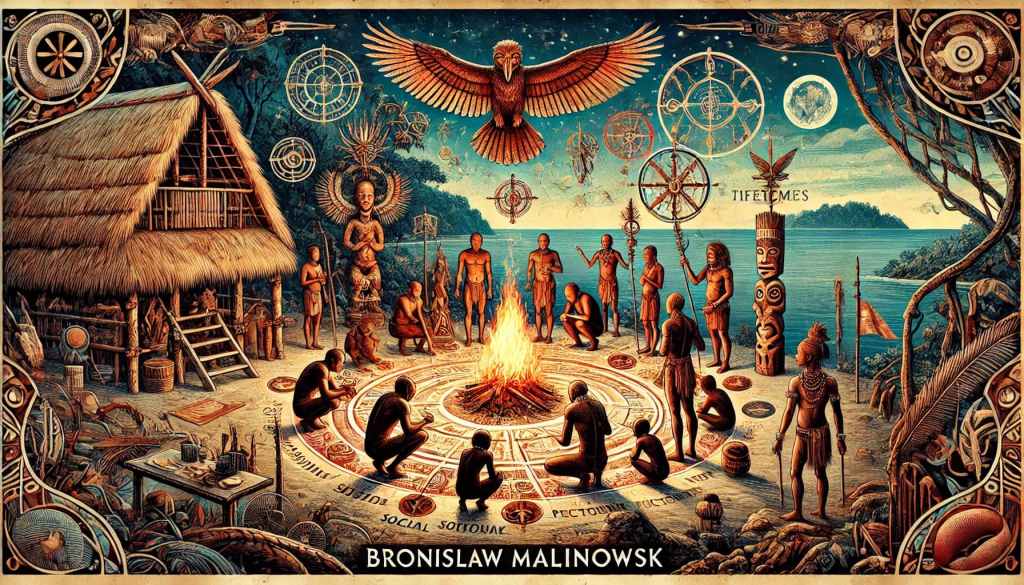
Malinowski is renowned as a foundational figure in anthropology, having conducted extensive fieldwork as a participant-observer on the Trobriand Islands, situated in the South Pacific near New Guinea, from 1914 to 1918. His exploration of the Trobriand society led to the development of his theory on religion, shaped by his observations of its significance within this small-scale community.
His work straddles a transitional period in anthropological thought, bridging traditional inquiries into universal principles of human behaviour with the emerging emphasis on empirical study within specific societies. While Malinowski can be associated with nineteenth-century scholars who delved into the nature and origins of religion and magic, he also marks a departure from their approach. Unlike his predecessors, who sought overarching explanations and principles, Malinowski championed a new phase focused on meticulous data collection within distinct cultural contexts.
Thus, Malinowski can be viewed as both a continuation of earlier inquiries and a pioneer of a novel methodological approach. This duality is reflected in the two distinct levels at which his ideas about magic, science, and religion are presented in his work, representing a synthesis of traditional questions and innovative methodologies.
In his analysis, Malinowski examines the societal dynamics of the Trobriand islanders, presenting them as a quintessential model of humanity. Drawing from his field research among them, he uses their practices to illustrate broader theories on the role of magic and religion in society. Malinowski seamlessly connects his observations of social life with overarching conceptual frameworks, offering simplistic yet insightful explanations. By extrapolating from this single case study, he endeavours to establish the universality and legitimacy of these phenomena.
While Malinowski’s approach may appear rudimentary to some, it introduces a fresh perspective on the study of science, religion, and magic. His pioneering method laid the groundwork for future advancements in sociological thought. Understanding Malinowski’s influence is crucial for tracing the evolution of these disciplines. According to Nadel, Malinowski’s work provides a foundational logic for studying these phenomena, shaping subsequent scholarship.
Robert Redfield praises Malinowski’s ability to discern universal principles within specific cultural contexts. Malinowski’s exploration of religion and magic reflects a profound interest in human social dynamics. Redfield suggests that Malinowski’s approach elevates anthropology to an art form, blending empirical observation with theoretical abstraction. Malinowski’s insights bridge the realms of human experience and scientific inquiry.
In summary, Malinowski’s analysis offers a novel perspective on the interplay between religion, science, and magic. His work not only sheds light on the societal dynamics of the Trobriand islanders but also lays the groundwork for a deeper understanding of human behaviour across cultures.
The Domain of the Profane
Malinowski initiates his inquiry by questioning whether primitive societies possess any rational understanding or control over their environment. In contrast to Levy-Bruhl’s assertion that primitive peoples inherently lack a capacity for reasoning, Malinowski argues that every primitive community exhibits a substantial reservoir of knowledge, derived from experience and shaped by rationality. He substantiates his argument by citing instances of behaviour among the Trobriand islanders concerning arts, crafts, and economic pursuits. These behaviours, distinct from magical or religious practices, are grounded in empirical knowledge and a belief in logical processes. Termed as the “profane” aspect of life, it delineates the realm separate from religious or magical domains. Malinowski underscores that the natives themselves maintain a clear demarcation between the profane and the religious or magical spheres.
Magic and its Relation to Science
Malinowski draws a comparison between magic and science to elucidate the social role of magic within primitive societies. Unlike science, which relies on empirical evidence and logical reasoning, magic emerges from traditional practices within a mystical framework. Science seeks to understand natural forces through systematic study, while magic entails a belief in a mystical, impersonal force accessed through ritualistic acts. Whereas science aims to explain natural phenomena through laws, magic endeavours to manipulate nature directly through human intervention. Malinowski suggests that even the most primitive societies exhibit nascent forms of scientific inquiry, albeit rudimentary, implying that magic can be seen as an early iteration of scientific exploration.
Magic, far from being a haphazard collection of actions, entails a methodical approach involving specific rituals and spells chosen for their intended effects. These rituals and spells are informed by personal experiences and are imbued with logical reasoning, akin to scientific hypotheses derived from observations of natural laws. The incantations used in magic are rooted in logical deductions, similar to scientific generalizations about natural phenomena, thereby reflecting a systematic approach to understanding and influencing the world.
Gardening Among the Trobriand Islanders
The inhabitants of the Trobriand Islands primarily rely on gardening for sustenance, complemented by fishing and trading goods they produce. Utilizing tools like pointed digging sticks and small axes, they cultivate crops to meet their needs and often generate surplus yields. Their agricultural success stems from extensive knowledge about soil types, plants, and their interplay, combined with diligent labour applied at precise times and locations.
Their expertise in soil selection and seedling cultivation is honed through observation and hands-on experience. From clearing plots and burning bushes to planting, weeding, and training yam vines, their diligent efforts must synchronize with seasonal rhythms and weather patterns. Dependable knowledge of plant varieties and pest behavior is essential for consistently successful agricultural practices.
Malinowski argues that these natives exhibit a rational understanding of their environment, enabling them to effectively cultivate crops for sustenance and surplus. He highlights a distinct correlation between practical gardening activities and annual rites associated with agriculture, cautioning against conflating the two despite their interconnectedness. Native discernment distinguishes between the outcomes of these endeavours, emphasizing their separate but intertwined roles in island life.
The Trobrianders adhere steadfastly to their traditional annual magical rites as indispensable for successful gardening, despite enduring influences from European cultures over the years. Even as late as 1989, observations by Granada Television of England revealed striking similarities between the ritual practices surrounding yam cultivation then and those documented by Malinowski in 1915. Central to the Trobrianders’ belief system is the conviction that neglecting these magical rites would imperil their agricultural endeavours, leaving them vulnerable to blight, drought, floods, pests, and wildlife incursions.
Malinowski contends that the performance of magical rites doesn’t imply that the Trobrianders attribute all their gardening success solely to magic. Rather, they recognize the role of natural conditions and causes, understanding that mental and physical effort can influence these factors. While their knowledge may be limited, it is practical and devoid of mysticism. When faced with challenges like broken fences or ruined seeds, the Trobrianders respond with work guided by reason, not recourse to magic.
However, despite diligent effort, crop failures are inevitable due to unpredictable factors like weather variations or locust infestations. To mitigate these uncertainties, the Trobrianders resort to magic, focusing their rituals specifically on controlling these uncontrollable influences. Thus, while they approach known factors like weather, soil, and farming practices rationally, they turn to magic for the unknown and unpredictable aspects.
Malinowski further delineates the separation between the realms of work and ritual among the Trobrianders. Each magical rite associated with gardening has its own designated name, time, and place of performance, distinct from the everyday tasks of gardening. Work is suspended during these rituals, which are conducted openly and attended by the community. Additionally, although the same individual often leads both agricultural activities and magical ceremonies, these roles remain clearly delineated and are never allowed to overlap or interfere with each other. While the leader of agricultural activities may direct gardening tasks and reprimand lazy workers, they do not blend this role with that of the magician, preserving the distinct spheres of work and ritual within Trobriand society.
Canoe-building Among the Trobriand Islanders
The canoe represents a distinctive type of watercraft, characterized by its elongated, lightweight structure with pointed ends and curved sides, typically propelled by hand-driven paddles. Among the Trobriand people, the construction of canoes involves a clear division between practical craftsmanship and spiritual beliefs.
Crafting a canoe requires a deep understanding of materials, stability principles, and hydrodynamics—the scientific study of water motion and its effects on solid objects. Trobriand artisans recognize the importance of balance, realizing that widening the outrigger— a beam attached to the canoe to maintain equilibrium—enhances stability but compromises resilience against stress. They employ precise measurements, understanding the optimal width relative to the canoe’s length to maintain performance.
Moreover, Trobriand canoe makers possess comprehensive knowledge of boat mechanics, including strategies for navigating storms and the importance of positioning the outrigger on the weather side for stability during adverse conditions. This integration of practical expertise and cultural wisdom underscores the Trobriand people’s holistic approach to canoe craftsmanship.
According to Malinowski, the terminology used by the Trobrianders in sailing is intricate and comprehensive, akin to that of contemporary sailors, as it is essential for navigating perilous conditions in their delicate canoes. Similar to their expertise in yam cultivation, their knowledge of canoe construction demonstrates their understanding of the necessities for successful sailing. However, Malinowski observes that despite their proficiency, the Trobrianders still contend with unpredictable elements such as sudden gales and strong tides, prompting the utilization of magical practices.
Magical rituals are incorporated into canoe construction and throughout sea voyages among the Trobrianders. Malinowski draws a parallel between them and modern sailors, noting that even with modern advancements and scientific understanding, sailors often harbour superstitions without forsaking their rationality or knowledge. In acknowledging both the rational approach to navigation and the use of magical rites to control unforeseeable natural forces, Malinowski underscores the coexistence of these seemingly disparate practices.
The Domain of the Sacred: Religion
Malinowski’s primary focus lies in:
- Organizing factual information.
- More precisely defining the boundaries between the Sacred and the Profane.
- Exploring the relationship between magic and religion.
He initiates his exploration by examining the distinction between magic and religion. According to him, magical rituals have a defined objective and anticipate specific outcomes, whereas religious ceremonies lack such explicit goals and are not tied to particular events. This distinction forms the basis of Malinowski’s analysis of religious beliefs and practices among primitive societies. He illustrates this through examples such as initiation ceremonies to elucidate the nature and function of religious behavior among these groups.
Initiation Ceremonies
Malinowski outlines several key elements of initiation ceremonies:
- Firstly, the novices undergo a period of seclusion as they prepare for the ceremony.
- During the ceremony itself, the initiates endure various trials, which may include symbolic acts of bodily alteration, whether real or mimetic.
- These trials symbolize the concept of ritual death followed by the rebirth of the initiated individual.
- While the dramatic aspects of the ceremonies are significant, the essential aspect lies in the systematic instruction of the youth in sacred myths and traditions, the gradual revelation of tribal mysteries, and the presentation of sacred objects.
- Both the trials and the instructional components of the ceremonies are believed to be orchestrated by ancestors, culture-heroes, or supernatural forces. It is believed that by undergoing these rites, novices establish a connection with these higher powers.
Malinowski’s inquiry delves repeatedly into the sociological significance of three key aspects, particularly focusing on the role of initiation ceremonies in primitive cultures. He explores the vital function these ceremonies play in upholding and evolving traditional practices and beliefs. Malinowski underscores the significance of imparting sacred teachings amidst physical discomfort and the endorsement of higher authorities, highlighting the imperative of preserving inherited knowledge and customs. He outlines the multifaceted functions of initiation ceremonies:
- They serve as a symbolic enactment, showcasing the paramount importance of tradition within primitive societies.
- Initiation ceremonies are instrumental in ingraining this significance deeply into the psyche of each succeeding generation.
- These rituals serve as conduits for the transmission of tribal wisdom, thus safeguarding tradition and fostering tribal cohesion.
Beyond elucidating these ceremonial functions, Malinowski underscores another dimension tied to the transition of novices. He observes that these religious rites not only mark biological maturation but also signify a social shift from mere physical growth to the assumption of adult responsibilities, entitlements, and sacred knowledge. Moreover, they facilitate a communion with the divine, which Malinowski regards as a transformative aspect within religious rituals.
Rites Related to Death
Malinowski suggests that death, being the ultimate culmination of life, serves as a pivotal aspect of religious practices worldwide. He observes similarities in death rituals across various cultures. For instance, as death nears, the individual is typically surrounded not only by close family but often by the broader community, transforming a private event into a communal one. This initiates a sequence of actions where some attend to the dying or deceased while others prepare for subsequent rites.
In Melanesian societies, Malinowski notes that death ceremonies are often carried out by relatives through marriage, while the deceased’s immediate family maintains a respectful distance. Conversely, among certain Australian tribes, the situation is reversed, with the deceased being prominently displayed immediately after death, triggering an intense display of mourning.
Expressions of grief vary, from shaving of heads to dishevelled appearances and torn garments, symbolizing the public manifestation of sorrow. Subsequently, the disposal of the corpse takes place through diverse methods, including burial, exposure in caves or on platforms, or even cremation or burial at sea. Malinowski highlights the contradictory customs within primitive communities, where some opt to preserve the body or its parts, while others prefer complete disposal. This dichotomy is exemplified by practices such as mummification or cremation, which represent extremes in this spectrum of customs.
Malinowski diverges from the prevailing notion of his era, which attributes certain practices to the diffusion and interaction of cultural elements from different regions. Dismissing diffusionist arguments, he posits that customs surrounding the deceased embody a dual psychological stance.
Firstly, on one hand, there’s an expression of longing for the departed, while on the other, there’s a sense of apprehension and aversion towards the changes wrought by death. Mortuary rites serve both ends: the desire to maintain a connection with the deceased and the simultaneous wish to sever it. Malinowski thus categorizes these practices within the realm of religion, as they serve a religious function through their performance.
In these rites, the actions themselves hold significance, signifying religious behaviour. Consider, for instance, the belief that contact with a corpse is ritually impure and hazardous, necessitating purification rituals for mourners. Moreover, these rites compel participants to confront their aversions and fears, facilitating a process of emotional resolution. This dual function underscores the complexity of death ceremonies.
Secondly, the process of overcoming revulsion and easing apprehensions often hinges on individuals’ faith in an existence beyond mortal life, commonly referred to as life after death. This faith entails a conviction in the perpetuity of the soul, or the concept of immortality. Malinowski suggests that this belief in the essence of the soul or the notion of immortality arises from a profound emotional experience shaped by religious practices, rather than merely being a primitive philosophical concept. Such faith in the eternal nature of the soul serves as a means for humans to confront and transcend the fear associated with death.
Malinowski highlights a significant aspect of rituals surrounding death. The ceremonies conducted shortly after someone passes away, coupled with the belief in immortality, symbolize both the collective mourning of the community and the belief in the persistence of the soul. Consequently, what is essentially a natural or biological occurrence assumes the stature of a social event.
The Domain of the Sacred: Magic
Malinowski delineates magic as a series of pragmatic actions conducted with the intention of achieving specific outcomes. Within the realm of magic, he identifies two primary categories:
1. Black Magic and Love Magic: Black magic entails the use of pointed objects such as bones, sticks, arrows, or animal spines directed towards an individual with the intent to harm them, symbolically mimicking the victim’s body. This ritual is characterized by intense emotional expression, where the magician ritually destroys a figurine or object representing the victim, manifesting deep-seated hatred and fury. Conversely, love magic operates in the opposite direction. Here, the magician tenderly interacts with an object representing the beloved, mimicking the behaviours of a person deeply infatuated. Essentially, whether it be black, love, or terror magic, these acts are fundamentally rooted in emotional expression, where the objects and actions utilized in these rituals are imbued with emotional significance.
2. Performing Imitative or Predictive Magic: This form of magic involves rituals that mimic the desired outcome. For instance, if the goal is to cause harm to an individual, the practitioner enacts gestures symbolizing the process of death, such as weakening the voice, simulating a death rattle, and collapsing to emulate the onset of demise.
3. Basic Magic: This category encompasses straightforward magical acts aimed at producing immediate effects. Typically, a magician imbues a magical incantation into an object, which can then be applied to exert influence over a target individual. The object receiving the enchantment must possess specific predetermined qualities.
After delineating these conventional forms of magic, Malinowski underscores their shared characteristic: the potency of magical force. This denotes the inherent power within the incantation, with its intricacies known solely to the magician tasked with upholding the tradition of knowledge within this realm.
The Tradition of Magic
The essence of magical incantations lies in the ceremonial recitation of a formula, passed down through generations of practitioners. Malinowski delineates three components associated with these magical formulas:
1. The first component involves phonetic effects, mimicking natural sounds like the wind’s whistle, thunder’s rumble, or the crashing of waves.
2. The second component consists of spoken words that articulate the intended outcome of the magic. For instance, in harmful magic, the practitioner may vocalize symptoms of a disease aimed at afflicting the target, while in healing magic, they describe conditions indicative of good health.
3. The third component, according to Malinowski, is the most pivotal aspect of any spell. It entails mythological references linking magic to ancestral transmission and cultural heroes. These mythological allusions establish a traditional context for magic, serving as a bridge between tradition and the ritual of magic.
Nearly every magical ritual is accompanied by a narrative that serves to justify its practice. These narratives typically recount the circumstances under which a particular magical rite came to be associated with a magician, a group or a family lineage. However, Malinowski warns against conflating these stories with the origins of magic itself, which is believed to have existed since time immemorial. Magic, according to this view, is an inherent aspect of human existence, coexisting alongside rational efforts to exert control over the environment. When conventional methods fail, magic steps in to address what eludes rational explanation.
In Central Australia, for instance, magic is viewed as an inheritance from ancient times. Similarly, in Melanesia, it is believed to have originated from a period when humans dwelled underground. Moreover, magic is intricately linked with various human endeavours, including agriculture, fishing, hunting, trade, health, mortality, and romantic relationships.
Malinowski emphasizes that magic primarily concerns humanity’s interaction with nature and the activities that influence this relationship. It is not perceived as a force inherent in nature or derived from an understanding of natural laws. Instead, it is rooted in tradition and the belief in humans’ capacity to shape outcomes according to their desires. This perspective leads Malinowski to critique scholars who equate magic with concepts like mana among Melanesians, wakan among North American Indians, or orenda among the Iroquois, as he sees these phenomena as distinct from the practice of magic itself.
Magic and Experience
Malinowski, as a sociological observer, delves into the belief in exerting control over specific outcomes. He elucidates a scenario where individuals resort to magical rituals when faced with a deadlock in their endeavours. When one reaches a point where efforts seem futile in averting undesirable consequences, a sense of powerlessness ensues. This feeling manifests when, despite strenuous attempts, a hunter fails to catch game, a sailor struggles to locate fish shoals, or a gardener battles insect infestations. The fear of losing control over one’s environment generates tension, prompting individuals to seek alternative actions.
In such circumstances, Malinowski suggests that individuals engage in “substitute activities.” Under the grip of frustration or impotent anger, one may engage in symbolic attacks against perceived adversaries or express anger verbally. Similarly, a person separated from a loved one might conjure visions of them, while a fisherman might mentally visualize a bountiful catch, invoking fish by name. Malinowski argues that these responses to overwhelming emotions or persistent desires are innate reactions stemming from a universal psycho-physiological mechanism. These reactions often materialize as magical rituals.
Malinowski posits that humanity discovers profound truths in moments of confronting the limitations of rational action through intense experiences. He suggests that the benefits of successful magical practices outweigh any setbacks, as successes are more memorable than failures. Magic typically resides with individuals of exceptional skill and reputation within a community, making its effectiveness contingent upon their personal attributes.
These beliefs imbue magic with a vital energy, with failures attributed to disregarding taboos or encountering stronger opposing magic. The desire for control over one’s environment and actions, coupled with a fear of impotence, drives individuals to engage in magical rituals. For instance, counter-magic may arise from desires to outdo neighbours in possessions or influence.
Drawing from his observations in the Trobriand Islands, Malinowski highlights the reciprocal nature of magical practices, where each action has a corresponding counter-action. A sorcerer who inflicts illness must also know how to cure it. This duality, comprising positive and negative forces, explains why magical outcomes sometimes fall short of expectations.
Similarities and Differences Among Magic and Science
In his essay’s conclusion, Malinowski delineates the connections between magic and science, as well as between magic and religion, in the following manner:
Magic and Science: Malinowski illustrates the relationship between these domains by highlighting both their similarities and disparities:
Similarities: Malinowski identifies several parallels between magic and science:
- Both magic and science are driven by specific objectives linked to human necessities and instincts. Additionally, they operate within a framework of regulations dictating the effective execution of certain actions.
- Both disciplines involve the development of methodologies for achieving desired outcomes. Drawing upon these resemblances, Malinowski leans towards James Frazer’s characterization of magic as akin to a pseudo-science.
Differences: Distinguishing between magic and science involves several key distinctions:
- Science, as seen in the basic understanding of tribal communities, emerges from everyday experiences and is shaped by observation and reasoning about interactions with the natural world. In contrast, magic originates from specific emotional states, particularly those marked by tension. In these states, the focus is not on observing nature but on internal reflections, often centered around feelings of powerlessness. Magic involves a kind of emotional drama within the human psyche.
- Science rests on the confidence in the validity of experiences, the application of effort, and the use of reason. Conversely, magic is rooted in the belief that hope and desire can still influence outcomes.
- The realm of scientific knowledge operates within a social framework and involves activities distinct from those associated with magical knowledge.
Drawing on these disparities, Malinowski suggests that science falls within the realm of the secular, while magic occupies a space that straddles the sacred and the profane.
Magic and Religion: Similarities and Differences
Malinowski draws parallels between magic and science, elucidating the connection between magic and religion, which he describes as follows:
Similarities: Similarities exist between magic and religion:
- Both are part of the sacred realm and emerge and operate within emotional intensity.
- Both serve as a refuge from emotional strain, a response to challenges beyond the grasp of primitive rationality.
- Mythological narratives envelop both magic and religion, while taboos and rituals set them apart from the secular sphere.
Distinctions: An analysis of the disparities between magic and religion reveals the following:
- Magic is instrumental, serving as a means to achieve specific ends, while religious practices are self-contained, undertaken for personal fulfillment.
- The practice of magic is characterized by a defined and limited set of techniques, revolving around spells, rituals, and the practitioner. Conversely, religion lacks such a straightforward methodology, encompassing a multitude of facets and objectives, with its rationale rooted in belief and ritual.
- Magical belief centers on an individual’s confidence in their ability to produce desired outcomes through specific spells. In contrast, religion encompasses a broader spectrum of supernatural forces and phenomena.
- Religious mythology is intricate and imaginative, focusing on foundational beliefs, while magical lore tends to glorify origins with boastful narratives.
- Transmission of magical knowledge occurs through direct lineage, typically from one generation of practitioners to the next, thus restricting it to specialized individuals. In religion, however, participation is widespread; initiation, mourning rituals, and the understanding of spirits involve the entire community. Furthermore, while becoming a spiritual medium is a specialized function within religion, it is not a learned profession but rather a personal gift.
In the realm of magic, there exist both constructive and destructive manifestations. Given magic’s tangible impact on outcomes, the differentiation between positive and negative forms holds considerable importance. In the nascent phases of religion, as per Malinowski’s observations, the delineation between benevolent and malevolent forces is often minimal.
References and Readings:
Magic Science and Religion and Other Essays, by Bronislaw Malinowski, https://amzn.to/3FsyBnV
The Early Writings of Bronislaw Malinowski, Edited by Peter Skalnik, Robert J. Thornton, https://amzn.to/4kNdtZv
Sociological Theory, by Ritzer G, https://amzn.to/3Da3pcm