- What is Marriage
- Meaning and Definitions of Marriage
- Characteristics of Marriage
- Aims of Marriage
- Significance of Marriage
- Changing Trends in Marriage in Indian Society
Marriage: An Introduction
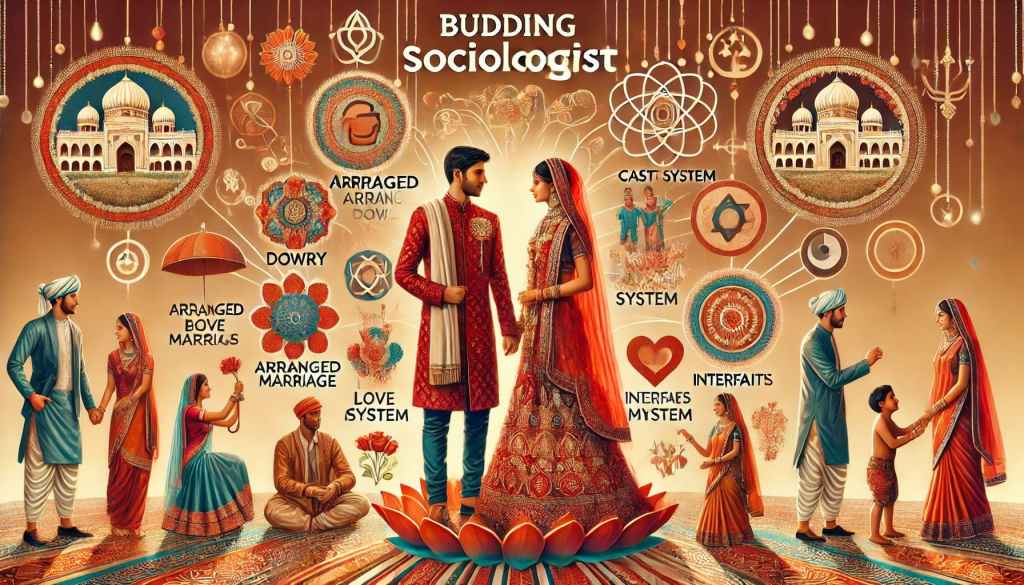
In the early stages of human civilization, people lived in primitive conditions, leading a nomadic lifestyle. Marital relationships were initially driven by a herd instinct, resulting in the birth of children without a clear determination of the father. However, as societies transitioned to agricultural lifestyles, the need arose to establish paternity for children. This necessitated the regularization of sexual relationships between one man and one woman. The pursuit of understanding paternity, along with the social acceptance of sexual behaviour, played a significant role in the evolution of the institution of marriage.
Marriage, as an institution, is crafted to meet the biological, especially sexual, needs of individuals in a legally, culturally, and socially sanctioned manner. Given that culture plays a pivotal role in shaping marriage, it can be asserted that marriage is not solely a social institution but also a cultural one. Furthermore, marriage integrates men and women into family life, defining specific rights and duties concerning their offspring. Serving as a stable social institution, marriage unites individuals of opposite sexes, granting them the status of husband and wife, and legitimizes their sexual relations and childbearing.
The formalized structure of sexual relations within the confines of marriage gives rise to the family. In India, the term “marriage” or “vivaha” combines “Vi” and “Vaha,” signifying the ceremonial act of carrying the bride to the groom’s house. While some societies view marriage as a religious sacrament, others perceive it as a social contract.
Meaning of Marriage
Marriage is the formalization of a relationship between two individuals, making it public, official and enduring. It signifies the union of two people in a bond that is intended to last until death, although, in reality, it is often terminated through separation or divorce. As a universal social institution, marriage serves to regulate and govern human life, closely intertwining with the institution of family. The relationship between marriage and family is symbiotic, each complementing the other. While the purposes, functions, and forms of marriage may vary across societies, its presence is ubiquitous as an institution.
Marriage holds different implications in diverse cultures, functioning as a means to control and fulfil various socio-psychological, biological, and cultural needs for both men and women. It is a specialized relationship that entails specific rights and obligations. Described as both an institution and an association, marriage binds individuals with established rules and regulations. On one hand, it forms an institution as it imposes regulations on the relationship between a man and a woman; on the other hand, it functions as an association, being a socially approved group comprising males, females, and their respective families.
Characteristics of Marriage
Marriage, as a universal institution rooted in the culture of each society, is remarkably diverse and expansive. Describing its character proves challenging due to its widespread nature. Nevertheless, based on the observations of numerous scholars, an effort is made here to outline some key characteristics of marriage:
1. Universality: Marriage is a nearly universal institution observed across diverse societies, encompassing both literate and pre-literate communities. In certain societies, it is mandated as a social norm. For instance, in Japan, celibacy faces public condemnation, while in Korea, unmarried individuals are referred to as ‘half persons.’ Among Hindus, marriage is considered a sacrament, carrying a sense of obligation. The Todas of Nilagiri showcase the significance attached to marriage, as they decline to conduct funeral rites for an unmarried girl who passes away but perform the ceremonies after completing a specific marriage ritual for the deceased.
2. Relationship between Man and Woman: Marriage signifies the union between a man and a woman, representing the connection between one or more men and one or more women. This relationship is governed by socially approved provisions, specifically the rules of mate selection. These provisions also determine the permissible number of marriages, specifying how many women a man can marry and how many men a woman can marry. In essence, there exists a socially sanctioned method for establishing relationships between men and women.
3. Enduring Bond: Marriage is a enduring connection sanctioned either by societal norms or legal recognition. It represents a lasting union between a husband and wife, persisting beyond the fulfillment of sexual satisfaction. This commitment involves a bundle of duties and obligations that endure until the end of life. In Hindu culture, for instance, marriage is regarded as a sacred and unbreakable bond, extending even beyond death and thought to transcend seven lifetimes.
4. Requires Social Approval: The establishment of relationships such as marriage relies on social approval. Society’s validation is essential, permitting men and women to embark on married life, engaging in procreation to ensure the continuity of society through the formation of a family. The union of a man and a woman cannot be deemed valid without societal approval. Once marriage attains social sanction, it transforms into a legal contract.
5. Civil or Religious Ceremony: Marriage receives social acknowledgment through various ceremonies across the globe. In Western societies, marriages are often arranged in either a church or a court, with specific rites, rituals, customs, and formalities contributing to the completion of the ceremony. The essential aspect is that the marriage must be finalized in a public setting for it to be officially recognized and validated. In some instances, marriage is even considered a sacrament, as seen among Hindus, where it is associated with rituals like Homa, Saptapadi, Panigrahana, Mangalya-Dharana, and others.
6. Mutual Obligations: Certain foundational understandings are crucial before entering into a marital relationship, and these must be mutually agreed upon to ensure the sustainability of the relationship. Beyond being merely a sexual connection, marriage is fundamentally a bond of mutual understanding. A greater degree of understanding and trust contributes to a more stable relationship. Additionally, marriage brings with it specific rights and responsibilities for both the husband and wife. Both partners are obligated to provide support not only to each other but also to their children and other family members from both sides.
Conclusion: Based on the preceding description, it can be asserted that marriage is the formal union of individuals of opposite sexes, sanctioned either by societal norms or legal regulations. It transcends mere union, encompassing a set of duties and responsibilities that both the man and woman are expected to fulfill, not only for themselves but also for the two family units involved. Marriage gives rise to the family, a foundational institution in society, responsible for nurturing socially accepted relationships and caring for children, thereby ensuring the continuity of society. Despite various societal structures, a viable alternative to marriage has yet to be identified. In the context of marriage, parental names are bestowed, and children born and raised outside the institution are not accorded social acceptance. Regardless of one’s economic or social standing, society prohibits relationships with individuals of the opposite sex outside the framework of marriage. Offspring born within the confines of marriage are deemed legitimate, while those outside it are labeled as illegitimate.
Aims of Marriage
Marriage, viewed as an association, represents a collective of two or more individuals sharing common objectives. On the other hand, as an institution, it entails adherence to specific rules and regulations. Considering these dual facets of marriage as a fundamental and widespread social institution, the ensuing list outlines some of its objectives:
1. Biological Aim: The primary objective of marriage is addressing biological needs, particularly the fulfilment of the natural requirement for sexual expression in both males and females. While the satisfaction of this need leads to childbirth, the vulnerability of human infants at birth necessitates a permanent institution for their care over several years. Consequently, the fulfilment of biological needs in human society is not an isolated process and cannot be solely dictated by individual desires. It inherently involves another individual from the opposite sex, emphasizing the importance of their well-being and satisfaction. Therefore, considering biological needs as the sole aim of marriage is incomplete. Entering into matrimony is not solely driven by biological needs, as young men and women also assume numerous social responsibilities that can only be adequately fulfilled within the institution of marriage. It is crucial to acknowledge that while sex constitutes one of the fundamental aspects of married life in nearly all human societies, it serves as a foundational element for a healthy and contented life.
2. Social Aim: Conceiving and raising children constitutes both a biological and social role within the institution of marriage, crucial for the perpetuity of society. The innate human instinct drives a desire for multiplication, and women, in particular, yearn for the experience of parenthood. Consequently, the inclination to have children and nurture them fulfils both a biological necessity and provides psychological satisfaction. Raising children within the family framework fosters a sense of contribution to the continuity of their family lineage, with individuals perceiving themselves as custodians of their family traditions. In many cultures, individuals who choose not to marry and participate in the procreation of offspring are often viewed with less piety and respect. Entering the institution of marriage and fulfilling one’s dharma (as in Hinduism) by contributing to society’s continuity is considered a virtuous act. The primary function of progeny lies in perpetuating the family and lineage, serving as a means to extend kinship bonds. Additionally, marriage contributes to the preservation of cultural heritage within society. Beyond these fundamental roles, married individuals enjoy certain social advantages, such as increased respectability, enhanced communicability, social facilitation, and greater reliability in social relationships, which are often not afforded to those who remain unmarried.
3. Economic Aim: Marriage, functioning both as an institution and an association, is fundamentally rooted in a straightforward division of labour, with the aim of assigning domestic responsibilities, regarded as “soft work,” to women (wives) within the household and designating “hard work” outside the house to men (husbands). The man assumes the role of ensuring that all economic needs of the family, including those of his wife, are met. In contemporary societies, this division is executed in a more sophisticated manner, while in primitive societies, marriage is primarily driven by economic motives. In societies where agriculture is the main profession, women are typically engaged in lighter tasks such as sowing and are expected to assist their husbands in various activities. In certain hilly tribes, polyandry is practiced, largely due to economic considerations. Economic constraints often lead to the collaboration of several males marrying a female to address poverty-related challenges and shared responsibilities. Economic reasons also drive females to consider marrying multiple males to mitigate economic insecurity. In many primitive societies, women bear almost equal burdens in economic activities, reflecting a division of labour between males and females. While the specific economic functions of males and females may vary, the principle of shared responsibility remains a common thread across diverse societies.
5. Emotional and Psychological Support: The institution of marriage is intricately linked to the maturity of both individuals involved, namely the man and the woman. Once they reach a certain age and level of maturity, they enter into a marital relationship. This stage is crucial as, with maturity, emotions become more regulated, and both parties are better equipped to offer each other psychological support. While marriage encompasses social and cultural dimensions, its essence predominantly revolves around emotional connections. It is essentially a bond with someone with whom an individual feels the utmost comfort. As life partners, the couple collaborates to nurture profound love and affection. This not only deepens their emotional connection but also fortifies the companionship between them. A healthy and joyful relationship significantly influences the socialization of children within the family unit.
6. Social Solidarity: Marriage serves as a unifying force, bringing together not only two individuals of opposite sexes but also their respective family and kinship groups. The harmonious interaction between these groups contributes to the overall strength of society. Sociologists emphasize the importance of fostering connections through marriages that transcend caste, group, class and religion. Furthermore, they advocate for inter-language and inter-regional marriages, envisioning these unions as potential avenues to reduce social distances and foster greater social solidarity.
Conclusion: Based on the above description, it can be asserted that marriage encompasses various objectives, spanning social, economic, religious, emotional, and psychological dimensions. Acting as a guide, marriage instructs individuals on how to contribute to the maintenance of a healthy society. Essentially, it serves as a set of directives with purposes such as establishing a family, nurturing socially integrated citizens for society, and preserving and passing on cultural heritage to the next generation. Globally, marriage is anticipated to fulfil three fundamental aims: satisfying sexual desires, fostering economic cooperation, and raising children. Thus, marriage represents a union between a man and a woman, not only for shared companionship but also for collaborative efforts and endeavours.
Significance of Marriage
Cultural variations can lead to differences in the nature and structure of marriage across the globe. However, despite this diversity, marriage remains a universal institution due to its intrinsic significance. Recognized as a fundamental necessity for society, the institutional aspect of marriage inherently illustrates its importance. The following points elucidate the significance of marriage:
1. Marriage for Union and Procreation: The primary significance of marriage lies in providing social validation to the partnership between individuals of different genders, enabling them to embark on married life and create a family. The union in marriage serves as a means for the physical, psychological, and spiritual communication of love and self-commitment. This bond results in the procreation of children, making childbearing a fundamental purpose of marriage. Crucially, marriage plays a foundational role in promoting values such as mutual love, pleasure, and happiness between spouses, contributing to a healthy society by offering a legitimate outlet for sexual satisfaction.
2. Marriage for Companionship and Friendship:The fundamental needs of human beings revolve around intimacy and commitment. Within the context of marriage, friendship serves as its bedrock, enduring beyond the phase of waning sexual desire and persisting even after children have matured and established their lives. This enduring connection between partners enhances the quality of life for both individuals, growing and deepening over time. As individuals age, the need for companionship becomes increasingly paramount. The bond of marriage enriches both man and woman by fostering unselfishness, deepening their capacity for love, and encouraging sacrifice. While marriage encompasses elements of love, sex and family, its ultimate and essential essence lies in the enduring companionship or friendship that lasts a lifetime. In Hindu society, this connection is believed to transcend death, with both partners expected to remain together not just in this life but across seven successive births.
3. Marriage for Socialization: Marriage serves as a potent and practical mechanism facilitating the socialization and development of individuals. Through marriage, both partners, husband and wife, acquire essential values such as sacrifice, togetherness, love, affection, cooperation, mutual understanding and security. These values are not only imbibed by the couple but are also prepared for transmission to the succeeding generation through the process of socializing children. Additionally, marriage plays a crucial role in establishing a family, providing a natural environment where individuals can discover and fulfill their potential. This familial foundation instills a sense of dedication and service in individuals, contributing to the formation of a solid societal framework and offering children a stable setting for their growth.
4. Marriage for Matured Relationship: The notion that relationships are ordained in heaven and celebrated on earth suggests that the choice of a life partner is predetermined by a higher power. However, the quest for a suitable and mature life partner has persisted since the inception of this institution. Selecting a mature life partner is a crucial decision, as it is a one-time choice that significantly influences the entirety of one’s life. While it is commonly expected that maturity naturally accompanies age, there are instances where maturity remains elusive throughout a person’s life. Marriage plays a pivotal role in fostering maturity as it entails numerous responsibilities. By shouldering these responsibilities, individuals learn to navigate life within the framework of family, extend their understanding to the broader society, and, by day’s end, cultivate a sense of maturity. Therefore, marriage is viewed as a transformative journey that contributes to personal growth and the development of maturity.
5. Emotional and Financial Security: Marriage functions as an institution that offers both financial and emotional stability to both partners, with emotional security being deemed more crucial than financial security. While living without financial resources is challenging, the absence of emotional care is considered impossible. The initial emotional bond is what draws young men and women towards marriage, as it provides a sense of security. Partners in marriage share the challenges and anxieties of the moment, creating a complementary self that serves as an emotional counterbalance. Moreover, marriage extends financial security not only to the children but also to other family members. A secure home environment is crucial for a child’s development, shielding them from unfavourable external influences. The absence of such security poses a significant risk to a child’s character and personality, potentially leading to warped and distorted development. The prevalence of delinquency among children from broken homes serves as tangible evidence of the critical need for security in upbringing.
6. Transmission of Ideals of Personal Responsibility: One of the primary roles of marriage is to uphold and transmit the values of personal responsibility that have been foundational to our civilization. This function begins with the establishment of unwavering dedication and commitment between the husband and wife. When the marital partners exhibit unquestionable loyalty to each other, the positive impact of this robust relationship extends beyond the confines of the home. It creates a secure environment within the household, instilling a sense of security for all its members. Furthermore, this positive influence spreads throughout the community, leaving a stabilizing effect within the broader circle of friends.
7. Continuity to Human Race: One crucial role of marriage is to ensure the continuity of the human race. Marriage serves as the socially accepted means of introducing new members to society. Although it is possible to have children outside of marriage, the social acceptance of a child often hinges on the acknowledgment of their father, a recognition typically facilitated by the institution of marriage. This is a key reason why marriage is considered a foundational social institution. From a biological perspective, the primary function is the initiation of children into society, while concurrently fostering happiness within the household. The news of a pregnancy transforms the entire family dynamic, engaging everyone in the care and upbringing of the child. In Hindu society, numerous ceremonies from conception to ongoing family events are specifically designated for those who are married. Conversely, a home without children is perceived as incomplete.
8. Life-long and Never-Ending Dynamic Relationship: Globally, marriage stands as the cornerstone of human society. It initiates the formation of a family, followed by the advent of children, their education, careers, marriages, and so forth, illustrating that marriage is an all-encompassing, lifelong commitment that extends throughout one’s existence. In Hindu tradition, marriage is regarded as a relational bond spanning seven generations, tracing back to its inception. What adds intrigue to marriage is its dynamic nature, never remaining static. The circumstances evolve from youth to old age, presenting constant challenges that test the adaptability and resilience of both husband and wife at every life stage. The adjustments needed for the arrival of a first child differ significantly from those required when the last child leaves home. The journey of marriage commences with the selection of a life partner and progresses through various phases, culminating in the mature years and ultimately concluding with the end of life.
Changing Trends in Marriage in Indian Society
In India, marriage holds significant importance as an institution grounded in religion, religious ceremonies, and the quest for spiritual pursuits. Traditionally, the ideals of monogamy, the absence of widow remarriage, the challenge of easy divorce, and the value of chastity have been upheld. However, contemporary observations reveal shifts in the institution of Hindu marriage, influenced by factors like urbanization, industrialization, secularization, modern education, the impact of Western culture and evolving marriage legislations. These factors contribute to ongoing changes in the ideals, forms, and values associated with Hindu marriage. An analysis of the transformations in the marriage system in India can be approached through the following considerations:
1. Changes in the Aims of Marriage: Originally, the primary objective of Hindu marriage was Dharma, with Kama or sex, being one of the aims but considered the least desirable in Indian society. However, in recent times, there has been a shift in the hierarchy of marriage aims, with sex becoming the foremost and Dharma assuming a less significant role. This transformation indicates a shift in the aims and foundations of marriage over time.
2. Change in the Process of Mate Selection: Historically, the responsibility of choosing a bride or groom rested with the parents or guardians. This tradition persisted until the late 19th century when the influence of Western culture, driven by liberal ideas and industrialism, began to shape Indian society. Consequently, there emerged instances of individuals exercising their choice in selecting a life partner. In post-independent India, there has been a noticeable shift towards an increased inclination for individuals to choose their own marriage partners. Presently, the younger generation exhibits a reduced preference for parental involvement in the selection process. A contemporary trend is emerging, particularly among the educated middle and upper class youth in urban areas, where individuals themselves play a more active role in choosing their marriage partners. While parents often permit their children to have a say in partner selection, there is a growing autonomy among individuals in this aspect of their lives.
3. Changes in the Rules of Endogamy and Exogamy: Significant transformations have occurred in the regulations governing endogamy and exogamy. Legislative measures have abolished the restrictions associated with varna, caste, sub-caste endogamy, gotra, and pravara exogamy. Cross-cousin marriages, once relatively uncommon, are witnessing a shift in societal attitudes, with a gradual increase in their occurrence. Notably, there is a growing acceptance of cross-cousin marriages under certain circumstances. Regarding endogamous practices, notable changes have transpired. The Hindu Marriage Disabilities Removal Act of 1946 facilitated marriages between different subdivisions within the same caste. Subsequent legislations, including the Special Marriage Act of 1954 and the Hindu Marriage Act of 1955, have permitted unions between individuals from diverse castes and religions. The Arya Samaj Movement has actively advocated for inter-caste marriages, challenging the traditional perception that deemed them unthinkable. Inter-caste marriages, once discouraged, are now not only allowed but also actively encouraged, and the freedom in mate selection, alongside legislative changes, has played a pivotal role in promoting this shift.
4. The Age at Marriage: Over time, child marriage emerged as the predominant form of matrimony in India, initially intended to safeguard the chastity and purity of females. This practice persisted well into the 20th century. In the 20th century, the Child Marriage Restraint Act, commonly known as the Sharada Act of 1929, established the minimum marriage age at 14 years for girls and 18 years for boys. The Indian Parliament later enacted The Special Marriage Act of 1954 and the Prohibition of Child Marriage Act of 2006, specifying the minimum marriage age as 18 years for girls and 21 years for boys. Marriages involving individuals below these prescribed ages were criminalized as cognizable offenses. Sociological studies conducted in recent decades have shown a consistent shift in the trend of marriage age since 1930. Contemporary social conditions have led to a preference for marriage at later ages.
5. Changes in the Rites of Marriage: In the traditional context, Hindu marriage holds a significant religious sanctity, requiring the performance of specific rites and rituals. Key ceremonies associated with Hindu marriage include Kanya Dana, Vivaha Home, Panigrahana, Agni Parinayana, and Saptapadi, among others. However, contemporary circumstances have witnessed changes in the landscape of marriage rites and rituals. On one hand, the constraints of time have led to a reduction in the traditional ceremonies linked to Hindu marriages. On the other hand, some marriages are now conducted in civil courts, resulting in a notable attenuation of the sacred nature of these rites and rituals. Furthermore, the Arya Samaj movement has played a role in streamlining and simplifying the rites and rituals associated with marriage. Another contributing factor to the diminishing religiosity of marriage is the broader shift in Indian society from a sacred to a more secular nature. Consequently, traditional values are undergoing substantial transformations.
6. Change in the Stability of Marriage: In the traditional context, obtaining a divorce was not readily sanctioned or allowed within Hindu society. This restriction on divorce played a pivotal role in maintaining the stability and longevity of the institution of family and marriage. However, with the introduction of marriage and family legislations, coupled with various other factors, the divorce rate in India has experienced a consistent rise. The growing frequency of divorces serves as a clear indicator that the institution of marriage is undergoing transformations, impacting the stability of married life. Marital instability is on the rise, reflecting a shift from a time when divorce was an unthinkable option for wives to the present scenario where women are increasingly seeking the dissolution of marital bonds.
7. The Problem of Remarriage: The ancient tradition of Kanya Dana historically prohibited the remarriage of widows, and Smritis generally disapproved of the practice. Even though widow remarriage was occasionally allowed, it lacked the sacramental significance attributed to the initial marriage. The Widow Remarriage Act of 1856 marked a turning point by permitting widows to remarry at their discretion. Additionally, the Arya Samaj Movement advocated for widow remarriage. Although sporadic cases of widow remarriage were evident in the early 20th century, a significant rise in such remarriages occurred in the post-independence era. This shift indicates a transformation in our traditional values. The negative attitudes and aversion associated with widow remarriage are gradually giving way to more liberal perspectives that embrace and accept the idea of widows remarrying.
8. Dowry Systems: The traditional marriage practice involves Kanya Dana, where the father of the bride gifts her jewels and ornaments during the marriage ceremony as a token of love and affection. Initially, this gesture did not constitute dowry in ancient India. Over time, the prevalence of child marriages brought forth the necessity for substantial dowries, particularly as the selection of a suitable bridegroom became challenging. In recent years, the issue of dowry has given rise to serious problems, including instances of girls resorting to suicide, unethical practices by fathers, and the humiliation of fathers unable to provide a dowry. Despite governmental efforts to eliminate this harmful practice, it persists, and the dowry problem is intensifying. Incidents of bride-burning are on the rise annually in various parts of the country due to the inability to meet the expected demands of the bridegroom’s family. Additionally, there are cases where newly married girls are denied their conjugal rights, citing the excuse that their father did not fulfil the agreed-upon dowry amount.
Chastity held a paramount role in Hindu marriage for both boys and girls, reflecting a significant cultural value. Hindu Sastrakaras underscored the importance of pre-nuptial chastity, placing equal emphasis on the virtue of both males and females. Elaborate rules were established to govern the sexual conduct of individuals until their marriage, strictly prohibiting pre-marital and extra-marital relations. Love, in this context, was seen as a consequence of marriage rather than a precursor to it. Kapadia noted the challenge of reconciling traditional values with the evolving understanding of sex relationships, recognizing a growing need for a new perspective.
While societal changes are occurring, with shifts in sex mores and values, certain aspects of traditional norms are being redefined. Notably, pre-marital sexual relationships, once unknown in traditional Indian society, are becoming more visible. The practice of establishing sexual relationships before marriage is gaining acceptance, challenging the relevance of the Brahmacharya Vrata. Additionally, unconventional ideas such as the exchange of spouses for enjoyment are emerging. The impact of Western culture, coupled with a weakening of regulations on sexual conduct, has led to married individuals engaging in extramarital relationships. In some cases, the traditional Vedic ideal encapsulated in the ‘Saptapadi formula’—”I take thee to be my companion in life”—is not universally accepted, illustrating the evolving landscape of marital values in contemporary Indian society.
Conclusion: To conclude Hindu marriage has undergone several changes. These changes have taken place in the institution of Marriage in India because of many factors, new norms and values. In spite of all these changes, marriage in India is not considered as a social contract and it continues to be sacrament for Hindus. Mutual fidelity and devotion to partner are still considered to be an essence of marriage.
References and Readings:
Sociology by C.N. Shankar Rao, https://amzn.to/41A3Wh4
Sociology Themes and Perspectives by Michael Haralambos and Martin Holborn, https://amzn.to/4ibTgdY