- Introduction
- Max Weberian Approach to Social Stratification
- Three-component Theory of Social Stratification
- Merger of All Three Spheres
- Critical Evaluation
Introduction
Max Weber, born Maximilian Karl Emil Weber, was a 19th-century German sociologist and a key figure in the development of modern sociology. He was also a political scientist, economist, journalist, literary critic, educator, and anti-war activist. Born on April 21, 1864, in Erfurt, Prussia (now Germany), he passed away on June 14, 1920, in Munich, Germany. After completing his university education, he became a professor. However, in 1897, he experienced a mental breakdown, which left him unable to work for nearly five years. In 1905, he published one of his most influential works, The Protestant Ethic and the Spirit of Capitalism. He resumed teaching in 1918 and made significant contributions to sociology, particularly in the study of social stratification, which he analyzed through his concept of verstehen (interpretative understanding).
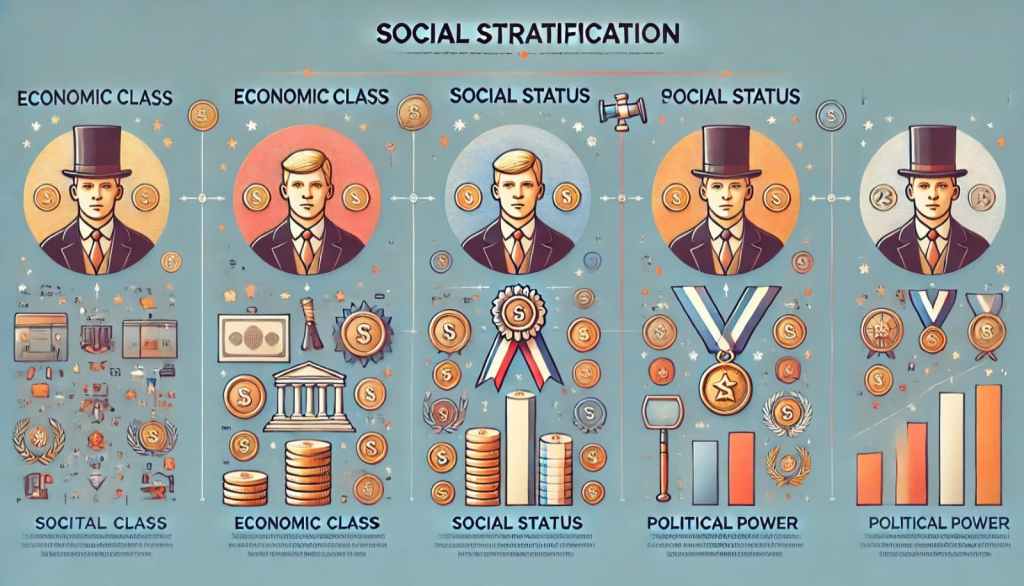
Weber’s theory of social stratification introduced a multidimensional approach, challenging the predominantly economic perspective of Karl Marx. He argued that society is not solely divided by wealth but also by differences in social prestige and political influence. His framework consists of three interrelated components:
1. Class (Economic Aspect): Weber viewed class as an individual or group’s economic position, shaped by access to resources, market opportunities, and economic status. Unlike Marx, who defined class strictly in terms of ownership of the means of production, Weber emphasized market interactions. Individuals with similar economic prospects—such as business owners, skilled professionals, or wage labourers—form distinct classes. Economic class plays a crucial role in shaping life chances, influencing one’s ability to secure employment, accumulate wealth, and improve living standards.
2. Status (Social Aspect): In addition to economic standing, Weber highlighted the importance of status, which refers to the level of social respect, prestige, or recognition a person or group receives. Status is often linked to non-material factors such as education, cultural habits, lifestyle, and profession. For example, an artist or a professor may hold significant social prestige despite having a moderate income. Status groups tend to establish social boundaries through shared values, traditions, or customs to maintain their exclusivity.
3. Party (Political Aspect): The third element of Weber’s model is party, which represents organized groups that seek to influence decision-making and power structures. While parties often take the form of political organizations, they can also include advocacy groups, lobbyists, or collectives striving to achieve specific goals. Unlike class or status, which may passively influence a person’s social standing, participation in a party involves active engagement in shaping policies and societal outcomes.
Weber’s perspective demonstrates that social stratification is complex and multidimensional, rather than being determined by economic factors alone. A person’s societal position may vary based on the interaction of wealth, social prestige, and political influence. For example, an individual may be financially affluent (class), hold high social status (status), but have little political power (party). Conversely, a politically influential figure may lack wealth or widespread social recognition.
By incorporating these three dimensions, Weber provided a more nuanced understanding of societal hierarchies. His theory remains a foundational framework for analyzing power structures, social inequality, and mobility in contemporary societies.
Weberian Theory of Social Stratification
Sociologist Max Weber developed a three-component theory of stratification, which explained political power as a combination of “class,” “status,” and “power.” Unlike Karl Marx, who emphasized the relationship between individuals and the means of production, Weber argued that a person’s class position was influenced by their skills and education. He built upon Marx’s ideas but stressed that no single factor, such as class, could fully determine an individual’s place within the social hierarchy. Instead, he viewed social stratification as a multifaceted system shaped by an unequal distribution of power.
Weber’s perspective on stratification incorporated two key elements from Marx’s approach:
- He acknowledged that social stratification is a structured expression of power inequality in society, similar to Marx’s analysis.
- He recognized the importance of capitalism and industrial societies in shaping social hierarchies, as emphasized by Marx.
However, Weber focused on institutionalized power—power that is exercised in a legitimate and systematic way. Since power can stem from various resources, social stratification operates across multiple dimensions. While Weber, like Marx, considered class in economic terms, he argued that individual and group actions could not be understood purely through economic factors. He identified three distinct components of social stratification: class, status, and party. These elements manifest in different aspects of society, particularly in occupation, power, and property. Together, these hierarchical structures shape the interests of major social groups and define the broader system of class-based stratification.
Positions of People in Institutional Structures
| Class Categories | Occupation | Bureaucratic Authority/ Institutionalised Power | Property Relation |
| Upper class/ The propertied upper class | High | High | Owner |
| Corporate class/ The property less white-collar workers | High | High | Nonowner/ low |
| Middle class/ The petty bourgeoisie | High to mid-level | Mid-level | Nonowner/ low |
| Working class/ The manual working class | Mid-level to low | Low | Nonowner/low |
| Lower class/ not working | Low | Low | Nonowner |
Based on the table, it can be inferred that in a class-based social stratification system, industrial society is categorized into five distinct classes. These classes are ranked from highest to lowest based on occupation and their position within the societal power structure, which is influenced by their relationship to property—where some individuals are owners while others are workers or non-owners. The analysis explores the characteristics of power within each category by examining the stratification system. As depicted in the table, social stratification follows a hierarchical arrangement.
Three-component Theory of Social Stratification
The three-component theory of stratification, also referred to as Weber’s Three-Class System of social stratification, categorizes class, status, and power as distinct yet interconnected elements. This theory adopts a multidimensional perspective to analyze social hierarchy, emphasizing the interaction between wealth, prestige, and authority.
According to Weber, power manifests in different forms and can be observed within three key domains:
- Social Order: An individual’s influence in society is reflected through their social status.
- Economic Order: A person’s economic standing is determined by their class position.
- Political Order: Power is also exhibited through political affiliation, signifying the influence one holds within their political party.
Class, status, and party each represent different dimensions of power distribution within a society. These aspects not only shape their respective domains but also influence one another in significant ways. The key components of this distribution are:
- Wealth: Also referred to as economic standing, wealth encompasses assets such as land, buildings, farms, houses, factories, and other properties.
- Prestige: Also known as social status, prestige reflects the level of respect and recognition an individual or a social position receives from others.
- Power: Power is associated with political influence and the ability of individuals or groups to accomplish their objectives, even in the face of opposition.
Based on the aforementioned scenarios, Weber identified two fundamental aspects of power:
1. Possession of Power: Weber described power as the capacity to control various “social resources,” which grant individuals authority and influence. The distribution of these resources creates monopolies, allowing a select few to accumulate wealth. Over time, this wealth is converted into capital, which, through entrepreneurial efforts, is further transformed—either directly or indirectly—into additional capital. This cycle ultimately fosters capitalism. These resources can encompass a wide range of assets, including land, financial capital, social prestige, physical strength, and intellectual expertise.
2. Exercising Power: The application of power manifests in different ways, but at its core, it involves the ability to impose one’s will on others, regardless of opposition. For instance, an individual’s likelihood of asserting their desires over another person is influenced by factors such as social standing, economic class, and political affiliations. These elements collectively shape a person’s ability to exert influence and maintain dominance in social and political interactions.
Max Weber analyzed the connection between power and social hierarchy, proposing several key concepts that explain how societies structure relationships of dominance and subordination. These concepts include:
1. Class and Power (Economic): Weber viewed class primarily as an economic category, defining it based on an individual’s position in the market, which in turn affects their opportunities in life. He argued that class emerges from unequal access to material resources. For instance, if one person possesses something that another needs, they hold a position of dominance over the latter. This dynamic is evident in the relationship between an employer and an employee, where the employer, who controls access to financial and material resources, holds more power. Essentially, the power a person wields is largely influenced by their class position, which is determined by their market situation and life opportunities.
2. Social Power (Status): Status groups manifest through various social behaviours, such as exclusivity in marriage, dining customs, traditions, and economic opportunities. Weber suggested that when individuals perceive others as socially superior, they may naturally defer to them, granting them a form of influence or power. Unlike economic power, social status is based on prestige and recognition rather than financial means. However, not all power is associated with social honor. In contemporary society, economic power—especially wealth—does not necessarily equate to social prestige. Influence, rather than direct authority, better describes the role of social status in shaping societal interactions beyond formal institutions.
3. Political Power (Party): Political power is exercised through organized groups, including political parties, which seek to gain control within institutions or the state. These groups function as a means to influence decision-making, such as law-making and governance. The ability to shape legislation and policies grants individuals or organizations political authority, which can be exercised directly or indirectly. Political parties, whether formally structured or informally organized, serve as instruments for acquiring and legitimizing power within a structured system. Their ultimate goal is to shape policies, gain influential positions, and engage in the competition for power within a recognized institutional framework.
Weber’s classification is not fixed; rather, it is fluid, allowing individuals to alter their class position through their own efforts. To gain a clearer understanding of how society is hierarchically structured within the framework of social stratification, Weber analytically divided the institutionalized power structure into three distinct spheres of activity.
1. Economic Sphere
2. Social Sphere
3. Political Sphere
1. Economic Sphere: Max Weber’s analysis classified individuals with similar economic interests and levels of economic power within the same social class. While this idea bears some resemblance to Karl Marx’s definition, it differs in key aspects. Weber viewed economic factors not only in terms of production relations but also in relation to market interactions.
By broadening Marx’s concept, Weber argued that social stratification was not limited to two opposing economic classes. He emphasized that economic conflicts between classes were not predetermined or divinely assigned to any particular group, which contradicted Marx’s perspective.
Unlike Marx, who divided society into two classes—those who owned the means of production and those who did not—Weber saw the means of production as a vehicle for acquiring economic power. He pointed out that ownership could lead to monopolies or control over the distribution and production of goods, ultimately transforming into economic dominance. Additionally, owning property could enable individuals to access better educational opportunities, further strengthening their social and economic status.
Weber believed that each of these factors could be ranked according to the power recognized by society within the existing class structure. He was also more skeptical than Marx about the likelihood of the working class triumphing over the bourgeoisie. While Marx assumed that market conditions could foster class consciousness, unity, and collective action, Weber argued that market-driven alliances were often temporary and dissolved once immediate economic objectives were achieved. According to Weber, economic forces alone were insufficient to bring about social transformation, challenging Marx’s assumption that they would naturally evolve into social forces.
2. Social Sphere: The second domain of power is social in nature. Max Weber introduced the concept of status to differentiate various social strata within this sphere. Individuals who share a similar level of honour or prestige often exhibit comparable lifestyles and typically belong to the same status group. Status is determined by socially accepted standards, both at the micro level within smaller communities and at the macro level across society as a whole. Unlike class, which represents an impersonal economic position, status is shaped by societal perceptions and personal evaluations.
Beyond lifestyle choices and patterns of taste and consumption, factors such as education, family background, and occupation also contribute to determining an individual’s social status. Various ranking systems are often interconnected to assess a person’s status as a composite outcome of multiple factors. Unlike Karl Marx, Weber proposed a multi-dimensional framework for social stratification.
It is reasonable to argue that economic factors play a role in status assessment, as maintaining a particular lifestyle is closely tied to financial resources. However, distinguishing between class and status remains important. For instance, the “nouveau riche”—a term often used critically—refers to individuals who have recently acquired wealth rather than inheriting it. Despite their financial success, they may not immediately attain high social status. Conversely, certain high-status groups may lack substantial economic power, as seen in the case of high-caste Brahmins in Hindu society who may have limited financial resources. This distinction highlights the fact that class, defined purely in economic terms, and status, rooted in social recognition, represent different dimensions of stratification. A person’s position in the social hierarchy is not solely determined by economic power; rather, social acceptance and recognition play a crucial role in defining one’s status.
3. Political Sphere: Political power was the third dimension, though it was the least developed aspect of stratified power. It was primarily considered a residual category since it often mirrors social and economic power. Individuals with significant wealth often pursue status and political influence, while those in prestigious positions seek to shape political decisions. Similarly, politicians are also driven by a desire for status and financial power.
Merger of All Three Spheres
| Sr. No. | Sphere | Order | Component | Reward |
| 1. | Social Sphere | Social Order | Social Status | Prestige |
| 2. | Economic Sphere | Economic Order | Social Class | Wealth |
| 3. | Political Sphere | Political Order | Political Party | Power |
Based on the description above, it can be inferred that all three spheres—social, economic and political—exist in a state of tension within society. In the social domain, individuals who control the social order attain a high social status, which in turn grants them prestige. In the economic sphere, those who dominate economic structures achieve an elevated social class, often accompanied by substantial wealth. Lastly, within the political sphere, individuals who hold authority over political institutions secure influential positions, leading to significant political power.
During the early stages of capitalism, these three spheres of power were largely distinct and occupied by different sections of the population. The remnants of the feudal aristocracy were able to preserve their social status, even as other traditional structures underwent transformation. Despite societal shifts, their inherited prestige remained relatively intact. Meanwhile, economic power became concentrated in the emerging bourgeoisie, who had gained control over the new means of production, as theorized by Marx.
Political power, however, was more dispersed, shared between the established aristocracy and the rising capitalist class. As capitalism evolved, the separation of these spheres led to increasing tensions. For instance, businesses could not operate independently of governmental influence, which became an essential factor in economic affairs. Consequently, economic elites had to collaborate closely with political leaders.
Over time, individuals within each sphere began seeking advantages in the other two domains to strengthen their dominance in society. For example, a person with high social status might strive to accumulate wealth to improve their economic standing while also engaging in political activities to enhance their influence. This pursuit allowed them to surpass those who held power in only one of these spheres, ultimately reinforcing their control over multiple aspects of society.
Individuals often sought to transition from one position of power to a similar rank within another power structure. Consequently, economic and political elites aimed to achieve an equivalent status in the social hierarchy. This led to a trend toward the integration of these three elite groups. Society can be classified based on class stratification as follows:
- Upper Class – This group owns or controls a significant share of a society’s resources.
- Working Class – Composed of industrial wage earners engaged primarily in blue-collar occupations.
- Middle Class – A broad category that mainly includes individuals in white-collar jobs and liberal professions such as medicine and law.
- Peasantry Class – Predominantly found in developing countries, this group exhibits attitudes and behaviors distinct from those of industrial workers.
In modern industrial societies, social classes cannot be solely defined by economic factors. Social stratification is complex, as it involves both status groups and economic classes. While social classes are determined by individuals’ roles in production and wealth acquisition, status groups are differentiated by their distinctive lifestyles.
Defining social stratification in Western industrial societies is challenging due to class distinctions and conflicts. Industrialization has significantly improved the economic conditions of the working class, reducing the stark contrast between the wealthy and the less privileged. Unlike in pre-industrial times, individuals from lower economic backgrounds now have access to various amenities, including nutritious food, decent clothing, educational opportunities, and medical care, which were previously out of reach.
Max Weber argued that social class distinctions are primarily based on ‘lifestyles’ that are shaped by various factors recognized by society as symbols of honour and prestige. These distinctions, rather than being solely economic, create what he referred to as status groups. Karl Marx, on the other hand, highlighted the role of prestige and honour in social stratification, emphasizing two key effects on the class system:
- The emergence of multiple status groups between the two primary classes—owners and workers—helping to bridge the gap between these extreme class positions.
- The development of a social hierarchy based on a continuum of clearly defined status positions, influenced not just by property ownership but also by other factors. Despite this, fundamental class conflict remains inherent in society.
Weber further noted that interactions among status groups are characterized by competition and imitation rather than conflict. This shared class consciousness fosters a sense of community among members of a given status group.
Critical Evaluation
Based on the above discussion, Max Weber’s theory of social stratification holds significant importance as it introduces a new perspective to the existing knowledge developed by earlier theorists, particularly Karl Marx. Weber’s ideas are largely influenced by Marxian thought, but he expands upon them in a way that has been widely discussed and accepted by American sociologists. However, despite its relevance, Weber’s theory is not without criticism. Some of the key critiques include:
1. This theory is primarily applicable to industrial societies where a legitimate system of power operates.
2. Oliver Cox argues that Weber’s classification of social classes is overly abstract and lacks dynamism. He contends that the distinctions Weber makes between property, class, and acquisition class—both in positive and negative terms—cannot be universally applied to any single society.
3. Celia Heller critiques Weber’s perspective on the relationship between economic order and status groups. Heller points out an inconsistency in Weber’s argument—while Weber claims that economic order and status groups are empirically distinct, he also acknowledges that they are often closely linked.
Despite these criticisms, Weber’s theory of social stratification remains an advancement over Marxian theory. Weber conducted an in-depth empirical analysis to explore the causes of social stratification, emphasizing class as a central factor. Unlike Marx’s one-dimensional approach, Weber introduced three distinct dimensions to analyze stratification. His contributions extend beyond sociology, encompassing various forms of stratification within a broader theoretical framework.
References and Readings:
Sociology by C.N. Shankar Rao, https://amzn.to/41A3Wh4
Sociological Theory, by Ritzer G, https://amzn.to/3Da3pcm