- Sociology of Religion: Max Weber
- Inter-relationship Between Religious Ethics and Economy
- Weber’s Comparative Studies on Religion
- Merits of Weber’s Study of Religions
- The Protestant Ethic and the Spirit of Capitalism
- Protestant Ethics
- Calvinism and Predestination
- The Theory of Religion Critical Evaluation
Sociology of Religion: Max Weber
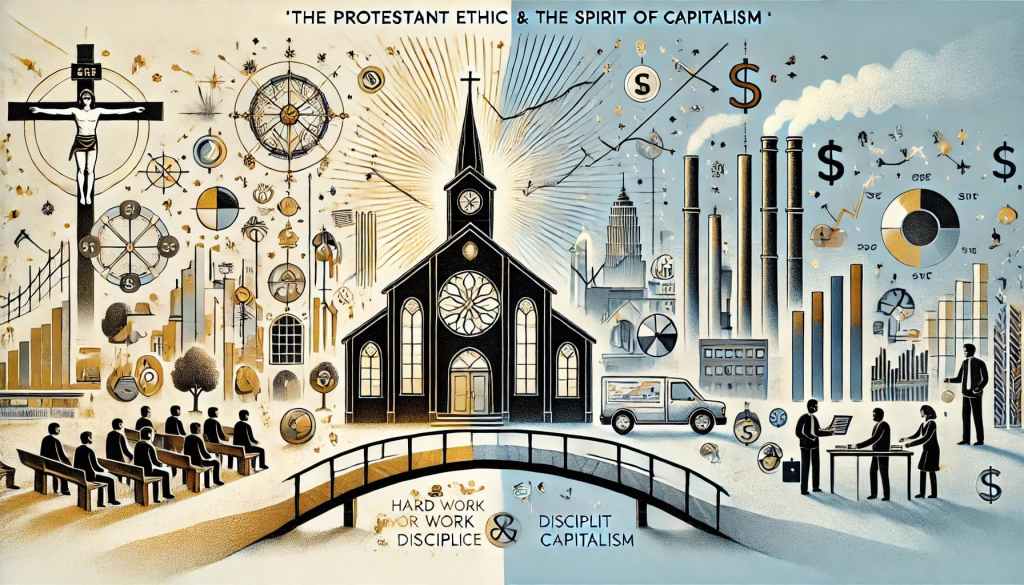
Religion, as a deeply ingrained and widespread institution, holds significant sway over human society. It goes beyond mere establishment, permeating and shaping various other societal facets. Scholars in fields like sociology and anthropology have long been intrigued by the mystical aspects of religion, and Max Weber was no exception. In his exploration of the sociology of religion, Weber delved into its impact on everyday life, as well as its effects on political, administrative, economic, and moral behaviours across different historical contexts.
Weber’s focus wasn’t solely on the rituals and practices of religion but on how they intersected with broader human experiences and societal structures. He sought to understand and organize the complexities of religion’s role in shaping cultures and societies. According to Weber, religion, driven by cultural imperatives, has evolved to encompass new dimensions of human life and development.
Weber’s sociological examination of religion aligns with his broader sociological inquiries. He investigated how specific religious sects could influence the economic behaviours of their adherents. Of particular interest to Weber was the extent to which religious worldviews impacted economic activities, particularly within Western societies. He posited that certain religious movements, such as the Calvinist branch of Protestant Christianity, wielded significant influence in the development of capitalism.
The theory also encompasses significant socio-economic influences that differentiate Western from Eastern characteristics. Weber employed the method of difference to conduct a comparative examination of the relationship between economic ethics in world religions and economic life. His aim was to highlight the unique elements of Western religious economic ethics.
Weber proposed that Protestant institutions and their ethics have significantly influenced economic development. This concept is elaborated in his renowned work, “Protestant Ethics and the Spirit of Capitalism.” In this book, Weber meticulously explores his interpretation of religion. Prior to writing the book, he distinguished his roles as a scientist and a publicist. His visit to America provided him with first-hand insights into capitalism, labour relations, and Protestant ethics in action. Consequently, Weber viewed his work as a factual rebuttal of the materialistic conception of history.
Motivation for Writing
Weber aimed to elucidate the distinctiveness of Western capitalism, investigating its values and interests inherent in its unique structures and dynamics. He explored this relationship from two perspectives:
- Examining the influence of religious doctrines on the economy.
- Analyzing the positioning of various groups within the economic system.
Rather than focusing on the ethical doctrines articulated by theologians, Weber was more interested in understanding how these doctrines, in their popular form, shaped group behaviour. His objective was to grasp capitalism as a civilization, the embodiment of modern society. Weber was particularly intrigued by the predominant drive for profit within ostensibly peaceful systems of exchange relationships.
Weber’s theory stemmed partly from his quest to conduct a distinct and autonomous theoretical analysis of social and political issues. He found dissatisfaction with both Marxism and German historical economics and jurisprudence in addressing these concerns, motivating his intellectual endeavours.
Inter-relationship Between Religious Ethics and Economy
On the surface, religion and society may appear distinct. Religion often delves into matters beyond the tangible realm, while economics focuses on the practical aspects of production, work, and consumption. However, Max Weber suggested a connection between these seemingly disparate systems. He proposed that the ideas, beliefs, values and worldview prevalent in societies influence the actions of their members, including economic activities. Religious teachings often provide moral guidelines for behaviour, shaping how adherents conduct themselves in various aspects of life, including the economy. Weber aimed to elucidate this relationship between religious beliefs and economic behaviour in his work.
Weber’s Comparative Studies on Religion
Weber endeavors to elucidate the connection between religious ethics and economic behavior. This correlation is further explored through comparative analyses of different world religions. Weber examines Confucianism in Ancient China, Hinduism in ancient India, and Judaism in ancient Palestine (West Asia) in his quest to validate this concept:
1. Confucianism in China: Ancient China boasted a robust economy marked by advancements in trade, commerce, finance, and manufacturing. However, unlike Western societies, it did not adopt a capitalist system. Max Weber attributed this variance to Confucian principles, which played a significant role in shaping Chinese societal norms.
Confucianism emphasizes several key tenets:
- Reverence for the natural order and harmony of the universe.
- Advocacy for individuals to align themselves with nature and cosmic balance.
- Adherence to tradition, with an emphasis on drawing wisdom from the past.
- Strong emphasis on familial and kinship ties, with obligations never to be overlooked.
These principles, particularly the emphasis on harmony, tradition, and familial duties, are fundamentally at odds with the profit-driven ethos of Western capitalism. In Chinese society, the pursuit of profit purely for its own sake would likely have been viewed as socially inappropriate, given the prioritization of communal harmony and respect for tradition.
2. Judaism in West Asia: This describes Judaism, the religion practiced by the original inhabitants of Palestine in West Asia, the Jews. Judaism stands as the oldest among monotheistic religions, emphasizing the belief in one all-powerful God. Within Judaism, there’s a belief in being chosen by God, known as “Jahweh,” with prophets guiding them toward establishing God’s Kingdom on Earth. Unlike Confucianism and Hinduism, Judaism advocates for mastery over the environment rather than harmony with it.
According to Weber, Judaism potentially could have fostered the spirit of capitalism. However, various historical factors intervened. The Jewish community experienced mass migrations, such as the Exodus, driven by persecution, which scattered them worldwide. Despite facing restrictions in various economic activities, such as land ownership, Jews excelled in money lending, establishing a successful niche in financial endeavours.
3. Hinduism in India: Weber offered a critical perspective on the compatibility of rational capitalism within the framework of Hinduism as observed in India. He doubted the feasibility of modern capitalism emerging from a caste-based society like India, or thriving if imported from the West.
Despite India’s historical economic advancement, exemplified by significant contributions to science and establishment of global trade links, Weber argued that Hinduism lacked the ethical foundation conducive to capitalist development. Concepts such as ‘Dharma’, ‘Karma’, and “punarjanma” instilled defeatism and fatalism, discouraging proactive economic improvement. According to Weber, the belief that present circumstances are predetermined by past actions stifles motivation for economic advancement among Hindus.
Moreover, Hinduism emphasizes otherworldly asceticism, prioritizing spiritual welfare over material prosperity. The transient nature of material wealth and the emphasis on the immortal soul (‘atma’) diminish the significance of material pursuits. Religions emphasizing such asceticism are unlikely to foster capitalist attitudes, as seen in India and China despite their economic infrastructure. Despite possessing trade, technology, and financial systems, the societal values in these cultures prioritize ideals incongruent with the pursuit of wealth for its own sake and the rational organization of labour required by capitalism.
Merits of Weber’s Study of Religions
Raymond Aron highlights the distinctive merits found within Weber’s scholarship. Notably:
1. Weber refrained from rigidly establishing causal relationships. He never asserted that the Protestant ethic, particularly the Calvinist ethic, singularly caused the emergence of capitalism. While Weber provided an interpretation of Protestantism, he acknowledged the possibility of alternative interpretations, emphasizing the importance of considering a comprehensive range of viewpoints.
2. Weber effectively demonstrated the connection between religious attitudes and economic principles, rendering it plausible.
3. He posed a significant sociological inquiry regarding the impact of worldviews on societal structures and individual behaviour, a question of considerable significance.
4. Contrary to the notion that Weber presented a thesis diametrically opposed to Marx’s, his approach didn’t substitute religion as the sole explanatory factor for economic phenomena. Instead, Weber examined the relationship between religion and economy without exclusively privileging one over the other.
The Protestant Ethic and the Spirit of Capitalism
In “The Protestant Ethic and the Spirit of Capitalism,” the author explores how the ethical principles of ascetic Protestantism contributed to the emergence of modern capitalism. Weber argues that theological beliefs, particularly those of Calvinism, influenced the development of a capitalist mindset. He observes a correlation between Protestantism and involvement in business, prompting him to investigate religion’s role in shaping contemporary economic systems.
Weber contends that the prevailing capitalist ethos prioritizes profit as a fundamental objective, considering profit-seeking as virtuous. Early European capitalism, he suggests, was heavily influenced by Protestant groups who viewed earthly success as indicative of eternal salvation, driving them to pursue wealth fervently.
Key aspects of Calvinism, such as disdain for material indulgence, emphasis on responsible stewardship of resources bestowed by God, and the structured approach to life, are identified by Weber as significant factors contributing to the economic ethic.
Protestant Ethics
Protestantism, originating during the European Reformation in the sixteenth century, denotes a religious movement that challenged the Catholic Church. Martin Luther and John Calvin, pivotal figures in its inception, opposed what they perceived as the Catholic Church’s excessive focus on doctrines and rituals, believing it had disconnected from the common people and fallen into greed and corruption. This dissatisfaction led to the emergence of various Protestant sects across Europe, aiming to revive a simpler, more devout form of Christianity. Calvinism, pioneered by John Calvin, was one such sect. Interestingly, Calvinists later played a significant role in the establishment of the United States of America, migrating to North America and contributing to its development. Max Weber observed that Protestants, particularly Calvinists, excelled in education and were prominent figures in the Western world, occupying positions as administrators, technical experts, and industrialists.
Calvinism and Predestination
Weber posited that the tenets of Protestantism, particularly Calvinism, played a pivotal role in the emergence of industrial capitalism. Calvinism, a Christian denomination shaped by theologians like John Calvin during the Reformation, centered on the doctrine of predestination. This doctrine held that certain individuals were predestined for salvation while others were not, solely at the discretion of an omnipotent God. Initially, adherents accepted this fate passively. However, over time, a shift occurred as Calvinists sought signs of their predestined salvation in their worldly success.
Desiring assurance of their salvation, many Calvinists engaged in strenuous labour and reinvested their earnings to further their prosperity. This pursuit of material success often led them to neglect charitable giving, as poverty was viewed as a sign of being among the predestined damned. Yet, despite their efforts, the doctrine of predestination instilled a pervasive sense of uncertainty and anxiety, known as “salvation panic,” as adherents grappled with the ambiguity of their eternal fate.
In response to this existential unease, Calvinists began to interpret worldly achievements as indicators of their chosen status. Consequently, they devoted themselves fervently to their work, viewing their accomplishments as divine affirmations of their salvation.
The Theory of Religion
Based on the preceding explanation by Max Weber, the emergence of capitalism within the Protestant sect of Christianity is elucidated, alongside the absence of its development in other religious contexts worldwide.
Weber delineates that within the Catholic sect, adherence to church doctrine directed individuals towards dedicating their time and resources primarily to the service of the Church. This resulted in the enrichment of the Church while the populace suffered a decline in their own conditions. This divergence from the prerequisites of capitalism hindered its evolution.
However, the advent of figures such as John Calvin and Martin Luther brought about a shift in perspective. They advocated for a Protestant Ethic, emphasizing the value of industriousness and discouraging blind adherence to the Church. According to this ethic, individuals were encouraged to devote their efforts towards productive labour rather than solely to religious activities. Wealth accumulation through diligent work was endorsed, with reinvestment into business endeavours prioritized over contributions to the Church. Weber posits that it was these principles that facilitated the rise of capitalism within the Western sphere, contrasting starkly with the trajectories of other regions and religions worldwide.
Critical Evaluation
Weber asserts that only those with expertise should critique his theory, showcasing his significance as a sociologist. He acknowledges limitations in his work, such as in “The Protestant Ethic and the Spirit of Capitalism,” where he suggests it may not fully capture reality, recognizing that economic motives are essential for societal progress alongside ideological constructs.
Moreover, Weber concedes to presenting only one facet of a multifaceted issue, acknowledging the unexplored socio-economic dynamics in Europe. His analysis of capitalism’s origins also may have been flawed, as evidenced by its emergence in non-Calvinist societies contrary to his initial thesis.
In his exploration of the interplay between religion and capitalism, Weber delves into how rational religious doctrines, exemplified by Calvinism, contributed to the development of rational economic systems. Conversely, he identifies religious systems like Confucianism, Judaism, and Hinduism as hindrances to rational economic growth.
Weber’s comprehensive examination of diverse societies across history underscores the enduring significance of his theory, which encompasses a broad spectrum of religious, cultural, and economic dynamics worldwide.
References and Readings:
The Protestant Ethic and the Spirit of Capitalism, by Max Weber, https://amzn.to/3FEy8Pi
Sociological Theory, by Ritzer G, https://amzn.to/3Da3pcm
Sociology by C.N. Shankar Rao, https://amzn.to/41A3Wh4