- Introduction
- Different Perspectives on Modernisation
- W.W. Rostow’s stages of growth
- Stages of development
- Criticism
Introduction
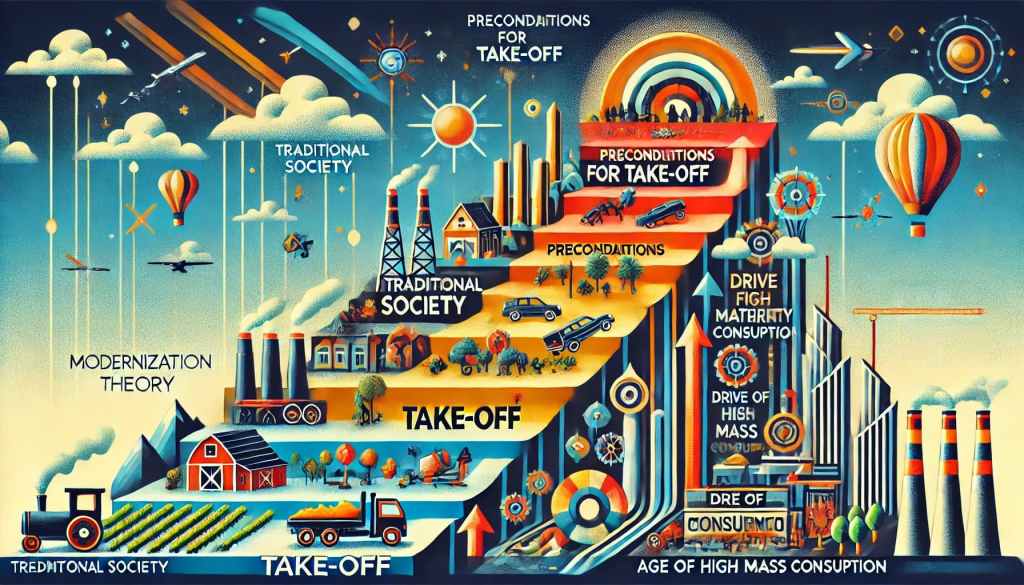
Modernization theory delineates the evolution from traditional or underdeveloped societies to modern ones, elucidating the transition’s mechanisms. Historically, it traces the trajectory of change toward social, economic, and political systems akin to those that emerged in Western Europe and North America between the seventeenth and nineteenth centuries, later disseminating to other European nations and eventually spanning continents like South America, Asia, and Africa during the nineteenth and twentieth centuries. Since the 1950s, modernization theory has constituted a prominent perspective in the sociology of national development and underdevelopment.
Its focus lies primarily on how societies progress from pre-modern states to modernity through processes involving economic expansion, alongside transformations in social, political, and cultural frameworks. Economically, modernization theorists emphasize indicators such as gross national product (GNP) to gauge societal progress, with mechanization and industrialization serving as integral components of economic advancement. Moreover, they delve into the social, political, and cultural repercussions of economic growth, scrutinizing the prerequisites for industrialization and economic development. Discussions surrounding modernization often entail circular reasoning, reflecting the prevalent notion within modernization theories of the functional compatibility among various societal components.
It’s important to clarify that when sociologists discuss modernization, they’re not simply talking about keeping up with the times. Instead, they’re referring to specific changes and processes within societies as they develop. It’s also crucial to note that theories of modernization in development don’t necessarily align with recent philosophical ideas like “modernity” and “postmodernity.” In philosophical and epistemological contexts, modernity suggests a belief in one universal descriptive and explanatory model that accurately represents reality. Postmodernity, on the other hand, rejects the idea of a single objective truth, viewing knowledge, ideology, and science as products of subjective interpretations and relational perspectives.
While modernization theory comes in various forms, it generally posits several key ideas:
- Societies evolve through distinct stages over time.
- These stages involve varying levels of social differentiation and integration of structural and cultural elements that serve the functioning of society.
- Developing societies today are considered to be in a pre-modern stage, but are expected to eventually achieve economic growth and adopt the social, political, and economic characteristics of advanced Western societies, such as those found in Europe and North America.
- This transformation occurs as these societies integrate complex Western technology and overcome traditional structural and cultural barriers that hinder development.
At its essence, modernization theory posits that the adoption of advanced industrial technology within developing societies leads not only to economic advancement but also triggers various structural and cultural transformations. While different versions of modernization theory may emphasize distinct traits, they generally agree that as societies modernize, their institutional frameworks and individual behaviours become more specialized, diversified, and integrated, resembling those of advanced Western nations.
For instance, socially, modern societies exhibit characteristics like heightened urbanization, literacy rates, scientific research, healthcare accessibility, secularization, bureaucratic systems, widespread media platforms, and advanced transportation networks. Family structures tend toward nuclear units with weaker kinship ties, while birth and death rates decrease, and life expectancy rises. In the political sphere, there’s a trend towards greater citizen participation in decision-making processes, with typical institutions including universal suffrage, political party systems, civil service bureaucracies, and parliamentary bodies. Traditional sources of authority wane as bureaucratic entities assume greater responsibility and authority.
Economically, modernization entails increased industrialization, technological advancement in production processes, a shift from barter to extensive monetary markets, heightened division of labour, expansion of infrastructure and commercial facilities, and the emergence of large-scale marketplaces. These structural shifts are accompanied by cultural changes in social roles and individual traits. Social interactions become more bureaucratic, social mobility rises, and status becomes less dependent on factors like age, gender, or ethnicity, instead favouring meritocratic principles. Traditional values of loyalty and tradition give way to rational exchange, competence, and universally applicable criteria. People become more adaptable to change, forward-thinking, achievement-oriented, and concerned with individual rights, displaying less fatalism in their outlook.
Different Perspectives on Modernisation
The portrayal of social dynamics and transformations within contemporary urban industrial societies relies on theoretical frameworks aimed at elucidating the transition from traditional to modern societal structures. These frameworks are rooted in predominant theoretical perspectives from the 1950s and 1960s, originating from classical evolutionary, diffusion, and structural-functional theories.
Evolutionary theory, with roots in thinkers like Spencer and Durkheim, suggests that societies advance from simpler to more complex forms, progressing through specialization towards more efficient societal functions. Western industrial societies are viewed as superior to preindustrial counterparts due to their evolution towards greater complexity and specialization. Diffusionist theories expanded on this by proposing that cultural patterns associated with modernity could spread through social interactions such as trade, conflict, migration, and media, suggesting multiple pathways to development rather than a linear progression. Structural functionalism accentuates the notion that societies are cohesive entities comprising interrelated institutions and roles, advancing towards increasingly intricate and effective social systems. This perspective underscores the significance of internal social and cultural factors as drivers or impediments of economic change.
Smelser’s research delves into the modernization of society through social differentiation, disturbances, and reintegration, drawing from various traditions. Similarly, in his conceptualization of modernization, Smelser highlights four key transformations:
- Transition from basic to complex technology.
- Shift from subsistence farming to commercial agriculture.
- Change from rural to urban demographics.
- Evolution from reliance on animal and human power to the use of inanimate power and industrialization.
In a parallel vein, Parsons’ later theoretical framework integrates these perspectives into a neo-evolutionary theory of modernization. Here, societies are viewed as self-regulated structural-functional entities, wherein primary processes of change include social differentiation and the identification of certain “evolutionary universals,” such as bureaucratic structures and monetary systems. These elements enhance society’s adaptive capacity by fostering more efficient social structures and often culminate in a set of universalistic norms. Parsons argues that these norms, rather than the industrial revolution itself, mark the onset of the modern era of social evolution.
Modernization theory was significantly influenced by Weber’s exploration of the Protestant ethic, which highlighted how cultural values shape entrepreneurial behaviour and the emergence of capitalism. Scholars like Lerner, McClelland, Inkeles, and Rostow have furthered this tradition. Lerner, through empirical studies in Middle Eastern societies, linked empathy to media, literacy, and urbanization, considering it crucial for rational behavior and societal advancement. McClelland emphasized the role of a high “need for achievement” in driving entrepreneurial activity and societal modernization. Inkeles and Smith, drawing from interviews across six societies, outlined traits defining “modern man,” attributing the prevalence of individual modernity to factors like education and factory experience, which contribute to societal modernization. Rostow’s stages of economic growth theory, based on Western development, underscored the significance of new values, education, entrepreneurship, and institutional factors in fostering self-sustaining economic progress for societies.
All iterations of modernization theory portray a gradual shift from “traditional” social frameworks to those considered “modern,” akin to Western European and North American societies. These theories generally assert the following:
- Modern societies resemble those of the industrialized West, implying a replication of Western development patterns.
- Tradition opposes modernity and is incompatible with it.
- The roots of economic and social underdevelopment lie within traditional societies.
- Economic development primarily stems from internal factors within societies rather than external influences.
- These internal factors, alongside industrial development, encompass social structures, cultural institutions, and personality types.
Consequently, empirical studies on sociological modernization typically explore the internal impacts of industrialization or economic advancements on traditional social institutions. They also investigate the social, political, and cultural factors that either facilitate or hinder economic growth in traditional or less-developed societies. For instance, research might examine how factory production affects traditional family dynamics or how indigenous land tenure systems influence the adoption of cash crop farming.
W.W. Rostow’s Stages of Growth
Rostow’s framework for economic development stands as a prominent historical model in the realm of economic growth. Proposed by American economist Walt Whitman Rostow in 1960, this model suggests that economic advancement unfolds through five distinct stages, each differing in duration.
- The traditional society
- The preconditions for take-off
- The take-off
- The drive to maturity
- The age of high mass-consumption
Rostow’s model presents a structuralist perspective on economic growth, suggesting that initial economic advancement is driven by specific sectors rather than uniform development across all sectors. This view resonates with David Ricardo’s notion of comparative advantage, contrasting with Marxist ideals advocating for self-reliance across all sectors. Rostow’s model prioritizes the early development of select sectors, a key tenet within the theory of modernization in social evolutionism.
Aligned with the liberal school of economics, Rostow’s model underscores the importance of free trade and draws inspiration from Adam Smith’s ideas. It diverges from Friedrich List’s argument, which warns against over-reliance on raw material exports, by proposing that such exports can finance the development of the industrial sector, especially in its nascent stages. While advocating for free trade, Rostow’s model acknowledges the significance of government intervention in domestic development, aligning with certain aspects of John Maynard Keynes’s views. It operates under the assumption that nations aspire for modernization and growth, and that societal norms prioritize materialistic progress.
Stages of Development
Following are the stages of development according to W.W. Rostow:
1. The traditional society: The initial phase of a traditional society reflects a primitive state with limited access to modern scientific advancements and technology. Essentially, it operates on rudimentary technology and an ancient worldview concerning the natural world. According to Rostow, a traditional society is characterized by structures shaped by pre-Newtonian science and technology, along with corresponding attitudes toward the physical world. However, Rostow doesn’t perceive traditional societies as entirely static.
Economies in this stage function with restricted production capabilities, barely reaching the minimum threshold of potential output. During this phase, output growth may occur through the expansion of cultivated land or the introduction and adoption of new crops. While irrigation systems are occasionally utilized by both states and individuals, agriculture predominantly serves subsistence purposes. Although there may be sporadic technological advancements, they remain largely ad hoc. These factors contribute to output increases, albeit within a predetermined upper limit that cannot be surpassed. Trade primarily occurs at regional and local levels, often through barter, and the monetary system remains underdeveloped.
Wars, famines, and epidemics such as the plague disrupt population growth, leading to a stagnation or decline in numbers, thereby impeding the primary factor of production: human labour. Trade volume fluctuations, often stemming from political instability, have historically posed significant risks, making transportation of goods and raw materials expensive, cumbersome, and unreliable. While the manufacturing sector and other industries may show growth potential, they are constrained by limited scientific knowledge and entrenched traditionalist mindsets, resulting in low labour productivity. Some regions in this stage operate as self-sufficient entities.
However, the defining characteristic of such societies is their constrained output per capita due to the lack of access to modern science and technology. These societies allocate a substantial portion of resources to agriculture and feature hierarchical social structures with limited vertical mobility. The prevailing value system, as described by Rostow, reflects a long-term fatalism, wherein individuals believe economic progress is unlikely for themselves and future generations.
2. The pre-conditions for take-off: The span of a century or more encapsulates the gradual establishment of preconditions necessary for significant advancement. These prerequisites primarily involve profound transformations across social, political, and economic spheres. Examples include shifts in societal perceptions towards science, risk, and profit, the flexibility of the workforce, attainment of political sovereignty, establishment of centralized taxation systems and financial institutions, as well as the creation of vital economic and social infrastructure such as railways, ports, power plants, and educational establishments. India began to address some of these requisites during the initial phase of its First Five-Year Plan (1951-1956).
During the second phase of economic advancement, the economy experiences a transformative process aimed at laying the groundwork for growth and development. According to Rostow, this transformation entails fundamental changes in both societal structures and production methods. This phase marks the establishment of the foundational elements necessary for economic progress. With the integration of modern scientific and technological advancements, productivity sees a significant boost in agriculture and industry alike. Moreover, there is a noticeable shift in people’s perspectives towards a future ripe with growth opportunities.
In tandem with these changes, a new cadre of entrepreneurs emerges, catalyzing investment in new ventures and assuming the associated risks and uncertainties. Politically, this phase witnesses the emergence of a more centralized nation-state structure, indicative of the evolving organizational landscape.
Rostow emphasizes agriculture’s pivotal role in this pre-take off stage. Firstly, it must meet the burgeoning demand for food, both for the growing population and the agricultural workforce. Secondly, increased agricultural incomes stimulate demand for industrial goods, thereby fostering further industrial investment. Lastly, the expansion of agriculture serves as a significant source of savings crucial for fuelling industrial sector growth.
Agriculture assumes a pivotal role in the transition process by leveraging surplus production to fuel exportation, thereby generating foreign exchange crucial for sustained development and capital accumulation. Moreover, enhanced agricultural productivity fosters the expansion of domestic markets for manufactured goods and processed commodities, thereby stimulating investment in the industrial sector.
According to Rostow, the creation of social overhead capital is primarily the responsibility of the government. This is because such endeavours are typically unprofitable, entail lengthy gestation periods, and yield benefits across various economic sectors rather than solely benefiting the investing entity. Consequently, the private sector exhibits limited interest in driving its development.
The transition towards “take-off” hinges upon fundamental shifts in societal attitudes towards risk, alterations in the work environment, and a receptiveness to change within social and political frameworks. Rostow posits that the prerequisites for take-off are catalyzed by external interventions from more developed societies, which instigate the adoption of modern alternatives to traditional societal norms. These preconditions for take-off closely mirror the historical stages of the British Industrial Revolution.
3. The take-off: This pivotal phase spans a relatively short period of two to three decades during which the economy undergoes a transformative shift, leading to subsequent economic growth almost automatically. Termed “the take-off,” this phase involves a surge in investment rates, resulting in a tangible rise in real output per capita. This initial boost triggers significant changes in production techniques and income distribution, sustaining the increased investment scale and perpetuating the upward trajectory of per capita output. According to Rostow, three key conditions characterize the take-off:
- The rate of productive investment must increase from around 5% to over 10% of national income or net national product.
- One or more substantial manufacturing sectors must develop, exhibiting high growth rates.
- There must be an existing or rapidly emerging political, social, and institutional framework capable of harnessing the expansionary forces within the modern sector and leveraging the potential external economic effects of the take-off.
The third condition suggests that necessary capital must be sourced from domestic reservoirs and channelled into the economy rather than domestic or state consumption. Industrialization assumes critical importance as it lays the groundwork for extensive structural changes. Rostow emphasizes that this transition lacks a predetermined trajectory, as various motivations or stimuli can initiate this growth process.
In the initial phase of development, there emerges a strong societal drive toward economic expansion aimed at enhancing living standards. This period witnesses transformative shifts in both agricultural and industrial sectors, leading to a significant surge in productivity. Urbanization intensifies, accompanied by a notable rise in the urban workforce. Within a relatively short span of time, typically a decade or two, fundamental alterations occur in the economic, social, and political fabric, facilitating the establishment of a sustainable growth trajectory.
It is notable, according to Rostow, that the emergence of a new elite, particularly a burgeoning entrepreneurial class, and the consolidation of a nation state are pivotal for fostering economic progress.
This phase is marked by robust economic advancement. As articulated by Rostow, this advancement hinges on distinct stimuli, encompassing economic, political, and technological transformations. The hallmark of this stage lies in its rapid and self-perpetuating growth. Take-off commences when sector-driven growth becomes prevalent, overshadowing traditional societal norms with the dominance of economic imperatives.
The commencement of economic progress also hinges on the emergence of a cohort of innovative entrepreneurs within society. This entrepreneurial class is nurtured under specific conditions. Firstly, there must exist a culture valuing “delayed gratification,” prioritizing capital accumulation over immediate consumption, and demonstrating a high tolerance for risk. Secondly, entrepreneurial groups often arise when individuals are unable to attain social status and influence through traditional avenues such as marriage, participation in established industries, or government and military service, due to certain disqualifying social or legal factors. Lastly, for such groups to flourish, the society must be adaptable, accepting unconventional paths to economic and political prominence amidst rapid societal changes.
4. The drive to maturity: Following the initial phase of advancement, a prolonged period of consistent expansion ensues, referred to as the drive to maturity stage. Rostow characterizes this phase as the point when a society has effectively integrated modern technology across its resources. In this stage, an economy in steady growth endeavours to integrate modern technology into all aspects of its economic operations. This phase materializes when an economy reaches maturity and can foster self-sustained growth. Substantial savings and investment rates propel economic development automatically. As the economy matures, the per capita capital increases, and there’s a noticeable transformation in its economic structure.
The pivotal industries that initiated the initial growth phase begin to slow down due to diminishing returns. However, the overall growth rate is maintained by the emergence of new rapidly expanding sectors, leading to a shift in the primary industries. Concurrently, there’s a decline in the proportion of the population engaged in agriculture and rural activities, accompanied by a significant alteration in the nation’s foreign trade structure.
The fourth stage of mature growing economies presents both challenges and cyclical fluctuations in national income, which captivate the attention of contemporary economic theorists. While scholars of developing nations and economic history may focus more on the preparatory and take-off stages, a comprehensive theory of economic growth must encompass these earlier stages, especially the dynamics involved in the transition to self-sustaining growth.
In this phase, societal transformations manifest in several key aspects:
- There’s a notable shift in the agricultural workforce composition, dwindling from 75% to 20% of the total working population. This transition is accompanied by an upsurge in skill acquisition among workers, leading to tangible increases in their real wages.
- Leadership dynamics undergo a significant overhaul within industrial sectors, marked by the infusion of heightened professionalism.
- There’s a growing acknowledgment of the environmental and health repercussions stemming from industrialization, prompting policy adjustments to address these concerns.
At this juncture, nations are confronted with a critical decision: whether to harness the industrial prowess and technological advancements for the betterment of their populace or to pursue dominance over others.
5. The age of high mass-consumption: During the era of extensive mass consumption, characterized by the contemporary comforts enjoyed in many Western nations, citizens prioritize durable goods over the subsistence worries of earlier times. As economies advance, individual incomes rise to levels where people’s spending extends far beyond basic necessities like food, clothing, and shelter, encompassing a broad array of comforts and luxuries on a large scale. This shift is fuelled by progressive industrialization and urbanization, which reshape societal values to favour increased consumption and elevated lifestyles. Emerging industries cater to this demand for durable consumer goods, becoming the driving forces behind economic expansion.
In such a period, societies face choices regarding their focus: whether to prioritize military and security concerns, equality and welfare initiatives, or the cultivation of extravagant luxuries for the elite. Each nation strikes its own balance among these objectives. Efforts toward egalitarianism are often pursued, influenced by various factors such as political, geographical, and cultural dynamics, as well as prevailing societal values. According to Rostow, a country’s pursuit of its unique identity is shaped by these multifaceted influences.
Criticism
The critiques of Rostow’s model are multifaceted:
- It’s labelled as historical because it assumes predetermined outcomes based on the historical trajectory of developed bureaucratic societies.
- It’s criticized as mechanical since it fails to elucidate the driving force behind change, reducing the stages to mere classifications relying heavily on data from developed nations.
- The model’s reliance on American and European history to define the norm of high mass-consumption as essential for economic development overlooks the diversity of paths to development.
- Rostow’s assumption of inevitable adoption of neoliberal trade policies and the relocation of manufacturing bases overlooks complexities and variations in economic systems, particularly in Asia and Africa.
- The model’s stage differentiation is also questioned due to similarities and overlaps between stages, particularly between take-off and pre-take-off stages.
- While Rostow suggests growth becomes automatic in the maturity stage, critics like Kuznets argue growth always requires external impetus.
- There’s ambiguity regarding the concept of ‘take-off’, whether it’s sectoral and non-linear or highly aggregative, leading to inconsistencies in interpretation.
- Rostow’s bias towards a western model of modernization overlooks alternative paths to development, especially for smaller nations without significant advantages like natural resources or large landmasses.
- The linear progression assumed by Rostow’s model fails to account for setbacks and regressions observed in empirical evidence from various countries, challenging the notion of steady, uninterrupted progress.
References and Readings:
The Stages of Economic Growth: A Non-Communist Manifesto, by W W Rostow, https://amzn.to/4kP483p
Politics and the Stages of Growth, by W. W. Rostow, https://amzn.to/4bQ0Icz