Nation, Caste, Religion and Ethnicity
- Political Identities: An Introduction
- Nation as a Political Identity
- Key Aspects of Nation as Political Identity
- Caste as a Political Identity
- Key Aspects of Caste as a Political Identity
- Religion as a Political Identity
- Key Aspect of Religion as a Political Identity
- Ethnicity as a Political Identity
- Key Aspect of Ethnicity as a Political Identity
- Intersectionality and Contemporary Relevance
Political Identities: An Introduction
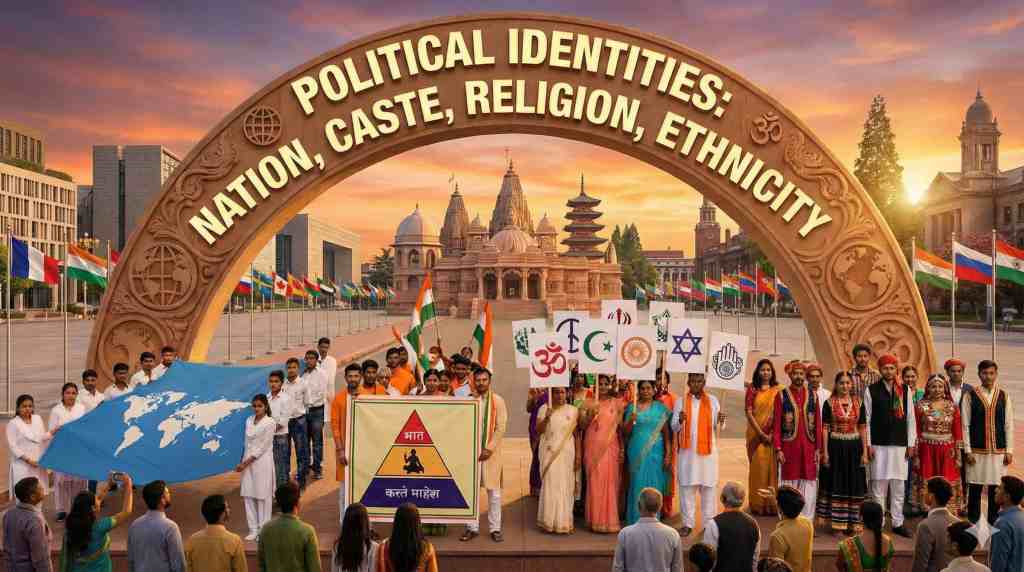
Political identity refers to an individual’s or group’s sense of belonging and alignment with particular political beliefs, ideologies, values or affiliations. It is shaped by various social factors such as caste, class, religion, ethnicity, language, region and historical experiences. Political identity influences how people perceive power, governance and rights, and it plays a key role in determining their political behaviour, such as voting patterns, activism or participation in movements.
In India, political identities have been shaped by the country’s vast diversity, colonial legacy, constitutional democracy and ongoing socio-political movements. These identities based on nation, caste, religion and ethnicity play a crucial role in defining political participation, access to power and the nature of political discourse. Unlike in many homogeneous societies, where political identity is primarily class-based, in India, these social categories are historically rooted and emotionally charged, making them powerful tools of both inclusion and exclusion in politics. Political identity in India is not static, it evolves with changing socio-economic realities, cultural consciousness and state policies. Each identity category carries its own unique significance but also intersects with others, resulting in complex layers of identity politics.
The idea of the “nation as a political identity” in India emerged prominently during the anti-colonial freedom struggle, where leaders like Gandhi, Nehru and Ambedkar attempted to unite diverse communities under a single national identity. Post-independence, this identity was institutionalized through the Indian Constitution, which envisioned India as a sovereign, socialist, secular and democratic republic. However, the meaning of Indian nationalism has since been contested. While one stream emphasizes pluralism, secularism and inclusivity, another promotes majoritarian nationalism which associates national identity closely with Hindu culture. National identity thus becomes a political instrument through which state policies, public discourse and citizenship rights are negotiated.
Caste has historically been a rigid system of social stratification in India, deeply embedded in Hindu society and sanctioned by religious texts. However, in modern India, caste has transformed into a powerful political identity. The implementation of reservations for Scheduled Castes (SCs), Scheduled Tribes (STs) and Other Backward Classes (OBCs) in education, employment and politics has created new avenues for marginalized groups to assert their rights. Political parties have increasingly organized themselves around caste lines, with parties like; the Bahujan Samaj Party (BSP) representing Dalit interests and various regional parties mobilizing OBC and upper-caste voters. The Mandal Commission and its recommendations in the 1990s brought caste to the center of political debate, intensifying demands for social justice and representation. Today, caste continues to be a key factor in electoral strategies, candidate selection and vote-bank politics. Rather than disappearing, caste has become democratized i.e. transformed from a social stigma into a basis for political empowerment and identity.
Religion is another central axis of political identity in India. While the Indian Constitution guarantees religious freedom and recognizes India as a secular state, religion has often been politicized to mobilize masses and shape political agendas. Religious identity influences voting patterns, policy-making and community relations. The communalization of politics, where political actors mobilize people along religious lines has led to several instances of religious violence, such as the anti-Sikh riots of 1984, the demolition of the Babri Masjid in 1992, the Gujarat riots in 2002 and more recent episodes of mob lynchings. In such a context, religion becomes not just a matter of faith but a marker of political loyalty, cultural authenticity and sometimes, national belonging. This undermines the secular framework and promote exclusion and discrimination under the guise of majority will.
Ethnicity in India refers to cultural and linguistic identities often tied to region, tribe or historical experience. These ethnic identities become political when they demand recognition, autonomy or resource control. India’s federal structure and the creation of states on linguistic lines reflect the political accommodation of ethnic identities. However, not all demands have been peacefully resolved. Movements in Northeast India, such as those in Nagaland, Mizoram and Manipur, have combined ethnic, cultural and political grievances to demand autonomy or even secession. Similarly, the Kashmir conflict, though framed in religious terms, is also deeply rooted in regional and ethnic identity. The demand for new states like Telangana and Gorkhaland also stemmed from ethnic and linguistic claims. Ethnic identity in India often overlaps with tribal affiliation, especially in states with large Adivasi populations, where development-induced displacement and lack of political representation continue to fuel unrest.
In contemporary India, these identities do not function in isolation. They are intersecting and overlapping, shaping unique experiences of inclusion and exclusion. For example, a Muslim Dalit woman may face multiple layers of marginalization due to the interplay of religion, caste, gender and class. Political parties and civil society groups often mobilize around such intersecting identities to demand more inclusive policies. However, the same intersectionality can also be manipulated to create divisions or consolidate majoritarian power. Policies like the Citizenship Amendment Act (CAA) and debates on Uniform Civil Code (UCC) reflect ongoing attempts to redefine the boundaries of political identity in India. As a result, identity politics remains a double-edged sword, it enables marginalized voices to be heard and represented but also risks deepening social divides if not grounded in constitutional values of equality and justice.
Nation as a Political Identity
A nation is a large group of people who share a common identity based on factors such as language, culture, history, territory and often a sense of belonging or shared destiny. It goes beyond merely living within a political boundary and involves a collective consciousness that unites individuals as members of a distinct community. Nations are often imagined communities, where people feel connected to others they may never meet but perceive themselves as part of the same group.
Nation as a political identity refers to the way individuals and groups come to identify themselves as members of a collective political community, bound not just by geography or culture, but by shared values, institutions and aspirations. Unlike cultural or ethnic identity, which may be based on language, religion or ancestry, political identity centers around a sense of belonging to a sovereign political entity, typically the nation-state. This sense of belonging is cultivated through common citizenship, participation in political life and adherence to shared symbols, laws and civic ideals. A nation as a political identity does not necessarily require ethnic or cultural homogeneity. Rather, it emphasizes a shared commitment to a collective future, governance and public life.
In modern times, especially with the rise of nationalism, people have come to imagine themselves as part of a broader community that extends beyond immediate kinship or locality. This transformation of identity is supported by institutions such as the state, the education system, political parties and media, which work to create a common narrative of the nation. Political identity becomes stronger when citizens participate in democratic processes, celebrate national symbols like the flag and anthem and accept the legitimacy of common institutions such as the constitution and judiciary. It is also reinforced in times of national crisis such as war, natural disaster or colonial struggle when individuals feel an emotional and moral connection to the nation.
In the Indian context, the formation of the nation as a political identity was shaped significantly by the anti-colonial struggle against British rule. Despite India’s immense social and cultural diversity, the nationalist movement brought people together under a common political vision of independence, democracy and self-rule. Leaders like Mahatma Gandhi and Jawaharlal Nehru framed the idea of India as a plural, inclusive political community where unity would be based not on religious or linguistic uniformity but on shared democratic ideals. The framing of the Indian Constitution after independence institutionalized this vision, establishing a legal and moral framework for a unified political identity rooted in citizenship, secularism, justice and equality.
However, the nation as a political identity is not static, it is continuously negotiated and contested. In India, political identity has often come into tension with regional, religious, caste-based and linguistic identities. Movements for regional autonomy, caste-based political mobilizations and debates over secularism and nationalism reflect the complexity and evolving nature of India’s national identity. Despite these tensions, the idea of India as a political nation continues to be upheld through democratic practices, constitutional values and the everyday participation of citizens in the political process.
Understanding nation as a political identity thus requires a sociological lens that considers how identity is socially constructed, historically shaped and politically mobilized. It shows how individuals see themselves not only as members of a cultural community, but also as actors in a shared political project, bound by common rights, duties and aspirations. In a diverse and democratic society like India, this understanding is crucial to maintaining unity while respecting pluralism.
Key Aspects of Nation as Political Identity
The concept of the nation as a political identity is central to understanding how individuals and groups in India perceive themselves as members of a collective political community. In a country marked by vast cultural, linguistic, religious and social diversity, nationhood is not a given but a constantly negotiated and constructed identity. This dynamic and often contested identity shapes political participation, social inclusion and the ongoing debates over belonging and citizenship in India’s complex society.
Following are the key aspects of nation as political identity:
1. Imagined Community and Collective Consciousness: The idea of the nation as an imagined community (Benedict Anderson), means that the members of a nation feel a strong sense of solidarity and belonging even though they will never personally know most other members. In India, this imagined unity is forged through shared historical experiences like the struggle against British colonialism, the adoption of the Constitution and participation in democratic elections. Public education, national media and mass communication play an important role in creating a collective consciousness that transcends local and ethnic boundaries. Despite linguistic and cultural diversity, millions identify themselves as “Indians” and partake in a shared national culture that emphasizes democracy, secularism and diversity as core values.
2. Historical and Cultural Pluralism: India is often described as a “unity in diversity” model because it encompasses a vast array of languages (22 official languages and hundreds of dialects), religions (Hinduism, Islam, Christianity, Sikhism, Buddhism, Jainism and indigenous faiths), castes, tribes and cultural traditions. Unlike many Western nation-states that evolved from relatively homogenous populations, India’s nationhood is built on accommodating difference. This pluralism requires constant negotiation to ensure co-existence. For example, festivals from multiple religions are celebrated nationwide and secularism is constitutionally mandated. However, pluralism also leads to challenges such as communal violence, linguistic conflicts and debates over cultural dominance, which continuously test the limits of the national identity.
3. Constitutional and Democratic Foundations: The Indian nation is grounded in a democratic constitutional framework that guarantees fundamental rights, including equality, freedom of religion and cultural expression. The Constitution serves as the legal foundation of national identity by defining citizenship and the rights and duties of citizens. Its Preamble famously declares India to be a “sovereign, socialist, secular, democratic republic,” articulating the ideals that hold the nation together. Elections allow diverse populations to participate politically, giving a voice to multiple groups. The judiciary plays a critical role in upholding these values, intervening when social injustices or discrimination threaten the inclusive vision of India. Thus, democracy and constitutionalism act as unifying principles in the political identity of the nation.
4. Role of Language and Regional Identities: Language is both a unifying and divisive factor in India’s nationhood. While Hindi and English serve as official languages facilitating inter-state communication and national integration, many states assert their linguistic identity fiercely (e.g., Tamil in Tamil Nadu, Bengali in West Bengal). The reorganization of states on linguistic lines in the 1950s acknowledged this reality. Regional pride often co-exists with national pride, but linguistic and cultural differences can fuel separatist movements or demands for greater autonomy. The federal structure of India is designed to balance these identities by devolving power to states while maintaining the sovereignty of the Union. The co-existence of regional and national identities is an ongoing process that shapes the contours of Indian political identity.
5. Caste and Social Inequality in National Identity: Caste remains one of the most persistent forms of social stratification in India, influencing access to resources, political power and social status. Though the Constitution abolished “untouchability” and mandates affirmative action for Scheduled Castes (Dalits), Scheduled Tribes and Other Backward Classes, caste discrimination still affects millions. National identity often reflects upper-caste norms and narratives, marginalizing Dalits and other oppressed groups. Social movements led by Dalit leaders like; B.R. Ambedkar, Kanshi Ram and contemporary activists challenge these exclusionary identities and demand an inclusive nation based on social justice and equality. The interplay between caste and nationhood reveals the contradictions in the Indian political identity.
6. Religious Pluralism and Secularism: India is home to multiple religious communities, making religious pluralism a central feature of its political identity. The secular ideal enshrined in the Constitution calls for equal respect and treatment of all religions by the state, ensuring religious freedom and preventing majoritarian dominance. However, tensions may arise, with the rise of religion-centric ideologies. This challenges the secular framework and leads to political polarization, communal violence and discrimination against other religious groups. The struggle between secular nationalism and religious nationalism remains one of the defining political conflicts shaping India’s national identity.
7. Nationhood and Political Mobilization: The idea of the nation is a powerful tool for political mobilization in India. Political parties use national identity to unite diverse groups or to mobilize specific communities through identity politics. For example, the INC historically promoted inclusive nationalism emphasizing secularism and unity, while other parties like the BJP have often mobilized support through Hindu nationalist rhetoric. Social movements, whether based on caste, language, religion or regional identity also engage with the idea of the nation to claim rights and recognition. Political mobilization around national identity can both strengthen democracy by involving marginalized groups and create exclusionary or majoritarian politics.
8. Federalism and Multi-tiered Identities: India’s federal system allows multiple levels of political identity to co-exist. Individuals may simultaneously identify with their village or city, caste group, religion, state, linguistic community and the nation as a whole. This layered identity is a hallmark of India’s political culture. Federalism decentralizes power to regional governments, which helps accommodate local aspirations and diversity within the national framework. However, demands for greater autonomy or even separatism in regions like Kashmir, Punjab or the Northeast challenge the integrity of the nation-state. The balance between unity and diversity is constantly negotiated through federal institutions, electoral politics and social movements.
9. Globalization and Transnational Influence: Globalization has introduced new dimensions to Indian national identity. The Indian diaspora, which spans across the world, acts as cultural ambassadors and economic contributors, redefining what it means to be Indian beyond geographic borders. The internet and social media enable diasporic and domestic Indians to engage in discussions about nationalism, identity and politics in real time. Economic liberalization since the 1990s and increased international interactions have also led to hybrid identities that combine traditional Indian values with global modernity. At the same time, global nationalist trends influence domestic politics, often reinforcing exclusivist or protectionist forms of nationalism.
10. Symbols and Rituals of Nationhood: Symbols like the Indian flag, the national anthem, the Ashoka Chakra and the Constitution serve as powerful tools to evoke emotional loyalty and patriotism. National holidays such as Independence Day and Republic Day involve large-scale public ceremonies, reinforcing a collective sense of belonging. Popular culture, including Bollywood movies and cricket, play a crucial role in creating shared experiences that transcend social divides. These rituals and symbols provide continuity, linking the past with the present and future and help inculcate a political identity aligned with the nation-state.
On the basis of above description, it can be stated that nation as a political identity is a complex, dynamic and pluralistic construct shaped by history, culture, democracy and social diversity. It is an imagined community that unites millions despite vast differences in language, religion, caste and region. Constitutional values of secularism, equality and federalism provide a foundation, yet challenges like caste discrimination, religious tensions and regionalism persist. The nation continuously evolves through political mobilization, globalization and cultural expressions. Understanding India’s nationhood sociologically reveals the ongoing negotiation between unity and diversity, inclusion and exclusion, making it a vibrant but contested political identity.
Caste as a Political Identity
Caste is a traditional system of social stratification that divides people into hierarchical groups based on birth. Historically rooted in the ancient Hindu varna system, caste categorizes society into distinct social groups called jatis, each with specific duties, customs and social status. This system governs various aspects of life, including marriage, social interactions and economic roles, often limiting mobility between castes. Although caste is officially outlawed as a basis for discrimination in modern India, its social and cultural influence remains strong, shaping identity, community relations and access to resources and opportunities across the country.
In Indian society, caste has long been a deeply entrenched system of social stratification, shaping people’s identities, relationships and access to resources. Traditionally based on birth, occupation and notions of purity and pollution, the caste system created rigid hierarchies, particularly privileging upper castes while marginalizing lower castes and Dalits. However, in the context of modern democratic politics and constitutional rights, caste has transformed significantly, emerging as a crucial axis of political identity. Rather than disappearing in the face of modernization, caste has adapted to new forms, especially in the realm of political mobilization and representation. This transformation of caste from a social category to a political identity is a major concern in India, revealing how oppressed groups have reinterpreted their caste status to assert themselves in public and political life.
The colonial period played an important role in politicizing caste identities. The British administration, through practices like the decennial census and categorization of castes, gave official recognition to caste divisions. These measures, although bureaucratic in nature, laid the groundwork for caste-based political consciousness. Reformers like Jyotirao Phule and B.R. Ambedkar further sharpened this awareness by using caste as a basis for socio-political critique and action. Ambedkar, in particular, envisioned caste as a system of graded inequality and launched powerful campaigns for Dalit rights, including access to education and political representation. He advocated for using the democratic space to transform caste oppression, emphasizing that political power was essential to achieving social justice. This perspective was foundational in framing caste as not just a social stigma but also a political identity that could be mobilized for change.
With the adoption of the Indian Constitution in 1950, caste-based inequalities were officially acknowledged through provisions for affirmative action. Scheduled Castes (SCs), Scheduled Tribes (STs) and later Other Backward Classes (OBCs) were granted reservations in education, government jobs and legislatures. These legal mechanisms converted caste from a system of exclusion to a basis for inclusion within the political structure. Over time, caste-based parties and movements emerged to represent the interests of these groups. Similarly, the Mandal Commission’s recommendations in the 1980s and their implementation in the 1990s led to a political awakening among OBCs, reshaping national and regional political alignments.
In electoral politics, caste has become a significant factor in candidate selection, voting patterns and party strategies. Political parties often form caste-based vote banks, relying on the numerical strength and solidarity of specific caste groups. This has led to both empowerment and division. On one hand, lower castes have gained greater access to political power and representation, with Dalit and OBC leaders assuming key roles in state and national governments. On the other hand, caste-based politics sometimes reinforces caste divisions and hinders the formation of broader class or issue-based coalitions. Despite these complexities, caste-based mobilization has undeniably expanded the democratic space by bringing historically marginalized voices into the political mainstream.
From a sociological perspective, caste as a political identity challenges the notion that modernity necessarily erodes traditional structures. Instead, it shows how traditional identities can be reinterpreted and rearticulated in new forms. Caste continues to shape individual aspirations, group consciousness and institutional dynamics in contemporary India. Political assertion based on caste is not merely about symbolic recognition but about real access to power, dignity and resources. It is through this lens that sociologists analyze caste not as a remnant of the past but as a living and evolving force in Indian democracy.
In conclusion, caste as a political identity illustrates the complex interplay between tradition and modernity, inequality and empowerment, and exclusion and assertion. It reflects how historically oppressed communities have used the language of rights, representation and democracy to transform their position in society. While challenges remain such as caste-based violence, discrimination and the co-optation of caste politics by elites the political assertion of caste has fundamentally reshaped the landscape of Indian society. As such, understanding caste in its political form is essential for a deeper grasp of India’s social realities and democratic processes.
Key Aspects of Caste as a Political Identity
In India, caste has historically functioned as a rigid system of social hierarchy, determining one’s status, occupation and access to resources. However, in the context of modern democracy, caste has transformed into a significant political identity. Far from being just a traditional social marker, caste now plays a vital role in shaping political mobilization, electoral behaviour and representation. It is a powerful tool through which marginalized communities assert their rights, demand justice and influence policy-making. This transformation highlights how caste, despite constitutional efforts to eliminate its discriminatory aspects, continues to evolve and remain central to Indian political and social life.
Following are some of the key aspects which describe caste as a political identity:
1. Caste-Based Political Mobilization: Caste-based political mobilization refers to the process through which political parties and leaders organize and rally support from specific caste groups. In India, caste is a deeply rooted social identity and political actors often tap into these affiliations to secure votes. Mobilization happens through community meetings, caste organizations and appeals to shared histories of oppression or pride. Political mobilization based on caste is not limited to elections alone, it also involves raising issues like reservation, development schemes and representation, which cater to particular caste groups. This form of identity-based politics has become an effective way for marginalized communities to gain visibility and influence within the political system.
2. Caste and Electoral Politics: Electoral politics in India is heavily influenced by caste considerations. Political parties often strategize their candidate selection, campaign messaging and alliances based on the caste composition of the electorate in a particular region. Voters, especially in rural areas, frequently align their preferences with caste kinship, believing that a candidate from their caste would be more responsive to their needs. Terms like “vote bank politics” and “caste arithmetic” reflect this reality, where caste identities are instrumentalized to maximize electoral gains. This dynamic has led to the creation of strong caste blocs that can sway election results in many states, making caste a central factor in democratic competition.
3. Emergence of Caste-Based Political Parties: Over the years, several political parties in India have emerged explicitly to represent the interests of particular caste groups. These caste-based parties have given a political voice to communities that were historically excluded from mainstream politics. For example, the Bahujan Samaj Party (BSP) champions the cause of Dalits, while parties like the Rashtriya Janata Dal (RJD) in Bihar and the Samajwadi Party (SP) in Uttar Pradesh have represented dominant OBC castes like Yadavs. In Tamil Nadu, the Dravidian parties such as DMK and AIADMK were rooted in the non-Brahmin movement. These parties challenge upper-caste dominance and redefine political representation in terms of caste-based identity and dignity.
4. Caste and Affirmative Action: The Indian Constitution institutionalized affirmative action through reservations in education, public employment and political representation for Scheduled Castes (SCs), Scheduled Tribes (STs) and later Other Backward Classes (OBCs). These policies were designed to correct historical injustices and promote equal opportunity. However, they also contributed to the consolidation of caste identities in the public sphere. Communities have begun to organize politically to demand inclusion in reserved categories or to protect their existing benefits. For example, agitations by Jats, Marathas and Patidars for OBC status show how caste identity is used strategically to access state benefits, thus reinforcing caste as a political category.
5. Caste Movements and Identity Assertion: Caste-based social movements have played a critical role in transforming caste from a symbol of exclusion to one of political empowerment. Movements led by Dalits, such as the Ambedkarite movement and the Dalit Panthers, have sought not just social reform but also political rights and self-respect. These movements use symbols, literature and public events to assert a collective identity rooted in resistance. Public celebrations of Ambedkar Jayanti, for instance, are not merely cultural events but they are political acts of identity assertion and solidarity. Such movements reclaim caste identity as a source of strength and collective mobilization.
6. Role of Caste in Political Representation: Political representation in India is deeply shaped by caste considerations. The Constitution mandates reserved constituencies for SCs and STs in the Lok Sabha and state assemblies to ensure their participation in governance. This has enabled many from historically marginalized communities to become part of the political process. However, it has also sometimes led to tokenism, where leaders are seen as representatives of their caste group rather than of the broader constituency. Despite this, representation based on caste remains a crucial mechanism for social justice and political inclusion in a stratified society like India.
7. Caste in Panchayati Raj and Local Governance: At the grassroots level, especially in rural India, caste continues to shape political dynamics under the Panchayati Raj system. Village politics is often dominated by locally influential caste groups that control resources and institutions. Even when Dalits or OBCs are elected to local offices due to reservations, they may face social boycotts, non-cooperation or violence from dominant castes. Nevertheless, decentralization has also enabled new forms of assertion where marginalized groups are using their political positions to challenge traditional hierarchies. The local level thus becomes a critical site where caste-based power structures are both reproduced and contested.
8. Caste and Identity Politics: In modern India, caste has increasingly become a form of identity politics. Rather than being seen purely as a social stigma, caste is often reimagined as a source of pride and cultural heritage. Communities assert their identity through festivals, monuments and even the renaming of public spaces. This form of politics is not just about gaining power but also about reclaiming dignity and history. Political leaders often build narratives around caste-based pride to mobilize support. For example, statues of leaders like Ambedkar or Phule in public spaces symbolize a broader political message of resistance and empowerment.
9. Caste Violence and Political Assertion: While political assertion by lower castes has increased, it has also triggered caste-based violence in several parts of India. Dominant castes often perceive the rising empowerment of Dalits and OBCs as a threat to their traditional authority. As a result, assertions of equality such as access to temples, schools or public resources have led to conflicts. Incidents like the Khairlanji massacre or Una flogging highlight how caste assertion is often met with violent backlash. This underscores the fragile nature of caste-based power relations and the challenges that accompany political empowerment of marginalized communities.
10. Changing Nature of Caste in Politics: In contemporary India, caste politics is undergoing transformation due to factors like urbanization, education, media and economic liberalization. While traditional caste loyalties are weakening in some urban and middle-class segments, they continue to persist and adapt in new ways. Caste identities are now expressed through digital platforms, professional networks and community-based organizations. Political leaders today often negotiate multiple identities like caste, class, religion and region to build wider coalitions. Even today, caste remains an enduring axis of political negotiation and identity, showing its resilience and relevance in both rural and urban democratic contexts.
In conclusion, caste as a political identity in India reflects the transformation of a traditional social hierarchy into a tool for democratic assertion and social justice. While caste politics often faces criticism for deepening divisions, it has also empowered marginalized groups to demand representation, dignity and equal rights. Through electoral participation, social movements and affirmative action, caste identities have reshaped India’s political landscape. However, challenges like caste-based violence and tokenism remain. Understanding caste politically is essential to grasp the complexities of Indian democracy, where identity, power and resistance intersect in the ongoing struggle for equality and inclusive development.
Religion as a Political Identity
Religion is a system of beliefs, practices and moral codes that connects individuals and communities to the sacred, the divine or a higher power. It often provides explanations about the origin of life, the purpose of existence and guidelines for ethical behaviour. Religion shapes people’s worldviews, rituals and social interactions, influencing cultures and societies throughout history. It also serves as a source of identity, belonging and social cohesion, while sometimes being a basis for conflict or division. In sociology, religion is studied not only as a set of spiritual beliefs but also as a powerful social institution that impacts values, norms and collective behaviour.
In the Indian context, religion functions not merely as a system of beliefs and rituals but also as a powerful political identity. This politicization of religion stems from the historical, social and cultural evolution of the Indian subcontinent, where religious affiliations have been deeply intertwined with questions of power, representation and identity. In a society marked by immense religious diversity, religion often becomes a means of collective identification, mobilization and negotiation with the state and society. Rather than existing in the private domain alone, religion in India operates as a visible, organized force influencing political participation, public discourse and policy decisions.
The roots of religion as a political identity in India can be traced back to the colonial period, when the British administration institutionalized communal identities by introducing separate electorates and census classifications based on religion. This classification laid the groundwork for viewing communities in religious terms, eventually culminating in the tragic partition of India in 1947 on religious lines. The trauma and legacy of partition still shape the political and communal consciousness of various religious groups. Post-independence, while the Indian Constitution adopted secularism as a core principle, the Indian model of secularism has allowed the state to intervene in religious matters, which has further complicated the relationship between religion and politics. Religion continues to be a significant factor in electoral politics in India. Political parties often appeal to religious sentiments and identities to secure vote banks. The mobilization of religious communities for electoral gains demonstrates how religion is deployed as a tool of political strategy.
Communalism, a phenomenon where religious identity is used to promote antagonism between communities, is one of the most visible expressions of politicized religion. Communalism is defined as a political ideology that seeks to unify members of one religious community against another, often leading to social tensions and violence. Instances of communal riots, such as those in Gujarat (2002) or Delhi (2020), show how religion-based identity politics can have devastating consequences for national unity and social harmony. These conflicts are not spontaneous but are often instigated through propaganda, rumour-mongering and political manipulation, reflecting deep-rooted structural inequalities and historical grievances.
In addition to political mobilization and violence, religion also influences identity movements and legal frameworks. The demands for a separate Sikh state (Khalistan), the assertion of Muslim identity in Kashmir or debates around Christian conversions in tribal regions are all examples where religion intersects with ethnicity, region and political aspirations. Moreover, religious personal laws governing marriage, divorce and inheritance often become sites of political contention, especially when issues of gender justice and minority rights are raised.
In conclusion, religion in India is not confined to the spiritual or moral sphere but plays a significant role in shaping collective identities and political realities. From being a basis of mobilization and assertion to becoming a cause of exclusion and conflict, religion as a political identity reveals the complex interplay of faith, power and society. A sociological understanding of this phenomenon requires looking beyond theological doctrines to the socio-political structures, historical experiences and everyday practices that give religion its political character in India.
Key Aspect of Religion as a Political Identity
In India, religion is not just a matter of personal faith but a significant political identity shaping social and political life. The country’s rich religious diversity intersects deeply with history, culture and politics, influencing how communities organize, assert rights and negotiate power. From colonial-era policies that institutionalized communal identities to contemporary electoral politics, religion has been central to India’s political landscape. While the Indian Constitution promotes secularism, religion continues to play a vital role in mobilization, identity formation and political conflict. Understanding religion as a political identity is essential to grasp the complexities of India’s democracy and social dynamics.
Following are key aspects which describe religion as a political identity:
1. Historical Institutionalization of Religious Identity: The roots of religion as a political identity in India can be traced back to colonial rule. The British introduced policies such as separate electorates for different religious communities and conducted censuses that categorized people primarily by their religion. These administrative measures institutionalized religious divisions and politicized community identities, which had been more fluid historically. This process hardened communal boundaries, turning religious identity into a political marker. The culmination of this was the partition of India in 1947, which divided the subcontinent largely on religious lines, creating the separate nations. The trauma and aftermath of partition continue to influence political consciousness and communal relations in India.
2. Indian Secularism and State Involvement: India’s model of secularism differs from Western notions of strict separation between religion and state. The Indian Constitution guarantees freedom of religion but also allows the state to intervene in religious matters for reform and regulation, such as managing temple affairs or abolishing practices like untouchability. This approach has created a complex relationship where religion is recognized as a public and political domain. While secularism aims to ensure equality and harmony, it often results in political contestation, with different religious groups demanding recognition, rights and protections from the state. This engagement between religion and the state institutionalizes religion as a key political identity.
3. Religious Mobilization in Electoral Politics: Religious identities are frequently mobilized by political parties to gain electoral support in India’s multi-religious society. Parties use religious symbols, rhetoric and appeals to community pride to consolidate votes from particular religious groups, forming what are popularly known as “vote banks.” For example, political parties may campaign by promising to protect minority rights or uphold Hindu cultural heritage, depending on their target audience. This strategic mobilization often transforms religion from a personal faith into a collective political identity, influencing voting behaviour and electoral outcomes.
4. Rise of Majoritarianism and Hindutva Politics: The rise of Hindutva has significantly shaped political discourse. Proponents of Hindutva seek to define India primarily as a Hindu nation, often marginalizing minorities in the process. This majoritarian politics gained momentum with movements like the Ram Janmabhoomi campaign, which advocated building a Hindu temple at a disputed site in Ayodhya. Such movements fuse religion and nationalism, reinforcing a collective Hindu political identity. This trend has influenced political party platforms and policy priorities, making religious nationalism a potent force in Indian politics.
5. Minority Identity and Resistance Politics: Religious minorities in India, such as Muslims, Sikhs and Christians, also utilize religion as a political identity to protect their cultural autonomy and assert their rights. These communities often face social, economic and political marginalization, leading to movements aimed at securing representation, legal protections and cultural recognition. Examples include Sikh demands for a separate state of Khalistan in the 1980s and ongoing debates over Muslim personal laws and citizenship rights. For minorities, religion becomes a crucial resource for political organization and resistance against dominant majoritarian narratives.
6. Communalism and Violence: Communalism in India refers to the politicization of religion that promotes antagonism and conflict between religious communities. This phenomenon often leads to violent clashes, riots and social polarization, deeply affecting inter-community relations. Such violence is rarely spontaneous, it is frequently preceded and exacerbated by political propaganda, hate speech and mobilization by vested interests seeking to consolidate power by dividing communities. Notable communal riots, such as the Gujarat riots of 2002 and Delhi riots of 2020, demonstrate the dangerous consequences of politicizing religion as an identity, threatening social cohesion and democratic stability.
7. Personal Laws and Legal Identity: India’s religious diversity is reflected in its system of personal laws, where different communities follow distinct laws governing marriage, inheritance, divorce and other family matters. These laws are often rooted in religious scriptures and traditions, giving religion a legal dimension in everyday life. Political debates around these personal laws such as the controversy over the Muslim practice of triple talaq or demands for a Uniform Civil Code, highlight how religion forms a political identity that intersects with gender, rights and state authority. Religious communities see these laws as integral to their identity, making legal reforms highly contentious.
8. Religion, Caste and Political Assertion: Religion in India is deeply intertwined with caste, especially within Hindu society, where caste hierarchies have shaped social and political relations for centuries. Dalits and other marginalized castes have used religious conversion, such as embracing Buddhism inspired by Dr. B.R. Ambedkar, as a form of political protest and identity assertion against caste oppression. Similarly, within Muslim and Christian communities, backward caste groups have begun organizing politically to challenge internal inequalities and demand greater representation. Thus, religion combined with caste or class becomes a tool for political mobilization and social justice claims.
9. Religion in Regional and Ethnic Movements: Religious identity often intersects with regional and ethnic identities in various parts of India, shaping localized political movements. The Sikh demand for a separate homeland (Khalistan), Muslim nationalism in Kashmir and Christian tribal movements in Northeast India exemplify how religion unites communities around ethnic and territorial aspirations. These movements illustrate that religious identity cannot be understood in isolation but as part of broader struggles involving language, ethnicity and historical grievances, which collectively inform political demands.
10. Role of Media and Technology: The rise of digital and social media has transformed the ways in which religious political identities are constructed and disseminated in India. Platforms like; WhatsApp, YouTube and Twitter (X) enable rapid spread of religious narratives, often polarized and sometimes inflammatory. Social media can amplify communal tensions by circulating misinformation, hate speech and propaganda targeting specific religious groups. This virtual space has become a critical arena where religious identity politics is played out, influencing public opinion, electoral behaviour and social relations beyond traditional platforms.
On the basis of above description, it can be stated that religion as a political identity in India is a complex and deeply rooted phenomenon shaping the nation’s social and political fabric. It influences electoral politics, social movements, legal frameworks and communal relations, often acting as both a source of empowerment and division. While India’s constitutional secularism strives to balance religious diversity, religion remains a potent tool for collective mobilization, identity assertion and political negotiation. Understanding this dynamic is essential to grasp how faith intersects with power, democracy and social justice in India, highlighting the ongoing challenges and possibilities of promoting inclusive, pluralistic co-existence in a diverse society.
Ethnicity as a Political Identity
Ethnicity refers to a collective identity rooted in shared cultural traits such as language, religion, customs, ancestry and historical experiences. When ethnicity transforms into a political identity, it becomes a powerful tool for mobilization and collective action, shaping how groups seek recognition, rights and resources within a political framework. In the Indian context, ethnicity plays a crucial and complex role in politics due to the country’s immense social diversity. India is home to a multitude of ethnic groups differentiated by language, religion, tribe and region, making ethnic identity a significant axis around which political struggles and alliances are formed.
One of the most prominent ways ethnicity manifests as political identity in India is through linguistic and regional mobilization. The reorganization of states along linguistic lines in 1956 acknowledged the political significance of language as an ethnic marker. Movements such as the Dravidian movement in Tamil Nadu, which emphasized Tamil identity against perceived northern dominance, highlight how ethnic identities rooted in language can influence regional politics profoundly. Similarly, demands for the creation of states like Telangana and autonomous regions such as; Gorkhaland stem from ethnic claims centered on language and cultural uniqueness. These demands underscore ethnicity’s capacity to shape territorial and administrative politics in India.
Tribal identities in India provide another vivid example of ethnicity as political identity. Tribal communities, with their distinct languages, customs and traditional ties to land, have mobilized politically to protect their rights and preserve their cultural heritage. Movements demanding autonomy and self-governance, such as those seen in the Northeast region and parts of Central India, highlight the political dimensions of tribal ethnicity. The creation of autonomous councils and special constitutional provisions for tribal areas reflect the state’s recognition of these ethnic identities in governance and policy-making.
Ethnicity also profoundly shapes electoral politics in India. Political parties often appeal to specific ethnic, caste or linguistic groups to build vote banks, promising representation, welfare and affirmative action. This ethnic-based mobilization is visible in the rise of regional parties like the DMK in Tamil Nadu, the Shiv Sena in Maharashtra and the Jharkhand Mukti Morcha, all of which base their political platforms on ethnic or regional identity. While such mobilization empowers groups politically, it can also deepen ethnic divisions and contribute to social fragmentation.
However, ethnicity as political identity is not without challenges. In some cases, the politicization of ethnicity has led to conflict and violence, such as insurgencies in Northeast India, the Kashmir conflict or communal tensions in various parts of the country. The overlapping of ethnic and religious identities sometimes increases communalism, affecting national integration and social harmony. The Indian state has attempted to address these challenges through policies such as reservations in education and employment for Scheduled Castes, Scheduled Tribes and OBCs, as well as the establishment of autonomous councils to give ethnic groups a degree of self-governance.
The emergence of ethnicity as a political identity in India illustrates how social identities are constructed, negotiated and contested within the larger framework of power and governance. It reveals the pluralistic nature of Indian society where multiple identities co-exist and compete for recognition and resources. Ethnic identity politics reflects broader struggles over social justice, equality and inclusion in a deeply stratified and diverse society. At the same time, it poses challenges for nation-building and social cohesion, requiring careful balancing between recognition of diversity and the promotion of unity.
In summary, ethnicity in India is far more than a cultural or social phenomenon, it is a dynamic and often contested political identity that shapes electoral strategies, social movements, policy frameworks and conflicts. Its role in India’s democracy underscores the importance of understanding ethnicity not just as a marker of difference but as an active force in the ongoing negotiation of power, rights and belonging in one of the world’s most diverse societies.
Key Aspect of Ethnicity as a Political Identity
In the Indian context, ethnicity transcends mere cultural belonging to become a powerful tool for political mobilization, representation and assertion of rights. Various ethnic groups use their distinct identities to seek recognition, autonomy and resources. This politicization of ethnicity influences electoral politics, social movements and state policies, highlighting the complex relationship between cultural diversity and power dynamics in India’s democratic framework.
Following are key aspects which describe key aspects of ethnicity as a political identity:
1. Linguistic and Regional Ethnicities: Language is one of the most salient markers of ethnicity in India. The reorganization of states along linguistic lines in 1956 was a landmark event that institutionalized linguistic ethnicity within the political structure. Movements such as the Dravidian movement in Tamil Nadu have used language as a symbol of identity and resistance against perceived cultural domination from the Hindi-speaking north. Similarly, demands for separate states like Telangana or autonomous regions such as Gorkhaland arise from ethnic claims rooted in language and regional culture, emphasizing how linguistic and regional identities influence territorial politics and state administration.
2. Caste as Ethnic-Political Identity: While caste and ethnicity are distinct sociological concepts, caste groups often function like ethnic groups in politics. Scheduled Castes, Scheduled Tribes and Other Backward Classes have mobilized politically on the basis of their shared social identities and experiences of discrimination. The political assertion of caste identities has been central to demands for social justice, affirmative action and increased political representation. Leaders like; Dr. B.R. Ambedkar transformed caste from a social stigma into a rallying point for political empowerment and constitutional rights, making caste a crucial ethnic-political identity in India.
3. Tribal Ethnic Identity: Tribal groups possess distinct languages, cultures and traditional ties to specific geographic regions. Their ethnic identity is often closely linked to land and autonomy. Tribal political movements have focused on safeguarding their cultural heritage, land rights and self-governance. This has resulted in the creation of autonomous councils and special constitutional provisions that recognize tribal ethnicity in governance. However, tribal areas have also witnessed insurgencies and conflicts, reflecting the tensions between ethnic assertion and state control.
4. Electoral Politics and Vote Bank Mobilization: Ethnic identities play a significant role in India’s electoral politics, where political parties often appeal to specific ethnic, caste or linguistic groups as vote banks. These groups are courted with promises of welfare, reservations and political representation. This strategy has facilitated the rise of regional parties that base their political legitimacy on ethnic identity, such as the DMK in Tamil Nadu or the Shiv Sena in Maharashtra. While vote bank politics empowers marginalized groups, it can also deepen ethnic divisions and lead to competitive identity politics.
5. Ethnic Conflicts and Challenges: The politicization of ethnicity in India has sometimes resulted in violent conflict and insurgency. Several regions, including the Northeast and Kashmir, have witnessed ethnic-based insurgencies demanding autonomy or independence. The overlap between ethnic and religious identities has also contributed to communal tensions and violence. These conflicts pose challenges to national integration and social harmony, highlighting the fragile balance between ethnic identity assertion and the state’s interest in maintaining unity.
6. State Policies and Recognition: The Indian state has taken multiple steps to address ethnic diversity and conflict by recognizing and institutionalizing ethnic identities. Policies such as reservations in education, employment and political representation for Scheduled Castes, Scheduled Tribes and OBCs reflect the state’s commitment to social justice. Additionally, the creation of autonomous councils and the recognition of multiple official languages demonstrate attempts to accommodate ethnic aspirations within the federal structure, aiming to integrate diverse identities while preserving their distinctiveness.
7. Sociological Implications: Ethnicity as a political identity in India reveals how social identities are constructed, negotiated and contested in the political arena. It underscores the pluralistic nature of Indian society, where multiple ethnic, linguistic and caste identities co-exist and compete for recognition, resources and power. This dynamic challenges the idea of a singular national identity and demonstrates the complexities involved in balancing diversity with social cohesion. Ethnic identity politics thus becomes a lens through which broader questions of democracy, inclusion and justice are examined.
8. Ethnicity and Social Movements: Ethnic identity often serves as the foundation for various social movements in India. These movements seek to address issues such as discrimination, marginalization and cultural preservation. Examples include the Dalit movement, tribal rights movements and regional autonomy movements. These collective actions reflect the power of ethnicity as a mobilizing force that can challenge dominant social orders and demand political and social change.
9. Globalization and Ethnic Identity: Globalization has had a dual impact on ethnicity as a political identity in India. On one hand, increased communication and migration have exposed ethnic groups to broader cultural influences, leading to hybrid identities and inter-ethnic interactions. On the other hand, globalization has sometimes intensified ethnic assertions as groups strive to preserve their distinct identities in a rapidly changing world. The global spread of identity politics has reinforced local ethnic mobilizations in India.
10. Ethnicity, Citizenship and Nationalism: The interplay between ethnicity, citizenship and nationalism is a crucial aspect of political identity in India. Ethnic groups often negotiate their place within the Indian nation-state, demanding recognition as full citizens with equal rights. At times, ethnic identity politics challenges dominant nationalist narratives, leading to debates over inclusion, exclusion and the meaning of Indian citizenship. These tensions are evident in contemporary issues such as the Citizenship Amendment Act (CAA) protests and debates over refugee and migrant populations.
On the basis of above description, it can be stated that ethnicity as a political identity in India is a powerful force shaping the country’s social and political landscape. Rooted in diverse cultural, linguistic, caste and tribal backgrounds, ethnic identities influence electoral politics, social movements and state policies. While ethnicity empowers marginalized groups by providing a platform for rights and representation, it also poses challenges such as conflicts and social fragmentation. The Indian state’s efforts to accommodate ethnic diversity through reservations, autonomous councils and linguistic recognition reflect ongoing negotiations between unity and plurality. Understanding ethnicity as a political identity reveals the complex dynamics of power, inclusion and identity in India’s democracy.
Intersectionality and Contemporary Relevance
Intersectionality is a theoretical framework that helps us understand how various social identities such as caste, religion, ethnicity, gender, class and nationality do not exist independently but intersect to produce complex experiences of privilege and oppression. The concept was first coined by Kimberlé Crenshaw in the context of gender and race but is highly relevant to the Indian socio-political context where multiple identity categories overlap, shaping people’s lives in multifaceted ways:
1. Definition of Intersectionality: Intersectionality is a framework that explains how various social identities such as caste, religion, ethnicity, gender, class and nationality overlap and interact to create unique experiences of privilege or discrimination. In India, where multiple social hierarchies co-exist, this concept helps us move beyond single-identity analyses to understand the complex realities of social exclusion and political mobilization. It recognizes that a person’s experience cannot be fully understood by looking at caste, religion or gender alone, but by examining how these identities intersect.
2. Multiple Identities Shape Social Experience: Individuals in India often embody more than one marginalized or privileged identity, which influences their social status and political participation. For example, a Dalit woman’s experience of oppression is shaped both by her caste and her gender; she may face caste-based discrimination in public spaces and gender-based violence within her community. Similarly, Muslims from lower socio-economic backgrounds face religious discrimination intertwined with class oppression. These overlapping identities create specific challenges and demands that cannot be addressed by policies focusing on a single identity.
3. Political Mobilization Reflects Intersectionality: Indian political parties and social movements often mobilize people by appealing to intersecting identities. Parties like the Bahujan Samaj Party (BSP) mobilize primarily on caste lines but also reach out to religious minorities and other backward classes to form broader coalitions. Similarly, regional parties in the Northeast engage with ethnic and religious identities simultaneously to strengthen their political claims. Intersectionality thus shapes voting behaviour and political alliances, reflecting the multi-layered identity affiliations of citizens.
4. Intersectionality in Identity Politics: Social movements in India increasingly incorporate intersectional perspectives, acknowledging that within marginalized groups, differences based on gender, religion or region impact individuals’ experiences. For example, Dalit women’s organizations, have brought attention to the specific violence and discrimination they face, which differs from the experiences of Dalit men or upper-caste women. This intersectional approach helps create more inclusive movements and policies that address the full range of social injustices.
5. Citizenship and Religion Intersection: The recent debates around the Citizenship Amendment Act (CAA) and the National Register of Citizens (NRC) highlight how religion and nationhood intersect to affect political identity. The CAA grants citizenship preferentially to non-Muslim religious minorities from neighbouring countries, excluding Muslims, thereby redefining the terms of belonging in religious terms. This policy creates new forms of exclusion and political contestation, illustrating how religious identity influences one’s relationship with the Indian nation-state and citizenship rights.
6. Caste and Gender in Social Justice: Government policies like reservations aim to reduce caste-based inequalities but often overlook how gender further compounds disadvantage. For example, Dalit women face triple layers of marginalization due to their caste, gender and often poverty. They are more vulnerable to violence, lack access to education and healthcare and have fewer economic opportunities. Recognizing these intersecting disadvantages is crucial for designing welfare programs that truly empower marginalized communities.
7. Ethnicity and Regional Politics: Ethnic identities in India often intertwine with language, religion and territorial claims, leading to demands for autonomy or separate statehood. For example, the ethnic groups in Northeast India, such as the Nagas and Mizos, have distinct religious (mostly Christian) and linguistic identities that shape their political aspirations. Similarly, in Kashmir, ethnic and religious identities intersect to fuel complex political movements for autonomy or independence. These overlapping identities challenge the Indian state’s attempts to create a unified national identity.
8. Policy Challenges from Intersectionality: Addressing social inequalities through public policy requires acknowledging intersecting identities. Single-identity based policies, such as reservations only for caste or tribe, may exclude marginalized subgroups who face compounded disadvantages. For example, Muslim Dalits or tribal women might not benefit fully from current affirmative action policies. An intersectional policy approach demands more deep data collection, disaggregated by multiple social categories and tailored interventions that reflect the complexity of lived experiences.
9. Competing and Conflicting Identities: Individuals often navigate conflicting identities that may pull them in different political or social directions. For example, a person from a lower caste but majority religion might feel torn between caste solidarity and religious community allegiance. These tensions can complicate political participation and social cohesion. Political actors sometimes exploit these conflicts to divide communities for electoral gains, leading to fragmented politics rather than collective empowerment.
10. Role of Intersectionality in Democratic Deepening: Despite its challenges, intersectionality contributes to the deepening of democracy in India by making visible the experiences of marginalized groups who have traditionally been excluded from political power. It pushes for more inclusive policies and public discourse that recognize the complexity of social identities, thereby enhancing representation and social justice. Intersectionality encourages democratic institutions to move beyond majoritarianism and embrace the pluralism that is the reality of Indian society.
On the basis of above description, it can be concluded that intersectionality offers a vital lens to understand India’s complex political identities shaped by nation, caste, religion and ethnicity. These overlapping identities influence individuals’ social experiences, political mobilization and access to justice, highlighting the multifaceted nature of inequality and exclusion. Recognizing intersectionality enables more inclusive policies and democratic practices that address the diverse realities of marginalized groups. While challenges remain, such as competing loyalties and politicization of identities, embracing intersectionality is essential for building a just, pluralistic and equitable society where all voices are represented and empowered within India’s vibrant democracy.
References and Readings:
Nationalism, Ethnicity and the State: Making and Breaking Nations, by John Coakley, https://amzn.to/4oOggm7
Religion, Caste and Politics in India, by Christophe Jaffrelot, https://amzn.to/48OkF2o
India’s Silent Revolution: The Rise of the Lower Castes in North India, by Christophe Jaffrelot, https://amzn.to/3XOiDug
Religious fragmentation, social identity and cooperation: Evidence from an artefactual field experiment in India, by Chakravarty, Fonseca, Ghosh & Marjit, DOI: 10.1016/j.euroecorev.2015.12.006
Deras, Identity, and Caste Cleavages in the Sikh-Dominated Society of Punjab, by Surinder Singh, DOI: 10.3390/rel15091039