- Political Mobilization: An Introduction
- Features of Political Mobilization
- Dimensions of Political Mobilization
- Challenges of Political Mobilization
- Contemporary Trends in Political Mobilization
Political Mobilization: An Introduction
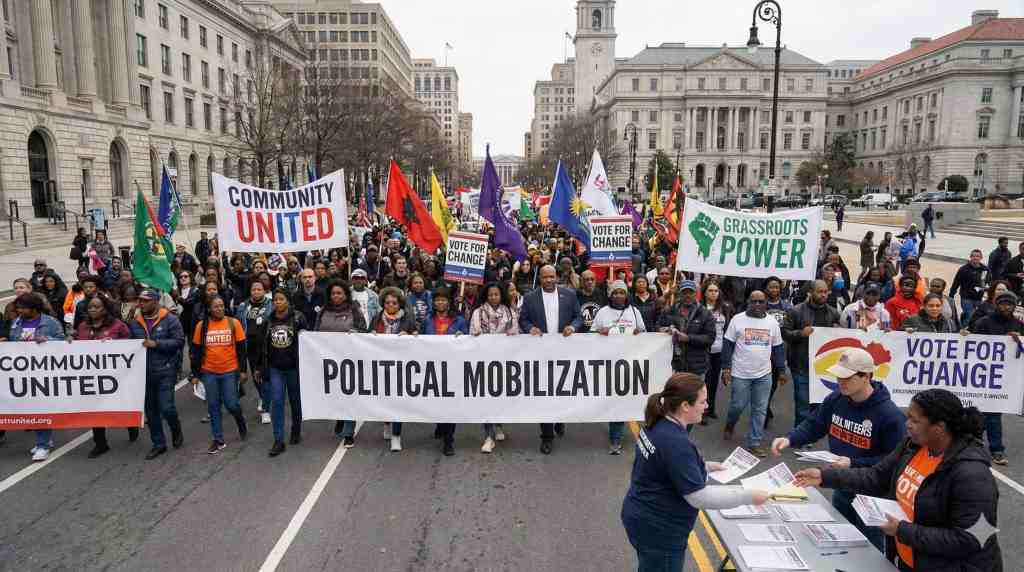
Political mobilization refers to the process by which various social groups based on caste, religion, region, language or economic status are awakened to political consciousness and encouraged to participate in political processes. It plays a critical role in the functioning of India’s democracy by enabling citizens to voice their concerns, claim their rights and influence state policies. In a country as diverse and complex as India, political mobilization serves not just as a tool for electoral participation but also as a mechanism for social transformation, inclusion and assertion of identity. It is through this process that communities particularly those historically marginalized, have been able to demand justice, representation and empowerment.
Political mobilization in India operates through multiple channels, including political parties, social movements, civil society organizations and grassroots activism. Political parties play a central role by organizing rallies, campaigning during elections, engaging in voter outreach and creating platforms that reflect the interests of specific social segments. Electoral politics remains a powerful space for mobilization, as seen in high voter turnouts, competitive campaigning and the expanding participation of women, youth and first-time voters.
Caste-based and identity-based mobilizations have historically shaped Indian politics. The mobilization of Dalits under the leadership of Dr. B.R. Ambedkar during the early and mid-20th century laid the foundation for Dalit assertion in politics. Post-independence, this mobilization was further institutionalized through political parties and movements that demanded affirmative action, representation and the eradication of caste discrimination. The implementation of the Mandal Commission recommendations in the 1990s triggered large-scale mobilization among Other Backward Classes (OBCs), transforming the political landscape in North India by bringing caste consciousness to the forefront of public discourse. Likewise, tribal movements in central and north-eastern India have mobilized indigenous communities for autonomy, land rights and preservation of cultural identity.
Religion, language and regional identities have also been potent sources of political mobilization. Movements based on linguistic identity led to the reorganization of states in the 1950s and 60s, while regional parties have mobilized people around regional pride, cultural identity and perceived neglect by the central government. This form of mobilization draws upon religious symbolism, temple construction movements and communal narratives to consolidate a majoritarian political identity.
Political mobilization in India has not been limited to elections. Numerous social movements such as the Chipko movement, the Narmada Bachao Andolan, anti-corruption protests, the agitation of farmers and various women’s and student movements, have mobilized large populations outside the formal political system. These movements have addressed issues such as environmental protection, land rights, labour rights, gender justice, education and transparency in governance. They often adopt protest tactics like dharnas (sit-ins), rallies, marches and hunger strike to put pressure on policymakers and raise public awareness.
The advent of digital media and technology has added a new dimension to political mobilization in India. Political actors increasingly use platforms like Twitter, WhatsApp, YouTube and Facebook to communicate with supporters, shape public opinion and spread political messaging. These tools have helped reach younger, urban and digitally literate populations, making mobilization faster and more interactive. Social media also allows decentralized and spontaneous mobilization, as seen in protests like the 2012 Nirbhaya movement or the 2020–21 farmers’ protests, where online networks played a crucial role in organizing, informing and sustaining the momentum.
Despite its strengths, political mobilization in India also faces serious challenges. It can sometimes lead to vote-bank politics, where communities are mobilized only to serve electoral interests without long-term benefits. Mobilization around narrow identities can reinforce social divisions and contribute to communalism, casteism and regionalism. Moreover, political mobilization is not always peaceful, instances of violence, riots and coercion have spoiled India’s political landscape, especially when leaders use identity politics irresponsibly. Furthermore, the influence of money, media manipulation and misinformation can distort the purpose of genuine mobilization.
In conclusion, political mobilization in India is a dynamic and evolving process that reflects the country’s democratic vibrancy, social diversity and historical legacies. It has empowered millions to participate in public life, shaped political discourse and facilitated the assertion of marginalized identities. At the same time, it requires continuous critical engagement to ensure that it contributes positively to democracy, equality and inclusive development rather than deepening societal divisions. Understanding the nature, methods and outcomes of political mobilization is essential to grasp the real pulse of Indian democracy.
Features of Political Mobilization
Political mobilization in India is a complex and dynamic process shaped by the country’s vast social diversity, democratic framework and historical experiences. Political mobilization often occurs along lines of caste, religion, region and class, reflecting the layered nature of its society. Following are some of important features of political mobilization:
1. Mobilization through Social Identities: In India, political mobilization is deeply rooted in the country’s complex and stratified social structure. Identities such as caste, religion, ethnicity and region often serve as bases for political organization and collective action. Caste-based mobilization has been particularly significant, with political parties forming alliances and selecting candidates based on caste arithmetic to secure electoral success. For example, the emergence of caste-based parties as a political force was based on the mobilization of Dalits under the Ambedkarite ideology, aiming to challenge upper-caste hegemony. Regional and linguistic identities also drive mobilization, as seen in movements for statehood and autonomy, where political leaders have used regional pride and linguistic identity to consolidate power.
2. Role of Political Parties in Mass Mobilization: Political parties are the primary agents of political mobilization in India’s electoral democracy. They reach the masses through large-scale campaigns, rallies, door-to-door canvassing and the strategic use of party symbols, slogans and manifestos. Political parties often craft their campaign strategies by aligning with dominant or marginalized caste groups, minority communities or regional blocs. The selection of candidates is carefully calibrated to appeal to specific social demographics, ensuring maximum electoral gain.
3. Political Mobilization through Social Movements: Social movements have historically played a crucial role in mobilizing marginalized and disenfranchised groups in India. These movements work outside the formal structures of political parties and focus on rights, justice and structural change. The Dalit movement, has mobilized oppressed castes around issues such as caste discrimination, access to education and political representation. Peasant movements, mobilized millions against agricultural reforms perceived as favouring corporates. Women’s movements have organized around gender justice, reproductive rights and protection against violence. These movements serve as pressure groups and alternative political platforms, often influencing policy decisions and shaping electoral agendas. While they may not always translate into immediate political gains, they significantly contribute to broadening democratic participation.
4. Electoral Politics as a Site of Mobilization: Elections in India are major moments of political mobilization where millions of citizens engage with the democratic process. Political parties and candidates employ a variety of methods to attract voter support, including door-to-door campaigns, caste-based coalitions, public meetings and mass media outreach. Voters are mobilized through promises of welfare, infrastructure development, employment and reservations. Personal charisma of leaders also plays a vital role, as seen in the electoral success of leaders, who present themselves as symbols of change and governance. Electoral mobilization also involves the strategic use of symbols, such as party logos and slogans, that appeal to collective memory and identity. Despite concerns about polarization and manipulation, electoral mobilization has led to a rise in voter turnout, especially among youth, women and rural populations.
5. Role of Media and Technology in Modern Mobilization: The evolution of media, especially digital and social media, has significantly transformed the landscape of political mobilization in India. Traditional media like newspapers, radio and television continue to be important, but social media platforms such as Facebook, WhatsApp, Twitter and Instagram now play a central role in political communication. Political parties and leaders use these platforms to directly engage with voters, shape public opinion and disseminate campaign material rapidly. Digital mobilization has enabled more targeted outreach, allowing parties to reach specific demographics with tailored messages. However, this has also raised concerns about misinformation, echo chambers and the manipulation of public sentiment.
6. Mobilization through Patronage and Clientelism: In many parts of India, political mobilization is closely tied to systems of patronage and clientelism. In this arrangement, political support is exchanged for material benefits, services or access to state resources. Politicians cultivate loyal vote banks by promising jobs, welfare benefits or personal favours to specific communities or local leaders, often reinforcing hierarchical relationships. This type of mobilization is particularly visible in rural areas and among marginalized populations who rely on political intermediaries to access government schemes. Vote-bank politics, where entire communities are courted or appeased based on their electoral strength, has become a common feature, raising questions about the quality of democratic engagement.
7. Grassroots and Decentralized Mobilization: The decentralization of governance through Panchayati Raj institutions and urban local bodies has led to the emergence of grassroots political mobilization in India. Reservations for Scheduled Castes, Scheduled Tribes and women in local bodies have empowered previously marginalized groups to participate in governance. This has created new political spaces where local leadership is promoted and people are mobilized around community development, resource allocation and grievance redressal. Grassroots mobilization is often facilitated by NGOs, community-based organizations and self-help groups, which raise awareness about rights and entitlements. In many villages, mobilization occurs around issues such as drinking water, education, health and infrastructure, making politics more participatory and locally responsive.
8. Mobilization Around Civic and Issue-Based Politics: There is a growing trend in India towards mobilization based on civic issues rather than traditional identity politics. This form of mobilization, often led by middle-class citizens, students and civil society organizations, focuses on rights, transparency, accountability and social justice. Notable examples include the India Against Corruption movement (2011) led by Anna Hazare, which demanded the implementation of the Jan Lokpal Bill and the protests following the 2012 Delhi gang rape case (Nirbhaya), which mobilized youth across the country to demand stronger laws and gender justice. Environmental movements and Right to Information (RTI) activism have also contributed to a more informed and engaged citizenry. These movements are less dependent on caste or religion and more focused on democratic ideals and constitutional rights.
9. Youth and Student Mobilization: Youth and students constitute a significant demographic in India and have historically played a crucial role in political mobilization. From the anti-Emergency protests of the 1970s to the recent student-led movements in Jawaharlal Nehru University (JNU), Jamia Millia Islamia and other institutions, student groups have consistently challenged the status quo and brought critical issues into national discourse. Political student organizations affiliated with larger parties act as training grounds for future political leaders. In recent years, youth have also been at the forefront of protests against government policies, such as the Citizenship Amendment Act (CAA) and unemployment-related agitations. Their participation, both online and offline, reflects a politically conscious generation ready to engage with systemic issues.
10. Mobilization Through Religious and Cultural Symbolism: Religious and cultural symbolism is another important tool for political mobilization in India. Political actors frequently invoke historical figures, myths, festivals and religious sentiments to mobilize support. Similarly, leaders often participate in religious festivals, wear symbolic attire and use culturally resonant language to connect with the masses. While this form of mobilization can promote unity among certain groups, it also risks deepening communal divisions and excluding minority voices from the political mainstream.
On the basis of above description, it can be stated that political mobilization in India is a dynamic and multi-layered process shaped by its plural society, historical legacies, democratic institutions and emerging socio-political trends. While it has enabled increased participation of historically marginalized communities and strengthened democratic engagement, it also presents challenges such as identity-based polarization, patronage politics and the commercialization of electoral processes. The evolving forms of mobilization reflect the changing nature of India’s political landscape.
Dimensions of Political Mobilization
Political mobilization in India is a dynamic and multifaceted process that shapes the country’s vibrant democratic landscape. Rooted in India’s diverse social fabric, mobilization plays a crucial role in political participation and power dynamics. From electoral campaigns and identity-based movements to protests and digital activism, political mobilization influences policymaking and social change. While it empowers marginalized groups and promotes democratic engagement, it also faces challenges like vote bank politics, political violence and youth apathy.
Following are key dimensions of political mobilization which are essential to understand the functioning of democracy in India:
1. Caste-Based Political Mobilization: Caste continues to be a deeply entrenched social institution in India, profoundly shaping political behaviour and allegiances. The political awakening of marginalized communities like Dalits and Other Backward Classes (OBCs) has been a key development in post-independence India. Dalits, historically subjected to extreme discrimination, have mobilized around Ambedkarite ideology, seeking not just political representation but also social dignity and economic upliftment. The rise of the caste based parties exemplifies this mobilization, which challenges the traditional dominance of upper castes. Some upper caste groups have also mobilized politically, fearing loss of social privilege or opposing affirmative action policies.
2. Religious Identity Mobilization: Religion forms a potent axis of political mobilization in India’s pluralistic society. Hindu nationalism has been strategically utilized by political parties to galvanize Hindu voters on cultural and religious lines. This mobilization often emphasizes symbols which evoke emotional and historical sentiments. On the other hand, religious minorities, often mobilize for their personal laws and socio-political interests. Religious mobilization is not confined to electoral politics but extends to social and cultural activism, with communities asserting their identities in education, employment and public life. However, this religious mobilization can also increase communal tensions and polarize electorates.
3. Regional and Linguistic Mobilization: India’s federal structure and cultural diversity have made regional and linguistic mobilization vital components of political life. Linguistic reorganization of states in the 1950s set the precedent for regional identity politics. Movements like the Dravidian movement in Tamil Nadu arose partly as a reaction to perceived north Indian (especially Hindi-speaking) dominance and sought to assert their language, culture and political autonomy. This led to the rise of strong regional parties which continue to dominate the state’s politics. Regional parties born out of such mobilization increasingly play king-maker roles at the national level, influencing coalition politics and national policy.
4. Electoral Mobilization Through Political Parties: Elections are the life-blood of Indian democracy, with political parties serving as the primary vehicles for mobilizing citizens. Parties engage in multifaceted strategies including rallies, door-to-door canvassing, distributing pamphlets, utilizing caste and religious leaders to reach voters. Manifestos tailored to specific demographics promise development schemes, social welfare, subsidies and reservations, designed to mobilize various groups. The Election Commission’s SVEEP (Systematic Voters’ Education and Electoral Participation) initiative focuses on increasing voter awareness, targeting first-time voters and marginalized groups. The extensive network of party workers at the booth level ensures that the party’s messages reach grassroots voters and that turnout is maximized. The strong electoral mobilization underpins the legitimacy of India’s democratic process but also raises concerns about populism and vote-buying.
5. Social Movements and Protest-Based Mobilization: India has a rich tradition of social movements that have mobilized people outside formal political structures to demand change. Movements such as the Chipko environmental movement of the 1970s united rural communities in protecting forests through non-violent resistance. The Narmada Bachao Andolan protested against displacement caused by large dams, highlighting the plight of tribal and farmer communities. Farmers’ protests, including the recent nationwide agitation against farm laws, have mobilized millions, showcasing the continuing power of agrarian mobilization in an increasingly urbanizing country. Women’s movements, especially after the 2012 Delhi gang rape, have mobilized for safety and gender justice. These protests deepen democracy by holding governments accountable and amplifying marginalized voices.
6. Role of Political Leaders and Charisma: Charismatic leadership has played a decisive role in political mobilization in India. Leaders like Mahatma Gandhi inspired mass participation in the freedom struggle through moral authority and nonviolent methods. In independent India, leaders such as Indira Gandhi, with her image as the ‘Iron Lady,’ mobilized people around populist programs and strong centralized control. Leaders have mobilized caste groups through personal narratives of empowerment and social justice. Charisma often cuts across party lines and helps unify diverse constituencies.
7. Political Parties as Mobilizing Agents: Political parties maintain vast grassroots organizations that are crucial for ongoing mobilization. Beyond elections, parties engage in continuous outreach by holding local meetings, running community services and building alliances with social organizations. Youth wings and women’s wings of parties serve as training grounds for future leaders and as mobilizers on the ground. In states with strong party systems, cadres maintain voter loyalty by addressing local issues and grievances. Coalition politics has made alliances with smaller parties and independent groups vital, encouraging mobilization through strategic partnerships. Parties also mobilize volunteers for rallies, fundraising and social campaigns, maintaining political engagement year-round. However, factionalism and internal competition can sometimes disrupt party cohesion and mobilization efforts.
8. Role of Media and Technology in Mobilization: The explosion of digital media has transformed political mobilization in India. Television channels, especially during elections, broadcast debates, campaign speeches and voter outreach programs, shaping public opinion. The rise of social media platforms has democratized political communication, allowing direct interaction between leaders and voters and enabling rapid spread of information. Viral hashtags and online campaigns have helped mobilize youth and urban populations on issues like climate change, gender rights and anti-corruption. Mobile internet penetration has brought political discourse to rural areas as well.
9. Challenges of Vote Bank Politics and Political Violence: While identity-based mobilization empowers groups, it often leads to vote bank politics where parties cater to narrow caste or religious constituencies for electoral gain, sometimes at the cost of broader social cohesion. This has contributed to the fragmentation of the electorate and reinforced identity politics, which can stall inclusive policy-making. In some regions, fierce competition for political power has led to violence, intimidation and criminalization of politics, undermining democratic participation and trust.
10. Limitations in Political Awareness and Youth Apathy: Despite India’s democratic vibrancy, many rural and marginalized communities suffer from low political awareness due to limited education, poverty and social exclusion. This reduces their ability to engage meaningfully with political processes and makes them vulnerable to manipulation. Meanwhile, urban youth, though more connected digitally, often display political apathy or cynicism, disillusioned by corruption, unemployment and perceived inefficacy of political institutions. This disengagement threatens future democratic participation and calls for renewed efforts in civic education and youth engagement.
On the basis of above description, it can be stated that political mobilization in India is a complex and dynamic process shaped by the country’s rich social diversity, democratic institutions and evolving political landscape. From caste and religious identities to regional aspirations and issue-based movements, mobilization channels the voices of millions into collective action. While political parties and charismatic leaders play central roles, modern technology and media have transformed how citizens engage politically. Despite challenges like vote bank politics, political violence and youth apathy, mobilization remains vital for sustaining India’s democracy, empowering marginalized groups and driving social change.
Challenges of Political Mobilization in India
Political mobilization plays a critical role in enhancing democratic participation and empowering marginalized communities. However, in the Indian context, the process is fraught with several challenges rooted in its complex social fabric, the structure of political institutions and the conduct of political actors. These challenges can hinder the development of an inclusive, participatory and issue-based democracy.
Following are the major challenges associated with political mobilization in India:
1. Identity-Based Fragmentation: One of the central challenges of political mobilization in India is its tendency to revolve around narrow identity markers such as caste, religion, language and region. Political parties often exploit these social divisions to create loyal vote banks, leading to the rise of identity-based politics. While this can offer historically marginalized groups a platform for representation, it simultaneously reinforces social boundaries and perpetuates divisions within society. The overemphasis on identity can shift political debates away from universal issues like poverty, education or health, and instead anchor them in sectarian or symbolic concerns.
2. Vote-Bank Politics and Clientelism: In many cases, political mobilization in India is characterized by transactional relationships between voters and political leaders, commonly known as vote-bank politics. Politicians often promise short-term benefits such as welfare schemes or monetary incentives targeted at specific communities in exchange for electoral support. This gives rise to clientelism, where loyalty to a leader or party is based not on ideology or performance, but on direct material gain. Such a system undermines the idea of citizenship based on rights and duties and leads to unequal distribution of state resources.
3. Marginalization Within Mobilization: Even within politically mobilized communities, internal hierarchies often result in unequal participation and representation. Marginalized subgroups, such as women, lower sub-castes within Dalit communities or indigenous tribal population are frequently side-lined by more dominant sections of their own group. For example, while Dalit movements have achieved significant political visibility, representation has often remained concentrated in a few dominant Dalit sub-castes, leaving others with limited voice. Similarly, women are frequently mobilized for rallies or voting campaigns but rarely occupy leadership positions in political parties or movements.
4. Political Violence and Coercion: In some parts of India, political mobilization is not entirely voluntary or peaceful. Political parties and organizations may resort to coercive tactics to influence voters, suppress dissent or eliminate opposition. This is particularly visible in regions with intense electoral competition or political unrest, such as parts of West Bengal, Jammu and Kashmir or the Red Corridor areas affected by Maoist insurgency. Voter intimidation, booth capturing and politically motivated violence erode the democratic ethos and deter genuine participation.
5. Misinformation and Media Manipulation: With the rise of digital media, political mobilization has increasingly moved to online platforms. While this opens up new avenues for outreach and engagement, it also presents serious challenges related to the spread of misinformation, propaganda and hate speech. Political parties and interest groups often use social media to circulate polarizing content, distort facts and manipulate public opinion. The absence of strong regulatory mechanisms allows fake news to go viral, influencing voter perceptions and decisions in misleading ways.
6. Populism over Long-Term Policy: Indian political mobilization is increasingly driven by populist agendas that promise immediate relief rather than long-term structural reforms. While schemes like free electricity, loan waivers or direct cash transfers may offer short-term benefits, they often come at the cost of sustainable development and sound governance. Politicians prioritize measures that yield quick electoral gains rather than investing in essential sectors like education, healthcare or institutional reform. This trend weakens policy depth, reduces public engagement in serious policy discussions and creates fiscal stress for governments.
7. Voter Fatigue and Cynicism: In an environment of constant political mobilization, voters can become disillusioned or fatigued. Many citizens lose faith in the political process when they see repetitive unfulfilled promises, persistent corruption and lack of genuine accountability. This can lead to apathy, reduced voter turnout and a growing sense of cynicism toward political institutions. This disengagement weakens the democratic process and makes it harder to build a vibrant, participatory civic culture.
8. Elite Capture of Political Mobilization: Despite being framed as democratic and mass-oriented, many political mobilizations in India are led and controlled by elites whether they are upper-caste leaders in anti-reservation protests or dominant men in women’s rights campaigns. These elites often use the language of social justice or empowerment while pursuing their own political or economic interests. Such elite-led mobilizations may silence genuine grassroots voices, distort the original goals of the movement or lead to outcomes that benefit only a select few. This form of ‘elite capture’ undermines the credibility and democratic potential of mobilization efforts.
9. Urban-Rural Mobilization Imbalance: Another significant challenge is the urban-rural disparity in political mobilization. Urban voters, despite having access to more information and connectivity, often show lower turnout and political involvement compared to rural citizens. Rural populations are more effectively mobilized through community networks, local leadership and party machinery. However, urban mobilization remains fragmented due to socio-economic heterogeneity, anonymity and a lack of cohesive political organization. This imbalance creates skewed policy attention, where rural votes dominate the political agenda and urban issues such as public transportation, pollution, housing or labour rights receive relatively less focus in mainstream politics.
10. Suppression of Dissent and Shrinking Civic Space: In recent years, there has been growing concern about the suppression of dissenting voices in India. Peaceful protests, student movements, farmer agitations and civil society organizations have faced legal crackdowns, restrictions on assembly and surveillance. Laws like the Unlawful Activities (Prevention) Act (UAPA) and sedition charges have been used against activists and critics of government policies. Such actions create a climate of fear and discourage political participation, especially among youth, minorities and marginalized sections. When the state uses its power to delegitimize or criminalize dissent, the very foundation of democratic political mobilization is threatened.
On the basis of above description, it can be stated that the challenges of political mobilization in India reveal the complex interplay between democracy, identity, power and participation. While mobilization has empowered millions, it has also led to new forms of exclusion, manipulation and division. To strengthen India’s democratic fabric, political mobilization must move beyond identity-based or clientelist politics and evolve into a more inclusive, issue-based and participatory process. Encouraging civic education, ensuring transparency, empowering grassroots voices and safeguarding the right to dissent are essential steps toward realizing the full democratic potential of political mobilization in India.
Contemporary Trends in Political Mobilization
Political mobilization in India is a dynamic and multifaceted process through which individuals and groups are encouraged to participate actively in political life. Rooted in the country’s rich history of struggle for independence and democratic governance, political mobilization today reflects India’s vast social diversity, including caste, religion, language and regional identities.
Following are the contemporary trends in political mobilization in India:
1. Surge of Populist and Nationalist Politics: In recent years, political mobilization in India has been strongly influenced by populist and nationalist themes. Parties have skilfully crafted narratives centered on Hindu cultural nationalism, often framing political debates in terms of national identity and pride. These narratives invoke symbols such as the national flag, ancient heritage and religious icons to create emotional resonance. This form of mobilization transcends traditional party loyalties, tapping into broad sections of the population who identify with the idea of a culturally unified nation. However, this approach sometimes side-lines minorities, contributing to social polarization. Populist leaders use direct communication, bypassing institutional checks, to present themselves as champions of the ‘common people’ against corrupt elites.
2. Widespread Use of Social Media and Digital Technology: The digital revolution has reshaped political mobilization in India by facilitating rapid, large-scale communication. Political parties, activists and interest groups use social media platforms not only for spreading messages but also for real-time organizing, fundraising and voter outreach. WhatsApp groups, viral videos, memes and live streaming of rallies have become critical tools, enabling localized mobilization even in remote areas. Digital mobilization has lowered entry barriers, allowing younger and marginalized voices to participate. However, this also poses challenges such as the spread of misinformation, echo chambers and online harassment, which can deepen social divides. Governments and political actors have increasingly invested in sophisticated data analytics and micro-targeting techniques to tailor messages for specific communities.
3. Youth as a Growing Political Force: India’s demographic dividend means a large proportion of the population is young, making youth a crucial target and agent of political mobilization. Unlike previous generations, today’s youth are more educated, digitally connected and aware of national and global issues. They have been at the forefront of movements demanding climate action, job creation, educational reforms and gender justice. Youth-led campaigns often use innovative strategies such as flash mobs, social media activism and campus protests to gain visibility. Political parties create dedicated youth wings and tailor manifestos to appeal to young voters, who increasingly seek transparency, accountability and opportunities. However, political apathy among some youth sections remains a concern due to disillusionment with traditional politics and corruption.
4. Identity-Based Mobilization: Identity continues to be a powerful force in Indian politics. Caste mobilization remains prominent as groups like Dalits, OBCs and tribal communities organize to demand political representation, social justice and economic benefits. The rise of caste-based parties and alliances has transformed electoral dynamics, with caste coalitions shaping government formation in many states. Religious identity mobilization is equally significant; Hindu nationalism, Muslim minority politics and Christian community mobilization often define electoral strategies and communal relations. Regional identity politics based on language and culture have led to the rise of strong regional parties in states like Tamil Nadu, West Bengal and Maharashtra, which mobilize voters around issues of autonomy, cultural pride and development. While identity mobilization empowers marginalized groups, it can sometimes entrench divisions and impede inclusive politics.
5. Protest and Issue-Based Movements Gaining Momentum: Political participation in India increasingly includes issue-driven and protest mobilizations beyond traditional party politics. Environmental movements opposing deforestation, mining and pollution have gained support from urban and rural populations. The anti-corruption movement of 2011 galvanized a broad middle-class constituency demanding clean governance. Farmers’ protests against agricultural reforms in recent years demonstrated the capacity of large rural mobilizations to impact national politics. Labour unions continue to mobilize for workers’ rights amid economic restructuring. Women’s protests against gender violence have highlighted systemic inequalities. These movements often operate in decentralized ways, use digital tools to organize and sometimes challenge the state and established parties. Their rise reflects a growing political awareness and the desire for more participatory democracy.
6. Rise of Populist Welfare Policies: Governments across the political spectrum increasingly use populist welfare schemes as instruments of political mobilization. By providing direct benefits such as subsidized cooking gas (LPG), affordable housing, free health insurance and cash transfers, political parties build loyalty among economically vulnerable groups. These welfare policies create a tangible link between citizens and the state, often influencing voting behaviour. While such schemes have helped reduce poverty and improve living standards, critics argue they sometimes prioritize short-term political gains over long-term sustainable development.
7. Decline of Traditional Party Structures and Rise of Leader-Centric Mobilization: Traditional political parties in India have historically relied on grassroots cadres, local workers and ideological platforms to mobilize support. However, contemporary mobilization increasingly centers on charismatic leaders who command mass appeal. Leaders use mass rallies, media appearances and social media to directly connect with voters, often sidelining party organization. This leader-centric mobilization personalizes politics and builds loyalty based on individual charisma rather than party ideology or program. While this can energize supporters and increase visibility, it risks weakening internal democracy within parties and reduces the emphasis on collective policy debates.
8. Challenges From Political Polarization and Communal Tensions: Political mobilization in India is often accompanied by rising polarization, particularly on communal lines. Political actors sometimes exploit religious and ethnic identities to consolidate vote banks, which can escalate tensions and violence. Polarizing narratives hinder inclusive political dialogue and complicate efforts to address broader socio-economic issues. Communal riots, hate speech and discrimination have periodically erupted, affecting social harmony. This polarization challenges India’s pluralistic democracy by creating an “us vs. them” mindset which reduces the space for adjustment and consensus-building.
9. Increased Role of Civil Society and Non-Governmental Actors: Civil society organizations, advocacy groups and independent activists play an important role in contemporary political mobilization by raising awareness, educating citizens and organizing marginalized communities. NGOs focusing on women’s rights, environmental protection, minority rights and social justice supplement electoral politics by creating pressure for reforms and policy changes. They use grassroots mobilization, legal advocacy and media campaigns to influence public opinion and government action. The expanding role of civil society enhances democratic participation but also sometimes creates tensions with governments, especially when activism challenges state policies or interests.
10. Barriers and Exclusion within Mobilization Processes: Despite democratic mechanisms and increased mobilization efforts, many marginalized groups in India face persistent barriers to full political participation. Economic deprivation, illiteracy, social discrimination and lack of access to information often exclude poor, rural and minority populations from effective mobilization. Women, Dalits, tribals and religious minorities frequently encounter structural obstacles that limit their political voice. While reservation policies and affirmative action help, these measures alone cannot fully eliminate exclusion. Overcoming these barriers requires sustained efforts to improve education, economic opportunities and social inclusion alongside political mobilization.
On the basis of above description, it can be stated that political mobilization in contemporary India reflects the country’s rich diversity and democratic vibrancy, shaped by identity politics, digital technology, populist rhetoric and grassroots activism. While nationalism and populism dominate much of the political landscape, growing youth engagement, issue-based protests and civil society activism demonstrate expanding political participation beyond traditional frameworks. However, challenges such as; communal polarization, exclusion of marginalized groups and leader-centric politics persist, impacting the inclusivity and quality of democratic engagement. Overall, political mobilization remains a dynamic force driving India’s evolving democracy, highlighting both its strengths and ongoing struggles for social justice and political representation.
References and Readings:
The Oxford Companion to Politics in India (Student Edition), Edited by Niraja Gopal Jayal & Pratap Bhanu Mehta, https://amzn.to/3YqDGTO
Social Movements and the State, by Ghanshyam Shah, https://amzn.to/3XSfx8s
Struggle Against the State: Social Network and Protest Mobilization in India, by Ashok Swain, https://amzn.to/3YuIQy0
Political Mobilization and Identity in Western India, by Shri Krishan, https://amzn.to/4rRLYBA