- Introduction
- Meaning of Political Sociology
- Origins and Intellectual Foundations of Political Sociology
- Historical Evolution of Political Sociology
- Nature and Scope of Political Sociology
- Key Characteristics of Political Sociology
- Core Analytical Themes in Political Sociology
Introduction
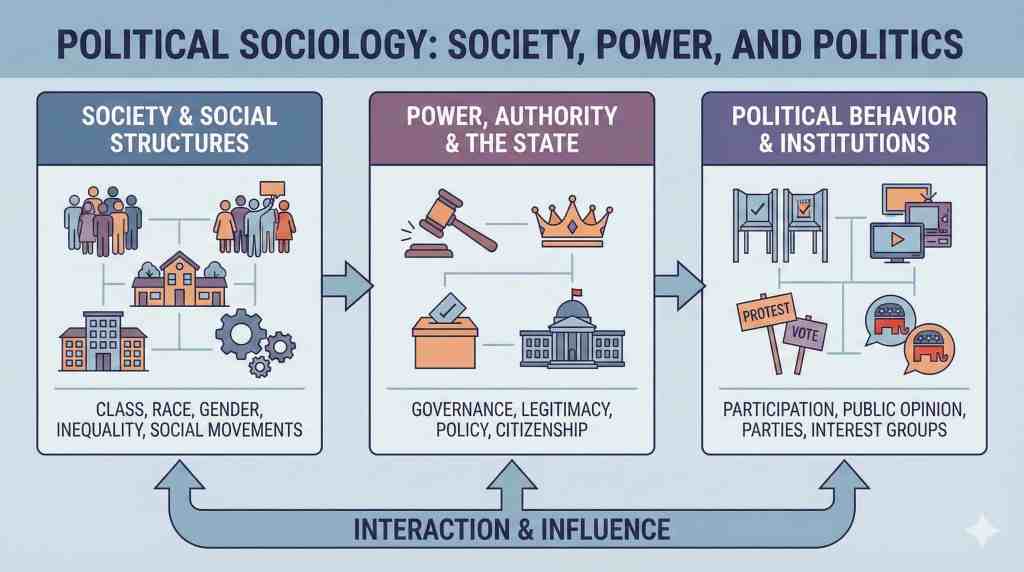
Political sociology occupies a central position within the social sciences as it seeks to understand how power is produced, distributed, legitimised and contested within society. It examines the complex and dynamic relationship between political institutions and the broader social structures within which they operate. Rather than viewing politics merely as governmental processes or electoral procedures, political sociology conceptualises political life as deeply embedded in the everyday interactions, norms, identities and material conditions of society. It therefore broadens the study of politics beyond formal structures to include the social foundations of authority, participation, conflict and change. Through this broader lens, political sociology investigates how social class, caste, gender, ethnicity, religion, economic inequalities, collective identities and cultural values shape political behaviour and the functioning of political systems.
Historically, the discipline emerged from the foundational contributions of classical thinkers such as Karl Marx, Max Weber and Émile Durkheim, each of whom offered distinctive insights into the nature of power, authority, legitimacy and social order. Marx emphasised the role of class conflict and economic structures in shaping political institutions, Weber highlighted the significance of authority types, bureaucracy and legitimacy and Durkheim explored the moral foundations of political cohesion and social solidarity. Over time, these classical foundations were expanded by elite theorists, pluralists, structural functionalists, neo-Marxists, feminist scholars, post-structuralists and contemporary political sociologists who addressed the complexities of modern and post-modern societies. As a result, the discipline today encompasses a wide array of perspectives that analyse political power through structural, institutional, cultural and interpretive approaches.
In the contemporary world, the relevance of political sociology has increased substantially. Globalisation, technological transformation, identity-based mobilisations, rising inequalities, democratic backsliding, migration, environmental crises and the digitalisation of political communication have reshaped political processes in unprecedented ways. Political behaviour is increasingly influenced by media narratives, algorithmic environments and transnational flows of information, capital and cultural practices. Simultaneously, new forms of political participation, ranging from social movements and civil society activism to digital campaigning and online mobilisation have transformed how citizens engage with the state. Understanding these transformations requires analytical tools that can bridge the social and the political, making political sociology indispensable for interpreting the shifting nature of power in the twenty-first century.
In the Indian context, political sociology offers a crucial framework for analysing how caste, religion, region, kinship, gender, marginalisation and socio-economic inequalities shape political processes. India’s democratic experience illustrates the deep interconnections between social stratification and political mobilisation, where patterns of voting behaviour, leadership formation, social movements, identity politics and public policy cannot be understood without situating them within the broader social structure. From caste-based electoral alignments and regional movements to women’s political participation and digital activism, the Indian experience provides a rich field for political sociological inquiry.
Thus, political sociology, by integrating theory, empirical investigation and comparative analysis offers a comprehensive lens to understand the complex and evolving relationship between society and politics. Its scope, significance and analytical depth make it an essential field for scholars seeking to understand the foundations and transformations of political life at both global and local levels.
Meaning of Political Sociology
Political sociology is a core subfield of sociology that examines the complex relationship between society and political power. It explores how social structures, cultural norms, economic arrangements and collective identities shape political behaviour, institutions and authority and how, in turn, political systems influence social life. The discipline studies the distribution of power within society, the functioning of the state, the nature of political participation and how social groups such as classes, communities and movements interact with political processes. From an international perspective, political sociology offers a comparative lens for understanding how different societies organise power, govern populations and resolve conflicts in a rapidly transforming world. Its analytical framework bridges sociology and political science, offering a broader socio-cultural understanding of politics beyond formal institutions.
Origins and Intellectual Foundations of Political Sociology
1. Early Foundations: The intellectual origins of political sociology can be traced to the mid-19th century, during which social thinkers began to examine the interplay between society and political power as analytically distinct yet interconnected domains. Although the term “political sociology” was coined later, the foundational ideas emerged through the works of classical sociologists such as Karl Marx, Max Weber and Émile Durkheim.
Karl Marx (1818–1883) provided one of the earliest and most influential frameworks for understanding political power as rooted in economic structures. He argued that the state functioned primarily to serve the interests of the dominant economic class, functioning as an instrument of class rule. Concepts such as class struggle, ideology and the base–superstructure model became central to political-sociological thought, shaping generations of analyses of power, inequality and social change.
Max Weber (1864–1920) expanded the discipline by introducing a sociologically detailed understanding of authority, legitimacy and bureaucracy. He distinguished among three ideal‑types of legitimate authority i.e., traditional, charismatic and rational-legal explaining how political power is maintained beyond coercion. Weber’s studies of bureaucracy, rationalisation and institutional power provided tools for analysing the organisation of modern states and the operation of complex political institutions.
Émile Durkheim (1858–1917) contributed to the understanding of political order through his focus on social solidarity, collective conscience and shared values. He emphasised that political stability depends not only on formal institutions but also on the moral and cultural integration of society, highlighting the significance of collective norms and cohesion in maintaining political systems.
2. Emergence as a Distinct Discipline: Political sociology formally emerged as a distinct subfield in the mid-20th century. While classical theorists provided the intellectual foundations, scholars in the post-World War II era recognised the need to integrate empirical sociological methods into the analysis of political phenomena. By the 1950s and 1960s, research expanded beyond the study of formal institutions to encompass political behaviour, public opinion, social movements, identity politics, political culture and the social bases of power.
The institutionalisation of political sociology was marked in 1959 by the establishment of the Research Committee on Political Sociology under the International Sociological Association (ISA) and the International Political Science Association (IPSA), with prominent scholars such as Seymour Martin Lipset and Stein Rokkan contributing to its foundation. This formal recognition underscored the interdisciplinary nature of the field, combining insights from sociology, political science, history and economics to understand the complex interactions between society and politics.
The post‑war era also witnessed significant social and political transformations, including decolonisation, the rise of welfare states and increasing social movements. These changes highlighted the need for political sociology to analyse not only state institutions but also the social contexts in which political power is exercised.
Historical Evolution of Political Sociology
1. Classical Phase: The classical phase of political sociology, spanning the late 19th to early 20th century, laid the intellectual foundations of the field. This period was marked by rapid industrialisation, urbanisation and the transformation of traditional societies into modern nation-states. Foundational thinkers such as Karl Marx, Max Weber and Émile Durkheim analysed how political power emerges from social structures and economic systems, providing theoretical frameworks that continue to guide political sociological inquiry. Marx examined the relationship between capitalism, class conflict and state power. Weber analysed bureaucracy, rational-legal authority and the legitimacy of rule while Durkheim emphasised collective conscience, social solidarity and the moral basis of political order. Central concerns of this phase included the decline of feudalism, the rise of capitalism, the expansion of democratic participation and the emergence of nationalism and mass politics. These thinkers collectively shaped the discipline’s enduring preoccupation with power, authority and the state.
2. Mid-Century Phase: The mid-20th century marked a major expansion of political sociology, especially after World War II, as scholars sought to understand democratic stability, mass political behaviour and the evolving role of political institutions. Researchers such as Gabriel Almond, Sidney Verba, C. Wright Mills, Robert Michels and Talcott Parsons broadened the discipline to include political culture, elite theory and political socialisation. Almond and Verba’s studies on civic culture examined how values and orientations support stable democracies, while Mills highlighted the concentration of power within military, corporate and political elites. Michels’ “iron law of oligarchy” underscored the tendency of organisations to develop hierarchical control structures despite democratic intentions. This phase also saw the rise of behaviouralism, survey research, public opinion studies and comparative political analysis. The emphasis shifted from abstract theory to empirical investigation, with a growing interest in mass participation, voting behaviour, party systems and the functioning of democratic institutions.
3. Contemporary Phase: The contemporary phase of political sociology, developing from the late 20th century into the 21st century, reflects the profound transformations brought by globalisation, technological change and the diversification of political identities. Modern political sociology recognises that politics extends far beyond the state and formal institutions, encompassing global markets, transnational actors, grassroots movements and digital platforms. Themes such as identity politics, feminist political sociology, environmental movements, migration, diaspora politics, human rights activism and global governance have become central to the field. The digital revolution has reshaped political communication, enabling new forms of mobilisation, surveillance and political manipulation. Scholars now analyse how cultural identities, social media networks and global economic forces influence political participation and state power. Contemporary political sociology also addresses challenges such as democratic backsliding, populism, climate politics, economic inequality and the reconfiguration of sovereignty in an interconnected world. This phase underscores the multidimensional nature of politics and highlights the need for interdisciplinary approaches to understanding rapidly changing political realities.
Nature and Scope of Political Sociology
Political sociology encompasses a broad and dynamic field of inquiry that examines how power, authority and governance operate within society. It explores the interactions between political institutions and social structures, revealing the ways in which political processes are shaped by cultural norms, economic conditions and collective identities. By analysing diverse dimensions of power relations, political sociology provides a deeper understanding of how political life is organised, contested and transformed over time.
1. Structure of Power: The structure of power refers to the organisation and distribution of authority within society. Political sociology investigates how power is concentrated among elites, the strategies they employ to maintain dominance and the institutional arrangements that support their authority. It also analyses how marginalised groups resist or negotiate these power structures through social, political and cultural means. This examination highlights the unequal access to influence and decision-making experienced by different segments of society.
2. The State and Its Institutions: The state is the central institution responsible for law, order, governance and the legitimisation of authority. Political sociology studies the various forms of the state, including democratic, authoritarian and welfare-oriented models, and the mechanisms through which they sustain legitimacy. It further examines the functions of bureaucracy, public administration, political parties and electoral systems, all of which shape policy-making and political representation. Together, these institutions determine how public interests are articulated, contested and implemented.
3. Political Behaviour: Political behaviour encompasses the attitudes, actions and orientations individuals and groups adopt toward political processes. This includes patterns of voting, participation, political socialisation and the formation of political values. Political sociology analyses the influence of family, education, media and social identities on political preferences to understand why populations support specific leaders or policies. Through this lens, it explains the broader dynamics of political engagement and public opinion.
4. Social Inequalities and Politics: Social inequalities such as class, caste, race, ethnicity and gender profoundly shape political participation and representation. Political sociology explores how these hierarchies affect the distribution of power and access to political institutions, often resulting in exclusion or marginalisation. It also examines how poverty and limited resources restrict the political agency of disadvantaged groups. Understanding these inequalities is crucial for analysing persistent political conflicts and the barriers to inclusive governance.
5. Collective Action and Social Movements: Collective action emerges when groups mobilise around shared interests, grievances or aspirations for social and political change. Political sociology studies various movements including environmental, women’s, peasant, workers’ and anti-globalisation movements to understand how ordinary people challenge established authorities. These movements rely on strategies of organisation, ideology and public mobilisation to influence political outcomes. They play a critical role in transforming policies, expanding rights and reshaping societal norms.
6. Public Policy and Governance: Public policy comprises the decisions and programmes formulated by governments to address social needs and developmental objectives. Political sociology examines how these policies are created, the interests they reflect and the extent to which they serve diverse populations. It also focuses on broader concepts such as the welfare state, decentralisation and good governance, emphasising accountability, inclusion and administrative efficiency. Governance practices ultimately determine how effectively institutions respond to societal challenges.
7. Globalisation and Transnational Politics: Globalisation has redefined political processes by increasing interconnectedness among nations, economies and communities. Political sociology analyses global governance, the influence of international institutions and the role of transnational actors in shaping national policies. It also studies diaspora politics and migration to understand how political participation increasingly occurs across borders. These trends demonstrate how domestic politics is deeply influenced by global forces and international networks.
8. Media, Technology and Political Communication: Media and digital technologies have become central to shaping political communication, mobilisation and public opinion. Political sociology investigates how social media platforms impact political participation, identity formation and the spread of political narratives. It also examines issues of digital surveillance, misinformation and post-truth politics, which pose challenges to democratic accountability. These developments illustrate the evolving relationship between technology, society and political life.
Key Characteristics of Political Sociology
1. Interdisciplinary Nature: Political sociology is inherently interdisciplinary, drawing on the conceptual and methodological insights of sociology, political science, economics, anthropology, psychology and history. This integration allows the field to analyse political processes not merely as institutional mechanisms but as deeply embedded social phenomena shaped by culture, economy and human behaviour. By bridging multiple disciplines, political sociology offers a more holistic understanding of how societal structures influence political life. This approach enriches theoretical interpretations and strengthens the empirical study of political dynamics.
2. Focus on Power Relations: A central characteristic of political sociology is its sustained focus on the nature, distribution and exercise of power. It examines power not only within formal state institutions but also in everyday social spaces such as families, workplaces, communities and cultural organisations. Through this lens, the field reveals how power circulates through norms, authority structures and social expectations. This wider view highlights the subtle, often invisible mechanisms through which influence and control are maintained or contested.
3. Emphasis on Social Structures: Political sociology emphasises that political actions and outcomes are deeply shaped by social structures such as class, caste, gender, religion and ethnic identity. These structures create differentiated access to resources, influence and representation, thereby shaping the political opportunities available to individuals and groups. By analysing these patterned inequalities, the field uncovers the structural roots of political conflict, exclusion and mobilisation. This perspective underscores that politics cannot be understood separately from broader social hierarchies.
4. Empirical and Theoretical Orientation: The discipline is grounded in a combination of empirical research and theoretical analysis, enabling a comprehensive understanding of political phenomena. Political sociologists employ both qualitative methods such as interviews, ethnography and case studies, and quantitative methods, including surveys, statistical analysis and comparative datasets. These methodological tools help identify patterns, test hypotheses and develop generalisable insights. Theoretical frameworks further guide interpretation, situating empirical findings within broader sociological and political debates.
5. Critical Approach: Political sociology adopts a critical stance toward existing political arrangements, questioning taken-for-granted assumptions about authority, legitimacy and governance. It seeks to expose power hierarchies, uncover mechanisms of domination and challenge forms of inequality that shape political life. This critical orientation encourages inquiry into how policies, institutions and ideologies benefit some groups while marginalising others. Through such analysis, the field contributes to debates on justice, rights and democratic reform.
6. Comparative Perspective: A comparative perspective is fundamental to political sociology, as it enables scholars to study political systems, cultures and behaviours across different societies. By comparing similarities and differences, the field identifies broader patterns, variations and unique trajectories in political development. This approach enhances understanding of how social, economic and historical contexts shape political institutions and practices. Comparative analysis also strengthens theoretical generalisations by examining how political processes operate under diverse conditions.
Core Analytical Themes in Political Sociology
1. State and Society
1.1 Nature of the State: The nature of the state has been interpreted through multiple theoretical traditions, each offering distinct insights into its role and functioning. Liberal theory views the state as a neutral arbiter that protects individual rights, ensures freedom and maintains the rule of law. Marxist theory, in contrast, argues that the state primarily serves the interests of the dominant economic class by safeguarding existing relations of production. Pluralist theory emphasises competition among diverse social groups, suggesting that power is dispersed rather than concentrated. Neo-Weberian theory highlights the importance of bureaucracy, legal authority and administrative competence in modern state functioning. Postcolonial theory examines how colonial legacies continue to shape state institutions, governance patterns and power relations in formerly colonised societies.
1.2 State Capacity and Legitimacy: State capacity refers to the ability of a government to effectively implement policies, maintain order and deliver essential services. A well-functioning state requires strong administrative systems, legitimate authority grounded in public trust and institutions that remain responsive to societal needs. In the Indian context, capacity challenges can be seen in rural governance, where limited resources and bureaucratic gaps affect service delivery. At the global level, Scandinavian countries illustrate high state capacity through efficient welfare systems, transparent administration and strong public confidence in government institutions.
2. Political Culture
2.1 Definition and Importance: Political culture refers to the collectively held values, beliefs, symbols and attitudes that shape how people perceive political authority, participate in public life and evaluate governance. It influences the stability of political systems by shaping public expectations, levels of trust and civic engagement. Political culture also determines the nature of political participation and the legitimacy that citizens accord to state institutions, making it central to understanding political behaviour in any society.
2.2 Types (Almond & Verba): Almond and Verba identify several forms of political culture. Parochial culture is marked by limited awareness of political institutions, usually found in traditional or tribal societies. Subject culture involves citizens who recognise political authority but take a passive role in governance. Participant culture reflects active engagement in political processes, where citizens are informed and involved. Civic culture, a balanced combination of participation and trust, is essential for stable democracies. Many advanced democracies, such as those in Scandinavia and North America, exhibit civic political cultures, where citizens are informed, actively participate in political processes and maintain trust in institutions, contributing to stable and resilient democratic systems.
3. Political Socialization: Political socialization refers to the lifelong process through which individuals acquire political values, identities and behavioural orientations. The family plays a foundational role by shaping early political beliefs and voting tendencies. Schools contribute through civic education, while peer groups influence attitudes during adolescence and adulthood. Religion often informs moral and ideological standpoints, whereas media and digital platforms increasingly shape political awareness and engagement. For example, Social media platforms worldwide have become powerful agents of political socialization, particularly among youth engaging with political content online.
4. Political Participation
4.1 Conventional Participation: Conventional political participation includes formal, institution-based activities that contribute to democratic functioning. These involve voting, which remains the most widespread form of participation, joining political parties and engaging in election campaigns to support candidates or mobilise voters. Such participation strengthens the legitimacy of democratic institutions and enhances accountability.
4.2 Unconventional Participation: Unconventional participation includes activities outside formal political structures, often used to express dissent or demand political change. These involve protests, social movements and digital activism that mobilise support through online platforms. For example, Movements such as Black Lives Matter and climate change activism illustrate transnational forms of collective political engagement driven by civil society.
5. Social Movements and Collective Action: Resource Mobilization Theory explains social movements as organised efforts that succeed or fail depending on their ability to acquire and mobilise resources such as leadership, funds, networks and organisational capacity. New Social Movements Theory highlights the emergence of movements concerned with identity, environment, culture and human rights, arguing that contemporary mobilisation goes beyond economic grievances to include lifestyle and value-oriented struggles. The Political Opportunity Structure approach emphasises how external political environments such as state openness, elite alignments and repression shape the timing, strategies and outcomes of collective action. Together, these theories provide a comprehensive framework to analyse why movements emerge, how they sustain themselves and what determines their impact.
Examples of contemporary social movements across the world demonstrate the practical relevance of these theoretical perspectives. The global climate justice movement, represented by initiatives such as Fridays for Future and Extinction Rebellion illustrates how resource mobilisation, digital networking and youth-led leadership can elevate environmental concerns into coordinated transnational action. Feminist mobilisations, including the #MeToo movement, highlight how identity-based collective action and online advocacy can challenge deeply embedded structural inequalities and cultural norms. The Black Lives Matter movement provides a compelling illustration of how grievances related to racial discrimination gain momentum when political opportunities expand through public discourse, institutional response or international solidarity. Likewise, pro-democracy movements in regions such as Hong Kong, Eastern Europe and Latin America reveal how citizens mobilise in response to state repression, authoritarian tendencies and threats to civil liberties. Collectively, these international movements underscore the diversity of contemporary social struggles and demonstrate how social actors, organisational capacities and political environments interact to shape patterns of collective action on a global scale.
6. Identity, Inequality and Politics
6.1 Class and Politics: Class inequality remains a determining factor in both global and Indian political systems, shaping access to resources, political influence and policy outcomes. Economic divisions influence voting behaviour, party alignments and ideological preferences within societies. Political actors often mobilise class-based grievances to articulate demands for welfare, labour rights and redistributive policies. Thus, class continues to structure political conflict and participation across the world.
6.2 Caste and Politics: In India, caste plays a central role in shaping political behaviour, party formation, leadership patterns and electoral outcomes. Caste identities influence voting preferences, access to public office and the distribution of political power. Political parties strategically mobilise caste groups to build vote banks and strengthen electoral coalitions. As a result, caste remains a defining axis of political competition in the Indian democratic system.
6.3 Race and Ethnicity: Globally, race and ethnicity structure political mobilisation, participation and state–society relations. Racial discrimination and ethnic exclusion continue to influence public policy, social movements and electoral preferences. Ethnic nationalism often shapes political conflict, demands for autonomy and struggles over citizenship and representation. These processes highlight the deep links between identity and political power.
6.4 Gender and Politics: Persistent gender inequalities significantly influence political participation, representation and access to leadership positions. Patriarchal norms restrict women’s engagement in public life, while institutional barriers limit their presence in legislative and decision-making bodies. Feminist interventions and gender-sensitive policies have sought to challenge these inequalities and promote inclusive governance. Yet, gender continues to remain a crucial site of political contestation.
7. Globalisation and Politics
7.1 Global Governance: Global governance refers to the system of international institutions such as the United Nations, International Monetary Fund and World Trade Organization that create norms, rules and frameworks influencing national policy-making. These institutions shape economic policies, development priorities and political decisions in both developed and developing countries. Their role underscores how national sovereignty increasingly interacts with transnational authority in the global era.
7.2 Migration and Diaspora Politics: Migration and diaspora communities significantly influence political debates, policy decisions and international relations in both host and home countries. Diasporas mobilise resources, articulate political demands and influence public opinion through lobbying and cultural networks. For example, the Indian diaspora exercises considerable influence in the United States and the United Kingdom through political engagement and community organisations. Similarly, Chinese diaspora communities worldwide impact economic, cultural and political spheres in regions where they are concentrated.
7.3 Economic Globalisation: Economic globalisation, driven by neoliberal reforms, has restructured welfare systems, labour markets and the autonomy of states. Governments increasingly adapt policies to global market pressures, often resulting in deregulation, privatisation and reduced social spending. These shifts reshape domestic political debates by redefining the role of the state and altering patterns of inequality.
8. Media, Technology and Political Communication
8.1 Traditional Media: Traditional media including newspapers, television and radio continues to shape electoral outcomes by influencing public opinion, framing political issues and providing information to voters. Media coverage affects perceptions of candidates, political parties and government performance. Its agenda-setting power enables it to highlight certain issues while marginalising others, thus shaping national political discourse.
8.2 Social Media: Social media has transformed political communication by enabling rapid mobilisation, personalised messaging and widespread dissemination of information. It has also amplified misinformation and polarisation through unregulated content flows and algorithm-driven engagement. A widely recognised example is how coordinated online campaigns, ranging from targeted digital advertisements to the organised spread of misleading content have influenced public opinion and shaped electoral behaviour across several democracies, demonstrating the profound impact of social media on contemporary political processes.
8.3 Surveillance and Digital Power: Digital technologies have expanded the capacity of governments and corporations to monitor behaviour, collect data and shape political preferences. Surveillance practices raise concerns about privacy, democratic accountability and the misuse of personal information. The growing use of algorithms and predictive analytics has further intensified debates on digital power and political manipulation.
9. Public Policy and Governance
9.1 Policy-Making: Policy-making is shaped by interactions among interest groups, bureaucratic institutions and electoral pressures that influence which issues are prioritised and how decisions are implemented. Political sociology examines how these actors negotiate power, shape agendas and influence state responses. This approach highlights the social foundations underlying policy outcomes.
9.2 Welfare State: The welfare state, which traditionally ensured social security and public welfare provisions, has undergone significant transformation under neoliberal economic reforms. Reduced state spending, privatisation and market-driven approaches have reshaped access to healthcare, education and social protection. These changes raise critical questions about equity, citizenship and the role of the state in ensuring well-being.
9.3 Decentralisation: Decentralisation transfers administrative and political authority to local institutions, reshaping participation, accountability and governance. In Sweden, local municipalities are empowered to manage education, healthcare and social services, ensuring governance is responsive to community needs. Similarly, in Brazil, municipal governments oversee local health, education and infrastructure programs, promoting citizen participation and accountability.
Conclusion: Political sociology provides an essential lens for understanding how power operates within and beyond formal political institutions, revealing the deep interplay between social structures, cultural identities and political processes. By integrating classical theory with contemporary developments ranging from globalisation and digital transformation to rising inequalities and identity-based mobilisation, it offers a comprehensive framework for analysing both stability and change in modern societies. The discipline illuminates how everyday experiences, collective struggles and institutional arrangements converge to shape political outcomes at local, national and global levels. In doing so, political sociology not only enhances scholarly understanding of governance and participation but also equips societies to respond more effectively to emerging challenges such as democratic backsliding, social fragmentation, technological disruptions and global interdependence.
References and Readings
What is Political Sociology?, by Elisabeth S. Clemens, https://amzn.to/4aAVLpw
Political Sociology: An Introduction, IGNOU, https://egyankosh.ac.in/handle/123456789/71464