- Politics and Society: An Introduction
- Interplay Between Society and Politics
- Concepts of Power and Authority
- Key Dimensions of Politics and Society in India
- Role of Politics in Society
- Role of Society in Politics
- Contemporary Issues in Politics and Society in India
Politics and Society: An Introduction
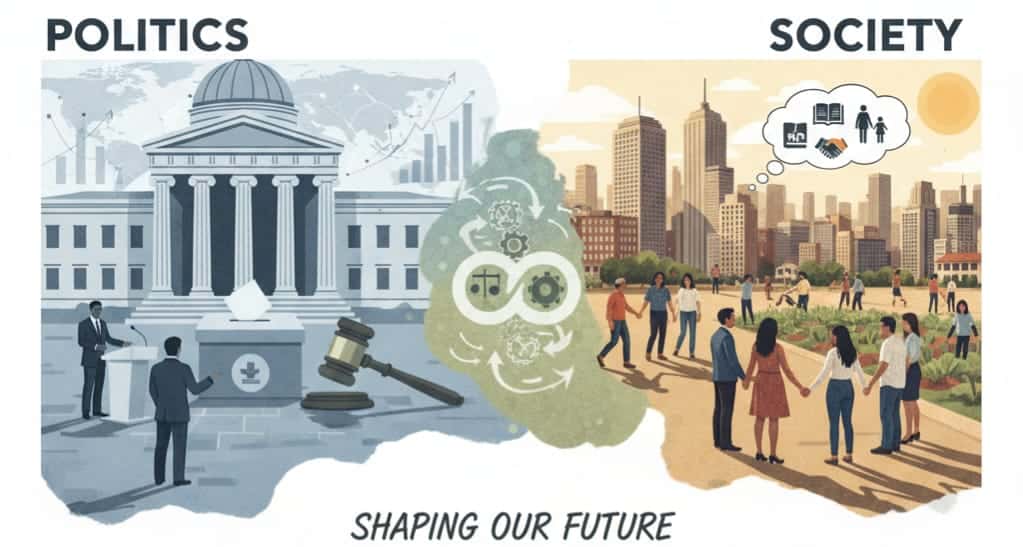
Politics is the process through which individuals and groups make decisions, exercise power, and influence others within a society. It involves the creation, implementation and enforcement of rules, laws, and policies that organize social life and manage conflicts. At its core, politics reflects the constant negotiation between competing interests and values in society. It plays a crucial role in shaping the structure of society and impacts the lives of individuals at every level.
On other hand, Society is a complex web of social relationships, institutions, and interactions that connect individuals and groups living together in a shared geographic area. It is more than just a collection of people; it is a structured system where individuals cooperate, communicate and follow certain norms, values and rules that guide their behaviour. Society provides the framework within which people fulfill their needs, form relationships, and develop a sense of identity and belongingness. It includes various institutions like; family, education, religion, economy, and politics, which help in organizing social life and maintaining order.
In sociology, the concept of politics goes far beyond the conventional understanding of elections, governments, political parties and state institutions. While these are important components, sociology views politics more broadly as a system of power relations that influence all aspects of social life. Politics, in sociological terms, involves the processes through which power is acquired, exercised, negotiated and contested within society. It is not confined to formal political arenas like parliaments or electoral campaigns; rather, it exists wherever decisions are made, resources are distributed and influence is exerted whether in a nation-state, a community, an organization or even within a family.
Sociologists emphasize that politics is deeply embedded in everyday social interactions. For example, decisions about who leads a local community organization, how school rules are enforced or who controls household finances all involve subtle or overt political dynamics. These interactions often reflect underlying power structures shaped by social class, caste, gender, ethnicity, religion and education. From this perspective, politics is understood as a fundamental aspect of social organization as it governs not just public life but also private and interpersonal relationships. This understanding broadens the scope of political analysis, revealing how power operates at both the macro and micro levels of society.
Interplay Between Society and Politics
The relationship between society and politics is deeply interconnected and mutually influential. Politics is a vital part of society because it governs the distribution of power, resources, and decision-making processes that affect the lives of individuals and groups. At the same time, society (with its cultural values, social structures, institutions, and relationships) shapes the nature of political systems and the behaviour of political actors. For example, the way people vote, form political opinions or participate in movements is influenced by their social background, including factors like; caste, class, religion, gender and education. Social norms and values often determine what is considered acceptable political behaviour, while political decisions can reinforce or challenge those very norms.
Moreover, political institutions such as the government, legal system, and political parties are themselves products of the society in which they exist. They reflect the historical, economic, and cultural context of that society. Changes in society, such as; social movements, technological advancements or shifts in public opinion can lead to changes in political systems and policies. Conversely, political decisions can bring about major transformations in society, such as the introduction of social welfare programs, education reforms or legal rights for marginalized groups. In this way, politics and society are in constant interaction politics shapes society and society shapes politics. Understanding this relationship is essential for analyzing how power operates and how social change occurs.
The relationship between society and politics in India is deeply intertwined and shaped by the historical, cultural and social diversity of the country. Indian society is characterized by a complex structure based on caste, religion, language, region and class, and these social divisions significantly influence political behaviour and institutions. Politics in India is not merely about governance or elections, it reflects the aspirations, conflicts and identities of various social groups. Political parties often mobilize support on the basis of caste and community identities, and electoral outcomes are frequently shaped by these social affiliations. This has led to the rise of identity-based politics, where marginalized communities like; Dalits, Adivasis and Other Backward Classes (OBCs) have used the political space to assert their rights and demand social justice.
In conclusion, the relationship between society and politics in India is dynamic and reciprocal. While social structures shape political behaviour and party strategies, politics also influences social change by challenging or reinforcing existing norms and power relations. Understanding this relationship is crucial to analyzing the functioning of Indian democracy and the ongoing struggles for equality, representation and justice.
Concepts of Power and Authority
A core concept in understanding politics and society is the idea of power, which is defined as the ability of individuals or groups to influence or control the behaviour of others, even against resistance. Or in simple words, Power is one’s will to impose his will even against the will of others. Power is not confined to formal political institutions like governments or armies; it exists in everyday social relationships, such as between parents and children, teachers and students or employers and employees. This ability to shape outcomes may take various forms like coercion through force or threats, economic control through resources or ideological influence through shaping beliefs and values. Importantly, power can be both visible, such as laws enforced by police and invisible, such as functioning subtly through social norms and cultural expectations. The dynamics of power are complex because those subjected to it often resist or challenge it, making power a key element in social conflicts, inequalities and transformations.
Closely linked to power is the concept of authority, which is a specific type of power that is recognized as legitimate by those who are governed. Authority differs from raw power in that it rests on social acceptance and consent, making it more stable and effective. The renowned sociologist Max Weber classified authority into three ideal types; traditional, charismatic, and legal-rational.
Understanding the difference between power and authority is important. While power represents the capacity to enforce one’s will, authority embodies power that is justified and accepted by society. Power without legitimacy can provoke resistance and instability, whereas authority maintains social order by grounding power in accepted norms and laws. This relationship between power and authority shapes political systems, social institutions and everyday interactions.
Overall, power and authority are fundamental to the organization and governance of societies. They influence who controls resources, how decisions are made and the ways social order is maintained or challenged. Sociologists study these dynamics to analyze social inequalities, the potential for abuse or corruption and the processes through which people accept or resist domination. The balance of power and the legitimacy of authority are central to understanding political behaviour, social control and the possibilities for social change within any society.
Key Dimensions of Politics and Society in India
In India politics and society are deeply interconnected, shaped by its vast diversity and complex social structures. The interplay of caste, religion, language and class profoundly influences political behaviour and power dynamics. Being the largest democracy of the world, the political landscape of India reflects though regional identities, social inequalities and evolving democratic participation. Understanding following key dimensions is essential to grasp how social forces shape political processes and governance in India, highlighting the country’s unique challenges and opportunities in sustaining its democratic fabric:
1. Caste and Political Mobilization: The caste system remains a fundamental social institution influencing political affiliations and power structures in India. Caste identities often determine voting patterns and political leadership. Political parties frequently mobilize support based on caste groups, especially among the SC/ST, OBCs, and upper castes. The politics of affirmative action has empowered marginalized castes, leading to the rise of caste-based political parties.
2. Religion and Communal Politics: Religion is another significant factor shaping Indian politics. The diverse religious landscape sometimes leads to communal tensions, where religion becomes a basis for political competition and conflict. Political parties may use religious identities to consolidate vote banks, resulting in communalism. However, the Indian Constitution’s secular framework advocates to maintain religious neutrality, making secularism a critical and contested political value.
3. Linguistic and Regional Identities: India’s multilingual population often translates into regional political movements and demands for state autonomy or reorganization. Linguistic pride fuels the rise of regional political parties like; the Dravida Munnetra Kazhagam (DMK) in Tamil Nadu or the Telugu Desam Party (TDP) in Andhra Pradesh. Such regionalism impacts national politics and federal relations, highlighting the tension between local identities and centralized governance.
4. Democracy and Electoral Politics: India has a vibrant electoral process involving multiple parties and active citizen participation. However, democratic politics is shaped by social inequalities such as; caste, class, gender and literacy. Electoral strategies, voter behaviour and campaign dynamics often reflect these social realities. Despite challenges like vote-buying and political corruption, elections remain a crucial mechanism for social representation.
5. Social Class and Economic Inequality: Economic stratification intersects with caste and community, influencing political power and policy priorities. The urban-rural divide, wealth disparities and poverty levels affect political access and influence. Class-based social movements advocating for labour rights, land reforms and social welfare highlight the role of economic inequalities in shaping political demands and party platforms.
6. Gender and Political Participation: The participation of women in politics in India has increased, but gender disparities persist. Traditional patriarchal norms often restrict access of women to political leadership. Constitutional amendments reserving seats for women in local bodies have enhanced grassroots involvement, but women’s representation in higher political offices remains limited. Issues of gender justice and empowerment continue to be central in Indian politics.
7. Tribal and Indigenous Politics: Tribal communities have unique political and social identities. Their demands for autonomy, protection of land rights and cultural preservation have led to the formation of tribal political movements and parties. Tribal politics also involves struggles against displacement due to industrialization, mining and development projects, raising questions about social justice and political inclusion.
8. Youth and Political Change: Large youth population of India is increasingly shaping the political discourse. Youth engagement through social media, protests and movements like the anti-corruption campaign or climate activism reflect new modes of political participation. Young voters influence election outcomes and push for accountability, transparency and reforms in governance.
9. Role of Political Parties and Coalition Politics: The multi-party system in India includes national parties and numerous regional parties, reflecting social and regional diversity. Coalition governments have become common, especially since the 1990s, requiring alliances among parties representing different social groups and regions. This coalition politics has influenced policy-making and power-sharing arrangements.
10. Globalization and Changing Political Economy: Economic liberalization and globalization since the 1990s have transformed India’s political landscape. New economic policies impact social classes differently, leading to shifts in political priorities and alliances. Issues like privatization, labour reforms and rural distress have become politically significant. Additionally, India’s role in global geopolitics shapes domestic political narratives and policies.
On the basis of above description, it can be stated that the complex relationship between politics and society in India is shaped by its rich diversity and complex social structures. Caste, religion, language, class and gender deeply influence political behaviour, representation and power dynamics. India’s democratic framework accommodates these varied identities, though challenges like communalism, inequality and regionalism persist. Political participation is evolving with greater involvement of marginalized groups and youth, while globalization reshapes the political economy. Understanding these dimensions is crucial to grasp how social forces shape India’s politics, revealing both the strengths and challenges of its democratic and pluralistic society.
Role of Politics in Society
Politics plays a vital role in shaping Indian society, influencing its social, economic and cultural dimensions. In a diverse and complex country like India, politics acts as a platform for managing differences related to caste, religion, language and region, while promoting democracy and social justice. It helps maintain order, resolve conflicts and distribute resources to uplift marginalized communities. Politics also promote national integration and drives economic development. Following are the roles of politics in India:
1. Maintenance of Social Order and Stability: Politics in India plays a crucial role in maintaining social order and stability within a highly diverse population. Given the country’s vast differences in religion, language, caste and culture, the political system establishes laws and policies that help manage conflicts and prevent chaos. Through the enforcement of legal frameworks and the functioning of police and judiciary, politics ensures that social interactions occur within acceptable norms, helping society function peacefully.
2. Representation of Diverse Interests: Indian politics is characterized by its pluralism, reflecting the country’s vast cultural and social diversity. Political parties, ranging from national to regional levels, provide platforms for different communities and groups, such as various castes, ethnicities, religions and linguistic groups to voice their concerns and seek representation. This multiplicity allows marginalized and minority groups to participate actively in governance and ensures that their interests are taken into account in policymaking.
3. Promotion of Democracy and Participation: India, the world’s largest democracy, thrives on political participation at the grassroots level. Politics enables millions of people from different backgrounds to engage in the democratic process through voting and contesting elections. Political mobilization and electoral competition encourage citizens to stay informed and involved, strengthening democratic values like accountability, transparency and representation.
4. Social Integration in a Plural Society: One of the significant roles of politics in India is to promote social integration despite its immense diversity. The political framework, including the federal structure and constitutional safeguards, facilitates the accommodation of different languages, religions and cultural identities. Politics mediates between conflicting interests and promotes a shared sense of Indian nationalism, promoting unity without erasing diversity.
5. Redistribution of Resources and Welfare: Politics in India is instrumental in shaping policies related to economic redistribution and social welfare. The government designs and implements programs aimed at reducing poverty, improving health and education and uplifting disadvantaged communities. Political decisions about resource allocation such as subsidies, employment schemes and rural development initiatives directly impact the quality of life of millions and aim to promote social equity.
6. Conflict Resolution and Mediation: Given India’s complex social fabric, conflicts based on caste, religion and regional identity frequently arise. Politics serves as a vital tool for conflict resolution by providing mechanisms for dialogue, negotiation and legal redress. Political leaders and institutions work to mediate disputes and broker compromises to maintain harmony and prevent violence.
7. Promotion of Social Justice: Politics in India has been a powerful instrument in advancing social justice, especially for historically marginalized groups. Through constitutional provisions and affirmative action policies like reservations in education and employment, politics actively seeks to correct historical injustices against scheduled caste, scheduled tribes and other backward classes. Political activism and legislation continuously push for a more equitable society.
8. Empowerment of Marginalized Groups: The Indian political system has facilitated the empowerment of marginalized groups by enabling their participation in governance and policymaking. Reservation of seats in Parliament and state legislatures for Scheduled Castes and Tribes, as well as growing representation of women in politics, has provided these groups with platforms to voice their concerns and influence decisions affecting their communities.
9. Driving Economic Development: Politics significantly influences India’s economic trajectory. Political leaders and parties formulate and implement policies related to industrial growth, trade, infrastructure development and foreign investment. Political stability and effective governance are essential to create an environment conducive to economic development, which in turn improves living standards and addresses social challenges.
10. Shaping National Identity and Patriotism: Politics in India plays a fundamental role in promoting a collective national identity and patriotism among its citizens. Through symbols like; the national flag, anthem and public holidays, as well as through education and cultural policies, politics helps build a sense of belonging and pride. At the same time, political discourse often emphasizes India’s pluralistic ethos, balancing unity with respect for diverse identities.
In the Indian context, politics is deeply intertwined with society, playing a vital role in shaping the nation’s social fabric. It maintains order, ensures representation of diverse groups and promote democratic participation. Politics promotes social integration, drives welfare programs and mediates conflicts, contributing to social justice and empowerment of marginalized communities. Additionally, it influences economic development and nurtures a shared national identity while respecting India’s pluralism. Understanding the role of politics in India highlights how political processes are essential not only for governance but also for promoting unity, equity and progress in one of the world’s most diverse societies.
Role of Society in Politics
In India, society plays a vital role in shaping the political landscape, deeply influencing how power is distributed and exercised. The country’s complex social fabric interacts continuously with politics, affecting voting behaviour, party formation and policy priorities. Social identities such as caste and religion often serve as bases for political mobilization, while movements driven by marginalized groups push for social justice and reform. Additionally, factors like; youth engagement, media influence and the rural-urban divide further shape political participation and discourse. Through following points, the role of society in Indian politics can be understood:
1. Caste System Influences Voting Patterns: The caste system remains deeply entrenched in Indian society and plays a crucial role in shaping political behaviour. Political parties often mobilize support by appealing to caste identities, forming caste-based vote banks. For instance, certain parties represent the interests of SC/ST, OBCs or upper castes, influencing candidate selection and election strategies. This social stratification impacts not only who votes for whom but also how policies are designed to address caste-specific issues like social justice and affirmative action.
2. Religious Communities Shape Political Discourses: Religion is a major factor in Indian politics, where different religious communities form significant political constituencies. Political parties often cater to the religious sentiments of these groups to secure votes, sometimes leading to communal polarization. Religious festivals, leaders and institutions can influence political mobilization, while religious identity frequently intertwines with political allegiance. This dynamic makes religion both a unifying and divisive force in Indian electoral politics.
3. Language and Regional Identities Impact Political Dynamics: The vast linguistic diversity of India gives rise to strong regional identities that shape political landscapes. Regional parties often emerge to protect and promote local languages and cultures, challenging the dominance of national parties. States like; Tamil Nadu, West Bengal and Punjab have powerful regional parties whose influence extends beyond their borders. Language politics impacts policy decisions, federal relations and even national unity debates, making it a significant factor in Indian democracy.
4. Social Movements Drive Political Change: Throughout Indian history, social movements have played a critical role in transforming political agendas and policies. Movements advocating for Dalit rights, women’s empowerment, environmental conservation and tribal welfare have pushed governments to enact reforms and legislate protective measures. These movements give marginalized sections of society a political voice and help democratize the political system by challenging established power structures and demanding greater inclusivity.
5. Youth as a Political Force: India has one of the world’s largest populations of young people and their political engagement is increasingly shaping election outcomes and policy priorities. Youth voters bring fresh aspirations and demand issues such as quality education, employment opportunities, digital access and political transparency. Political parties actively seek to engage this demographic through social media campaigns, youth wings and promises of reform, recognizing their potential to be game-changers in Indian politics.
6. Role of Family and Kinship Networks: Family ties and kinship networks often influence political recruitment and leadership in India. Political dynasties are common, with many prominent politicians coming from established political families. These networks provide access to resources, organizational support and voter loyalty. While this sometimes perpetuates nepotism, it also reflects the social fabric where trust and loyalty within families and communities translate into political capital.
7. Media and Civil Society Influence Political Awareness: The expansion of media, especially television, newspapers and social media platforms, has dramatically increased political awareness among Indians. Civil society organizations and NGOs also play a crucial role in educating citizens, monitoring government performance and advocating for transparency and accountability. This vibrant media environment encourages greater citizen participation, helps expose corruption and facilitates public debate on political issues.
8. Economic Class and Political Participation: Economic disparities significantly affect political participation in India. While the wealthy often have easier access to political power and decision-making, marginalized economic groups use politics as a means to fight for their rights and upliftment. Policies like; subsidies, reservations and welfare schemes are crucial for poorer sections and influence their political choices. Economic inequalities thus shape both the nature of political competition and the demands placed on political leaders.
9. Gender and Politics: The role of women in Indian politics has gradually increased due to policy measures such as reservations in local governance (Panchayati Raj institutions) and growing feminist activism. Issues related to women like; education, health, safety and economic empowerment have gained prominence on political agendas. Despite challenges like patriarchy and underrepresentation, women are becoming more active as voters, candidates and leaders, reshaping political discourse and priorities.
10. Rural-Urban Divide in Political Priorities: Indian rural and urban populations often have differing political needs and expectations, reflecting their distinct socio-economic realities. Rural voters typically prioritize issues like agricultural subsidies, irrigation, rural employment and infrastructure, while urban voters focus more on education, jobs, healthcare and urban amenities. Political parties craft region-specific manifestos to address these varied concerns, making the rural-urban divide a central feature of Indian electoral politics.
In the Indian context, society plays a pivotal role in shaping politics through its diverse social structures, identities and movements. Caste, religion, language and economic class deeply influence political behaviour and party strategies, while social movements and youth participation drive political change and democratization. Family networks and media further shape political awareness and leadership. Gender dynamics and the rural-urban divide add complexity to political priorities. Together, these societal factors create a vibrant but complex political landscape, highlighting the inseparable link between society and politics in India. Understanding this relationship is essential for appreciating India’s democratic processes and challenges.
Contemporary Issues in Politics and Society in India
The interplay of politics and society in India reflects both the promises and contradictions of democracy in a deeply diverse and hierarchical society. The issues faced today are shaped by a long history of colonialism, social stratification, democratic aspirations and global influences. Following are the major contemporary issues in politics and society in India:
1. Communalism and Religious Polarization: Communalism remains one of the most pressing issues in contemporary Indian politics. It refers to the politicization of religious identities that often results in social division and conflict. Though India is constitutionally a secular nation, religious polarization has grown in recent years, with political parties at times mobilizing support along communal lines. Events such as the 2002 Gujarat riots and the 2020 Delhi violence highlight how religious identities can be manipulated for political gain, resulting in widespread mistrust and violence. Sociologically, this kind of polarization damages the fabric of social harmony and weakens the foundational values of pluralism and secularism that are essential to a diverse society like India.
2. Caste-Based Politics and Social Justice: Caste continues to play a central role in Indian politics. Political parties often form alliances and craft strategies based on caste arithmetic to secure votes. The implementation of reservation policies in education, employment, and politics has helped in uplifting historically marginalized communities. However, this has also led to competitive caste-based mobilizations, with dominant castes such as; Marathas, Patidars and Jats demanding reservation benefits. The demand for a caste census has further intensified the debate on representation and equity. While caste politics has enabled the emergence of Dalit and backward class leadership, it also risks reinforcing caste identities and limiting the discourse on broader social justice and economic equality.
3. Gender and Political Representation: Gender inequality remains a major barrier in the political landscape of India. Although women have achieved notable positions in Indian politics their representation remains disproportionate. The 73rd and 74th Constitutional Amendments, which reserve one-third of seats for women in Panchayati Raj Institutions, have helped enhance women’s political participation at the grassroots level. However, in many cases, women leaders serve as figureheads while male relatives exercise real power, a phenomenon often referred to as “sarpanch-pati.” Moreover, issues like gender-based violence, discrimination and lack of access to education and resources continue to obstruct women’s full political participation.
4. Youth, Social Media and Political Activism: Large youth population of India is becoming increasingly politically conscious, aided by the rapid rise of digital platforms. Social media has transformed the way political information is disseminated and consumed, enabling youth to engage in political discussions, activism and protests. Movements like the anti-CAA protests, student agitations and farmer solidarity campaigns were significantly driven by youth mobilization, both online and offline. At the same time, social media has also become a breeding ground for misinformation, political propaganda and digital surveillance.
5. Regionalism and Federal Tensions: India’s federal structure, which allows for decentralized governance, is increasingly under strain due to rising tensions between the central and state governments. Regional parties and leaders often assert their autonomy and resist perceived overreach by the central government. Language-based identity, cultural pride and economic demands have led to regional movements such as the demand for Gorkhaland, opposition to NEET in Tamil Nadu or linguistic assertion in Karnataka. Additionally, fiscal issues like the distribution of GST revenue and central schemes impinging upon state autonomy have further complicated centre-state relations. Regionalism, though essential for recognizing diversity, when politicized excessively, can challenge the unity and cooperative federalism envisioned in the Indian Constitution.
6. Populism and Electoral Democracy: Populism has become a dominant feature of Indian politics. Political leaders often present themselves as messiahs of the common people, bypassing institutions and offering direct solutions to complex problems through welfare schemes, subsidies or symbolic gestures. While such measures may bring temporary relief, they often ignore structural reforms and institutional accountability. Electoral politics is increasingly centered around personalities rather than ideologies or policies. The rise of charismatic leaders has sometimes led to personality cults, diminishing the role of democratic institutions like Parliament, judiciary and independent media.
7. Media, Democracy and Free Speech: The role of media in a democracy is to inform, educate and hold those in power accountable. However, in recent years, concerns have emerged about the erosion of media independence in India. Several mainstream news outlets have been criticized for biased reporting, sensationalism and acting as extensions of political propaganda. Simultaneously, journalists, activists and dissenting voices have faced legal harassment, threats and even physical violence. The use of sedition laws, surveillance and internet shutdowns to curb free expression poses serious threats to democratic values.
8. Economic Inequality and Political Marginalization: Despite economic growth, India continues to face stark inequalities in income, wealth and opportunity. The neoliberal turn in policy-making since the 1990s has prioritized privatization and market efficiency, often at the cost of public welfare and employment generation. Marginalized communities remain politically underrepresented and economically disadvantaged. As economic disparity grows, access to political influence becomes increasingly skewed in favour of the affluent. This translates into what is called “political exclusion,” where entire social groups find themselves without meaningful voice or power in decision-making processes that affect their lives.
9. Environmental Politics and Development: India’s development agenda has long been contested on environmental grounds. The pursuit of infrastructure and industrial growth often leads to displacement of tribal and rural communities, deforestation and ecological degradation. The debate between economic development and environmental sustainability has taken center stage in recent years. Grassroots movements like; the Narmada Bachao Andolan and Save Aarey have highlighted the voices of those impacted by developmental projects. Climate change, pollution and resource exploitation also pose new political and social challenges, particularly for vulnerable populations. The politics of development must now be reimagined to include ecological justice, sustainable practices and equitable resource distribution.
10. Corruption and Political Accountability: Corruption continues to be a systemic issue in Indian politics, affecting both governance and public trust. Despite anti-corruption laws and watchdog agencies, political funding remains opaque and criminalization of politics is a persistent problem. The use of electoral bonds has raised concerns about the lack of transparency in political donations. Moreover, political leaders with serious criminal charges continue to contest and win elections. From a sociological perspective, corruption is not merely an individual moral failure but a reflection of deeper structural issues such as weak institutions, lack of civic engagement and normalization of unethical practices within political culture. This undermines faith in democracy and public institutions.
On the basis of above description, it can be stated that above mentioned contemporary issues reveal the layered and interconnected challenges facing Indian democracy today. They reflect the complex interaction between historical social hierarchies, evolving political structures and the aspirations of a diverse citizenry. Sociology plays a critical role in analyzing these phenomena, uncovering underlying patterns of power, inequality and resistance. Addressing these issues requires not only political reforms but also a deeper transformation in social values, civic participation and collective consciousness.
Readings and References:
Handbook of Politics: State and Society in Global Perspective edited by Kevin T. Leicht & J. Craig Jenkins. https://amzn.to/3W1X9Jd
Indian Politics and Society since Independence: Events, Processes and Ideology by Bidyut Chakrabarty. https://amzn.to/4niBGbe
Society and Politics in India: Understanding Political Sociology by Shefali Roy. https://amzn.to/3W4534U