- What is Progress
- Social Progress
- Auguste Comte on Social Progress
- Meaning of Social Progress
- Characteristics of Social Progress
- Indicators of Social Progress
- The Social Progress Index
- The Social Progress Index Methodology
- Criticism
Progress: An Introduction
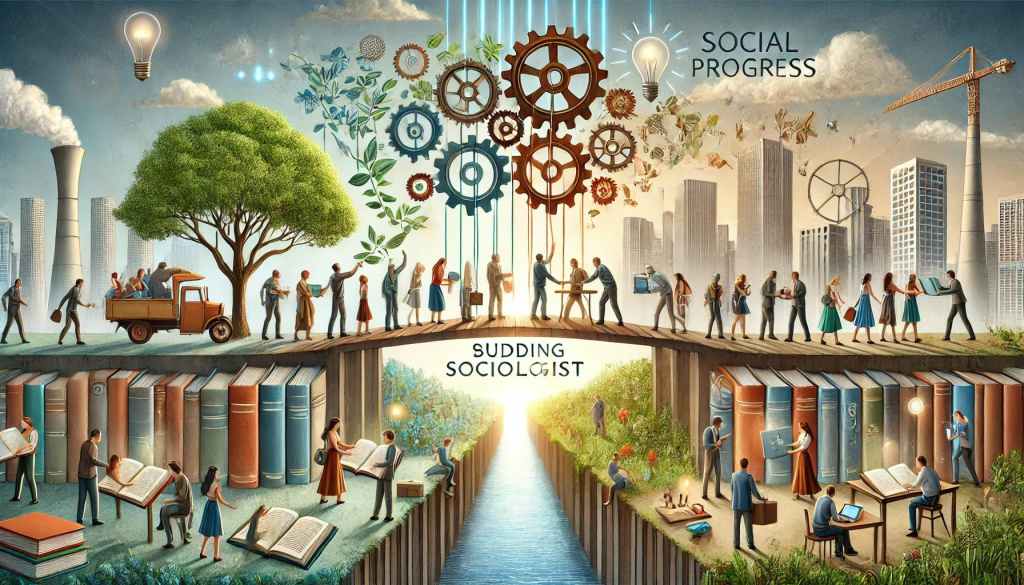
The concept of progress, originating from the Sanskrit term “pra-gat,” embodies the idea of moving forward towards a favourable destination. Progress encompasses various forms, such as intellectual growth, physical well-being, or journeying towards a particular destination. Historically, progress has been associated with ethical advancement, representing humanity’s continuous pursuit of moral ideals. However, moral standards vary across societies, influencing the pursuit of different indicators of progress.
Progress denotes the advancement towards a more refined, enhanced, or desirable state. Within a progressive framework, it signifies the belief that advancements in technology, science, and social structures contribute to improving the human condition. This improvement may occur through direct human intervention, such as social initiatives or activism, or as a natural outcome of socio-cultural evolution.
The notion of progress emerged within the social theories of the early 19th century, notably within the frameworks of social evolution articulated by thinkers like Auguste Comte and Herbert Spencer. This idea also found resonance in the philosophies of history during the Enlightenment era. Throughout history, social progress has been championed by diverse political ideologies, each offering distinct theories on the means to attain it.
Social Progress
The imperative for social progress has escalated, drawing the attention of leaders across government, business, and civil society. This call for advancement in quality of life has been resonating throughout history, gaining particular momentum post-Arab Spring and the rise of new political movements, even in the most affluent nations. In the aftermath of the 2008 financial crisis, there’s been an increasing expectation for both businesses and governments to actively contribute to societal enhancement and environmental protection, marking the emergence of a social progress imperative.
Contrary to popular assumption, economic development doesn’t inherently translate to social progress. While heightened income often correlates with improvements in access to essentials like clean water, sanitation, literacy, and education, personal security doesn’t consistently improve in middle-income countries, and conditions often deteriorate in low-income nations. Additionally, irrespective of income, many individuals face systemic discrimination or violence based on factors like gender, religion, ethnicity, or sexual orientation. It’s evident that conventional metrics such as GDP per capita inadequately capture the holistic progress of societies. True social progress hinges on a society’s ability to fulfil fundamental human needs, enhance citizens’ quality of life, and foster opportunities for all to thrive.
The idea of progress was prominently articulated by French philosophers like Turgot, Condorcet, and Francis Bacon during the 18th century. Sociologists such as Saint-Simon, Auguste Comte, and Herbert Spencer were among the pioneers in advocating for social progress. Comte believed that progress could be ushered in by the intellectual elite.
Auguste Comte on Social Progress
The notion of social progress emerged during the early 19th century within various social theories, particularly in the context of social evolution articulated by Auguste Comte and Herbert Spencer. This idea also found roots in the Enlightenment philosophies of history. Social progress, as a concept, has been endorsed across different political ideologies, each proposing distinct pathways to its realization.
Auguste Comte prioritized social progress over social order, viewing it as a fundamental aspect of society. He perceived progress as having a clear objective and trajectory, aiming for the attainment of a scientific and positive stage in human thought. Comte emphasized the study of the laws governing the succession of social phenomena, suggesting that societal change adheres to these laws. He proposed Social Dynamics as a scientific endeavour aimed at uncovering these laws and principles of social change and progress, as well as identifying the requisite conditions for sustaining ongoing social advancement. According to August Comte there are three types of social progress:
1. Physical Progress: Comte described physical progress as advancements in external living conditions such as housing, agricultural practices, and industrial production. This form of progress lays the foundation for social advancement and is considered the most fundamental aspect of human progress. Without physical progress, other forms of progress become unattainable. It serves as the initial step in the journey toward social progress.
2. Intellectual Progress: Intellectual advancement encompasses the dynamics of both social cohesion and social disintegration, which are the driving forces behind societal upheaval and chaos. Comte proposed that by cultivating an understanding of the significance of social cohesion, our innate selfish inclinations can transform into altruistic impulses. This shift towards altruism could then catalyze significant strides in societal development.
3. Moral Progress: In his work “Positive Polity,” Comte placed significant emphasis on the advancement of morality, considering it to hold greater value than intellectual pursuits. He elevated morality above intellect, naming it the highest goal of human development and labelling it the “Religion of Humanity.” He firmly asserted that progress entails the cultivation of order.
Distinguishing between social statics and dynamics, Comte stressed that Social Statics involves studying the cohesion within society, focusing on its essential structures. Social Dynamics, on the other hand, pertains to describing the successive stages of societal development. It traces the necessary stages of human mental and societal evolution, indicating that progress is achieved through the foundational order inherent in every society, despite the ups and downs encountered along the way.
In contemporary times, progress is measured using specific indicators such as economic metrics, technological advancements, changes in political or legal systems, and factors affecting individual well-being like life expectancy and health risks. Recognizing this, the International Organization Imperative Social Progress has devised the Social Progress Index, comprising fifty-two indicators across three dimensions: Basic Human Needs, Foundations of Wellbeing, and Opportunities. This index aims to assess the relative performance of nations worldwide.
Meaning of Social Progress
Social progress encompasses a society’s ability to fulfil the basic needs of its members, lay the groundwork for individuals and communities to improve and sustain their quality of life, and cultivate an environment where everyone can achieve their full potential.
The term “progress” originates from the concept of moving forward, but it’s essential to consider that progress and regress are relative to the direction of change. Progress isn’t just any change; it’s a change in a specific direction. For instance, if educational standards decline in a country, leading to a morally compromised youth, it represents change but not progress. Progress entails advancing towards a desired goal. Various thinkers have offered differing interpretations of progress.
From this perspective, progress signifies a movement towards an ideally desirable change or objective. As progress implies improvement, it inherently involves subjective value judgments. Just like tastes, values lack a universal measuring tool. What may appear progressive to one individual may not to another due to differing values. In summary, social progress involves a deliberate directional shift within society.
Characteristics of Progress
Progress represents improvement and is not solely about moving in a particular direction but is driven by a specific end goal. The nature of progress is determined by two main factors: the nature of the goal itself and the distance to be covered to reach that goal. Below are the defining features of progress:
1. Progress is Dependent upon Social Values: Progress hinges on and is shaped by societal norms. This implies that the notion of progress is not fixed across all contexts, as values evolve over time and vary from one place to another. No single entity can be universally regarded as valuable regardless of the circumstances. Consequently, Maclver and Page suggest that progress behaves like a chameleon, adapting to the prevailing environment’s hues, and contrasting sharply when we sense a discord.
2. There is a Change in Progress: Progress relies fundamentally on change, an intrinsic element of advancement. Progress embodies the desired evolution in a particular direction, inherently intertwined with the notion of change. The essence of any change lies in its aspiration for progress. Progress materializes when changes align in a specific trajectory. Hence, progress cannot exist without change.
3. Desired Goal: Progress isn’t just about alteration; it denotes a specific trajectory of change. Essentially, progress entails moving closer to an ideally favourable outcome or objective, typically associated with enhancing human well-being. It’s important to note that not all changes signify progress.
4. Progress is based on Community: Morally, advancement might pertain to individuals, but from a sociological standpoint, it hinges on the collective. Progress acknowledges the individual solely within the context of the broader society. True social progress encompasses only those transformations that benefit or improve the entire community or society.
5. Progress is Volitional: Advancement doesn’t stem from idleness; it arises from the aspirations and determination of individuals within society, driven by specific aims such as happiness. When these aspirations are actively pursued and achieved, it signifies progress. However, it’s crucial to note that not all endeavours lead to progress.
6. Progress is Dynamic, not Static: The notion of progress is subjective, fluctuating across different societies and eras. It’s not a fixed standard applicable universally. What’s deemed progressive today might be viewed as regressive tomorrow. For instance, while the free interaction between young men and women is seen as regressive in certain Indian contexts, it’s considered a sign of progress in Western cultures.
7. Different Criteria of Progress: As previously mentioned, the standards for measuring progress depend on the particular temporal and societal context. Progress is shaped by social values, which evolve over time and vary across different locations. Consequently, the criteria for progress differ from one place to another. Moreover, various scholars have proposed distinct criteria for evaluating progress. For instance, while some view health and longevity as indicators of progress, others prioritize factors such as economic stability and moral behavior.
8. No Uniform Measuring Rod: The concept of progress is highly subjective and laden with values, making it difficult to demonstrate definitively. Without mutual agreement on evaluations, proving progress to others becomes challenging. While we may perceive advancements, they might not universally signify progress as traditionally understood. Technological advancements, for instance, often lack the comprehensive improvement indicative of true progress, as they may address specific issues without resolving broader societal disparities.
Throughout history, the coexistence of extremes like poverty alongside technological advancements suggests a nuanced understanding of progress. The conventional notion of progress, once widely accepted, is now regarded as elusive. Contemporary approaches to measuring progress have emerged, such as the Social Progress Index established in 2014, offering a more comprehensive assessment of societal advancement. These tools provide measurable variables for evaluating developmental projects and assessing progress on a global scale.
Indicators of Social Progress
Defining the standards of progress in relation to their temporal setting proves challenging. Progress is intricately tied to social values, which evolve over time, influencing what is deemed progressive. The perception of whether a change constitutes progress hinges on prevailing social values, which are subject to temporal and spatial fluctuations. Thus, establishing a universally accepted criterion for progress is arduous. However, several criteria can be contemplated to gauge social progress:
1. Health and Longevity of Life: The average lifespan serves as a measure of societal advancement, indicating whether the world is progressing positively. However, merely extending life expectancy doesn’t guarantee an increase in overall happiness or quality of life.
2. Wealth: Wealth serves as a significant indicator of progress, acting as the economic foundation for upward mobility and fulfilling various human needs. However, the means through which wealth is attained hold paramount importance; it must align with socially accepted norms and values.
3. Population: A sufficient population is vital for the functioning of any social system. Population growth can indicate progress, but it must consist of capable and skilled individuals. A surplus of non-working and unskilled individuals does not signify advancement. Overpopulation, exceeding a society’s capacity to support, is not a marker of progress.
4. Moral Conduct: Ever since Auguste Comte, the pioneer of Sociology, emphasized the significance of morality, it has remained a cornerstone for social advancement. Moral behaviour shapes societies into environments where progress thrives.
Given the multifaceted nature of life, establishing a universally agreed upon objective standard of progress proves challenging. Nonetheless, it is argued that societal advancement can be gauged by considering various criteria. This holistic approach encompasses mental, physical, and spiritual dimensions, incorporating the aforementioned criteria. Moreover, a recent development involves the creation and utilization of an index to assess social progress, as elaborated in the following section.
The Social Progress Index
The Social Progress Imperative (SPI), a US-based non-profit organization, collaborates with experts like Professor Michael Porter from Harvard Business School and Professor Scott Stern from the Massachusetts Institute of Technology (MIT) to produce an index that evaluates the social and environmental progress of various nations. In India, the Institute of Competitiveness, headquartered in Washington DC with a branch in Phase-3 Gurugram, operates as part of the global network of the Institute for Strategy and Competitiveness at Harvard Business School. They develop Social Progress Indicators for the entire country, including district-level assessments, aiding policymakers and implementers.
Drawing inspiration from the works of Amartya Sen, Douglass North, and Joseph Stiglitz, the Social Progress Index comprehensively evaluates a country’s social and environmental performance, irrespective of its economic status. It not only allows for an absolute assessment of a country’s performance but also facilitates comparisons with other economies. This index equips governments and businesses with the necessary tools to monitor social and environmental performance meticulously, enabling informed public policy decisions and investment choices.
The Social Progress Index provides a means to evaluate how effectively a nation translates economic advancements into better social conditions. It offers a unique framework for evaluating and prioritizing actions that enhance both social and economic well-being. This index integrates three key dimensions:
- Basic Human Needs
- Foundations of Well-being
- Opportunity
Every dimension comprises four elements, each consisting of three to five distinct outcome indicators. These indicators are chosen for their suitability in measurement, utilizing a uniform methodology administered by the same entity across all surveyed nations. This framework endeavours to encompass a wide array of interconnected factors identified in academic research and practical expertise as fundamental to societal advancement.
The Social Progress Index Methodology
Based on the three dimensions outlined in The Social Progress Index, the following four fundamental design principles emerge:
1. Exclusively Social and Environmental Indicators: The primary goal is to assess social advancement without relying on economic metrics. By omitting economic indicators, we can thoroughly and systematically examine the connection between economic growth and social advancement. Previous attempts to surpass GDP have mixed social and economic measures, complicating the ability to discern causality.
2. Outcomes not Inputs: Another objective involves assessing the results relevant to actual individuals, rather than just the resources invested. For instance, instead of focusing solely on the amount of effort exerted or the healthcare expenditure, the aim is to gauge the health and wellness attained by a country’s populace.
3. Holistic and Relevant to all Countries: Considering the need to develop a comprehensive gauge of societal advancement that considers various dimensions of societal well-being, previous endeavours have primarily targeted the least developed nations, understandably so. However, understanding what defines a prosperous society for all nations, regardless of income level, is crucial for guiding the trajectory of societal development worldwide.
4. Actionable: The Social Progress Index seeks to serve as a valuable resource for government officials, business professionals, and members of civil society, aiding them in the implementation of policies and initiatives geared towards accelerating social progress. Its objective is to assess outcomes on a broad scale, concentrating on particular domains that can be readily translated into actionable strategies.
The foundational pillars of the index establish the conceptual framework and articulate the essence of social progress.
Working Definition of Social Progress
Social progress, as outlined by The Social Progress Index, pertains to a society’s ability to fulfil its citizens’ basic needs, establish foundational elements for individuals and communities to improve their quality of life, and foster conditions conducive to everyone realizing their full potential.
Built upon this definition, the index incorporates 12 components and 51 unique indicators. Beyond offering an overall country score and ranking, this framework enables detailed assessment of specific strengths and weaknesses. The transparent measurement system, grounded in a comprehensive framework, empowers agents of change to prioritize strategic actions addressing the most urgent societal concerns. This initiative is known as the social progress imperative, and its structure is presented as follows:
The framework comprises twelve components, each consisting of between three and five specific outcome indicators. These indicators are chosen for their consistent measurement methodology by the same organization across all countries in the sample. Additionally, the framework seeks to encompass a diverse array of interconnected factors, informed by thorough scholarly literature review and input from practitioners dedicated to advancing social progress.
The Social Progress Index-2018 outcomes, derived from data collected from 146 countries across all 12 components, have categorized these nations into six tiers, representing varying levels of social progress from highest to lowest.
| Tier | Total Countries | Ranking |
| I | 14 | 1-14 |
| II | 25 | 15-39 |
| III | 21 | 40-60 |
| IV | 25 | 61-85 |
| V | 50 | 86-135 |
| VI | 11 | 136-146 |
1. Tier-I: Tier 1 nations encompass those with elevated incomes, boasting closely aligned social progress scores. The gap between Norway, leading the pack, and Canada in the 14th position, is a mere 1.64 points. This elite group comprises 14 countries, ranging from the top-ranked to the 14th-ranked.
2. Tier 2: This category displays a broad spectrum of scores, spanning from Australia at 88.32 (ranked 15th) to Latvia at 79.25 (ranked 39th). Among the G-7 nations, the United States, France, and Italy fall into Tier 2 of the Social Progress Index, despite their wealth. While most Tier 2 countries boast high incomes, there’s a noteworthy outlier in Costa Rica, a middle-income nation which holds the highest score in Latin America. Tier 2 encompasses 25 countries, ranging from ranks 15 to 39.
3. Tier-3: Newly admitted EU nations Bulgaria (ranked 40th with a score of 76.27) and Romania (ranked 44th with a score of 74.51) stand prominently within Tier 3, alongside significant Latin American nations like Argentina, Brazil, Colombia, and Mexico. Notably, several resource-endowed countries, including Kazakhstan and the United Arab Emirates, also share Tier 3 status. Russia, securing the 60th position with a score of 70.16, falls in the middle of this tier. This tier comprises 21 countries, ranging from the 40th to the 60th rank.
4. Tier 4: Tier 4 within the Social Progress Index encompasses a diverse spectrum of scores, exhibiting significant variance among its member countries. For instance, South Africa, ranking 77th with a score of 66.00, stands 12.91 points ahead of Tajikistan, placed 106th with a score of 53.09. Notably, among the Tier 4 nations are three BRICS countries: South Africa, China, and India. While most Tier 4 countries tend to be middle or lower-income, there are exceptions, such as Saudi Arabia, a high-income country ranked 85th globally with a score of 64.75. This tier spans from the 61st to the 85th rank, encompassing 25 countries.
5. Tier 5: This category primarily consists of nations with lower-middle and lower-income status, with a significant portion located in South Asia and sub-Saharan Africa. Notably, Ethiopia transitioned into this tier from Tier 6 in 2018, marking its first inclusion. The tier encompasses 50 countries, ranging from rank 86 to rank 135.
6. Tier-6: In this tier, comprising eleven nations ranging from 136th to 146th in rank, several face significant challenges due to political instability. Countries like Yemen and Afghanistan are not only grappling with internal conflicts but also struggling to make strides in social development. While the majority belong to lower-income brackets, Angola, a middle-income nation, finds itself among them in the lowest tier of social progress. At the bottom of the 2018 Social Progress Index stands the Central African Republic, ranking 146th with a score of 26.01.
Criticism
Based on the description provided, it appears that the Social Progress Index (SPI) stands out as a distinctive initiative, enabling the evaluation of social progress across various metrics and the ranking of countries accordingly. Nonetheless, some have pointed out similarities between the SPI and previous attempts to supplement conventional economic metrics such as gross domestic product (GDP).
A significant critique is that the SPI encompasses indicators akin to those utilized in earlier econometric models, including the Gross National Well-being Index of 2005, Bhutan’s Gross National Happiness Index of 2012, and the World Happiness Report of 2012. However, unlike these models, the SPI neglects subjective measures of life satisfaction and psychological well-being.
Furthermore, criticism extends to the omission of certain dimensions such as population, the efficiency of the judicial system, and the quality of transportation infrastructure from the SPI. Some argue that the SPI’s focus on inclusive capitalism implies a bias towards measuring progress solely through a business lens.
Based on the preceding information, one can conclude that the Social Progress Index scores of countries, weighted by population, offer insight into global performance. Generally, the world performs best in areas such as Nutrition and Basic Medical Care, as well as Access to Basic Knowledge. However, it demonstrates the least advancement in the Opportunity dimension, particularly regarding Inclusiveness and Access to Advanced Education.