- Race: An Introduction
- Meaning of Race
- Characteristics of Race
- Classification of Races
- Ethnicity: An Introduction
- Meaning and Usages of Ethnicity
- Definitions of Ethnicity
- Characteristics Features of Ethnicity
- Ethnicity and Ethnic Identity
- Difference between Ethnicity and Race
Introduction
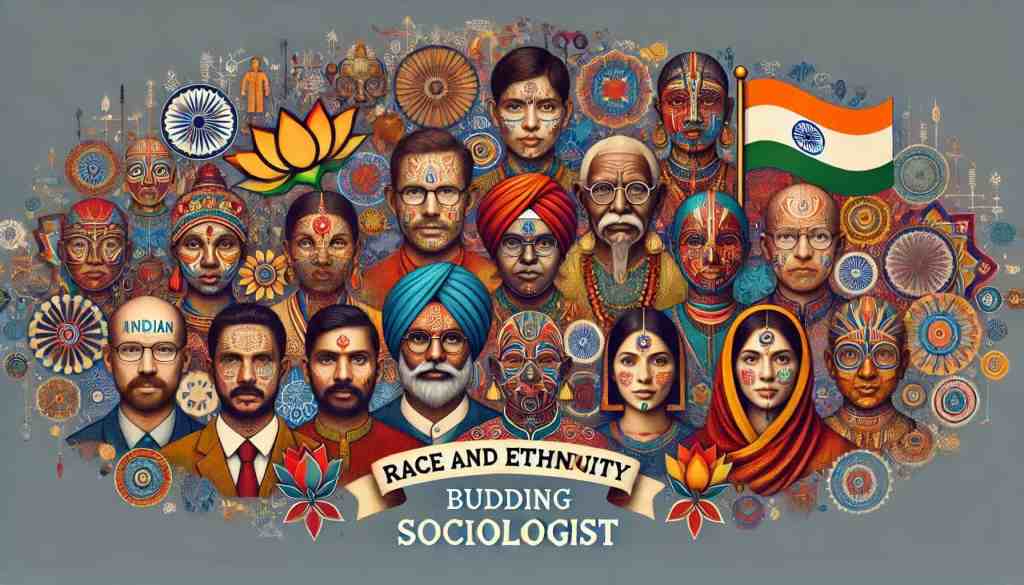
India is a diverse nation characterized by a rich tapestry of ethnicities. Many of its inhabitants trace their origins to migrations from neighbouring regions across the Himalayas. The Indian populace encompasses major racial groups found across the globe.
When discussing “race,” it’s essential to distinguish between genetically inherited physical traits and culturally acquired distinctions, known as “ethnicity.” While some define race as a group distinguished by specific physical attributes, it’s important to recognize that these distinctions aren’t solely biologically determined. Instead, race serves as a social construct used to categorize groups of people inhabiting a particular region over generations.
Racial classifications are products of social perception, where certain biological or imagined characteristics are attributed to a group, setting them apart from others. In society, race influences hierarchies, where factors like race, religion, or nationality determine social standing and associated privileges. Thus, race is defined socially, often based on presumed shared genetic ancestry leading to identifiable physical traits.
Anthropologists and biologists approach the concept of race from different angles. Anthropologists emphasize its cultural dimensions, seeing race as culturally defined groups, while biologists focus on its biological aspects. However, the reality of race encompasses both physical and cultural factors, illustrating the intricate nature of human diversity.
Biological perspective: Biologists argue that while there are social distinctions among racial groups, biologically there is no distinct “race gene” or genetic set defining race. The genetic variances between individuals and groups are so negligible that they hold no meaningful biological significance.
Social perspective: Conversely, social scientists highlight the significance of social interpretations attached to perceived physical differences such as skin colour, hair type, and height. These interpretations are influenced by political and economic forces, leading to the understanding that race is a social construct.
Many scholars, across various disciplines, agree that race is a socially constructed concept with profound implications in societal, legal, and economic spheres. There’s ongoing debate within academic circles about how to conceptualize race. Many advocate for abandoning racial classifications altogether, instead focusing on analyzing human variation in terms of populations.
In light of this perspective, some researchers have shifted their approach from studying human diversity through a racial lens to one focused on populations, rejecting the notion of race as a meaningful biological or social category.
Meaning of Race
The concept of race pertains to observable physical variances that a particular society deems significant. Originally, the term “race” encompassed any nation or ethnic group, as seen in Marco Polo’s use of “Persian race” in reference to the inhabitants of Iran during the 13th century. It denotes a broad group of individuals distinguished by shared heritage or physical traits like skin tone and hair texture.
However, anthropologists attribute the current understanding of “race,” along with associated notions, to the 16th and 17th centuries, coinciding with the Scientific Revolution. This period, marked by European imperialism and colonization, fostered speculative discourse on physical, social, and cultural disparities among human groups, which eventually formed the basis of racial categorization.
Between the 17th and 19th centuries, a fusion of folk beliefs and scientific reasoning regarding group distinctions led to the development of what social anthropologist Audrey Smedley termed an “ideology of race.” According to this ideology, races are perceived as innate, enduring, and distinct entities. In contemporary society, individuals are often categorized as “white” or “black” based on skin colour, contributing to modern understandings of race.
Broadly defined, race denotes “a grouping of humanity sharing specific physical traits,” typically associated with biological characteristics like skin colour or hair type. Despite lacking a genetic foundation, the social construct of race continues to influence human interactions and experiences.
Conclusion: Based on the preceding description, it can be argued that “race” is a socio-cultural concept. It represents a fluid and evolving racial classification system influenced by historical and environmental factors. Physical attributes associated with race are largely shaped by local environmental conditions, impacting human biology, and are socially endorsed. Moreover, race encompasses socio-political and economic dimensions. White societies historically utilized skin colour as a determinant for political and economic power, establishing a hierarchical structure predominantly based on skin colour. This framework operates on the assumption of inherent physical disparities, assigning varying societal value and status based on these differences within local social hierarchies.
Characteristics of Race
The concept of race has been utilized across various domains including culture, tradition, language, and nationality. Debates persist regarding the origins of racial diversity. One perspective posits that racial distinctions have always existed, while another suggests that diverse races evolved from a common ancestral lineage.
Scientifically, human racial classification relies on observable traits such as head shape, facial features, nose shape, eye shape and colour, skin colour, stature, and blood groups. These traits embody morphological, biological, and genetic dimensions. As more traits are considered, the complexity of racial analysis increases due to the growing number of combinations. From these observable characteristics, efforts are made to delineate the characteristics of different racial groups.
1. Skin Colour: Skin color is a highly conspicuous characteristic associated with race and contributes significantly to perceived differences among groups. Members of the Caucasoid race typically exhibit skin tones ranging from pale or reddish to olive brown. In contrast, Mongoloids display skin colors spanning from saffron to yellowish-brown, with certain individuals also showing reddish-brown hues. Negroids, on the other hand, commonly possess skin tones ranging from brown to brown-black or yellowish-brown. Notably, the stark contrast between black and white skin tones serves as a fundamental delineator, dividing the global population into two overarching categories and forming a crucial basis for social hierarchy.
2. Stature: Caucasian individuals typically exhibit a medium to tall stature, whereas Mongoloid populations tend to range from medium-tall to medium-short, and Negroid groups commonly display heights from tall to very short, representing one of the prominent physical distinctions
3. Head Form: Among individuals classified as Caucasoids, the typical head shape tends to range from long to broad, with varying heights from short to medium high, sometimes extending to very high. In contrast, among those classified as Mongoloids, heads predominantly exhibit a broad shape and medium height. Conversely, among Negroids, head shapes are predominantly long and low to medium high.
4. Face: Among Caucasoids, the nasal bridge typically ranges from narrow to medium breadth and tends to be high, lacking prognathism. Conversely, in Mongoloids, it spans from medium breadth to very broad, coupled with a medium to high nasal bridge. In Negroids, the face tends to be medium broad to narrow, leaning towards medium height, often exhibiting pronounced prognathism.
5. Hair: Within the Caucasoid population, hair ranges from light brown to dark brown, with a texture ranging from fine to medium and a natural form that varies between straight and wavy. Caucasoids typically have moderate to profuse body hair. In contrast, Mongoloids tend to have hair that is brown to brown-black in colour, with a coarse texture and predominantly straight form, along with sparse body hair. Among Negroids, hair color tends toward brown-black, with a coarse texture and a characteristic woolly or frizzly form, while body hair is generally sparse.
6. Eye: In Caucasoids, eye colours range from light blue to dark brown, with occasional lateral eye-folds. Mongoloids typically have brown to dark brown eyes and a very common medial epicanthic fold. Negroids commonly exhibit brown to brown-black eye colours and a prevalent vertical eye-fold.
7. Nose: Within the Caucasoid population, it’s common to observe a high nasal bridge, typically accompanied by a narrow to medium breadth. In contrast, Mongoloids typically exhibit a nasal bridge that ranges from low to medium, with a medium breadth. Negroids often display a low nasal bridge and a medium to very broad form.
8. Body Shape: Within the Caucasoid group, the physique ranges from linear to lateral and from slender to rugged. In contrast, Mongoloids typically exhibit a lateral orientation with varying degrees of linearity, while Negroids tend to possess a muscular, lateral body shape.
9. Blood Group: Within the Caucasoid population, the occurrence of A surpasses that of B, whereas among Mongoloids, B is more prevalent than A. Negroids, on the other hand, exhibit occurrences of both A and B.
Classification of Races
There exist three primary racial categories worldwide, encompassing a vast majority of nations and populations: Caucasoid, Negroid, and Mongoloid.
1. The Caucasoid: The concept of “Caucasian” as a racial classification emerged in the 1780s from the scholars of the Göttingen School of History. Christoph Meiners, a German philosopher, introduced the term in his 1785 publication, “The Outline of History of Mankind.” This term, derived from the Greek suffix “eidos,” which conveys a sense of form or resemblance, was initially used to denote a likeness to the people of the Caucasus region. The term “Caucasoid” stems from “Caucasian,” with its components “caucaus” and “ian.” This anthropological designation gained prominence through Johann Friedrich Blumenbach, who posited that humanity’s origins trace back to this region. “Caucasian” denotes individuals who reside in or are native to the Caucasus region, encompassing its people, languages, and cultures. Historically, it has been used to encompass populations from Europe, Western Asia, Central Asia, South Asia, North Africa, and the Horn of Africa.
2. The Negroid: Negroid originates from a blend of Latin and Ancient Greek roots. It directly signifies “resembling black” from negro (meaning black) and oeides (pertaining to appearance). The term “Negroid” was first documented in 1859. Presently, it is linked with populations generally displaying the typical physical traits associated with Negro heritage.
3. The Mongoloid: It represents a diverse assembly of individuals originating from East Asia, Central Asia, Southeast Asia, North Asia, Polynesia, and the Americas. Initially delineated in the 1780s by scholars affiliated with the Göttingen School of History, it constitutes one of the traditional tripartite racial classifications, alongside Caucasoid and Negroid groups. Members of these populations often exhibit shared phenotypic characteristics, encompassing various physical traits. In addition to these primary racial categories, certain anthropologists and scholars have proposed further classifications, which will be elaborated upon below:
Racial Classification of Herbert Risley
Sir Herbert Hope Risley, born on January 4, 1851, and passing away on September 30, 1911, was a prominent British ethnographer and colonial administrator, belonging to the Indian Civil Service (ICS). His work primarily focused on studying the various tribes and castes within the Bengal Presidency. One of his significant contributions was overseeing the application of the caste system to the entire Hindu population of British India during the 1901 census, which he supervised.
Risley’s approach incorporated elements of scientific racism, notably utilizing the ratio of the width of the nose to its height to classify Indians into distinct racial categories, including Aryan and Dravidian, as well as delineating seven castes. As per Herbert Risley’s classification, the Indian population can be categorized into seven distinct racial types:
1. The Turk-Iranian: Individuals of this demographic inhabit the Frontier Province and Baluchistan, regions now under Pakistani jurisdiction. The Turks-Iranian populace is characterized by their tall stature and fair skin, often accompanied by dark eyes and a slender nose.
2. Indo-Aryan: This particular ethnic group resides primarily in the Eastern regions of Punjab, Rajasthan, and Kashmir. Many individuals within this group exhibit elongated head shapes and notable nose structures. Generally, they possess above-average height, fair skin tone, and dark-coloured eyes.
3. Scytho-Dravidian: Scytho-Dravidian refers to a hybrid racial blend of Scythians and Dravidians. Individuals with this ancestral mix are reportedly located in regions such as Saurashtra, Coorg, and the mountainous areas of Madhya Pradesh. Accounts suggest that while those in higher social echelons exhibit predominantly Scythian traits, those in lower socio-economic tiers are notably influenced by Dravidian characteristics. Descriptions portray them as having broad heads, fine noses, medium stature, and fair skin tones.
4. Aryo-Dravidian: This ethnic group inhabits Uttar Pradesh, Rajasthan, and Bihar. They originate from the blending of Indo-Aryan and Dravidian ancestry through inter-marriages. Characterized by elongated heads, their skin tone ranges from light brown to black.
5. The Mongol-Dravidians: The predominant racial group in the populations of Bengal and Orissa is characterized by the prominence of Bengali Brahmins and Kayasthas. This racial identity has emerged through the blending of Mongolian and Dravidian ancestry, with some traces of the Indo-Aryan race. Typically, individuals of this group exhibit dark complexion, rounded heads, medium-sized noses, and average height.
6. The Mongoloid: This racial group spans from the regions of Nepal and Assam to Burma.
7. The Dravidian: This ethnic category is prevalent in Southern India, notably in regions such as South of Madhya Pradesh, Chotanagpur, Madras, and Hyderabad. The Santhals of Chota Nagpur epitomize this group. They typically possess a dark complexion, dark eyes, short stature, long head shape, and broad nose.
Many Indian anthropologists tend to disagree with Hebert Risley’s racial categorization of the Indian population.
Conclusion: Based on the description provided, it becomes evident that India boasts a diverse population comprised of significant racial groups from around the world. Over centuries, these racial identities have intermingled through intermarriages, resulting in a blended populace where purity of any particular race is elusive. Consequently, strict categorization of races within India proves challenging. In essence, India serves as a melting pot, where various races converge, earning it the title of a ‘museum of races’. Throughout history, India has served as a meeting ground for diverse races and civilizations, characterized by a continual process of integration and amalgamation.
Ethnicity: An Introduction
In sociology, ethnicity denotes a shared cultural background and way of life, encompassing language, religion, material culture (like clothing and cuisine), and cultural expressions such as music and art. It serves as a significant factor both in fostering social unity and in generating social tensions.
Across the globe, there exist myriad ethnic groups, ranging from vast communities like the Han Chinese to small indigenous tribes comprising only a handful of individuals. Despite their diversity, these groups typically share a common history, language, religion, and cultural heritage, which collectively form the basis of their shared identity.
Importantly, ethnicity isn’t determined by biological characteristics but rather by the cultural aspects embraced by a particular group. Moreover, it can emerge through acculturation, wherein members of a native group are compelled to adopt the customs and practices of a dominant host group. It’s crucial to distinguish ethnicity from nationality, which pertains to citizenship.
The emergence of nation-states in Europe during the 17th century resulted in the establishment of many countries characterized by ethnic homogeneity that persists to this day. For instance, Germany’s population is predominantly German, comprising 91.5 percent of the populace. Conversely, countries established through colonialism tend to be more ethnically diverse.
Meaning and Usages of Ethnicity
An ethnic group, or ethnicity, refers to a collective of individuals who bond over shared characteristics such as language, ancestry, history, culture, or social experiences within their community. This term finds its roots in the Greek word “ethnos,” which translates to “nation,” and is commonly associated with the concept of “folk,” meaning people. Thus, ethnicity denotes a community believed to share common lineage and possess a distinct cultural identity.
Ethnicity encompasses notions of shared heritage, cultural practices, and linguistic ties. Additionally, it may emphasize common ancestry and religious beliefs, distinguishing it from racial categorization. In essence, ethnicity revolves around:
- Shared ancestry
- Common language
- Shared customs and traditions
The concept emerged in the mid-19th century, denoting the idea of “a people” or “a nation.” The term “ethnicity” was coined in the 20th century, appearing in records from the 1950s. Depending on the context, “nationality” may be synonymous with either ethnicity or citizenship within a sovereign state. The contemporary understanding of “ethnic group” reflects the various interactions industrialized states have had with external groups like immigrants and indigenous peoples. It contrasts “ethnic” with “national,” referring to individuals with distinct cultural identities who have come under the authority of a state or “nation” with a different cultural mainstream through migration or conquest.
The term “ethnic group” was first used in 1935 and entered the Oxford English Dictionary in 1972. Initially, in the vernacular of Great Britain and the United States, “ethnic” commonly connoted “race.” In North America, “race” primarily referred to colour or to the descendants of immigrants from non-English-speaking countries. Max Weber, the German sociologist, was the first to introduce the term “ethnic group” into sociology.
In contemporary language, “ethnic” and “ethnicity” still evoke associations with exotic peoples, minority issues, and race relations. However, within the social sciences, the usage has broadened to encompass all human groups that both identify themselves and are identified by others as culturally distinctive.
Characteristic Features of Ethnicity
Following are the characteristic features of ethnicity:
1. Communal Character: Ethnic groups are inherently defined by shared emotions, shared experiences, and shared histories. Ferdinand Tönnies introduces the classic concepts of gemeinschaft and gesellschaft to elucidate the essence of communal identity. According to Tönnies, gemeinschaft relations are grounded in sentiment, bravery, and moral conscience, characterized by virtues like authenticity, benevolence, and loyalty. Conversely, gesellschaft relations are primarily driven by practical considerations, such as calculation, ambition, and materialistic pursuits.
2. Historical Past: Ancestral heritage plays a pivotal role in defining ethnicity, serving as a cornerstone for both understanding history and shaping contemporary identities. Families serve as the bridge between generations, linking the past with the present through the continuum of procreation. Despite the challenge of pinpointing precise origins, common ancestry is widely acknowledged as a driving force behind the shared characteristics and beliefs of present ethnic groups. Mythologies and belief systems further cement this connection, imbuing the past with vitality and seamlessly integrating it into the fabric of the present, thereby ensuring the continuity and coherence of the ethnic group.
3. Cultural Distinctiveness: Culture serves as a prevalent aspect that forms the foundation of ethnicity and its theoretical framework. At its essence, culture comprises subjective elements that render ethnicity culturally unique. The diversity in culture has given rise to numerous distinct societies worldwide. Defined as the complete way of life, culture encompasses beliefs, values, institutions, rituals, and overall lifestyle patterns. It serves as a distinguishing characteristic, fostering a sense of communal identity and purpose among people.
4. Aesthetic Cultural Patterns: Various ethnic groups find their identity rooted in distinct aesthetic cultural practices. These encompass a range of elements such as dance traditions, clothing styles, culinary customs, and perceptions of physical attractiveness. For instance, within African-American communities, communication patterns including language, gestures, and vocabulary serve as markers of mutual recognition and belonging. In India, diverse aesthetic cultural traditions thrive across different regions, each ethnic group cherishing its own heritage. Take for example the Rajasthani people, who revel in life’s moments through song and dance. Across southern Rajasthan, numerous tribal communities uphold their rich legacy of folk dances, with the Ghoomar being a notable ceremonial dance performed exclusively by women during significant events like weddings and festivals. Similarly, in hilly regions, various tribal communities diligently preserve their unique aesthetic identities.
5. Structural Components: The structural aspect of an ethnic group can be viewed as a unique sociological phenomenon initially, aiming to circumvent the immediate revelation of several intricate structural elements. However, it becomes evident that this structural complexity varies among ethnic groups, influenced by factors such as geographical location, historical background, and population size. Frequently, the members of a particular ethnic group do not inhabit a singular territory; instead, they are often dispersed across one or multiple countries. In rural areas, a sense of community tends to develop, characterized by distinctiveness, small scale, homogeneity, and self-sufficiency. Despite being inherently conservative, these communities typically exhibit a reluctance to intermarry outside their ethnic groups.
6. Associational Character: Gordon observes that among ethnic communities, a complex web of organizations and casual social ties emerges, facilitating members’ lifelong adherence to the group. This phenomenon is especially prevalent in nuclear families, where the depth of connection and inclusivity is notably pronounced. Religious, economic, regulatory, social, and recreational endeavors all reflect the ethnic identity. Decision-making within these groups is democratic, devoid of external influence from formal organizations or other groups.
7. We-ness and They-ness of an Ethnic Group: “We-ness” refers to the sense of belonging within an ethnic group, while “they-ness” pertains to how that group is perceived by the broader society. The distinction between these two levels lies in the perception of distinctiveness. Each group evaluates its own distinctiveness positively, but this evaluation differs between the ethnic group itself and the larger society. While the ethnic group typically sees its distinctiveness in a positive light, the broader society often views it negatively. Consequently, what may be considered a positive attribute of “we-ness” within the ethnic group can be seen as a negative by the society to which they belong.
8. Territoriality: In various regions globally, ethnic communities inhabit distinct geographical locales where they exhibit cohesive behaviours and cultural norms. It’s important to distinguish between nationality and ethnicity: nationality typically pertains to a legal or political identity, while ethnicity relates to cultural heritage and is more subjective. Certain ethnic groups may aspire to territorial autonomy for political reasons, whether to reclaim lost lands or assert independence.
9. Language: Language plays a crucial role in preserving distinct ethnic identities. It serves as both an objective identifier and a subjective aspect of ethnicity. In the context of post-independence India, the partition was influenced by factors such as religion and language as markers of ethnicity. This is evident in the establishment of “linguistic states” like Andhra Pradesh. However, for a language to truly represent an ethnic group, it must meet certain criteria:
- It should be widely spoken among members of the ethnic group.
- It should not be commonly spoken by members of other ethnic groups.
10. Religion: Religion serves as a cornerstone in delineating the unique characteristics of an ethnic group. It addresses the psychological needs of both society as a whole and the specific ethnic community. The role of religion in shaping the ethnic identity of a group cannot be overstated. It’s often argued that ethnicity is more about one’s personal perception rather than conforming to external expectations. In simpler, self-contained cultures, individuals typically have a clear and coherent sense of self. However, this cohesion is challenged when a centralized authority, such as a state, emerges to govern multiple ethnic groups under a single political structure.
Conclusion: Based on the preceding explanation, one can assert that ethnicity encompasses a sense of distinctiveness derived from various factors outlined earlier. In contemporary society, this complexity intensifies when intertwined with forward-thinking revolutionary doctrines. These ideologies often manifest as religious movements purporting a transcendent form of identity, challenging societal cohesion, and advocating for separation from the predominant culture in a given country.
Difference between Ethnicity and Race
| Base of Difference | Ethnicity | Race |
| Definitions | An ethnic group, or ethnicity, denotes a community of individuals who share a sense of identification with each other, rooted in either actual or assumed common lineage or genetic heritage. | Race is the classification of individuals into distinct groups based on a range of physical traits that can be attributed to genetic heritage. |
| Significance | Ethnicity refers to the collective cultural characteristics and historical experiences of a particular group. While some ethnic communities share language or religious practices, others unite through a shared history despite differences in language or faith. | The concept of race typically assumes common biological or genetic characteristics, whether they’re real or claimed. In the past, it was believed that genetic disparities among races played a role in intelligence, but today there’s no substantiated evidence supporting this notion. |
| Genealogy | Ethnicity is commonly understood as rooted in shared ancestry, whether confirmed or assumed. Generally, individuals who identify with and seek affiliation with a specific ancestral lineage are considered part of that group. This connection often arises from a sense of belonging or perceived descent from a particular ethnic community. | Racial classifications emerge from common ancestry shaped by geographical isolation. However, in contemporary times, the barriers of such isolation have been dismantled, leading to increased intermingling and blending among racial groups. |
| Distinguishing Factors | Across various epochs, ethnic communities have consistently manifested unique identities, which evolve over time. While they endeavour to establish their own narratives, they are also influenced by the prevailing stereotypes propagated by dominant societal factions. | Races have traditionally been identified by characteristics like skin color and facial features. However, scientific evidence suggests that the foundation for racial distinctions is quite tenuous. Studies indicate that genetic variations between races are generally minimal, with notable exceptions primarily related to skin pigmentation. |
| Nationalism | During the 19th century, a significant emergence took place in the realm of political ideology with the advent of ethnic nationalism. This ideology aimed at forming nations grounded on perceived common ethnic heritage, as evidenced by the cases of Germany, Italy, Sweden, and others. | During the 19th century, nationalism frequently served as a rationale for one racial group to assert dominance over another within the confines of a particular nation. |
| Legal System | During the latter years of the 20th century, both in the United States and many other countries, legal frameworks and official doctrines actively opposed discrimination based on ethnicity. | In the closing years of the 20th century, both the legal framework and the prevailing ideology underscored the importance of racial equality. |
| Conflicts | Throughout history and across the globe, instances of intense conflicts between ethnic groups have been evident. However, it’s important to recognize that in many nations, the majority of ethnic groups coexist peacefully with each other for the most part. | Racial bias persists as an enduring challenge globally. Nonetheless, compared to historical trends, there appears to be a reduction in race-related hostilities in the 21st century. |