- Introduction
- Rise of Identity Politics and Social Mobilization
- Changing Electoral Behaviour and Participation
- Impact of Technology and Media on Indian Politics
- Emergence of New Political Forces and Decline of Traditional Parties
- Governance, Policy Shifts and Social Welfare
Introduction
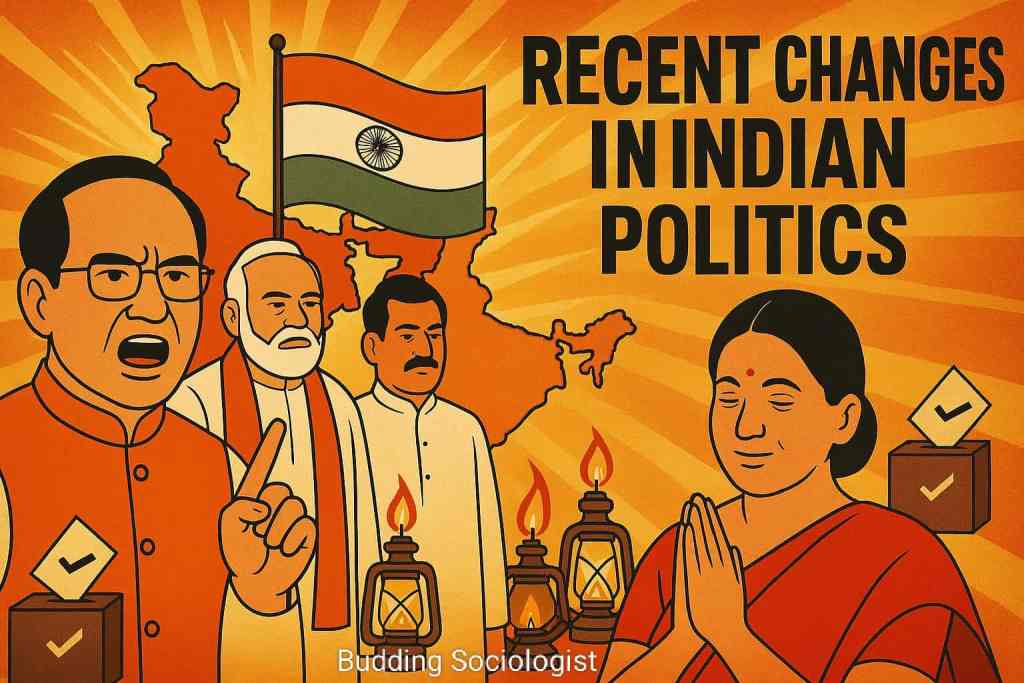
In recent years, Indian politics has witnessed profound and complex changes that reflect broader social transformations within the country. These changes are not isolated political events but are deeply intertwined with shifts in social identities, economic conditions, technological advances and cultural dynamics.
One of the most significant trends has been the resurgence and realignment of identity politics, where caste, religion, language and regional affiliations increasingly shape political behaviour and party strategies. The politicization of social identities has led to greater mobilization of marginalized groups seeking representation and justice, while also contributing to heightened social polarization and contestations over national identity. The rise of Hindu nationalism, for instance, has reshaped political discourse, affecting inter-community relations. Concurrently, regional parties have grown stronger, giving voice to localized aspirations and grievances, thereby decentralizing political power and reflecting the country’s vast social diversity.
Technological innovations and the digital revolution have revolutionized political engagement in India. The widespread use of social media and mobile technology has transformed electioneering, information dissemination and citizen participation, allowing political actors to reach voters directly and mobilize support at an unprecedented scale. However, these tools have also facilitated the spread of misinformation, fake news and hate speech, posing new challenges to democratic deliberation and social harmony. Alongside these developments, changing electoral behaviour reveals an increasingly issue-based and aspirational electorate, especially among youth and urban populations, who demand better governance, employment opportunities and social welfare, reflecting broader socio-economic shifts.
At the same time, the traditional dominance of national parties like; the Indian National Congress has waned, giving way to the rise of the Bharatiya Janata Party (BJP) and a more fragmented multiparty system. This shift reflects not only changing political ideologies but also evolving class structures, urban-rural divides and the aspirations of a growing middle class. The interaction of economic liberalization, globalization and social policies has further complicated the political landscape, influencing patterns of inequality, migration and social mobility, all of which feed back into political alignments. Moreover, the increased political participation of women, Scheduled Castes, Scheduled Tribes and Other Backward Classes signals ongoing social empowerment, even as structural barriers and social exclusion persist. These recent changes in Indian politics underscore the dynamic and contested nature of India’s democracy, where social transformations and political processes continuously interact to shape the country’s future trajectory. Over the last few years, the Indian politics have changed drastically and such changes can be categories as follows:
1. Rise of Identity Politics and Social Mobilization
2. Changing Electoral Behaviour and Participation
3. Impact of Technology and Media on Indian Politics
4. Emergence of New Political Forces and Decline of Traditional Parties
These four categories are being described in detail as follows:
1. Rise of Identity Politics and Social Mobilization
In recent years, Indian politics has witnessed a marked rise in identity-based mobilization, where social groups assert their distinct cultural, religious, caste and regional identities to influence political power. This shift reflects deeper social dynamics, as historically marginalized communities and dominant groups alike seek recognition and representation. Identity politics has reshaped electoral strategies, party formations and policy priorities, intertwining social identities with political agendas. While this has empowered many groups, it has also introduced challenges to social cohesion and national integration.
Understanding this phenomenon is crucial for analyzing contemporary Indian political and social transformations and this understanding can precisely be described as follows:
1. Central Role of Caste in Political Mobilization: Caste remains a foundational element in Indian politics, deeply embedded in the social fabric of the country. Political parties have long recognized caste identities as crucial for mobilizing voters. Many parties specifically target caste groups to consolidate electoral support, often promising social welfare tailored to particular castes. Over time, this has led to the emergence of regional and caste-based parties that claim to represent the interests of their communities. Caste mobilization not only shapes election outcomes but also influences policymaking and governance, reinforcing the persistence of caste as a social and political reality.
2. Religious Identity and Communal Politics: Religious identity, particularly Hindu identity, has surged as a key political mobilizer in recent decades. The rise of Hindu nationalist ideologies, spearheaded by organizations, has brought religion to the forefront of political discourse. Campaigns and policies increasingly appeal to a majoritarian Hindu ethos, emphasizing cultural nationalism and religious pride. This has heightened tensions with minority communities, especially Muslims, often resulting in polarization and communal conflict. Religious mobilization shapes electoral strategies and influences how citizens relate to the state and each other.
3. Emergence of Subaltern and Marginalized Group Assertion: The political awakening and mobilization of historically marginalized groups such as; Scheduled Castes, Scheduled Tribes and Other Backward Classes have reshaped Indian politics. These groups, once excluded from power, now actively seek representation and challenge social inequalities through voting, protests and political participation. The rise of Dalit leaders and parties focused on social justice signifies a shift toward greater inclusivity. However, this assertion sometimes leads to tensions with upper-caste groups and poses challenges to traditional power structures, pushing Indian democracy to address deeply rooted social hierarchies.
4. Regional and Linguistic Identity Politics: Regionalism has become a powerful force in Indian politics, with linguistic and cultural identities serving as the basis for mobilization. Many states have seen the rise of regional parties that prioritize local issues, cultural preservation and autonomy over centralized authority. Movements demanding the recognition of regional languages, protection of local customs and political decentralization have gained momentum. This regional assertion reflects the diversity of India but also occasionally generates friction between state and central governments and between different linguistic communities.
5. Women and Gender-based Political Mobilization: Although women remain under-represented in Indian legislatures, there has been a growing push for their political empowerment. Women’s groups and feminist movements advocate for increased representation through quotas and address issues like; domestic violence, sexual harassment and access to education. Women’s participation in political protests and grassroots movements has increased, signalling a shift in social attitudes. Gender-based mobilization challenges patriarchal norms and demands policies that ensure equality and justice, gradually altering the gender dynamics within Indian politics.
6. Youth as a Social Force in Identity Politics: India’s large youth population plays an increasingly critical role in shaping political trends. Young people are often at the forefront of demands for economic opportunities, quality education and social reforms. Many youths align their political choices with their social identities, including caste and religion, while also expressing aspirations for a modern and equitable society. The mobilization of youth through campus politics, social media and protests reflects their growing agency and the complex interplay between identity and broader social issues in contemporary politics.
7. Use of Symbolism and Rituals by Political Parties: Political parties in India skilfully use cultural symbols, rituals and religious festivals to forge emotional connections with voters. By participating in or sponsoring local festivals and religious events, parties affirm their commitment to community identities. This ritualistic engagement helps transform social identities into political loyalties, promoting a sense of belonging and collective identity among supporters. Symbolism also serves to legitimize parties as protectors of cultural traditions, which can be a powerful tool in mobilizing rural and traditional voters.
8. Impact of Social Movements on Political Identity: Social movements in India have played a crucial role in politicizing social identities and challenging established power relations. Movements centered around land rights, environmental issues and anti-corruption have mobilized diverse groups, including marginalized communities, around shared grievances. These movements provide alternative political spaces where identities intersect with demands for justice and rights, broadening the scope of political participation. They have influenced policy and political discourse by highlighting social inequities and pressing the state for reform.
9. Role of Social Media in Amplifying Identity Politics: The rise of social media has transformed how identity politics operates in India. Platforms like; WhatsApp, Facebook and Twitter (now X) allow political actors to communicate directly with supporters, spreading identity-based narratives quickly and widely. While social media can empower marginalized voices and facilitate mobilization, it also promotes echo chambers and misinformation. The rapid dissemination of communal and caste-based messages sometimes aggravates social divisions and fuels polarization, making identity politics more visible and volatile in the digital age.
10. Challenges to National Integration and Social Cohesion: While identity politics empowers various social groups by recognizing their distinct identities and demands, it also poses challenges to the broader ideal of national integration. The emphasis on exclusive group identities can lead to social fragmentation, inter-group competition and conflict. These dynamics complicate efforts to promote a cohesive, pluralistic society where diverse identities co-exist harmoniously. Political mobilization along narrow identity lines risks undermining social solidarity and poses dilemmas for democratic governance in a multi-cultural nation like India.
On the basis of above description, it can be stated that in recent years, the rise of identity politics and social mobilization has profoundly reshaped Indian politics, reflecting deeper social realities of caste, religion, region, gender and youth aspirations. While these movements have empowered marginalized groups and enhanced political participation, they have also intensified social divisions and challenges to national unity. The interplay between identity and politics reveals the complexity of India’s diverse society, where political allegiance is often intertwined with social belonging. Understanding these dynamics is essential to grasp the evolving nature of Indian democracy and the ongoing struggle to balance group identities with inclusive governance and social cohesion.
2. Changing Electoral Behaviour and Participation
Electoral behaviour and political participation in India have experienced notable changes over the last decades, reflecting shifts in the social fabric and the aspirations of a rapidly transforming society. These changes are important sociologically because they reveal evolving patterns in how citizens engage with democratic processes, their expectations from political leaders and the factors that motivate their voting choices as follows:
1. Increasing Political Awareness and Issue-Based Voting: Over recent years, there has been a noticeable shift in Indian voters’ approach towards elections, moving beyond traditional loyalties to caste, religion or community. With the spread of education and mass media, voters today have greater access to information about governance, policies and candidates’ track records. This has led to an increase in issue-based voting, where citizens prioritize economic development, job creation, infrastructure improvements and corruption control over mere identity politics. For example, voters are increasingly holding governments accountable for delivering tangible benefits such as electricity, clean water, roads and welfare schemes, rather than simply voting along inherited social lines. This growing political awareness reflects a maturing democratic ethos where performance and promises significantly influence electoral choices.
2. Youth Participation: A Growing Political Force: India’s demographic dividend is largely composed of its youth, making their participation in elections a critical factor shaping contemporary politics. Unlike older generations, young voters are more connected digitally and socially, exposing them to a variety of perspectives and global issues. Their political interests extend beyond traditional concerns to include employment opportunities, quality education, environmental sustainability and aspirations for modernization. This voting behaviour of current generation is often less predictable and more issue-oriented, as they tend not to exhibit unwavering loyalty to established parties. Consequently, political parties are compelled to engage with youth-specific issues actively and adopt campaign strategies that resonate with their concerns. The rise of youth participation thus marks a significant transformation in Indian electoral politics.
3. Increasing Political Participation of Women: The participation of women in Indian elections has seen gradual but important growth, both as voters and candidates. Social reforms, increased literacy and women’s empowerment movements have promoted greater political engagement among women. Additionally, policies such as reservation quotas in local governance bodies have enabled more women to hold elected offices, encouraging political participation at the grassroots level. Women voters have become a powerful electoral constituency, prompting political parties to address gender-related issues like; healthcare, education and social welfare in their manifestos. However, despite this progress, challenges such as patriarchal norms, gender-based violence and limited representation in higher political offices persist, signalling the need for continued efforts to achieve gender parity in political participation.
4. Rural vs Urban Voting Behaviour: India’s vast rural and urban populations often exhibit differing electoral priorities, reflecting their distinct socio-economic realities. Rural voters tend to focus on agriculture-related policies, access to subsidies, rural infrastructure and basic social services, as their livelihoods are closely tied to farming and rural economies. In contrast, urban voters prioritize issues such as employment in formal sectors, better urban infrastructure, public transportation, education and law and order. However, rapid urbanization and migration patterns have started to blur this divide, with urban-rural interactions giving rise to more nuanced political demands. The complexity of voter behaviour in these two spaces necessitates that political parties craft tailored strategies to address the heterogeneous concerns of these populations.
5. Role of Caste and Community in Voting: Despite evolving political dynamics, caste and community identities continue to play a central role in Indian electoral behaviour. Political parties actively mobilize support by forming caste-based alliances and appealing to group identities, particularly in regions where caste hierarchies remain deeply entrenched. The politics of social justice, especially in states such as; Uttar Pradesh, Bihar and Tamil Nadu, highlights how caste remains a powerful factor in shaping electoral outcomes. Nevertheless, a gradual shift is perceptible among younger voters who are increasingly willing to look beyond caste loyalties and evaluate candidates on governance, ideology and development agendas. This co-existence of identity and issue-based politics adds complexity to Indian elections and reflects the ongoing social transformations within the country.
6. Political Apathy and Voter Turnout Trends: Voter turnout is a key indicator of political participation and democratic health. In India, overall voter turnout has generally remained steady or increased in recent elections, indicating strong electoral engagement. Nonetheless, certain groups such as urban youth or marginalized communities sometimes display political apathy due to disillusionment with corruption, lack of effective representation or socio-economic barriers. Efforts by the Election Commission and civil society organizations to promote voter registration, awareness campaigns and the use of technology have helped mitigate apathy and encourage greater participation. However, overcoming deep-rooted social inequalities and ensuring inclusive political engagement remain ongoing challenges for India’s democracy.
7. Impact of Social Media and Digital Campaigning: The advent of social media and digital technologies has revolutionized political participation in India by changing how voters engage with political content and candidates. Platforms like; WhatsApp, Facebook, Twitter (now X) and Instagram enable rapid dissemination of information, direct communication between politicians and voters, and grassroots mobilization. Political parties use sophisticated data analytics and targeted advertising to influence voter behaviour, making campaigns more personalized and immediate. However, the digital sphere also poses risks such as; misinformation, fake news and online polarization, which can distort democratic discourse. Nonetheless, digital campaigning has undeniably increased political participation, especially among younger and urban populations, marking a fundamental shift in electoral dynamics.
In short, recent changes in Indian electoral behaviour and participation reflect a dynamic and evolving democracy shaped by social transformations. Increasing political awareness, rising youth and women’s involvement and the interplay between identity and issue-based voting, signal a maturing electorate. While caste and community remain influential, emerging trends show voters prioritizing development and governance. The urban-rural divide, political apathy and digital media’s dual impact add complexity to participation patterns. Together, these shifts highlight India’s vibrant democratic process, emphasizing both challenges and opportunities in achieving inclusive, representative and responsive political engagement for a diverse society.
3. Impact of Technology and Media on Indian Politics
The rapid advancement of technology and the proliferation of media platforms have revolutionized Indian politics, transforming how political actors communicate, how citizens engage and how political power is exercised and contested. From grassroots mobilization to national campaigns, technology and media now play a pivotal role in shaping political processes and social interactions:
1. Widespread Access to Digital Technology: In recent years, the exponential growth in affordable smartphones and internet connectivity has revolutionized political engagement across India. This digital expansion has bridged the urban-rural divide by providing millions of Indians, including those in remote areas, with unprecedented access to political information. Unlike earlier times when news and political updates depended largely on newspapers, radio and television, the digital revolution ensures that individuals can access political content in real time, often personalized to their interests. This access democratizes information flow, empowering citizens with knowledge and enabling more people to participate in political discussions and decision-making processes.
2. Direct Communication Channels: Political leaders and parties increasingly use social media platforms such as; Facebook, Twitter, Instagram (now X) and WhatsApp to communicate directly with voters. This direct communication eliminates the filter of traditional media and allows politicians to craft their messages carefully and respond instantly to political developments or controversies. The personalized nature of these interactions promotes a sense of closeness between politicians and the electorate, especially among younger voters who are more engaged online. Moreover, this direct line of communication facilitates mobilization and encourages active political participation beyond mere voting.
3. Enhanced Political Mobilization: Digital technology has transformed the scale and methods of political mobilization in India. Political campaigns now extensively use viral videos, memes, hashtags and digital advertisements to engage voters and create enthusiasm. These tools allow campaigns to reach not just local constituencies but also global audiences and diasporas. The digital space also supports grassroots activism by enabling individuals and groups to organize rallies, protests and awareness drives efficiently. This new mode of mobilization is cost-effective and instant, allowing parties to rapidly adapt strategies and sustain momentum throughout election cycles.
4. Reinforcement of Political Identities: Social media platforms use algorithms that make content tailored to users’ preferences and past interactions, creating environments often called “echo chambers.” Within these spaces, individuals are repeatedly exposed to political views that reinforce their existing beliefs and group identities. While this strengthens social cohesion within groups, it also hardens political divisions and reduces opportunities for dialogue across different communities. In India’s diverse society, such echo chambers contribute to the intensification of caste, religious and regional identities, sometimes promoting exclusion and conflict rather than consensus.
5. Spread of Misinformation and Fake News: While technology enhances communication, it also facilitates the rapid spread of misinformation and fake news. False or misleading information can quickly go viral, influencing public perceptions and electoral behaviour before facts can be verified or corrected. In India, such misinformation often exploits communal sensitivities, increasing tensions and occasionally inciting violence. The challenge is compounded by the difficulty in regulating vast online spaces and the anonymity offered by digital platforms, which hinder accountability and the establishment of reliable information sources.
6. Growing Political Polarization: The digital media ecosystem tends to magnify emotionally charged and divisive content because such material attracts more engagement, clicks and shares. This dynamic contributes to increasing political polarization in Indian society, where online discourse often becomes a battleground for competing caste groups, religious communities and regional interests. The heightened polarization affects real-world social relationships, eroding trust and sometimes leading to harassment, threats and communal violence. This climate of division weakens democratic deliberation and social harmony.
7. Media as Political Actors: Traditional media institutions in India, including television channels, newspapers and online news portals, play an active role in politics beyond simply reporting news. Many media houses have political leanings, which shape their editorial choices and coverage priorities. Sensationalism and entertainment-driven content often overshadow discussions of policy and governance. As a result, the media can amplify certain political narratives while marginalizing others, influencing public opinion and election outcomes in significant ways. This blurring of journalism and political activism challenges media ethics and public trust.
8. Surveillance and Data Analytics: The use of technology for political surveillance and targeted campaigning has become sophisticated in India. Political parties and governments employ data analytics and social media monitoring to track voter behaviour, preferences and even opponents’ strategies. Micro-targeting allows highly personalized political advertising, where messages are customized for specific demographics or even individual voters. While these techniques improve campaign efficiency, they raise serious concerns about privacy, manipulation and the ethical use of data, threatening democratic fairness and transparency.
9. Impact on Democratic Participation: Digital platforms have lowered traditional barriers to political engagement by providing new avenues for participation. Online petitions, social media campaigns, digital voter registration drives and e-governance services empower citizens to interact with political processes more easily. These tools have expanded the political space for groups traditionally marginalized from mainstream politics, such as women, youth and minorities. However, differences in digital literacy, access and infrastructure mean that this participation is not uniformly distributed, reinforcing existing inequalities in political voice and influence.
10. Shifting Social Relationships and Trust: Technology’s impact extends beyond politics into the realm of social relationships and institutional trust. Online political interactions, often anonymous and uncensored, can erode interpersonal trust and community cohesion. Political debates on social media are frequently hostile and divisive, influencing how people perceive each other and their institutions. For younger generations, political socialization increasingly happens online, shaping their values and expectations in ways that differ from previous generations. This shift changes the nature of citizenship and collective identity, with implications for the future of democratic engagement and social solidarity.
In conclusion, technology and media have profoundly reshaped Indian politics by transforming communication, mobilization and political participation. While digital platforms have democratized access to information and empowered diverse groups, they have also intensified political polarization, misinformation and surveillance concerns. The evolving media landscape influences not only electoral outcomes but also social relationships and trust within society. As India continues its digital journey, balancing the benefits of technology with its challenges is essential to strengthen democratic processes and social cohesion. Understanding these dynamics sociologically is crucial to navigating the complex interplay between politics, society and technology in contemporary India.
4. Emergence of New Political Forces and Decline of Traditional Parties
The political landscape of India has witnessed a marked transformation in recent decades, characterized by the rise of new political forces and a relative decline of traditional, historically dominant parties. This phenomenon is deeply rooted in changing social structures, voter expectations and evolving modes of political engagement, reflecting broader sociological processes and can be described in more precise way as follows:
1. Decline of Traditional Parties: The Indian National Congress (INC), once the unrivalled political powerhouse of independent India, has experienced a significant decline in its political influence in recent decades. This decline is rooted in several sociological factors. Historically, the Congress was a broad coalition that included; elites, middle classes, marginalized communities and minorities, which helped it maintain a pan-Indian appeal. However, as Indian society evolved, becoming more aware and assertive of its diverse identities, the Congress struggled to effectively address these specific social aspirations. Its traditional catch-all strategy seemed inadequate in a society increasingly segmented by identity politics. Moreover, the party has faced internal organizational challenges, including leadership crises and factionalism, which weakened its grassroots connections. This organizational decay created a disconnect between party elites and ordinary voters, especially among youth and marginalized groups who sought more assertive representation. As a result, many traditional Congress voters shifted their loyalty to parties that explicitly championed their social or regional identities, signalling a sociological transformation in voter behaviour.
2. Rise of Regional Parties: The rise of regional political parties in India reflects the sociological phenomenon of local identity assertion in a country marked by tremendous ethnic, linguistic and cultural diversity. These parties emerged as political vehicles for articulating regional grievances, protecting cultural and linguistic heritage, and demanding greater political autonomy. Regional parties have capitalized on local pride and regional aspirations to mobilize support. Their success highlights the limits of centralized political power and the increasing importance of sub-national identities in Indian democracy. This shift has reshaped political competition, encouraging a more pluralistic and fragmented party system that better reflects India’s social heterogeneity.
3. Emergence of New National Parties and Social Movements: Alongside the rise of regional parties, new national-level political forces have emerged that challenge the traditional power structures. The current governmentis the most prominent example of this trend, rising from a marginal political player to the dominant force in Indian politics. It has effectively mobilized religious identity, nationalism and developmental promises to build a broad-based electoral coalition. This rise represents a significant shift toward the politicization of religion and the redefinition of Indian national identity along cultural and ideological lines. In parallel, new social movements focusing on issues such as anti-corruption, governance and social justice have also entered the political arena. These new forces signify how social movements and ideologies can translate into political power, responding to citizens’ demand for alternative governance models and accountability.
4. Multipolar Party System and Coalition Politics: The political transformation in India has led to the emergence of a multipolar party system characterized by multiple influential regional and national parties. This has ended the era of single-party dominance and ushered in coalition politics, where no single party can easily secure a majority in the parliament without forming alliances. Coalition governments require parties to negotiate and accommodate diverse social interests and regional aspirations, reflecting the pluralistic nature of Indian society. While coalition politics has allowed for greater representation, it has also introduced challenges related to political stability, policy coherence and governance efficiency, highlighting the complexities of managing a deeply heterogeneous society.
5. Changing Nature of Political Participation: The changing political landscape has also altered how people participate in Indian democracy. New political parties and movements have adapted to modern communication technologies and media platforms to reach out directly to voters, especially younger generations who are more informed, connected and politically aware. Social media, mobile technology and grassroots campaigns enable these parties to engage with citizens on issues that matter to them, such as employment, education and social justice, thus making politics more participatory and issue-focused. Moreover, there has been an increase in political participation among marginalized groups, including; women, Dalits and Other Backward Classes (OBCs), who demand greater representation and social equity. This shift signals a democratization of political engagement, where traditional hierarchical structures are challenged by more horizontal, networked forms of mobilization, empowering citizens to influence political outcomes in new ways.
In conclusion, the emergence of new political forces alongside the decline of traditional parties in India reflects profound sociological changes within its diverse society. As identity politics, regional aspirations and social movements gain prominence, Indian democracy has become more fragmented yet inclusive, accommodating multiple voices and interests. This shift challenges old power structures, reshapes political participation and demands adaptive governance models. The evolving political landscape underscores the deep link between social change and political transformation, highlighting how democracy continuously responds to the complexities of India’s pluralistic social fabric. Ultimately, these dynamics reflect India’s ongoing journey toward a more representative and participatory polity.
Governance, Policy Shifts and Social Welfare
Governance in India has witnessed notable transformations in recent years, marked by shifts in policy priorities and approaches to social welfare. These changes are deeply intertwined with the political landscape, reflecting broader ideological currents, electoral compulsions and evolving social demands. Governance and policy shifts play a critical role in shaping social relations, redistributing resources and defining citizens’ rights and identities:
1. Changing Nature of Governance and Political Leadership: In recent years, governance in India has increasingly reflected a shift toward centralized decision-making, particularly with the growing concentration of power in the executive branch. The office of the Prime Minister has emerged as a pivotal locus of authority, with major policy decisions often made at the highest level. This centralization aims to expedite decision-making and enforce uniform policies across a vast and diverse nation. Concurrently, political leadership has embraced a narrative of strong, charismatic leadership combined with assertive nationalism. This has shaped policy priorities, focusing on national unity, security and cultural identity, sometimes at the expense of accommodating India’s pluralistic social fabric. The style of governance often involves direct communication with the populace through mass media and social media, promoting a sense of personal connection with political leaders, yet potentially side-lining traditional democratic deliberation processes.
2. Policy Shifts Reflecting Ideological Priorities: Policy-making in India today reflects clear ideological undercurrents, with economic development and nationalism dominating the agenda. There is an intensified focus on building infrastructure that proponents argue will drive economic growth and generate employment opportunities. Social welfare programs have expanded under various flagship schemes designed to reach farmers, the poor, women and youth, offering subsidies, health coverage and sanitation improvements. These schemes serve dual purposes: addressing socio-economic challenges and cementing political support by demonstrating government responsiveness. Nonetheless, critics point out that the distribution of welfare benefits is often uneven, influenced by political calculations that favour particular castes, communities or regions. This selective approach may deepen social inequalities and fuel resentment among excluded groups.
3. Impact on Social Justice and Inclusion: Social justice remains a deeply contested terrain within India’s governance and policy shifts. Affirmative action policies (like reservations in education, employment and political representation) continue to play a vital role in attempting to redress historical caste-based disadvantages. However, these policies are frequently subject to political debate, with some advocating for their expansion, while others demand their limitation or reform. For marginalized communities, including; Scheduled Castes, Scheduled Tribes, religious minorities and women, welfare schemes are critical lifelines that offer avenues for upward mobility. Yet, structural discrimination, social exclusion and periodic communal tensions undermine the effectiveness of such initiatives. Gender-focused policies have gained traction, with increasing attention on women’s safety, education and economic participation, but prevailing patriarchal norms and conservative social attitudes often constrain these gains. Consequently, while governance initiatives have promoted some progress in inclusion, significant gaps persist in achieving equitable social outcomes.
4. Governance Challenges: Despite numerous reforms, challenges in governance remain significant barriers to the effective delivery of social welfare programs. Corruption and bureaucratic red tape continue to hinder access to services for many citizens, particularly those from disadvantaged backgrounds. Complex administrative procedures and lack of transparency create bottlenecks that dilute the impact of welfare schemes. However, the adoption of digital governance tools, such as; Direct Benefit Transfer and Aadhaar-based identification systems, has introduced greater transparency and efficiency by reducing intermediaries and leakages. This digital push, while promising, also raises concerns about the digital divide, as marginalized populations with limited internet access or digital literacy may be left behind. Additionally, demands for greater government accountability have grown, driven by active civil society organizations, media scrutiny and judicial interventions. The political polarization and centralized control can sometimes limit the scope for effective checks and balances, challenging the democratic ideals of accountability and responsiveness.
5. Social Welfare as a Political Tool: Social welfare policies in India are complexly linked to electoral politics, often serving as instruments to secure and consolidate vote banks. Political parties strategically design and implement welfare schemes targeting specific social groups whose support is crucial during elections. This politicization of welfare can sometimes lead to patronage systems where benefits are dispensed based on political loyalty rather than objective need, distorting the equitable distribution of resources. Governments also use welfare achievements to demonstrate performance legitimacy, presenting themselves as effective agents of development and social upliftment. Furthermore, welfare policies often intersect with identity politics, where the allocation of benefits reinforces social identities linked to caste, religion or region. While this can empower certain groups politically, it may also deepen social fragmentation and tension, complicating the pursuit of inclusive governance and national integration.
On the basis of above description, it can be stated that recent changes in Indian governance and social welfare reveal a complex interplay between political power, ideology and social justice. While centralized leadership and ambitious policy shifts have accelerated development and expanded welfare programs, challenges such as; uneven benefit distribution, bureaucratic inefficiencies and identity-based politics persist. Social welfare often doubles as a political strategy, influencing social cohesion and inclusion. From a sociological perspective, these dynamics reflect ongoing negotiations in India’s social contract, where governance shapes and is shaped by the diverse realities of its population. Achieving inclusive, accountable governance remains essential for India’s social stability and equitable progress.
Readings and References:
The New India: The Unmaking of the World’s Largest Democracy by Rahul Bhatia, https://amzn.to/4nzxKSJ
Recent Trends in Indian Politics by Braham Singh & H. C. Sharma, https://amzn.to/4qsxZS6
Tracking Contemporary Trends in Indian Politics: Reflections on National Developments and Emerging Issues in the States by Sandeep Shastri, https://amzn.to/3JeinRD
Thomas, V., Deka, C., Raja, A., & Sathyan, A. V. (2024). Examining the intervention of religion in Indian politics through Hindutva under the Modi regime. Religions, 15(12), 1509. https://doi.org/10.3390/rel15121509
Dutta, R. (2021). Coalition politics in India: An analysis of emerging trends since 1989 general elections. Social Science and Development Journal, 6(1), 389. https://doi.org/10.31567/ssd.389