- Introduction
- Models of Sanskritization
- Characteristics of Sanskritization
- Impacts of Sanskritization
- Dominant Caste Defined
- Functions of Dominant Caste
Introduction
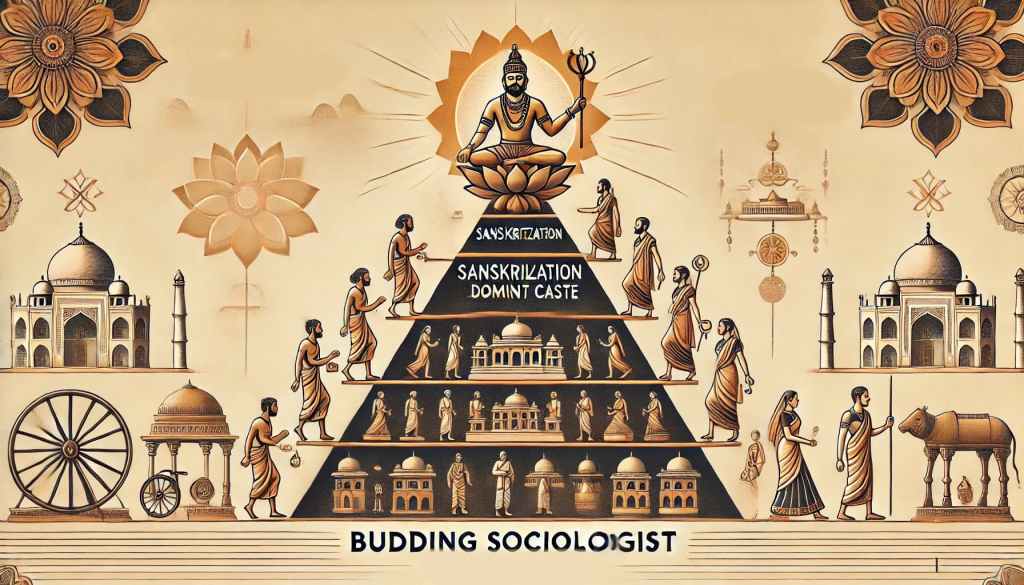
The caste system is often perceived as a rigid structure where mobility is restricted, though some movement does occur in reality. Despite its inherent limitations, the phenomenon known as “Sanskritization” sheds light on social transformations within the caste system.
Coined by M.N. Srinivas, “Sanskritization” delineates the cultural mobility process within India’s traditional social framework. Srinivas observed instances of Sanskritization in his research on religion and society among the Coorgs in Mysore, providing empirical support for this concept.
He discovered that individuals belonging to lower castes, in their quest to ascend the caste ladder, adopted certain practices of the Brahmins while relinquishing some of their own traditions deemed impure by higher castes. For instance, they abandoned meat-eating, alcohol consumption, and animal sacrifice to their deities, while emulating Brahmin customs in attire, diet, and rituals. Through this process, within a generation or so, they could assert higher positions within the caste hierarchy.
Initially, M.N. Srinivas termed this phenomenon as “Brahminisation,” but later replaced it with “Sanskritization.” Brahminisation was narrow in scope and didn’t encompass other pathways of caste mobility. Srinivas’ observations, particularly those concerning the Coorgs, were specific and didn’t include other non-Brahmin castes categorized as “twice-born.” The redefined concept of Sanskritization by M.N. Srinivas can be summarized as follows:
Sanskritization denotes the transformation whereby a ‘low’ Hindu caste, tribal, or another group alters its customs, rituals, ideology, and lifestyle to align more closely with those of a ‘high,’ often ‘twice-born,’ caste. Typically, such adaptations are accompanied by a claim to a higher caste position than traditionally recognized for the group by the local community. This assertion usually occurs gradually over a span of one or two generations before it is fully established.
In essence, Sanskritization can be described as the mechanism through which cultural and social mobility occurs within the caste structure. This phenomenon originates from within the caste system itself, termed as indigenous. Essentially, it involves the process whereby lower castes adopt the customs, rituals, and ideologies of higher castes, particularly those belonging to the twice-born castes like Brahmins, Rajputs, and other dominant groups in local hierarchies.
Furthermore, Sanskritization is not confined solely to the caste system but also encompasses non-caste groups such as tribals. Here, the caste prevalent in a local area serves as the blueprint for social change, with any twice-born caste potentially serving as the model for emulation. Yogendra Singh expands this redefined concept of Sanskritization to include the ‘varna’ system as well.
Models of Sanskritization
Following are the models of Sanskritization:
1. Cultural Model: Throughout Hindu culture, castes have historically been stratified based on various cultural traits. Practices such as wearing the sacred thread, abstaining from meat and alcohol, practicing endogamy, forbidding widow remarriage, adhering strictly to caste-based restrictions, following prescribed modes of worship outlined in religious texts, and revering religious and mythological narratives have been deeply ingrained. These practices are upheld as sacred and pure, serving as benchmarks for sanctity and purity within traditional society. Embracing these behaviours and norms associated with elevated status and purity, as delineated in religious texts, is a process known as Sanskritization.
2. Varna Model: In the Varna system, the highest status is attributed to the Brahmins, followed by the Kshatriyas, Vaishyas, and Shudras. At the lowest rung is the fifth Varna, known as the untouchable. Lower castes often emulate the ideals and lifestyle of the higher castes. For instance, when Kshatriyas exhibit superiority, lower castes tend to adopt their lifestyle and values. Similarly, when Vaishyas are perceived as superior, lower castes may emulate them. This process, known as Varna model or Sanskritization, involves adopting the lifestyle or values of a higher Varna based on the honour and perceived superiority associated with that class.
3. Local Model: In many societies, certain social groups hold more prestige due to their economic influence, often referred to as the “master caste” or the “dominant caste”. Consequently, those belonging to lower castes often emulate the lifestyle of the dominant caste in hopes of elevating their own social standing.
Characteristics of Sanskritization
In 1952, the introduction of the concept of Sanskritization stirred significant debate within the realms of sociological literature, sparking considerable interest among social anthropologists and sociologists alike. Scholars recognized its utility in examining social transformation within rural communities, particularly concerning cultural shifts. Drawing from various sociological research materials, both domestic and international social anthropologists assessed the fundamental traits associated with Sanskritization, identifying the following key characteristics:
1. It is a Cultural Paradigm: The fabric of a caste’s culture is woven from its ideas, beliefs, traditions, rituals, and similar elements. Any alteration in these facets of societal existence marks a shift in cultural dynamics. Sanskritization, therefore, represents a cultural transformation observed among lower castes and non-caste communities.
2. Sanskritization directed towards upper castes: Originally, Sanskritization referred primarily to the process of Brahminization. However, over time, M.N. Srinivas expanded this concept to encompass emulation of other higher caste models as well. Milton Singer (1964) brought this idea to Srinivas’ attention, highlighting the diversity of models existing within a society’s culture. Nonetheless, there was a notable absence of models for emulation among the Shudras.
3. Also applies to Tribals: In a nuanced explanation, Srinivas has articulated that Sanskritization extends beyond Hindu castes to include tribal and semi-tribal communities as well. Examples include the Bhils in western India, the Gonds and Oraons in central India, and the Pahadis in the Himalayas. These tribal groups aspire to elevate their social status by adopting Hindu practices and seeking recognition as a caste within Hindu society.
4. Sanskritic Values, Beliefs belong to Hindu Tradition: When Srinivas discusses the process of Sanskritization among lower castes, he refers to their adoption of caste-Hindu traditions. Hinduism derives much of its ethos from sacred texts like the Ramayana, Mahabharata, Upanishads, and Brahmanas. The principles and ideologies enshrined in these texts serve as the basis for emulation by lower castes. Given that Brahmins, the priestly caste, typically interpret these traditions, they serve as the primary model for imitation by lower castes.
5. Sanskritization also means Teetotalism: When Srinivas discusses the process of Sanskritization among lower castes, he refers to their adoption of caste-Hindu traditions. Hinduism derives much of its ethos from sacred texts like the Ramayana, Mahabharata, Upanishads, and Brahmanas. The principles and ideologies enshrined in these texts serve as the basis for emulation by lower castes. Given that Brahmins, the priestly caste, typically interpret these traditions, they serve as the primary model for imitation by lower castes.
Criticism: Based on the preceding analysis, it is evident that Srinivas has undertaken a significant endeavour to examine social transformation not only within rural settings but also within broader societal contexts. It is important to distinguish between concepts and theories; concepts serve as frameworks for theories and are susceptible to various weaknesses. Despite its limitations, the reception towards Srinivas’ concept of Sanskritization has been largely positive.
Impacts of Sanskritization
If we consider that Indian culture primarily revolves around the cultural norms of the twice-born Varnas (Brahmans, Kshatriya, and Vaishyas), then it’s evident that a process akin to Sanskritization has been unfolding over the course of a millennium. This is because foreign invaders, rather than imposing their own cultural values, embraced the traditions of the indigenous twice-born culture of India. This phenomenon explains the absence of significant traces of the successors of figures like Alexander the Great, such as the Seleucids from Greece. The effects of Sanskritization manifest in the following ways:
1. In Religious Field: Members of lower castes have established their own places of worship, akin to those of higher castes. They honour their esteemed figures alongside deities, and some even adopt sacred rituals such as wearing the sacred thread. Regular visits to these temples for rituals like arti and bhajan are common, with priests from within their own caste serving them. They observe various ceremonies and practices traditionally associated with higher castes, including sacrifices and hawan during child naming ceremonies. Moreover, they are progressing towards adopting cleanliness practices, abstaining from forbidden foods and occupations, and maintaining personal hygiene. Notably, they have developed expertise in conducting ceremonies similar to those performed by Brahmins.
2. In Social Field: The significance of Sanskritization lies predominantly in its social dimension, particularly in terms of fostering change. Members of lower castes are drawn towards Sanskritization as a means to enhance their social standing and ascend the caste hierarchy. Their aspiration is to attain a status comparable to that of Brahmans and Kshatriyas. Furthermore, certain castes not only assert their claim to being twice-born but have also effectively attained such a status.
3. In Economic Field: Sanskritization extends beyond mere cultural adoption; it’s evident even in occupational shifts. Prestige is often associated with clean professions, reflecting social status. For instance, in western Uttar Pradesh urban areas, individuals from traditionally marginalized backgrounds, like the Bhangis, now engage in occupations such as selling vegetables and snacks. Moreover, there’s a notable trend of individuals from backward classes ascending to higher positions. Affirmative action policies also facilitate the inclusion of scheduled castes and scheduled tribes in various service sectors. Interestingly, this societal transformation sometimes results in situations where twice-born individuals find themselves working as clerks or assistants under officers hailing from scheduled castes.
4. In Living Patterns: Living standards have undergone a transformation, adopting aspects akin to Sanskritization. Previously, lower castes lived in makeshift shelters, but now they inhabit sturdy homes with furnished drawing rooms akin to those of higher castes. They comfortably share spaces with higher castes, devoid of any apprehension. Additionally, they prioritize cleanliness, adorning their walls with images of leaders and Hindu deities. Their attire reflects a departure from previous semi-nudity, now aligning more closely with that of higher castes. Moreover, their manner of speech echoes that of the higher castes, marking a shift in social dynamics.
5. Other effects: The process of Sanskritization has posed challenges for women belonging to lower castes. Before Sanskritization, their adherence to caste norms was comparatively less stringent. However, with the adoption of Sanskritization, they began emulating the sexual and marital norms of the Brahmin caste, which proved burdensome for women. Practices such as early marriage, prohibition of widow remarriage, and the ritual of shaving widows’ heads were adopted by lower castes seeking upward mobility, perpetuating hardship for women.
Conclusion: Sanskritization has spurred the marginalized castes to abandon the consumption of alcohol, beef, domestic pork, and toddy. Srinivas predicts that within the next two to three decades, the cultural practices of untouchables across the nation will undergo significant transformations. Despite various considerations, MN Srinivas’s theory remains highly pertinent. It represents a notable departure, as it challenges the traditional framework of the Indian caste system. It introduces the notion that the ascribed status (caste) can undergo transformation under the influence of dominant castes, acting as role models for those in lower castes. This phenomenon, broadly termed as Sanskritization, marks a significant shift in the understanding of social dynamics within Indian society.
Dominant Caste
The notion of the ‘dominant caste’ was introduced by M.N. Srinivas in his seminal work “The Social System of a Mysore Village,” based on his observations of Rampura village. While formulating this concept, Srinivas may have been influenced by studies from Africa on dominant clans and lineages, albeit unconsciously. His aim in exploring this concept was to conduct a comprehensive study of Rampura village.
Srinivas defined a caste as dominant when it not only outnumbers other castes but also holds significant economic and political sway. A caste is more likely to be dominant if its standing in the local caste hierarchy is relatively high.
McKim Marriott expanded on this notion, suggesting that the dominance of a caste, as seen in various anthropological studies, often manifests in political power, traditionally referred to as juridical power within the village community. This dominance may also extend to religious and quasi-divine authority, as well as the ability to exert physical force.
In essence, as per Srinivas, a dominant caste typically possesses a substantial portion of the local arable land, boasts a large population, and occupies a prominent position in the local social hierarchy. When a caste exhibits all these characteristics, it can be said to wield decisive dominance.
Factors on Which Dominant Caste Depends
In 1962, M.N. Srinivas delineated three key features of a dominant caste:
- The caste exerts control over economic and political spheres.
- It occupies a prominent position within the caste hierarchy.
- It boasts significant numerical strength within its community.
Consideration of caste dominance involves assessing several factors:
1. Economic Strength: The financial status of individuals significantly influences their perceived dominance within society. Even if someone’s ascribed status isn’t inherently dominant, their economic standing can elevate their societal stature.
2. Political Power: Attaining positions of political authority can establish dominance irrespective of caste affiliation. For instance, India’s Prime Minister wields considerable influence regardless of their caste background.
3. Ritual Purity: In Indian society, the Brahmin caste holds a revered status akin to divinity, imbuing them with ritualistic power. Consequently, ritual purity serves as a determinant of dominance within certain contexts.
4. Numerical Strength: Groups or castes boasting larger populations inherently wield more influence, often being recognized as dominant within the social fabric.
Functions of Dominant Caste
Following are the main functions of dominant caste:
1. Social Hegemony: The prevailing caste holds sway over society by shaping its social norms, traditions, and behaviours in a specific community or area. This influence typically spreads across economic, political, and cultural domains, moulding the broader societal framework.
2. Cultural Leadership: Individuals belonging to the prevailing social group frequently assume the role of cultural influencers, establishing norms for appropriate conduct, ceremonies, and customs within their society. Their contribution is pivotal in upholding and transmitting cultural legacy over time.
3. Economic Control: It often wields substantial economic influence within their community, overseeing vital resources, land ownership, and market operations. This financial authority empowers them to shape economic endeavours and establish socio-economic dynamics within the society.
4. Political Influence: Individuals belonging to the prevailing caste frequently hold significant sway in the realm of politics, assuming key roles within community governance frameworks, political factions, and administrative entities. Leveraging their political leverage, they mould policies and steer decision-making procedures to align with their own agendas.
5. Social Stratification: Social stratification emerges when one caste exerts dominance, establishing explicit hierarchies and disparities rooted in caste identities. The privileged caste reaps benefits and advantages inaccessible to lower castes, thereby perpetuating social inequality.
6. Conflict Management: The predominant caste frequently serves as an intermediary in resolving disputes within the community or among various caste factions. Their sway and leadership aid in conflict resolution and the preservation of societal harmony.
7. Symbolic Representation: The leading caste serves as a symbolic representation of the community or locality, shaping its internal dynamics and external image. Their behavior and roles frequently mould the communal identity and impact its portrayal to those beyond its borders.
8. Social Cohesion: Although caste relations are structured hierarchically, the predominant caste assumes a significant responsibility in upholding social unity within the community. Through the organization of social and religious gatherings, they nurture a collective sense of solidarity and cohesion among members of the caste.
Criticism: Based on the aforementioned description, it can be observed that during the 1950s and 1960s, the field of rural sociology saw a rivalry between proponents of Redfield’s village studies approach and Radcliffe-Brown’s functional analysis. Despite their methodological disparities, both groups emphasized the significance of culture. Subsequently, Louis Dumont highlighted the pivotal role of culture and caste as influential factors in the examination of Indian civilization holistically.
The notion of the ‘dominant caste’ is argued to have originated from studies on dominant classes in Africa. When Srinivas introduced the concept of the dominant caste, it sparked significant discussion and critique among sociologists and social anthropologists.
References and Readings:
Caste in Modern India, and Other Essays, by Mysore Narasimhachar Srinivas, https://amzn.to/4iRhfiH
Religion and Society Among the Coorgs in South Asia, by M. N. Srinivas, https://amzn.to/3FuxOTj
The Dominant Caste and Other Essays, by Mysore Narasimhachar Srinivas, https://amzn.to/3RfqayF