- Introduction
- Meaning of Society
- Definitions of Society
- Characteristics of Society
- Relationship Between Individual and Society
- Types of Societies
Introduction
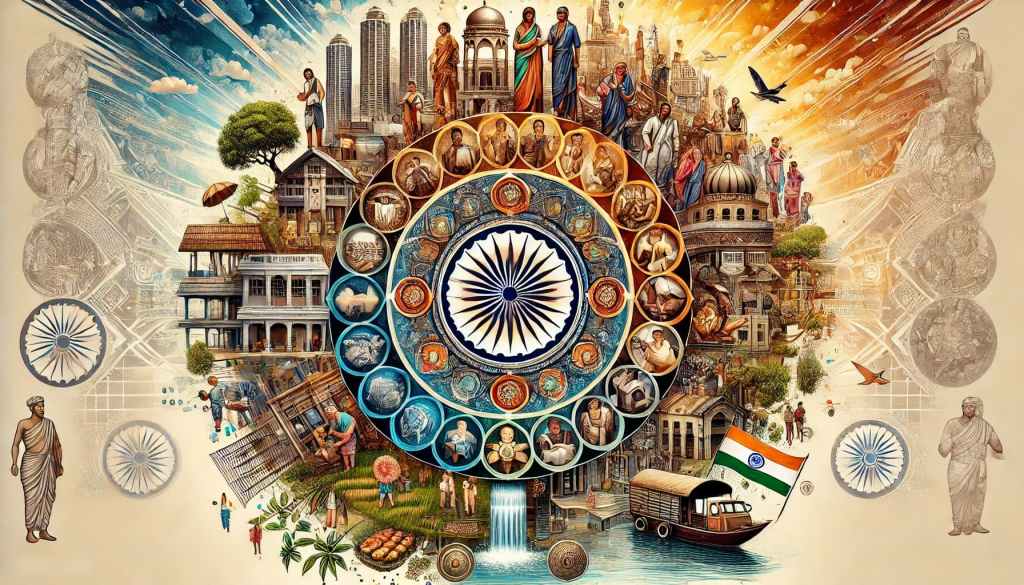
George Simmel, a renowned sociologist, posits that the essence of society lies in its elements of sociability and camaraderie. Similar to Aristotle’s ancient observation that humans are inherently social beings, it’s evident that human existence consistently intertwines with communal living. Society thus becomes a fundamental requirement for the perpetuation of human life.
Auguste Comte conceptualized society as a cohesive social organism with harmonious structures and functions. Emile Durkheim regarded society as an autonomous entity. Talcott Parsons defined society as a complex network of human relations, emerging from actions driven by intrinsic or symbolic means-end relationships. G. H. Mead depicted society as an exchange of symbolic gestures.
Morris Ginsberg described society as a conglomerate of individuals unified by specific relationships and behaviours, distinguishing them from those outside these relationships or exhibiting different behaviours. Cole perceived society as a complex of structured associations, institutions, and communities. McIver and Page characterized it as a system encompassing authority, mutual assistance among various groups, customs and procedures for regulating human conduct and liberty.
In essence, society denotes a cluster of individuals connected by enduring relationships such as social status, roles, and networks. Broadly, it encompasses the populace of a locality, nation, or even the global community. The concept of societal autonomy, independence and self-reliance is relative, often leading to arbitrary distinctions between different societies.
Meaning of Society
The term “society” originates from the Latin word “societas,” stemming from “socius,” which denotes comradery, friendship, or alliance. It is employed to depict the connection or engagement between amicable or at least civil entities. Additionally, it encompasses the entirety of humanity, although those who are hostile or uncivilized may be deemed antisocial.
Society emerges as a complex network of social relations resulting from interactions, which in turn are products of social actions. Therefore, society can be viewed as the culmination of the social action process. Social action is initiated based on four fundamental elements: the actor, goal/aim, means, and situation, laying the groundwork for social interaction, ultimately contributing to societal formation.
A society constitutes a collective of individuals engaged in social interaction, occupying a shared geographical or social space, typically under the governance of the same political authority and bound by prevailing cultural norms. These social groupings exhibit patterns of relationships among individuals who share specific cultural or institutional aspects, forming the fabric of societal bonds. Moreover, societies may comprise subcultures, wherein like-minded individuals adhere to distinct norms and values within the overarching societal framework.
Characteristics of Society
The concept of society encompasses both narrow and broad perspectives. In a limited context, it denotes a collective of individuals, while in a more expansive view, it embodies the entirety of human civilization. A society fundamentally requires a population; without individuals, no societal structure can emerge. However, society transcends mere aggregation of people; it signifies a complex network of social connections. Establishing these connections necessitates collective social engagement and interaction. A deeper comprehension of society can be achieved by examining its defining characteristics:
1. Likeness: The cornerstone of society lies in its shared likeness among individuals. Maclver emphasized this point by stating that society hinges on this similarity, as without it, there would be no mutual recognition of belonging together, consequently rendering the concept of society moot. This sense of likeness is inherent in fundamental social institutions such as kinship, family, and marriage, forming the foundation of their existence. Likewise, friendship, intimacy, and various forms of association rely on this likeness, often referred to as the ‘consciousness of kind’, without which they would be unattainable.
2. Differences: Diversity, alongside similarity, stands out as a pivotal aspect of society. Society thrives on diversity just as much as it does on commonality. Differences serve as a vital complement to social dynamics, shaping the fabric of society. Indeed, it’s the amalgamation of various distinctions that gives rise to society; solely relying on similarities would be insufficient. Take the family, for instance, which serves as the fundamental unit of society: it emerges from biological disparities and variations in inclinations, interests, and abilities.
3. Inter-dependence: Interdependence stands out as a crucial feature of society, evident across all facets of contemporary life. Aristotle famously observed that humans are inherently social beings, necessitating reliance on others for survival and welfare. No individual exists in complete self-sufficiency; rather, each relies on others to fulfil basic needs such as food, shelter, and clothing. This interdependence extends not only among individuals but also encompasses groups, communities, and entire societies.
4. Co-operation and Conflict: In every society, there is a dynamic interplay between cooperation and conflict. Cooperation is indispensable for societal cohesion, as it forms the bedrock upon which communities are built; without it, societal structures would falter. Cooperation fosters harmony and prevents the erosion of social bonds through mutual understanding and support. Conversely, conflict, while often viewed negatively, plays a vital role in societal dynamics. It serves as a catalyst for growth and resilience, strengthening social connections by addressing underlying tensions and fostering necessary change. In a mature and thriving society, both cooperation and conflict are intrinsic components, working in tandem to shape its fabric. Conflict imbues cooperation with significance, whether through direct confrontations or subtle negotiations, ultimately contributing to the evolution and refinement of societal norms and relationships.
5. Web of Social Relationship: Social relationships serve as the cornerstone of society, without which the very fabric of society would cease to exist. Maclver observed that society functions as an intricate web of social connections, rooted in mutual awareness and acknowledgment. Much like social relations themselves, society possesses an abstract essence. Various social processes, such as cooperation and conflict, continuously emerge from social interactions within society, ultimately shaping its structure and dynamics.
6. Permanent Nature: Permanence stands as a pivotal trait of society. It transcends mere transience, persisting beyond the lifespans of its individual constituents. Society endures as a cohesive entity, even amidst the passing of its members.
7. Society is Abstract: Society, as described by Maclver, is akin to a complex network of social bonds and interactions, intangible yet deeply felt. It comprises a multitude of abstract elements such as customs, traditions, folkways, mores, and culture. These facets, while invisible to the eye, form the very fabric of society, shaping its dynamics and essence.
8. Society is Dynamic: Society’s essence is ever-evolving and adaptable, devoid of any fixed state. Continuously, societies undergo a transformation, shedding old customs, traditions, and values while embracing new ones. This perpetual shift from tradition to modernity defines the inherent dynamism of society, marking it as a vital characteristic.
9. Comprehensive Culture: Culture stands as a pivotal trait within any society. Unique to each community, culture sets them apart from one another. It encompasses the lifestyle, values, beliefs, art, morals, and more of its members. Being all-encompassing, culture fulfills societal needs and remains distinct across various societies. Moreover, societies perpetuate their cultural fabric to succeeding generations.
10. More than just Collection of Individuals: People come together to create a society, but a society is not merely a gathering of individuals. It encompasses something greater, extending beyond the individual. Durkheim’s insight holds true: society transcends the mere aggregation of its members; it embodies a collective entity greater than the sum of its individual parts.
Conclusion: Based on the preceding explanation, it is evident that humans rely on society for survival, just as societies rely on their members for existence. Despite this interdependence, conflicts between individuals and society can arise. It’s conceivable that social structures operate more smoothly when adhering to societal norms and regulations. Society plays a pivotal role in molding human personality, effectively shaping individuals into products of their social environment.
Relationship between Individual and Society
The interconnection between the individual and society runs deep within the fabric of human existence. Society encompasses norms, customs, and behavioural patterns, shaping how individuals interact and function within their communal settings. This symbiotic relationship is intrinsic, as neither can thrive in isolation from the other. Despite advancements in knowledge, the age-old question persists: which came first, society or the individual? This quandary underscores the inseparable nature of human life and societal structures.
Biologically and psychologically, humans are predisposed to communal living, underscoring the vital role of society in human survival and evolution. However, delving into the relationship between the individual and society reveals a realm more philosophical than sociological. It delves into the complexities of social values, cultural influences, and the adherence to societal norms, all of which shape individuals’ identities and roles within the larger social framework. In essence, the bond between the individual and society is one of mutual dependence, each nurturing and evolving in tandem with the other.
As social creatures, humans innately seek connection and community. From infancy, individuals rely on familial and societal support for survival, as well as for the cultivation of their inherent abilities and personal growth. Society, in turn, endeavours to foster the well-being and fulfilment of its members, striving to create an environment conducive to individual flourishing.
In summation, the relationship between the individual and society is multifaceted, characterized by mutual reliance and shared evolution. It is a dynamic interplay wherein individuals contribute to the collective while society, in turn, nurtures and empowers its constituents:
1. Man is Social Animal: Aristotle famously stated that humans are inherently social beings. According to him, living apart from society categorizes one as either akin to a beast or elevated to a divine status. This underscores the vital necessity of societal bonds for human existence, sustenance, and well-being. In essence, humans are biologically and psychologically wired to thrive within social frameworks. Elements such as personality, language, and culture find their fullest development within the fabric of society. From birth to death, every individual’s journey is intertwined with the collective entity of society, forming a deeply interconnected and interdependent relationship.
2. The Nature of Man is Social: The inherent sociability of humans is evident as it is ingrained in their nature. Man, being a social creature, cannot exist in isolation; rather, interaction with others is essential for the development of various human qualities. This fundamental aspect of human nature is exemplified by notable cases examined by the sociologist MacIver. One such case is that of Kasper Hauser, who spent his formative years in the woodlands of Nuremberg. Despite efforts to integrate him into society later in life, he remained severely developmentally delayed, highlighting the crucial role of social interaction in individual growth.
Similarly, two Hindu children discovered in a wolf den displayed behaviours akin to their animal companions, underscoring the necessity of socialization for acquiring human traits and customs. Through patient guidance and instruction, the surviving child eventually learned to adapt to social norms. Another compelling example is Anna, an American child confined to a room for several years. Upon discovery, she lacked basic abilities such as walking and speech, demonstrating the profound impact of social isolation on human development. These instances collectively illustrate that human nature blossoms within the context of society. It is through shared experiences and communal living that individuals acquire essential skills and attributes. Thus, the inclination towards social interaction is not externally imposed but rather intrinsic to human existence.
3. Necessity Compels Individual to be with Society: Human beings are inherently social creatures, driven not only by instinct but also by necessity. The satisfaction of fundamental needs and requirements inherently fosters a social inclination within individuals. These needs encompass a spectrum of social, psychological, and physical aspects, all crucial for survival. To fulfill these needs, individuals are compelled to exist within a societal framework, relying on the cooperation and support of others.
Psychological well-being, social validation, love, and self-actualization are facets of human existence that can only be realized within the context of society. Man’s very survival hinges upon the presence of a social structure; without it, he would struggle to endure even a single day. Basic necessities such as sustenance, clothing, shelter, health, and education are all obtained within the societal construct, integral for both survival and personal development. Moreover, societal norms dictate the acceptable expression of human needs, including sexuality. Throughout life’s various stages, from infancy to old age, individuals rely on societal support systems. Whether it’s the security provided in old age or the assistance needed during infancy, societal bonds are indispensable. The provision of nutrition, shelter, warmth, and emotional connection further underscores the necessity of communal living for human beings.
4. Society Requires for Mental and Intellectual Development: Society serves not only to satisfy our physical requirements but also significantly influences our mental and intellectual growth. Human development, both cognitively and emotionally, thrives within the context of society. Through socialization, society shapes our values, beliefs, morals, and ideals, ultimately contributing to the formation of our individual personalities. Every stage of life, from infancy to old age, exposes us to various social experiences that enrich our social skills and understanding. In essence, one can assert that our innate nature and societal interactions mutually shape us as social beings. The bond between individuals and society mirrors the interconnectedness of cells within a body.
5. Favourable Atmosphere for Development: The societal environment fosters the growth of human character, offering ample chances for personal advancement. Within society, individuals learn to adapt and thrive, finding security amidst life’s uncertainties and solace during challenging times. Additionally, society serves as a repository of collective knowledge and wisdom, enriching each person’s life through the accumulated insights of countless generations.
6. Society as a treasury of Knowledge for Individual: Society serves as a reservoir of wisdom and collective experience transmitted across generations. Through active participation in societal interactions, individuals both share and gain from this accumulated wisdom and experience. They also contribute their own unique insights to diverse aspects of social existence. By leveraging the advantages and resources provided by society, individuals foster the development of their personalities.
7. Isolation is Punishment: Isolation inhibits human development. When individuals are kept apart from others in society, their growth is hindered. Criminals may face isolation as a form of punishment from the community. This underscores the deep interconnection between individuals and society from birth. Human nature compels social interaction, and the necessities of life dictate living within a community.
8. Society Required for Survival and Self-defence: From the moment of birth until their final breath, individuals rely on society at every turn, unable to envisage survival without it. It’s an innate drive to seek survival amidst life’s challenges. Society alone provides the framework for defense and security. Human existence is intertwined with communal living, seeking aid and solidarity from others. Various social norms safeguard life, property, and freedom. Without society, chaos would reign, rendering life unbearable.
9. Society and Individual are Complimentary and Supplementary: A society comprises all its members, with individuals serving as integral components. It’s evident that each person is not only influenced by society but also contributes to its formation. The dynamic between society and the individual is symbiotic, each relying on and complementing the other. Individuals make up the fabric of society, and in turn, society shapes individuals, fostering their development into social beings.
Conclusion: From this perspective, it becomes apparent that humans are born into society, shaped by its norms and values, and eventually, they pass away within its framework. Humanity exists in varied states of civilization, often congregating in communities and societies. There’s an innate inclination among people to seek companionship and engage in communal living. This urge is not only instinctual but also essential for a fulfilling life. Thus, it’s ingrained in human nature to live within social structures, driven both by inherent tendencies and practical necessity.