- State and Society in India: An Introduction
- The Concept of State
- Meaning and Definition of State
- Characteristics of State
- The Concept of Society
- Meaning and Definitions of Society
- Characteristics of Society
- Differences Between State and Society
State and Society in India: An Introduction
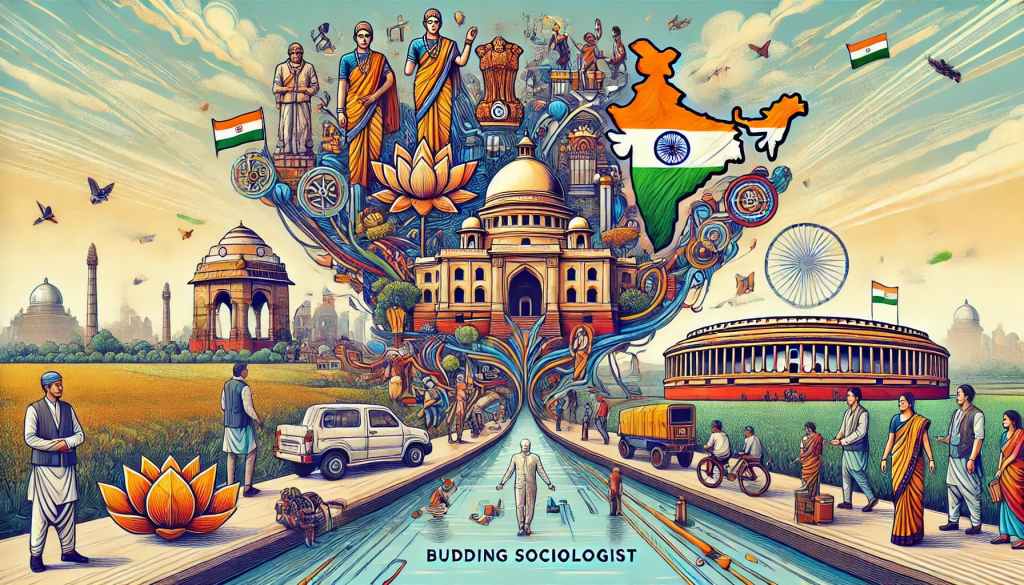
A society denotes a collective of individuals sharing a common geographical or social space, united by a cohesive political structure and prevailing cultural norms. Meanwhile, a polity signifies a discernible political entity within any organizational framework, characterized by a shared identity, institutionalized social arrangements, and the ability to leverage resources. Examples of such entities include corporate boards, governmental bodies, or administrative branches structured for governance.
India, renowned for its rich cultural tapestry, underwent a significant transformation during the colonial era with the influx of Western ideologies introduced by the British. This period witnessed a clash between traditional values and modernity, as some embraced Western lifestyles while reformers like Dayananda and Vivekananda sought to modernize Hindu traditions.
The infusion of Western ideals such as liberalism, individualism, and constitutionalism catalyzed political awareness and activism within Indian society. However, British colonial rule inflicted economic hardship and exploited societal divisions through divisive policies, hindering the burgeoning Indian nationalist movement. This era also saw the emergence of communal tensions, exacerbated in post-independence India.
Following independence, the new ruling elite aspired to propel India towards prosperity on par with developed nations. Consequently, there arose a collective endeavour among the populace to safeguard their interests through organized group participation. The Indian civil society evolved, exhibiting civic virtues and asserting autonomy from state authority, thereby safeguarding individual rights and fostering the creation of numerous autonomous associations.
The symbiotic relationship between the state and civil society ensures the protection of both governmental interests and citizen welfare. The democratic ethos ingrained in Indian civil society is reflected in the establishment of a democratic state and the enactment of a democratic constitution.
The Concept of State
For much of human history, societies thrived without centralized states, but around 5,500 years ago, significant shifts occurred with the rise of cities, the advent of writing, and the development of new religious practices. While political organizations like Greek city-states and the Roman Empire have ancient roots, the modern concept of the state emerged much later. This concept crystallized notably with Machiavelli in the early 16th century, who defined it as “the power which has authority over men,” marking a crucial distinction regarding the nature of governance rather than its ultimate purpose.
A state can be defined as a community permanently settled within a defined territory, possessing legal independence from external influence, and governed by an organized authority responsible for creating and enforcing laws within its jurisdiction. Essentially, the state is viewed as a natural, indispensable, and globally prevalent institution. Its naturalness stems from its alignment with fundamental aspects of human nature, while its necessity arises from its role in meeting essential societal needs and maintaining order. Without a governing authority, societies would descend into chaos and disorder due to the lack of regulation and control.
In essence, a state represents a political entity comprising a population within defined borders, exercising sovereignty, and wielding the power to enforce a system of laws. This system typically includes various legal instruments such as constitutions, statutes, regulations, and common law, through which the state governs its inhabitants.
Meaning of State
The term “state” has its roots in the Latin word “status,” which originally denoted a condition or circumstances. This Latin term, in turn, stems from “stare,” meaning to stand, remain, or be permanent, imbuing the concept with a sense of permanence or sacredness in the realm of politics. Broadly speaking, in English, “state” refers to the condition or circumstances in a political context.
During the resurgence of Roman law in 14th century Europe, the term began to encompass the legal status of individuals—be they noble, common, or clerical—and particularly highlighted the unique status of the king. The writings of Machiavelli, notably “The Prince” in the early 16th century, played a significant role in popularizing the contemporary usage of the term “state.”
Drawing from these historical understandings, one can assert that a state is a political structure wherein a society is organized under the governance of a recognized authority, which claims legitimate sovereignty over a defined territory, authority over all members of society, and the prerogative to employ physical force as needed to uphold its legitimate control.
Characteristics of State
The concept of a state encompasses four fundamental characteristics, each of which will be elaborated upon in the following discussion.
1. Population: Population stands as a pivotal attribute of a state, defining its strength and sustainability. A state requires a substantial populace, commonly known as citizens, to uphold its sovereignty. Inadequate population size leaves a state vulnerable, potentially unable to defend its autonomy against more populous adversaries. Conversely, states comprise individuals of varied races, nationalities, religions, languages, and customs, forming diverse but cohesive communities. While homogeneous groups might lack independent political standing, existing as constituents within larger states, the overall population encompasses diverse segments with varying political beliefs. Stability often lies within those segments sharing common political ideologies, contributing to the state’s cohesion.
2. Territory: Territory stands as a pivotal aspect in the formation of a state, marking a fundamental constituent element. While mere population alone does not suffice to stabilize a state, as evidenced by various communities such as nomads, gypsies, and roaming Jews who did not form states until settling permanently on land, common territory emerges as a significant cohesive force, fostering unity of action and behavior. It serves to unify both socially and politically. For any state, revenue is essential, yet unattainable without territory. The economic foundation stems from the land under the state’s jurisdiction. Authority over subjects can only be established within a defined territory where they reside. Territory holds significance in identifying a population within physical boundaries. Consequently, it can be asserted that territory is a prerequisite for a state, although there exists no fixed rule regarding the minimum required area for statehood.
3. Government: Government serves as a vital tool of the state, comprising the executive, legislative, and judicial branches alongside administrative agencies. It acts as the machinery through which the state upholds its presence, executes functions, and pursues its policies. However, it’s crucial to distinguish government from the state itself; while the state encompasses the entire populace, the government involves only a subset tasked with governance. The state endures as a near-permanent entity, whereas a specific government can be entirely replaced, as seen in revolutions, without eradicating the state’s existence, sovereignty, or rights. Even if a state succumbs to conquest or undergoes transformations, its international legal status remains unchanged. Governments may come and go, but states persist indefinitely.
4. Sovereignty: The state’s sovereignty, which constitutes its supreme political authority derived from its ability to control the use of force within its borders, is recognized by other nations. This sovereignty is defined by the state’s autonomy and power, which allows it to be bound only by its own will and not subject to external limitations.
The sovereignty of a state can be categorized into two aspects:
- Internal Sovereignty: This refers to the state’s exclusive authority within its territory, which is unrestricted.
- External Sovereignty: This aspect of sovereignty is subject to international laws and norms, governing the state’s interactions with other nations.
Through its sovereignty, a state asserts its laws and decisions through its government, expecting obedience from its citizens. Those who defy these laws are subject to punishment according to established legal norms. Additionally, sovereignty empowers the state to engage independently with other nations. As long as a state maintains its sovereignty, it remains a functioning entity.
Some researchers argue that a state possesses additional attributes or characteristics beyond the four mentioned earlier, which are outlined as follows:
1. Permanence: A state represents a lasting institutional structure. Once established, the framework of a state endures regardless of shifts in governance or territorial adjustments resulting from conflicts or diplomatic agreements. These changes may involve alterations in sovereignty, such as when Bangladesh gained independence from Pakistan. Despite such transitions, the populace remains rooted in the same geographical region. Therefore, while rulership may evolve, the fundamental existence of the state persists, demonstrating its enduring nature.
2. Unity: Unity entails that the individuals residing within a state’s borders should be governed by a singular political structure. The populace and land of a state are not eligible to be incorporated into any other sovereign entity.
3. Necessary Membership: Belonging to a state isn’t a choice but a requirement. Individuals residing within its defined geographical boundaries automatically become its members. It’s not possible for someone to be a member of more than one state simultaneously.
4. International Recognition: Numerous academics argue that international recognition is a vital prerequisite for a state. They contend that it is through gaining recognition from the international community that a state becomes part of the global diplomatic network and establishes formal relations with other nations. Conversely, there are dissenting voices among scholars who reject this perspective, asserting that international recognition holds no bearing on the status of states.
5. Continuity: The state is not a fixed entity but rather a dynamic institution that evolves over time. While the form of government within a state may undergo regular transformations, the state itself endures. Whether transitioning from monarchy to democracy or from one political party’s governance to another, the essence of the state persists. As per the principle of state succession, each new government inherits the obligations stemming from treaties and agreements made by its predecessor. Therefore, despite changes in leadership, the state maintains its continuity.
Based on the preceding explanation, it is evident that for an entity to qualify as a state, it must possess four fundamental characteristics: population, defined territory, a governing body, and sovereignty. Without any of these elements, it cannot be considered a state. While the mentioned supplementary aspects may contribute to an ideal state, they are not indispensable features in defining a state.
The Concept of Society
Society emerges from the intricate interplay of social relationships, which are cultivated through ongoing social interactions. These interactions, in turn, stem from social actions. Thus, society can be viewed as the culmination of these social actions. Social action is catalyzed by four fundamental elements: the actor, the goal or aim, the means, and the situation. These elements lay the groundwork for social interactions, ultimately shaping the formation of society.
A society represents a collective of individuals engaging in social interactions within a shared geographical or social space, often under a common political authority and prevailing cultural norms. Within societies, patterns of social relations define the interactions among members, contributing to the development of a distinctive culture and institutional framework. Additionally, societies may encompass subcultures, wherein like-minded individuals adhere to their own norms and values within the broader societal context.
Meaning of Society
The concept of society originates from the Latin term societas, derived from socius, meaning comrade, friend, or ally. It denotes a connection or interaction among individuals that is friendly or, at the very least, civil. It encompasses humanity as a whole, referred to as society in general or society at large, although those exhibiting unfriendly or uncivil behaviours may be deemed anti-social.
In the context of an association, society represents a group of individuals characterized by functional interdependence, often including aspects such as national or cultural identity, social solidarity, language, or hierarchical structure. Specifically within sociology, society refers to a social group that enables its members to achieve benefits not attainable on an individual basis.
From these definitions, it can be inferred that society is a network of social relationships shaped by individual actions and interactions. Throughout history, societies have evolved towards more complex forms of organization and control, influencing cultural and communal patterns. For instance, hunting and gathering tribes settled to form agrarian villages, which later developed into towns and cities, eventually evolving into city-states and nation-states.
Characteristics of Society
The concept of society can be comprehended from both narrow and broad viewpoints. In a narrow sense, society denotes a collective of individuals, while in a broader sense, it encompasses the entirety of human society. For a society to exist, it necessitates a population; without a collective of individuals, no society can emerge. However, society doesn’t merely denote a gathering of people but rather a complex network of social relationships. The formation of these social relationships requires individuals engaging in social actions and interactions. Understanding society can be facilitated by examining its defining characteristics:
1. Similarity stands as the cornerstone of society, as noted by Maclver, who emphasized that a society thrives on the sense of similarity among its members. Without this shared likeness, there can be no mutual recognition of belonging together, thus rendering the concept of society void. This sense of similarity permeates through fundamental social institutions such as kinship, family, and marriage, providing the very foundation for their existence. Moreover, friendship, intimacy, and various forms of association rely heavily on this “consciousness of kind.”
2. In tandem with likeness, differences play a crucial role in shaping societies. Diversity is inherent to social relationships and is just as essential as similarity. It’s the interplay of differences of all kinds that shapes the fabric of society. For instance, the family unit, often considered the first society, is built upon biological distinctions and variations in aptitude, interest, and capacity.
3. Interdependence emerges as another pivotal characteristic of society, evident in all facets of contemporary social structures. Aristotle’s notion of humans being inherently social beings underscores the necessity of dependency on others for survival and well-being. No individual exists in isolation; instead, reliance on others for basic needs such as food, shelter, and clothing is inevitable. This interdependence extends not only to individuals but also to groups, communities, and societies at large.
4. Cooperation and conflict coexist within society, each playing distinct yet interconnected roles. Cooperation is indispensable for the formation and sustenance of society, fostering harmony and averting mutual destruction. Conversely, conflict serves as a catalyst for strengthening social bonds, contributing to the cohesion of society. In a healthy societal framework, both cooperation and conflict are integral components, facilitating the formation and evolution of social structures.
5. Social relationships serve as the bedrock of society, forming intricate networks essential for its existence. Maclver’s depiction of society as a web of social relationships underscores the mutual awareness and recognition upon which these relationships are based. As society is characterized by abstract social processes such as cooperation and conflict, its nature too is abstract, shaped by the complex interplay of these relationships.
6. Permanence distinguishes society from transient gatherings of individuals; it persists beyond the lifespans of its members, representing a cohesive and enduring entity. Furthermore, society’s abstract nature, as highlighted by Maclver, transcends tangible manifestations, encompassing customs, traditions, and cultural elements that contribute to its essence.
7. Dynamicity defines the nature of society, marking it as ever-evolving and adaptable. Societal norms, values, and institutions undergo continual transformation, transitioning from traditional to modern paradigms. This inherent dynamism is intrinsic to the societal framework, facilitating growth and adaptation in response to changing circumstances.
8. Culture serves as a defining characteristic of society, encapsulating its unique way of life and identity. Each society boasts its distinct cultural patterns, encompassing values, beliefs, art, and morals that distinguish it from others. This comprehensive cultural framework fulfills the social needs of its members, perpetuating its essence across generations.
9. Finally, society transcends the mere aggregation of individuals, embodying a collective entity greater than the sum of its parts. Durkheim’s assertion that society surpasses individual components underscores its holistic and multifaceted nature, emphasizing the interconnectedness and interdependence inherent in societal structures.
Based on the preceding description, it’s evident that human existence relies on society, just as societies rely on their members. Although conflicts between individuals and society can arise, adherence to societal norms generally enhances the functionality of social systems. Society plays a crucial role in shaping human personality, as individuals often embody the values and norms imparted by their social environment.
Differences Between State and Society
Following is the difference between state and society:
1. Society has Wider Scope than State: Society encompasses a vast network of human interactions across various realms, including social, economic, cultural, political, moral, and religious spheres, among others. It arises from the myriad relationships that form and evolve among its members. In contrast, the state is a specific political entity or institution primarily focused on wielding power within society. It represents the sovereign authority of the social order.
2. Society comes first: Society finds its foundation in the inherent traits of human beings. Being social creatures by nature, individuals instinctively forge social bonds, giving rise to communities. The genesis of society dates back to antiquity, emerging during humanity’s earliest epochs. Similarly, the institution of the state boasts a lengthy historical lineage, universally acknowledged to have emerged subsequent to the establishment of societal structures. The imperative to safeguard these social bonds and ensure order paved the way for the inception of the state. It arose following the progression of society towards a settled, territorially defined community of individuals.
3. State is Organised: A state embodies a structured political entity formed by its populace, exercising sovereignty over a defined territory. In contrast, society represents the inherent cohesion among individuals through social bonds, encompassing organized and unorganized groups, their interactions, and activities. It comprises the intricate web of human relationships within a community. The state serves as the organized political expression of a society’s people, residing within a specific geographical region.
4. Government is the Agency of the State; Society has no Agency: The state operates via its governmental apparatus, which serves as its representative entity, wielding the state’s sovereignty. In contrast, society operates differently—it functions as a self-regulating network of relationships, guided by customs, traditions, and innate moral codes, without a formal organizational structure or intermediary agent.
5. Sovereignty Belongs to State and not to Society: Sovereignty stands as the cornerstone and defining feature of a State. It uniquely wields ultimate authority over its populace and institutions. Serving as the guardian of law and order, the State’s regulations hold sway over every member of society. Society, in turn, operates as a complex network of social interactions.
6. Territory Belongs to State and Not to the Society: A state is characterized by its territorial jurisdiction, an integral aspect of its identity. Unlike society, which lacks a defined territory, even individuals without a fixed abode, connected by social bonds, form a society. For instance, non-resident Indians who acquire citizenship in other countries still maintain ties with Indian society.
7. Difference in Approach to Human Behaviour: Society and state each focus on distinct facets of human behavior. The state primarily attends to external conduct, enforcing laws that govern the actions of individuals, groups, institutions, and organizations. Utilizing its coercive authority, it responds to any infractions of these laws. Conversely, society encompasses a broader spectrum, addressing all dimensions of human behavior and interpersonal dynamics. Social norms, customs, and moral principles guide interactions across various levels of society, from individual to national contexts.
8. Different Disciplines for Scientific Study: Sociology examines society, while political science focuses on the state. In sociology, the primary focus lies in understanding social relations, whereas political science centers on analyzing state structures and political dynamics. However, there is a significant overlap between the two disciplines. Political science delves into social relations as they pertain to the state, while sociology considers political institutions as integral components of society.
The relationship between state and society is intricate yet interconnected. The state’s function revolves around upholding laws, maintaining order, and ensuring societal security. Its authority extends to regulating various social interactions. Conversely, social dynamics significantly influence political affairs. Factors such as caste, religion, family structure, customs, and ethnicity all play crucial roles in shaping political landscapes.
Thus, while state and society possess distinct characteristics, they are deeply intertwined. The state serves to govern and stabilize society, while societal elements exert considerable influence on political processes.