Claude Levi‐Strauss
- Structural Anthropology: An Introduction
- Structure of the Human Mind
- Levi-Strauss’s Analysis of Myth
- Key Concepts in Levi-Strauss’s Analysis of Myth
- Structural Analysis of Levi-Strauss’s Theory of Kinship
- Aspects of Levi-Strauss’s Theory of Kinship
- Core Components of the Structural Analysis of Kinship
Structural Anthropology: An Introduction
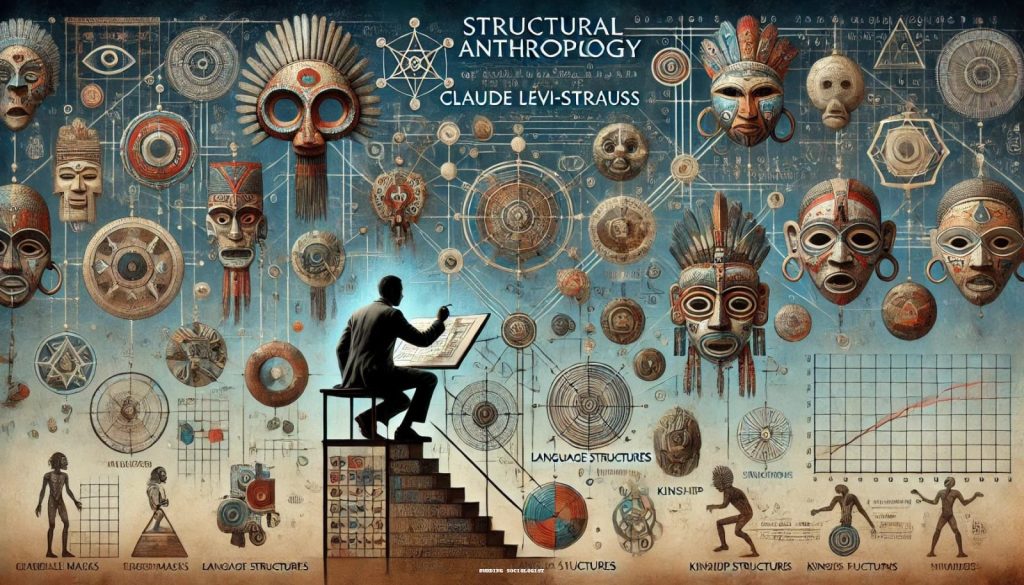
Claude Levi-Strauss is widely recognized for establishing structural anthropology, a theoretical approach that uses structuralist ideas to analyze human culture and society. Influenced by fields such as linguistics, sociology and psychology, he aimed to reveal the fundamental patterns that govern human thinking and behaviour across different cultures.
Structural anthropology, posits that the human mind organizes cultural phenomena using universal structures that transcend individual societies. Drawing inspiration from the structuralist movement in linguistics, particularly the work of Ferdinand de Saussure, Levi-Strauss argued that human cognition is fundamentally shaped by binary oppositions (pairs of opposing concepts that structure thought and culture). These oppositions, such as raw/cooked, nature/culture and male/female, serve as a lens for understanding the deeper principles that govern social systems, myths and rituals.
One of Levi-Strauss’s key contributions was his application of structuralism to the study of kinship, mythology and cultural practices. His work on kinship systems revealed how societies maintain order through systems of exchange and reciprocity, particularly in marriage alliances. He explored how incest taboos are not just moral rules, but part of a broader social exchange system aimed at creating alliances between groups. This concept of exchange extended beyond marriage into various social and economic relationships, influencing patterns of cooperation and conflict within communities.
Levi-Strauss also applied his structural approach to the study of myths. In his influential work Mythologiques, he demonstrated that myths, despite their cultural differences, share fundamental structural similarities. By deconstructing myths into their basic components, such as characters’ roles and the relationships between events, he identified recurring patterns that reflect universal human concerns and cognitive structures. These patterns, according to Levi-Strauss, reveal how humans navigate contradictions in their understanding of the world, such as the tension between nature and culture or life and death.
Beyond kinship and mythology, Levi-Strauss’s structuralism impacted various fields, including; linguistics, philosophy and art. He emphasized that human cultures are interconnected through shared cognitive structures, regardless of geographical or historical context. His focus on universal patterns provided a framework for viewing human societies as interconnected systems of meaning, where each cultural element contributes to social unity.
Structure of the Human Mind
Claude Levi-Strauss’s structural anthropology emphasizes the notion that universal cognitive structures guide human thought. According to him, these structures rely on binary oppositions, which people use to understand and interpret the world around them. He proposed that such oppositions are not limited to specific cultures but are fundamental to human cognition, manifesting in myths, rituals, language and various other cultural phenomena. The structure of human mind has been described by Strauss as follows:
1. Binary Oppositions: Levi-Strauss proposed that the human mind naturally organizes information through contrasting pairs, which are fundamental for interpreting and classifying experiences. These binary oppositions create meaning by defining concepts in relation to their opposites. Common examples include:
- Life vs Death: A core dichotomy in human existence, often reflected in rituals, myths and philosophical traditions worldwide.
- Nature vs Culture: A key distinction in anthropology, with nature symbolizing the unaltered and innate, while culture represents human influence, norms and transformation.
- Raw vs Cooked: Examined in Levi-Strauss’s The Raw and the Cooked (1964), this pair symbolizes the transformation of the natural (raw) into the cultural (cooked), serving as a metaphor for the shift from nature to culture.
- Good vs Evil: A universal contrast shaping moral systems, myths and religious ideologies.
These oppositions illustrate a shared human tendency to categorize and structure knowledge.
2. Universal Cognitive Structures: Levi-Strauss proposed that all humans, regardless of their cultural backgrounds, share the same fundamental mental processes and structures. These universal structures go beyond individual or cultural distinctions. He highlighted the following key points:
- Human Thought Is Logical: Human reasoning is inherently logical across all societies, including those considered “primitive.” The primary difference lies in the areas of focus, modern societies emphasize scientific reasoning, while traditional societies prioritize myths and symbolic systems.
- Unconscious Processes Influence Culture: Cultural phenomena such as myths and rituals stem from unconscious cognitive mechanisms. These shared mechanisms explain why similar themes and patterns appear across diverse human societies.
3. Manifestation in Myths and Culture: Levi-Strauss utilized his understanding of cognitive structures to examine myths, kinship systems and various cultural phenomena.
- Myths: Levi-Strauss proposed that myths are structured narratives that reflect the universal logic of human thought, often addressing binary oppositions through storytelling. For example, creation myths commonly illustrate the transition from chaos, representing nature, to order, symbolizing culture, typically achieved through the actions of a divine being. Similarly, myths surrounding life and death, such as resurrection myths, explore the tension between mortality and immortality, offering resolutions to these fundamental opposites.
- Rituals: Rituals serve as symbolic actions that bridge and resolve opposites, such as purity versus impurity or the sacred versus the profane.
- Food Practices: Food preparation exemplifies the cognitive structures underlying human thinking. In The Culinary Triangle, Levi-Strauss illustrated how societies categorize food into three groups—raw (nature), cooked (culture) and rotted (a transformation gone wrong)—and how these classifications reflect deeper cultural meanings.
4. Nature of Binary Oppositions: Levi-Strauss often identified oppositions that exhibit the following characteristics:
- Hierarchical: One element in the pair typically holds a dominant or preferred position. For example, culture is frequently regarded as superior to nature and cooked food is considered more refined than raw food.
- Interdependent: The elements are mutually defining and cannot exist in isolation. For instance, “life” gives meaning to “death,” just as “cooked” derives its significance from “raw.”
Through the study of these oppositions, Levi-Strauss revealed the underlying structures that shape cultural systems.
Levi-Strauss’s structural anthropology is rooted in the concept of the human mind’s organization. By focusing on binary oppositions and universal patterns of cognition, he highlighted the inherent logic and structure in human thought. These underlying principles, evident in myths, rituals and cultural traditions, offer a way to comprehend the common cognitive foundations that unite humanity across different cultures.
Levi-Strauss’s Analysis of Myth
Claude Levi-Strauss’s analysis of myth stands as a key contribution to anthropology. He viewed myths not simply as stories or cultural relics, but as complex systems of meaning shaped by universal patterns of human cognition. Myths are universal cultural expressions shaped by shared cognitive frameworks inherent to all humans. Levi-Strauss regarded myths not simply as narratives but as complex systems of meaning that reveal how people structure and interpret their understanding of the world.
Myth is amongst one of his most salient works is his study of Myths. Strauss asserts that myth operates as an independent form of logic. While myths may appear logically irrational, they exhibit remarkable consistency and recurrence across various cultures. Unlike jokes or fables, the core meaning of a myth remains largely intact even when translated. Through the lens of structuralism, Strauss explains this phenomenon by emphasizing the role of differences and relationships in shaping meaning.
His primary interest was in these structures which are presented in the myths itself. It is a language itself and is similar to them. According to Levi-Strauss, a myth also has its language which is the synchronous structure which enables the specific parole of a certain myth. While details about the myths, may vary from myth to myth, the structure remains the same.
Like his anthropological theories, Lévi-Strauss viewed myths as a form of communication that could reveal the structure of language. His work is a structuralist theory of mythology which attempted to explain how seemingly fantastical and arbitrary tales could be so similar across cultures. Because he believed that there was no one “authentic” version of a myth, but they all were the manifestations of the same language, he sought to find the fundamental units of myth, namely, the mytheme.
A mytheme represents the smallest unit of meaning within a myth, analogous to a morpheme in linguistics. Just as morphemes combine to form words, mythemes combine to create the larger narrative structure of a myth. Levi-Strauss argued that these basic units of myth are universal and can be understood as part of a deeper cognitive structure shared across human cultures. These mythemes are combined in particular ways to form the overarching structure of a myth. For example, in myths about cultural heroes, recurring mythemes might include extraordinary birth, the overcoming of significant obstacles and the hero’s role in establishing or restoring order.
Levi-Strauss broke each of the versions of a myth down into a series of sentences, consisting of a relation between a function and a subject. Sentences with the same function were given the same number and bundled together. These are mythemes. What Levi-Strauss believed he had discovered when he examined the relations between mythemes was that a myth consists of connected binary oppositions.
Inspired by Hegel, Lévi-Strauss argued that the human mind naturally structures thought through binary oppositions, which are then reconciled through a process akin to the thesis-antithesis-synthesis model. This framework, he believed, is essential for the creation of meaning. Furthermore, he considered the job of myth is to work to connect an irreconcilable (irrelevant) binary opposition with a reconcilable (relevant) binary opposition by removing illusion and establishing belief.
Lévi-Strauss recognized an inherent contradiction in the analysis of myths. On one hand, myths appear to be highly imaginative and unpredictable, with seemingly arbitrary content. On the other hand, myths from diverse cultures often share striking similarities. While it may seem that anything can happen in a myth, this sense of randomness is contradicted by the remarkable consistency observed in myths from different parts of the world. This raises an important question: if myths are created independently and their content is not predetermined, how can we account for their widespread similarities?
Lévi-Strauss argued that myths are shaped by universal laws governing human thought, which help resolve this paradox by generating similar narratives across cultures. While each myth appears unique, he suggested that it is merely a variation of an underlying universal structure. His approach to myth analysis sought to bring order to seemingly arbitrary details and uncover the deeper patterns that impose a kind of necessity beneath the illusion of randomness.
According to Lévi-Strauss, “mythical thought always progresses from the awareness of oppositions toward their resolution.” In simpler terms, myths are structured around:
- Contrasting or opposing elements
- Additional elements that serve to mediate and reconcile these oppositions
This theory about the structure of myth helps support Levi-Strauss’s more basic theory about human thought. According to this basic theory, universal laws govern all areas of human thought. Myths are deep rooted in the arbitrariness of human mind which is uncontrolled one and being regulated by the basic rule and on the basis of that rule (s), the structure of the society is being operated at psychological as well as in form of manifestation at societal level. If the human mind appears determined even in the realm of mythology and also must be determined in all its spheres of activity.
Out of all the products of culture, myths seem the most fantastic and unpredictable. Therefore, Levi-Strauss claims, if even mythical thought obeys universal laws, then all human thought must obey universal laws.
Key Concepts in Levi-Strauss’s Analysis of Myth
Claude Levi-Strauss introduced a transformative approach to understanding myths, emphasizing their structure and function in reflecting universal patterns of human thought. He argued that myths, much like language, operate as systems of meaning, addressing fundamental questions and contradictions inherent to human existence. His structuralist perspective revealed that myths are not arbitrary tales but are systematically constructed narratives that serve as tools for understanding the world and mediating its complexities and can be described in detail as follows:
1. Myths as Systems of Meaning: A central element of Levi-Strauss’s perspective is the notion that myths serve to resolve binary oppositions, such as life versus death, nature versus culture or male versus female. These oppositions reflect profound tensions in human thought and myths act as tools to mediate or symbolically reconcile these conflicts. For instance, a myth might portray a hero restoring order out of chaos, representing the victory of culture over nature or life over death. Through these symbolic resolutions, myths enable societies to make sense of complex realities and maintain cultural unity.
2. Binary Oppositions in Myth: Levi-Strauss proposed that myths are structured around binary oppositions, which mirror the way humans inherently categorize and interpret the world. These opposites represent universal mental patterns that influence cultural storytelling. Myths often address the interplay between these contrasting forces, offering narratives that either resolve or transform them. For example, a myth might illustrate the tension between nature and culture, symbolized by the contrast between untamed wilderness and cultivated land and resolve it through an act like domesticating a wild animal. These patterns and their resolutions are not confined to a single culture but appear in various forms across the myths of different societies, highlighting the universal cognitive frameworks shared by humanity.
3. Structure of Myths – The Myth as a Language: Levi-Strauss compared myths to language, asserting that both share an underlying structure that can be examined systematically. He introduced the concept of “mythemes,” the basic units of meaning in myths, which parallel phonemes in linguistic systems. These mythemes are combined in particular ways to form the overarching structure of a myth. For example, in myths about cultural heroes, recurring mythemes might include extraordinary birth, the overcoming of significant obstacles and the hero’s role in establishing or restoring order. Although the specific details of myths differ across cultures, the relationships between mythemes tend to remain consistent. This structural approach enabled Levi-Strauss to show that myths, no matter their cultural background, adhere to a universal “grammar” that mirrors the cognitive patterns of the human mind.
4. Transformation of Myths: Levi-Strauss noted that myths evolve as they are recounted across different cultures, adapting to the unique circumstances of each society while preserving their core structure. He referred to this process as myth transformation, emphasizing the fluidity of myths and their ability to address universal themes in ways that resonate with specific cultural contexts. For instance, one society’s creation myth might feature a deity shaping the world from chaos, while another might tell of a hero conquering a chaotic beast to bring about creation. These variations reveal how myths reflect the historical, environmental and cultural realities of a society while maintaining an underlying framework.
5. The Function of Myths: Myths play a crucial role in human societies by offering symbolic resolutions to complex contradictions and uncertainties that are difficult to confront directly. These narratives provide explanations for various natural and social phenomena, such as the creation of the universe, the changing seasons or the foundations of societal rules. Myths also serve as behavioural guides, reinforcing ethical principles and maintaining social harmony. According to Levi-Strauss, myths are not merely sources of entertainment or simple explanations; they function as cultural frameworks for organizing and interpreting the complexities of life. By addressing fundamental questions about existence, morality and humanity’s connection to nature, myths help sustain the coherence and longevity of cultural traditions.
On the basis of above description, it can be stated that Levi-Strauss’s structural analysis of myths marked a significant departure from earlier approaches, shifting attention from the content of myths to their underlying structure. By revealing the universal patterns that shape myths, he offered a new way to understand the shared cognitive frameworks of human societies.
In other words, his work demonstrated that myths are not isolated cultural artifacts but part of a broader system of thought that reflects the universal nature of human cognition. Although some critics have argued that his structuralist approach can be overly abstract or deterministic, his contributions have had a lasting impact on the fields of anthropology, mythology, and cultural studies, providing valuable insights into the ways humans make sense of their world.
Structural Analysis of Levi-Strauss’s Theory of Kinship
Claude Levi-Strauss’s analysis of kinship remains one of his most significant contributions to anthropology, offering a systematic way to understand how social relationships are organized within human communities. Grounded in structuralism, his approach focuses on the universal patterns that underpin kinship systems across diverse cultures. Unlike earlier anthropologists who emphasized kinship as a biological or genealogical concept, Levi-Strauss treated it as a symbolic system governed by cognitive and cultural rules. He highlighted the role of exchange and reciprocity as fundamental mechanisms for promoting alliances and maintaining social order.
At the core of his theory lies the incest taboo, which Levi-Strauss interpreted not as a moral or biological constraint but as a universal rule compelling individuals to seek marriage outside their immediate family. This prohibition transforms biological relationships into a system of social exchange, promoting alliances between families, clans or tribes. By enforcing these taboos, societies create a network of mutual dependence, with the exchange of women serving as a tool to establish cooperation and solidarity. Levi-Strauss referred to this dynamic as the “exchange of women,” underlining its significance in promoting social unity.
He also differentiated between two key types of kinship systems: restricted exchange and generalized exchange. In restricted exchange, two groups are directly involved in reciprocal relationships, exchanging women exclusively with one another. Generalized exchange, on the other hand, involves more complex systems where women are circulated among multiple groups, creating broader and more complex networks of alliances. Levi-Strauss argued that generalized exchange facilitates greater social integration and stability, particularly in larger societies.
A notable aspect of Levi-Strauss’s theory is his interpretation of kinship as a form of symbolic communication. He proposed that, similar to language, kinship systems operate through shared symbols and rules, making them an integral part of a society’s cultural framework. Kinship terms, marriage customs and family roles are not isolated phenomena; rather, they interact with myths, rituals and other social practices to reveal the underlying cognitive structures shaping human relationships.
Nonetheless, Levi-Strauss’s insights into kinship have left a profound and enduring impact on anthropology. By reinterpreting kinship as a symbolic and structural system rather than a purely biological one, he provided a fresh perspective on how societies function. His ideas continue to inspire research into the connections between social organization, culture and cognition, solidifying his legacy as a foundational thinker in the study of kinship and social systems.
Aspects of Levi-Strauss’s Theory of Kinship
Using a structuralist approach, Levi-Strauss highlighted the symbolic and interconnected aspects of kinship, uncovering their underlying and often concealed patterns and these aspects are being described in detail as follows:
1. The Basis of Kinship in Structuralism: Claude Levi-Strauss’s theory of kinship is a cornerstone of his structuralist perspective, which suggests that universal structures underlie all human cultures. He viewed kinship not merely as a product of biological connections but as an complex system of social organization and symbolic meaning. Kinship systems serve to regulate social relationships, manage resources and forge alliances between groups within a society. By emphasizing the cultural and symbolic dimensions of kinship, Levi-Strauss proposed that it is possible to identify universal patterns that influence the structure of human societies, regardless of their unique traditions or behaviours.
2. Kinship as a Cultural Construct: Levi-Strauss challenged the notion that kinship is purely a biological or natural phenomenon, proposing instead that it is fundamentally a cultural construct. Although all human societies recognize biological ties, the ways in which these relationships are understood and managed vary greatly across cultures. He asserted that kinship systems are primarily symbolic and cultural, governed by norms that structure family relationships, social roles and community dynamics. For instance, while the bond between parents and children exists universally, the cultural interpretations and associated practices (such as inheritance rules or caregiving roles) differ significantly from one society to another. This perspective underscored that kinship is shaped more by societal customs, values and organization than by biological factors alone.
3. Linguistic Influence – Kinship as a System of Signs: Levi-Strauss was deeply influenced by structural linguistics, especially the ideas of Ferdinand de Saussure. Saussure proposed that language functions as a system of signs, where meaning is generated through the relationships between words. Levi-Strauss extended this concept to kinship, arguing that it operates in a similar way, governed by rules and structures that dictate how social bonds are formed and understood. In this view, kinship systems are made up of interconnected “signs” that function within a larger cultural system. The structure of kinship, then, is not separate but part of an overarching code that shapes human social behaviour. Levi-Strauss made a distinction between langue, the underlying set of rules and parole, the specific expressions of kinship in various societies. In this analogy, the rules of kinship are akin to the “grammar” that dictates social relations, while the actual kinship practices observed in different cultures are like the “speech acts” in language. Although marriage, inheritance and family roles may differ across societies, these variations are simply different manifestations of universal rules that govern kinship. This approach allows for the analysis of kinship systems as complex webs of meaning, where individuals’ relationships are shaped and communicated through shared social norms.
4. Universal Patterns in Kinship Systems: Levi-Strauss contended that, despite the vast diversity of kinship systems across cultures, there are common structural patterns that form the foundation of all human societies. These patterns are ingrained in human cognition and shape the way social relationships are classified and organized. One of the key universal principles he identified is the incest taboo. Levi-Strauss proposed that this prohibition goes beyond the biological rationale of avoiding genetic defects; it serves as a cultural imperative that structures social life. The incest taboo compels individuals to marry outside their immediate family, promoting alliances between different groups. This, in turn, prevents social isolation and encourages cooperation and solidarity across communities. Additionally, Levi-Strauss highlighted the importance of reciprocity. Reciprocity refers to the exchange of goods, services or even individuals, particularly in marriage arrangements. These exchanges establish mutual obligations, contributing to social cohesion. The exchange of women in marriage alliances plays a vital role in this reciprocity, creating bonds of alliance and unity.
5. The Transition from Nature to Culture: Levi-Strauss’s structuralism emphasizes that kinship marks the shift from nature to culture. He contended that human societies do not simply mirror biological connections, but rather actively construct and interpret these relationships through cultural norms and practices. Kinship, in this regard, becomes a key area where the division between the natural and the cultural is clearly visible. While humans share certain biological instincts with animals, it is the cultural regulation of these instincts (such as the prohibition of incest and marriage rules) that allows society to bring order to human connections. The incest taboo is particularly significant in this transformation. By forbidding sexual relations within specific family boundaries, it compels individuals to form marital ties beyond their immediate family. This practice of exogamy creates bonds between different groups and introduces a cultural framework to biological functions like reproduction. Thus, kinship is more than a reflection of biological ties; it is a complex cultural system that structures and governs human interactions.
6. Kinship and Communication: Levi-Strauss viewed kinship as a form of communication, akin to language, which facilitates the exchange of ideas and the formation of social connections. Just as language enables the sharing of abstract concepts and the development of social bonds, kinship systems allow individuals and groups to communicate and negotiate their social interactions. These systems, with their specific rules and symbols, play a crucial role in establishing and maintaining relationships. Kinship practices, such as bride exchange or the giving of gifts, act as communicative acts that convey social responsibilities, strengthen alliances and promote group solidarity. Through kinship, individuals and groups can bridge social divides, form alliances and address conflicts. As such, kinship is not limited to personal relationships but extends to the broader network of connections between different groups. The complex frameworks of marriage, inheritance and kinship roles serve as communication tools that manage the distribution of resources, information and social capital within and between communities.
In conclusion, Levi-Strauss’s kinship theory, framed within structuralism, reconceptualizes kinship as a set of cultural and symbolic practices beyond biological connections. By treating kinship as a cultural construct and a system of signs that reflects universal structures, Levi-Strauss provided fresh insights into how societies organize relationships, build social bonds and maintain social unity. His approach challenges reductionist, biological interpretations of kinship, highlighting the complex influence of culture in shaping human social dynamics.
Core Components of the Structural Analysis of Kinship
Claude Levi-Strauss’s structural approach to kinship explores the universal structures and patterns that define kin relationships and their function in promoting social unity. He views kinship systems not merely as biological connections but as symbolic structures influenced by exchange and relational principles. Central to Levi-Strauss’s analysis are concepts such as alliance theory, the incest taboo and reciprocity, all of which are essential for comprehending the operation of kinship systems in different societies. The following provides a detailed exploration of these crucial elements:
1. Alliance Theory – Kinship as a System of Exchange: Levi-Strauss’s structural analysis centers on alliance theory, which views kinship not merely as a web of family relationships but as a system for forming social alliances between distinct groups. This approach differs from descent theory, which focuses on family lineage as the foundation of kinship and being described as follows:
1.1 Kinship as a Mechanism of Social Exchange: Levi-Strauss contended that kinship systems are primarily based on the concept of exchange. He suggested that marriage goes beyond the mere union of two individuals and functions as a social transaction that forges alliances between various groups, such as clans, tribes or families. This process of exchange plays a crucial role in establishing and sustaining social connections that extend beyond the immediate family unit. For example, in numerous traditional societies, marriage exchanges involve transferring women from one group to another. In this context, women serve as a means to create and reinforce alliances between different groups. Such exchanges contribute to intergroup solidarity and promote enduring social unity.
1.2 Women’s Role in Creating Alliances: Levi-Strauss highlighted that women are often seen as the “objects” exchanged between groups. While this perspective is contentious and criticized for portraying women as passive participants, it remains a core element of his theory on kinship as a means of maintaining balanced social relations between various groups. According to his analysis, The exchange of women serves as a cornerstone of social order, facilitating the establishment of enduring intergroup relationships.
Marriage alliances help prevent internal strife by strengthening ties with external groups, as demonstrated by practices like cross-cousin marriage, where such unions play a vital role in forming intergroup alliances.
2. The Incest Taboo – Social Regulation and Cultural Transformation: A central element of Levi-Strauss’s theory is his exploration of the incest taboo, which he viewed as a key characteristic of all human societies. He suggested that the prohibition of incest is not merely a biological or natural restriction but a cultural practice that helps shape and control social relationships.
2.1 The Prohibition of Incest: The incest taboo refers to the prohibition against sexual relationships or marriage between close relatives. Levi-Strauss regarded this rule as a universal feature across cultures, positing that its main function is to regulate marriage alliances and promote social bonds between different families or groups. By banning incest, societies encourage individuals to form unions outside their immediate family, promoting exogamy (marriage outside the group). This process ensures that marriages are exchanges between distinct groups, thereby enhancing social interaction and cooperation across different communities.
2.2 Transforming Nature into Culture: Levi-Strauss saw the incest taboo as a symbol of the transition from nature to culture. While humans possess innate biological urges that might lead to relationships within their families, the incest taboo acts as a cultural rule that channels these impulses into socially structured exchanges. This cultural prohibition is foundational for establishing social networks beyond the family unit, facilitating the creation of intergenerational and intergroup alliances that help sustain social order and reduce conflicts.
3. Reciprocity and Exchange – The Basis of Social Interaction: Levi-Strauss’s structural analysis of kinship emphasizes the concept of reciprocity, which he viewed as central to the organization of society. He extended the idea of exchange beyond the mere trade of goods and services, suggesting that the exchange of women, children and labour within kinship structures forms the foundation of social order.
3.1 Forms of Reciprocity: Levi-Strauss categorized reciprocity into different types that shape kinship exchanges:
3.1.1 Generalized Reciprocity: In this form, exchanges are not immediate or direct. For example, a parent may care for a child without expecting anything in return right away. Over time, however, the child may reciprocate the care as they age, such as providing care for the parent in their later years. This type of reciprocity helps sustain familial bonds and contributes to long-term social harmony.
3.1.2 Balanced Reciprocity: This involves direct exchanges with the expectation of an equal return within a short time frame. A common example is the exchange of bride prices or dowries, where the value of what is exchanged is carefully balanced. These transactions strengthen social bonds and reinforce solidarity within the group.
3.1.3 Negative Reciprocity: Unlike generalized or balanced reciprocity, negative reciprocity involves exchanges where one party seeks to gain more than the other, often through deceit or exploitation. This can occur in familial conflicts or rivalries and may disrupt social norms, leading to tensions within and between groups.
3.2 Reciprocal Exchanges and Kinship Duties: Kinship systems are fundamentally shaped by reciprocal exchanges, especially those linked to marriage, which are essential for maintaining social order. The exchange of women between families or groups promote social connections and creates obligations between different kin groups. For instance:
3.2.1 Bride-wealth or Dowries: In many cultures, bride-wealth involves the groom’s family offering gifts or money to the bride’s family, symbolizing the exchange of women and establishing inter-family alliances.
3.2.2 Reciprocity in Alliances: When one family gives a woman in marriage to another, they typically expect a similar exchange in return, completing a cycle of reciprocity that strengthens social ties.
3.3 Social Unity and Integration: Levi-Strauss’s focus on reciprocity underscores the importance of kinship systems in promoting social unity. By creating obligations and alliances through marriage exchanges, kinship structures ensure that families are interconnected and depend on each other. This interdependence helps integrate the broader social structure and prevents fragmentation.
On the basis of above description, it can be stated that Levi-Strauss’s structural analysis of kinship reveals the underlying principles and universal frameworks that shape how societies structure relationships, exchange resources and uphold social order. Central to this theory are the concepts of alliance, the incest taboo and reciprocity. By examining these elements, Levi-Strauss illustrated how kinship serves as a symbolic system that reconciles individual desires (like sexual relations) with societal needs (such as forming alliances). The primary goal of these structures is to preserve balance, unity and unity within human communities.
References:
Structural Anthropology by Claude Levi-Strauss, https://a.co/d/2uALOeO
Unit 3, IGNOU Study Material, https://egyankosh.ac.in/bitstream/123456789/90652/1/Unit-3.pdf