- Biographic sketch of Talcott Parsons
- System Theory of Talcott Parsons
- Pattern Variables of Talcott Parsons
- AGIL Model of Talcott Parsons
Biographic Sketch of Talcott Parsons
Talcott Parsons stands as a pivotal figure in American sociology during the 20th century, belonging to the classical sociological tradition. He is renowned for laying the groundwork for the modern functionalist perspective. His notable contributions include the development of social action theory and structural functionalism, where he delved into the intricacies of the socialization process to elucidate the interplay between individual personality and societal structure. His pioneering work not only advanced social theory but also facilitated interdisciplinary fusion, merging clinical psychology and social anthropology with sociology to establish a comprehensive school of social thought.
In his seminal work, “The Structure of Social Action” (1937), Parsons extensively studied and synthesized the ideas of Max Weber, Emile Durkheim, and Vilfredo Pareto, forging a cohesive framework for understanding social action. Emphasizing a voluntaristic principle, he proposed that choices among alternative values and actions must possess a degree of freedom. This synthesis significantly impacted the foundational concepts of various disciplines within modern sociology, reshaping intellectual discourse across both the United States and Europe.
Role of Parsons in Academics
Parsons is widely recognized for his contributions to sociology, yet his influence extends beyond this discipline. He diversified his academic endeavours by offering courses and enriching various fields such as economics, race relations, and anthropology. Central to his scholarly pursuits was the framework of structural functionalism, which aimed to comprehend society through a cohesive theoretical lens.
Talcott Parsons left an indelible mark on sociology through his seminal theories. Notably, he formulated the “sick role” theory within medical sociology, drawing insights from psychoanalysis. This concept delves into the societal dynamics surrounding illness, encompassing both privileges and responsibilities. Furthermore, Parsons played a pivotal role in crafting “The Grand Theory,” a comprehensive endeavour to amalgamate disparate social sciences into a unified framework. His overarching objective was to synthesize insights from multiple disciplines, ultimately aspiring to construct a universal theory elucidating human relationships.
In his work “The Social System” (1951), he delved into the examination of large-scale systems and the challenges related to social order, integration, and equilibrium. He advocated for a structural-functional analysis approach, which investigates how interconnected units within a social system contribute to its development and maintenance. Rather than attributing social action solely to internal psychological processes, Parsons interpreted voluntary action within the framework of cultural values and social structures.
Parsons was a staunch supporter of the professionalization of sociology and its expansion within American academia. His dedication to this cause led to his election as president of the American Sociological Association in 1949, and he subsequently served as its secretary from 1960 to 1965.
Early Life and Education
Talcott Parsons entered the world on December 13, 1902, in Colorado Springs, Colorado, USA. His parents, Edward Smith Parsons and Mary Augusta Ingersoll, both contributed to his upbringing. Edward Smith Parsons held a position as a professor of English and served as vice-president at Colorado College before pursuing a career in politics. The Parsons family boasts a rich lineage, tracing back to early English settlers who arrived in America in the 17th century.
Amherst College
Following his elementary education in Colorado, he pursued his undergraduate studies at Amherst College. While there, Parsons delved into Biology, Sociology, and Philosophy, culminating in the attainment of his Bachelor’s degree in 1924. Notably, during his undergraduate years, Parsons penned two significant papers: “The Theory of Human Behavior in its Individual and Social Aspects” (December 19, 1922) and “A Behaviouristic Conception of the Nature of Morals” (March 27, 1923). These papers showcased his divergence from conventional thought, asserting the independence of technological advancement from moral development. This early departure from mainstream views set him apart.
Upon graduation, Parsons found himself drawn towards social sciences, influenced by his biology professors. They encouraged him to explore works by esteemed authors such as Thorstein Veblen, John Dewey, and William Graham Sumner. Additionally, Parsons engaged in courses on Immanuel Kant’s philosophy and modern German philosophy under George Brown’s tutelage.
Subsequently, Parsons pursued further studies, obtaining a master’s degree from the London School of Economics and ultimately earning his Ph.D. in economics and sociology from the University of Heidelberg in Germany.
London School of Economics
After earning his undergraduate degree from Amherst, he pursued further studies at the London School of Economics. While at LSE, he became acquainted with the works of scholars such as Bronisław Malinowski, R. H. Tawney, L. T. Hobhouse, and Harold Laski. He formed friendships with notable figures like E. E. Evans-Pritchard, Meyer Fortes, and Raymond Firth, all of whom participated in the Malinowski seminar. Additionally, he developed a close bond with Arthur and Eveline M. Burns.
During his time at LSE, he met Helen Bancroft Walker, an American, whom he married on April 30, 1927. Together, they had three children: Anne, Charles, and Susan.
University of Heidelberg
In June, Parsons embarked on his academic journey at the University of Heidelberg, culminating in the attainment of his PhD in sociology and economics in 1927. During his time there, he collaborated with notable figures such as Alfred Weber, brother of Max Weber; his dissertation advisor Edgar Salin; Emil Lederer; and Karl Mannheim. Parsons underwent examinations on Kant’s “Critique of Pure Reason” by philosopher Karl Jaspers, as well as on the French Revolution by Willy Andreas. His doctoral thesis, titled “The Concept of Capitalism in the Recent German Literature,” focused primarily on the perspectives of Werner Sombart and Weber, highlighting Parsons’ preference for Weber’s approach over Sombart’s quasi-idealistic views.
Of particular significance during his tenure at Heidelberg was Parsons’ introduction to the works of Max Weber, a scholar previously unknown to him. Weber’s insights proved pivotal for Parsons, addressing the longstanding query regarding the role of culture and religion in global historical processes—a question deeply ingrained in Parsons’ upbringing under a liberal yet devoutly religious father. Enthralled by Weber’s theories, Parsons embarked on translating Weber’s works into English, eventually establishing a close connection with Marianne Weber, Max Weber’s widow. Parsons’ involvement in Marianne Weber’s “sociological teas,” informal study gatherings held in the couple’s former apartment, further enriched his understanding of Weber’s ideas. Among his fellow enthusiasts was Alexander von Schelting, with whom Parsons shared a mutual admiration for Weber’s scholarship, eventually leading Parsons to write a review of Von Schelting’s work on Weber.
In addition to his immersion in Weberian thought, Parsons delved extensively into religious literature, particularly works exploring the sociology of religion. Ernst D. Troeltsch emerged as a significant influence on Parsons, alongside his wide-ranging exploration of Calvinism, encompassing studies by Emile Doumerque, Eugéne Choisy, and Henri Hauser.
Career and Later Life
After completing his doctorate in sociology and economics at the University of Heidelberg in 1927, he began his academic career at Harvard University. Initially, he joined as faculty in the newly established sociology department in 1930, later playing a key role in the establishment of the Department of Social Relations, where he served as chair until his retirement in 1973. During his time at Harvard, he engaged with influential figures such as F. W. Taussig, Edwin Gay, and Joseph Schumpeter, broadening his intellectual horizons beyond his initial focus in economics. While originally affiliated with the Economics Department, his teaching expanded to include courses on “Social Ethics” and the “Sociology of Religion,” reflecting his evolving interests and contributions to sociology.
Harvard Sociology Department
In 1930, Parsons transitioned to sociology when Harvard established its first Sociology Department under the guidance of Russian scholar Pitirim Sorokin. Joining him as one of the department’s inaugural instructors was Carl Joslyn. Parsons forged close bonds with biochemist and sociologist Lawrence Joseph Henderson, who took a keen interest in Parsons’ academic journey at Harvard. Parsons also became involved in L. J. Henderson’s renowned Pareto study group, which included prominent figures such as Crane Brinton, George C. Homans, and Charles P. Curtis.
Drawing inspiration from Pareto, Parsons penned an article on Pareto’s theory and credited Pareto for influencing his adoption of the concept of a “social system.” Additionally, Parsons maintained significant correspondence with economist Frank H. Knight and Chester Barnard, a notable American businessman.
However, Parsons’ relationship with Sorokin soured over time due to personal tensions exacerbated by Sorokin’s disdain for American civilization, which he perceived as a declining sensate culture. Sorokin’s later writings took on an anti-scientistic tone, further alienating him from Parsons and the increasingly positivistic American sociology community. Additionally, Sorokin’s unwillingness to entertain alternative sociological viewpoints made him unpopular at Harvard by 1930.
In the early years of the newly established sociology department at Harvard, notable students of Parsons included Robin Williams Jr., Robert K. Merton, Kingsley Davis, Wilbert Moore, Edward C. Devereux, Logan Wilson, Nicholas Demereth, John Riley Jr., and Mathilda White Riley. Subsequent cohorts included Harry Johnson, Bernard Barber, Marion Levy, and Jesse R. Pitts. At the behest of his students, Parsons initiated an informal study group that convened regularly at Adams’ house. Towards the end of Parsons’ career, German systems theorist Niklas Luhmann also attended his lectures.
In 1932, Parsons purchased a modest farmhouse in New Hampshire for $2,500, situated near Acworth. Referred to as “the farmhouse in Alstead,” it became integral to Parsons’ life and work, providing a tranquil setting for his most significant writings. Despite receiving an offer from Susan Kingsbury to teach at Bryn Mawr College in 1933, Parsons declined, citing his contentment with his current situation.
During the academic year of 1939–1940, Parsons and Schumpeter led an informal faculty seminar at Harvard, exploring the concept of rationality. Participants included D. V. McGranahan, Abram Bergson, Wassily Leontief, Gottfried Haberler, and Paul Sweezy. While Schumpeter proposed collaborating on a book about rationality, the project never came to fruition.
Although criticized for ethnocentrism, Parsons was a pioneering and innovative sociologist, renowned for his contributions to functionalism and neo-evolutionism. He authored over 150 publications during his lifetime and passed away on May 8, 1979, following a severe stroke.
Structural Functionalism
Functionalism, alternatively known as structural-functional theory, posits that society functions as a structured entity comprising interconnected components tailored to fulfill both the biological and societal needs of its members. Within sociology and related social sciences, this perspective views each institution, relationship, role, and norm within a society as serving a distinct purpose, with each being essential for the sustained functioning of the others and society as a whole.
Within the framework of structural functionalism, social change is perceived as an adaptive reaction to tensions within the social structure. Any alteration in one aspect of the integrated social system generates tension with other components, prompting adaptive changes in those components to resolve the resulting imbalance.
Structural functionalism underwent a transformation with Talcott Parsons introducing the concept of “functional prerequisites” necessary for the survival of any social system. These prerequisites included establishing standardized interpersonal arrangements, defining relationships with the external environment, delineating boundaries, and recruiting and managing members. Parsons, along with Robert K. Merton and others, categorized these structures based on their functions, a methodology termed structural-functional analysis or systems theory. This approach became widely adopted, often considered synonymous with the scientific examination of social organization.
However, the dominance of structural functionalism waned in the 1960s due to challenges to its core belief that a society’s survival relied on institutional practices. Critics argued that this belief, coupled with the idea that the stratification system naturally selected the most capable individuals, served as a conservative ideology maintaining the status quo and hindering social progress. Additionally, it overlooked the agency of individuals within society. Similar critiques were offered by other theorists of the period, such as Henry Maine and Ferdinand Tonnies, who also made distinctions in their analyses akin to those of Durkheim.
Social System: AGIL and Pattern Variables
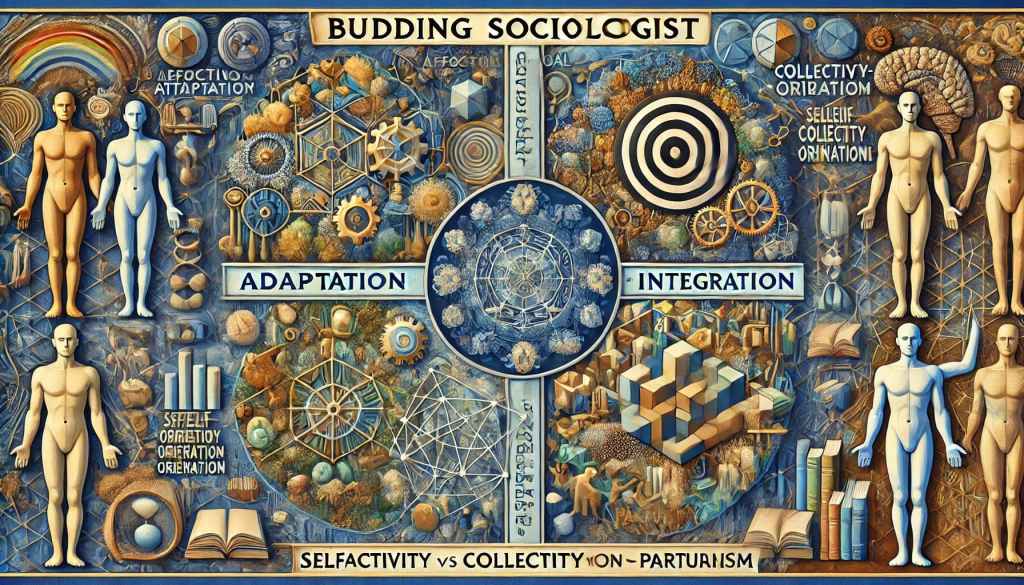
Talcott Parsons dedicated his scholarly attention to the theory of the social system, which delves into the intricate workings of society as a cohesive entity. This framework, often referred to as the theory of society as a whole, encompasses the vast array of social institutions. Central to this theory are two key components: the AGIL model and pattern variables, collectively constituting the theory of the social system. Parsons posited that a social system comprises numerous individual actors engaged in interactions within a context that encompasses physical and environmental dimensions. These actors are driven by a pursuit of gratification optimization and navigate their relationships and surroundings through culturally ingrained symbols.
At the heart of Parsons’ conceptualization lies the notion of the status-role bundle or complex as the fundamental unit of the social system. These entities are structural in nature, distinct from individual traits or specific interactions. Analogous to positions within a stratification model, a status denotes a structural placement within the social framework, while a role pertains to the actions associated with that status. For instance, designations like brother or sister represent statuses, each entailing certain roles typically linked to them. Importantly, these statuses need not adhere to a hierarchical structure akin to the stratification model.
The foundation of the social system theory lies in Talcott Parsons’ AGIL model. A comprehensive depiction of this theory can be outlined as follows:
1. Adaptation: The adaptability of a social system to its changing environment is paramount. While it’s true that a social system is shaped by geographical factors and a lengthy historical evolution, which inherently impart it with stability and rigidity, it shouldn’t become inflexible. Rather, it should exhibit flexibility and functionality.
Economic sustenance, the division of labour for enhanced production and efficient services, and role differentiation for creating job opportunities are imperative. Emile Durkheim’s insights in “Division of Labour in Society” underscore the significance of division of labour and role differentiation in enabling a higher level of skill attainment. Parsons similarly highlights that a lack of adaptability often poses challenges to the social system, leading to revolutions and systemic overhauls throughout history. Nevertheless, the Indian social system has consistently showcased a remarkable capacity for adaptability over time.
2. Goal Attainment: Both goal attainment and adaptability are closely linked and essential for maintaining social order. Every society has its own objectives that require cooperation to accomplish, such as ensuring national security. Adaptation to various environments, both social and non-social, is crucial for achieving these goals. Furthermore, effective utilization of human and non-human resources is necessary, tailored to the specific tasks at hand.
For instance, there needs to be a method for ensuring that the right number of people, neither too few nor too many, fill each role according to current circumstances, and that they perform their designated duties. This process resolves the challenge of allocating roles within the social system. Allocating scarce and valuable resources is vital for both adaptation and goal achievement, and the distinction between the two is relative.
3. Integration: The social system functions as an intricate web of integration within which individuals navigate their lives. Rather than society at large, it is often specific groups or sub-groups that command individuals’ attention and allegiance. According to Durkheim, an individual is deeply shaped by the society they inhabit; the emotional and historical ties are so profound that detachment is nearly impossible.
This dynamic becomes most evident during moments of domestic turmoil or external challenges, where appeals to concepts like society, culture, patriotism, or national solidarity elicit swift responses. Cooperation, in such instances, becomes a manifestation of integration, the very foundation of society. In times of stability, integration is maintained through adherence to established norms, guided by a sense of mutual benefit. The relationship between authority and obedience is upheld by notions of rationality and order; failure to adhere to these principles threatens the fabric of social order.
In virtually every social setting, there are individuals or groups who deviate from established norms, posing a challenge to the system’s cohesion. Social control mechanisms are thus necessary to address such violations and safeguard the integrity of the system. Disputes arising from differing interpretations of norms require agreed-upon mechanisms for resolution, lest they undermine the integration of the social structure.
4. Latent Pattern-maintenance: The central role of social systems lies in pattern maintenance and managing tensions. Without dedicated attention to this task, the continuity of social order becomes precarious. Each social system inherently incorporates mechanisms to fulfill this purpose.
Individuals and sub-groups assimilate these patterns through the internalization of norms and values. Socialization fosters the development of attitudes and respect towards these norms and institutions. However, it’s not enough to merely instill these patterns; ensuring adherence to them requires ongoing efforts by the social system for effective social control. Despite these efforts, tensions may arise from internal or external sources, leading to critical situations for society.
Addressing these tensions constitutes tension management. Similar to a family unit, society bears the responsibility of maintaining functional members, alleviating anxiety, and supporting those who may pose risks to the system as a whole. The decline of societies often stems from failures in pattern maintenance and tension management mechanisms.
Pattern Variables
In a given scenario, individuals often face significant dilemmas that challenge their understanding and approach to the situation. They must navigate these dilemmas by making choices that assign meaning to the situation. These choices are binary, requiring the individual to select one option over the other within a certain timeframe. These binary choices, which present alternative paths for action, are referred to as pattern variables. As Parsons described, a pattern variable represents a dichotomy where one side must be embraced by the individual to clarify the meaning of the situation and enable decisive action. Parsons identified five sets of pattern variables as follows:
1. Affectivity vs Affective Neutrality: The pattern is effective when a structured system of action prioritizes gratification, wherein individuals strive to minimize pain and maximize pleasure. Conversely, the pattern is affective neutral when it advocates for discipline, renunciation, or the postponement of certain gratifications in favour of other objectives. For instance, soldiers are required to exhibit emotional neutrality by disregarding immediate gratification and fulfilling their duties, even if it means risking their lives.
2. Self- orientation vs Collective orientation: This contrast arises from societal norms or commonly held beliefs that either endorse individuals pursuing their own interests or compel them to prioritize the collective good. For instance, while salespeople and shopkeepers are encouraged to promote their products enthusiastically, focusing on self-interest, doctors are expected to prioritize the well-being of their patients, even if it means forgoing potential profit from recommending costly procedures.
3. Particularism vs Universalism: The first type of standard pertains to criteria established based on an actor’s specific connections with a particular entity, while the second type involves value standards that are broadly generalised. For instance, when a teacher evaluates all students without bias, adhering to universal principles, they are acting in accordance with generalized standards. However, if the teacher shows favouritism towards their own child or a friend in the class, they are acting in a particular manner, as they are treating individuals differently based on their personal relationships.
4. Ascription vs Achievement: This dilemma revolves around the decision-making process of giving precedence to an object either based on its inherent qualities or its actions and performance. One perspective entails categorizing individuals based on intrinsic attributes like age, gender, race, nationality, etc., while the other perspective focuses on evaluating individuals based on their skills and abilities.
5. Diffuseness vs Specificity: This is the dilemma of characterizing the connection between an object and an actor as either boundlessly extensive, morally obligatory, and significant in diverse scenarios; or narrowly defined. For instance, the relationship between employer and employees in contemporary factories is narrowly circumscribed, governed solely by what’s delineated in the contract. On the other hand, certain land tenure systems like semi-feudal and zamindari arrangements are believed to impose an array of obligations on tenants toward their landlords. Likewise, friendships and spousal relationships are often perceived to entail a myriad of boundless obligations.
Based on the aforementioned discussion, it can be inferred that pattern variables offer a framework for examining the diverse manifestations of norms and social behaviours, along with their underlying orientations. These variables elucidate the nature of societal norms and the fundamental values that underpin decision-making within the personality structure. Parsons’ framework encompasses a wider spectrum of potential motivations and actions compared to many classical sociological theorists, including utilitarians, Durkheim, and Marx. While Weber emphasized the importance of motivation and meaning, he didn’t provide a general method for their application. Perhaps, these pattern variables can be conceived as a way individuals engage with the situations they encounter, their orientations, and how they interpret meaning in social actions.
The instrumental characteristics pertain to “the aspects of goal achievement and adaptation.” These encompass the attributes, individuals, roles, and behaviours associated with problem-solving, task completion, and goal attainment. These tasks often align with traditionally male roles, public engagements, economic activities, or political endeavours.
Conclusion
Based on the provided description, it can be inferred that a system can be broadly defined as a structured and organized entity existing within a specific context. For a system to maintain stability, it must fulfill four essential requirements, referred to as adaptation (the ability to adjust to its surroundings), goal attainment (establishing and pursuing specific objectives), integration (maintaining coherence within the system), and pattern-maintenance (encouraging elements within the system to fulfill their roles), commonly known as AGIL. It is posited that any stable social system must meet these functions.
A social system operates through four interconnected subsystems: the behavioural system (involving individual interaction with the environment), the personality system, the social system, and the cultural system. These subsystems are linked through roles, which are in turn associated with societal norms and values present in every society. The cultural system generates values that govern the norms and roles within the social system, which are then internalized to influence the motivation of the personality system and guide physical adaptation.
Critics have pointed out a significant oversight in the theory, noting its neglect of social change. While much of the discussion has centered on the stability and equilibrium of social structures, Parsons’s intricate model of the social system does offer insights into societal evolution.
By drawing upon an evolutionary framework that underscores the non-linear nature of social change, Parsons suggests that societies progress through increased differentiation. This entails a finer delineation of functional prerequisites, which are met by specialized institutions or subsystems.
A prime illustration of this phenomenon can be observed in the evolution of the family within European society. Initially tasked with child rearing, education, and a substantial portion of economic activities, the family has gradually relinquished many of these roles to more specialized institutions.
Despite facing some criticism, it’s undeniable that Parsons’s theory of the social system marks a significant milestone in sociological thought. While it may have lost some relevance with the emergence of critical perspectives, its enduring importance lies in its capacity to elucidate societal dynamics.
References and Readings:
Sociological Theory, by Ritzer G, https://amzn.to/3Da3pcm
Sociological Theory and Modern Society, by Talcott Parsons, https://amzn.to/41WQmV2