- Introduction
- Varna
- Asharma
- Dharma
Introduction
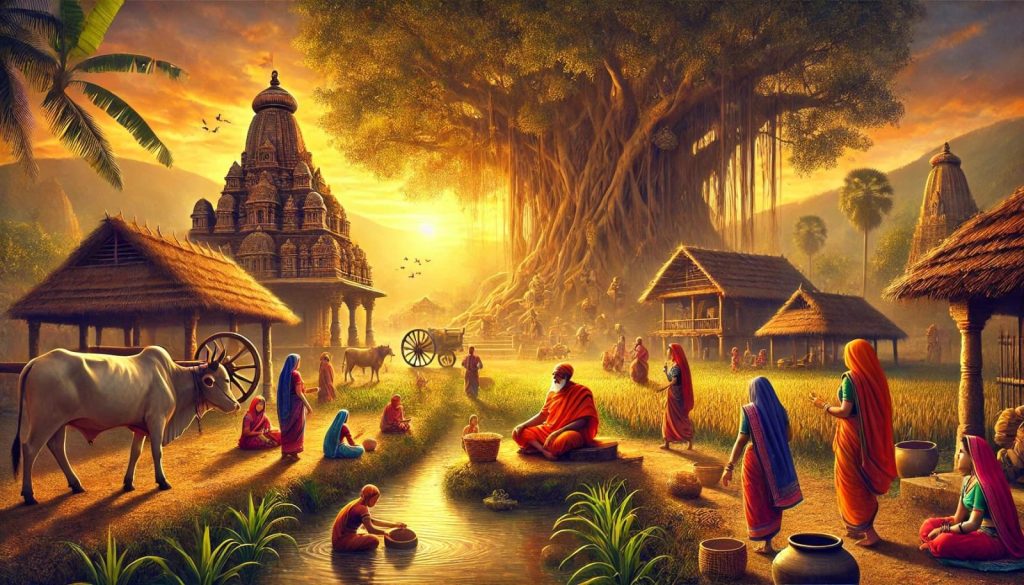
Varṇa, originating from Sanskrit, encompasses the notions of type, order, color, or class. Within Brahminical texts such as the Manusmriti, it denotes social classifications. Throughout Hindu literature, including the Manusmriti, society is typically categorized into four varnas based on these principles.
- Brahmins: priests, scholars and teachers
- Kshatriyas: rulers, warriors and administrators
- Vaishyas: agriculturalists and merchants
- Shudras: labourers and service providers
Communities categorized within one of the four varnas or classes are referred to as savarna. In contemporary society, this category encompasses all forward castes. On the other hand, Dalits and scheduled tribes, who do not fit into any varna, are termed as avarna. It’s important to note that this classification into four varnas is a form of social hierarchy distinct from the more intricate Jāti system or the European concept of “caste.”
The varna system finds its roots in Hindu scriptures, where it’s depicted as an idealized division of human roles. Its origins are often traced back to the Purusha Sukta verse of the Rig Veda, and the Manusmriti provides commentary on this system. However, despite these textual references, many Hindu texts and doctrines challenge and dissent from the varna-based social classification.
Etymological and Origin of Varna
Varna, originating from the Sanskrit term varṇa, stems from the root vṛ, signifying actions like “to cover, to envelop, count, classify, consider, describe, or choose” (resembling vṛtra). Its usage in the Rigveda denotes aspects like “colour, outward appearance, exterior, form, figure, or shape,” while in the Mahabharata, it conveys meanings like “colour, tint, dye, or pigment.” In various Vedic and medieval texts, Varna contextually expands to encompass notions of “colour, race, tribe, species, kind, sort, nature, character, quality, or property” concerning objects or people. Furthermore, in the Manusmriti, Varna denotes the division into four social classes.
Initially, there was a misconception regarding the correlation of Varna with Jati, despite Varna carrying distinct implications from Jati. The Varna system was conceived not as a rigid caste structure but as a framework for social classes. Varna, stemming from the root ‘vri’ meaning choice based on inherent traits, appears to have delineated society during the Rig Vedic era into four classes: Brahmin, Kshatriya, Vaishya, and Sudra. Evidence from Vedic literature suggests that Varna originally denoted skin colour, leading to the division of society based on distinctions between the white Aryans and the black Dravidians.
An alternative perspective suggests interpreting Varna as professions or occupations. In this sense, Varna symbolizes the occupational groups that delineated Hindu society. Hence, two distinct interpretations of the Varna concept emerge:
Firstly, Varna is interpreted as reflecting the colour of the skin, thus resulting in the classification of society along racial lines.
Secondly, Varna signifies the division of society based on occupational differences, with each Varna having specifically defined functions.
Varna in Classical Literature
The Vedic texts contain passages discussing the Varnas, such as the ‘Purusha Sukta’ hymn in the Rig Veda. This hymn metaphorically assigns roles to different Varnas, likening them to parts of the universal man. The Brahman Varna is associated with the mouth, the Kshatriya with the arms, the Vaishya with the thighs, and the Sudra with the feet. These divisions were linked to specific duties or karma assigned to each Varna. It is suggested that the original Vedic literature did not incorporate the rigid caste system; rather, this system developed later.
In the Rig-Vedic society, individuals were not constrained by specific occupations based on their Varna. Members of any Varna could choose and practice any profession they desired. For example, a Brahmin could engage in medical practice. Additionally, there were no restrictions on dietary habits or intermarriage among the various Aryan classes. Consequently, the Varnas were considered as “open classes,” not rigidly defined compartments. These classifications were determined by individual characteristics rather than birth status.
Views of Sociologists on Varna
In the traditional and classical Indian societal framework, varna has been examined by various sociologists, each offering their own perspective:
View of J. H. Hutton: According to J. H. Hutton, varna is frequently misconstrued as synonymous with caste or Jati, despite their distinct meanings. Originally, varna represented the four primary classes within society. During Vedic times, the boundaries between these classes were not rigidly defined. It was possible for a Kshatriya to transition into the role of a Brahmana. With the advent of Vedic influence, society came to be structured into four varnas: the Brahmanas serving as priests, the Kshatriyas as rulers, the Vaishyas as merchants, and the Sudras as laborers. Each varna was symbolically associated with a particular colour: Brahmanas with white, Kshatriyas with red, Vaishyas with yellow, and Sudras with black.
View of G. S. Ghurye: Varna, originally signifying distinction, delineates the societal structure in early Hindu society. Initially, two main classes emerged:
- Aryas
- Dasas
Ghurye observes that in the Rig Veda, the term “Varna” is not explicitly attributed to specific classes like Brahmana or Kshatriya. Instead, it contrasts Arya Varna, representing the Aryan people, with Dasa Varna. The Satapatha Brahmana, however, portrays the four classes as distinct Varnas, with “Varna” understood in terms of colour, symbolizing the fair and dark complexions of Aryas and Dasas respectively. This initial contrast between Arya and Dasa eventually led to the distinction between Arya and Sudra.
During the Vedic era, society was primarily divided into three classes: Brahmana, Kshatriya, and Vaishya. It’s only in later Vedic texts that Sudras are mentioned as the fourth Varna. Untouchables had no place within this Varna system during the Vedic age.
Over time, the original three classes mentioned in the Rig Veda evolved into four more consolidated groups, with occasional references to three or four additional groups.
Ghurye interprets “varna” as a representation of the colour spectrum within society. As the Aryans, arriving from outside India, conquered indigenous populations, they assumed higher social positions, while the defeated populace occupied lower societal strata. Ghurye thus adopts a racial interpretation of the origin of the Varna system, emphasizing the dominance-subordination dynamics resulting from conquest.
\View of M. N. Srinivas: Professor Srinivas posits that the caste system is a highly intricate social structure distinct from the Varna system. While there are only four Varnas, there exist over three thousand castes. The key disparity between the two lies in their scope: castes are localized groups, while the Varna system operates on a pan-Indian level. Additionally, mobility is absent in the caste system but present in the Varna system. According to Professor Srinivas, the Varna system obscures the diversity inherent in caste systems across different regions.
Regarding the Varnas, although they were theoretically open classes based on individual attributes, distinctions existed among them on various grounds. These differences manifested in diverse forms, including modes of address and religious practices. For instance, different terms such as Agachehha and Adrava were employed to welcome individuals of different Varnas, and variations existed in the recitation of the Gayatri mantra. Furthermore, distinctions were observed in rituals, such as the use of specific types of wood for sacrifices by different Varnas, as evidenced in Rig-Vedic and Brahminic literature, illustrating societal transitions across ages.
Concerning the Shudras, they were relegated to menial labour or servitude due to their non-Aryan status. While the later period acknowledges the existence of the four Varnas, the Shudras, positioned as the fourth Varna, still faced limitations, notably their inability to perform certain rituals reserved for higher Varnas.
The Origin of the Varnas
There are different theories regarding the origin of Varna. Following are some theories:
The Theory of Parasara: Parasara posits that humanity originates from Brahma, suggesting a shared origin for all individuals. He observes that offspring inherently inherit the qualities of their progenitors, implying an initial unity among all people. However, Parasara acknowledges the existence of societal distinctions among varnas and offers an explanation. He analogizes the creation of varnas to the quality of soil and seed: if these are inferior, so too will be the resulting offspring. Parasara further delineates that while all varnas emanate from the great Brahmana, they originate from different parts of his body—Brahmanas from the mouth, Kshatriyas from the arms, Vaishyas from the thighs, and Sudras from the feet. This differentiation, Parasara suggests, initially occurred during creation, with subsequent subclasses evolving through intermixture. He provides a detailed list of fourteen subclasses to further elucidate this process.
Theory of Mahabharata: The Mahabharata narrates the emergence of the Varna system, attributing it to different parts of the creator’s body. According to the text, the Brahmanas were born from the mouth of Brahma, tasked with preserving the Vedas. The Kshatriyas emerged from the creator’s arms, designated to govern and safeguard society. Vaishyas, originating from the torso, were meant to support the other Varnas and sustain themselves through agriculture. Lastly, the Sudras, emerging from the feet, were intended to serve the other three Varnas.
Theory of Manu: As per the Manu Smriti, the four Varnas originate from the limbs of the creator, each assigned distinct duties and occupations for the preservation of the universe. The Brahmana Varna holds a position of paramount importance according to this text. Manu emphasizes that the Brahmana, Kshatriya, Vaishya, and Sudra constitute the sole Varnas, with no mention of a fifth Varna.
Asharma System
The Ashrama system stands as a cornerstone of Hindu Social Organization, deeply rooted in the considerations of ancient Hindu philosophers regarding human existence within society. It acknowledges that an individual’s life is shaped by various factors: the environment in which they live, the era they inhabit, the efforts they exert, and their inherent characteristics. This system offers a distinctive perspective on life’s challenges and the conduct required to navigate them.
Central to the Ashrama system is the notion of fulfilling different duties (shramas) across four stages to achieve moksha, the ultimate aim of human life. Each stage, roughly spanning 20-30 years, corresponds to different phases of life, with the total lifespan considered to be around 100 years per birth. However, the duration of each stage isn’t uniform and varies among individuals, influenced by factors such as caste and societal obligations. Some castes may not partake in all four stages, and it’s believed that even Kshatriyas may have the choice to skip the final stage.
It’s important to note that the Ashrama dharma doesn’t apply universally; certain castes and women are exempt. For instance, according to the Brihadaranyaka Upanishad, Yajnavalkya’s decision to renounce worldly life involved entrusting family matters to his wives while he pursued a solitary life in the forest. Women typically took on household responsibilities and supported their husbands in their duties, but they weren’t expected to follow the same progression through the four stages as men.
Meaning of Asharma
Asrama, also known as ashrama, denotes a place of solitude, refuge, or dwelling, often associated with ascetics and seekers. It also signifies a phase or stage in the life of an individual within the Vedic tradition. Hinduism delineates four distinct stages, or asramas, which include brahmacharya (student life), grihasta (householder life), vanaprastha (retired life), and sannyasa (renunciate life). It’s important to note that not all individuals progress through all four stages; some may only experience the first three. Additionally, there are cases where individuals may transition directly from brahmacharya to sannyasa, bypassing the intermediate stages.
Viewed through the lens of spiritual evolution, these four stages represent different phases of learning and growth for beings on Earth. Human life is regarded as particularly significant from a reincarnation perspective, as it offers beings the unique gift of intelligence, enabling them to discern truth and make enlightened choices that could ultimately lead to liberation. Among all the diverse species in existence, only humans possess the capacity to attain Brahman and access the realm of immortality. The asramas serve as a structured framework to guide individuals through progressive stages of spiritual development, facilitating their journey towards this exalted state.
In terms of duties and responsibilities, the four stages hold varying significance. If one views life as a sacrificial journey, these stages represent the segments of a grand sacrifice. Analogously, if a human lifespan is likened to a day, the initial three stages embody the day while the final stage symbolizes the night. The first three stages correspond to morning, mid-day, and evening sacrifices, where individuals offer homage to the sun, while the fourth stage signifies the night—a period of withdrawal from activity in preparation for rest.
The term Ashrama originates from the Sanskrit root ‘Srama’, denoting exertion. Thus, Ashrama encompasses:
- The locus of exertions.
- The initiation of such exertions.
As P.H. Pradhu elucidates, Ashrama signifies a pause, a temporary halt during life’s journey to rest and prepare for further progression. He posits that Ashramas serve as resting points along life’s path towards ultimate liberation, the ultimate goal. Vyasa, in the Mahabharata, compares the four life stages to a ladder or a flight of steps leading to Brahma, indicating that they facilitate the journey to the realm of Brahma. These Ashramas are perceived as successive stages in an individual’s life, each serving as a period of training and exertion to prepare for the subsequent stage.
According to the scheme, life is divided into four stages by dividing average life of a Hindu of 100 years:
| Stage | Age |
| Brahmacharya | 0 – 25 years |
| Grihastha | 25 – 50 years |
| Vanaprastha | 50 – 75 years |
| Sanyasa | 75 – 100 years |
Each phase of life is characterized by its unique set of responsibilities and roles, known as Dharma. The concept of Purusharthas finds manifestation in the Hindu framework of Ashramas. Each Ashrama delineates specific duties and functions, offering beneficial constraints on human instincts and impulsiveness. Progressing through these Ashramas and fulfilling the assigned duties enables individuals to ready themselves for Moksha, the ultimate aspiration in Hindu life.
The Four Ashramas
In a general sense, ashrama can be understood as the various stages of an individual’s life, with an average lifespan of around 100 years. Maturity is a crucial factor in assigning responsibilities according to societal norms, and it plays a significant role in this regard. The allocation of roles is tied to age since maturity tends to correlate with age. The progression of an individual’s life begins with the acquisition of skills in the initial ashrama and concludes with the pursuit of Moksha at life’s end.
Below, I will elucidate the symbolism and importance of the four ashramas in human life, drawing upon my research and comprehension.
| Ashrama | Age | Presiding Deities | Aspects of Brahman | Knowledge |
| Brahmacharya | Childhood Upto 25 years | Brahma and Sarasvathi | Viraj | Lower knowledge |
| Grihasta | Young age 25-50 years | Vishnu and Lakshmi | Hiranyagarbha | Worldly knowledge |
| Vanaprastha | Middle age 50-75 years | Siva and Parvathi | Isvara | Higher knowledge |
| Sanyasa | Old age 75-100 years | Isvara | Brahman | Self-knowledge |
| Asharma | Type of Sacrifice | Gain | Purushartha |
| Brahmacharya | Morning Sacrifice | Knowledge | Dharma |
| Grihasta | Mid-day sacrifice | Wealth and progeny | Artha and Kama |
| Vanaprastha | Evening Sacrifice | Wisdom | Moksha |
| Sanyasa | Internal Sacrifice | Liberation | Moksha |
| Ashrama | Resting Place | Main Duty | Supporting Organ | Parts of Vedas | Type of Chanting |
| Brahmacharya | Gurukula | Study | Mind and senses | Samhitas | Prastava |
| Grihasta | Svagriha | Sacrifice | Intelligence | Brahmanas | Udgitha |
| Vanaprastha | Forest dwelling | Contemplation | Breath | Aranyakas | Pratihara |
| Sanyasa | The world | Renunciation | Self | Upanishads | Nidhana |
In common practice, following is the detailed description of asharma:
1. Brahamacharya Ashrama: The initial phase of life, known as Brahmacharya Ashrama, marks the beginning of a person’s journey into adulthood. It commences with the Upanayana ceremony, signifying a symbolic rebirth (Dwija) for the individual. The age at which one undergoes this initiation varies according to their social class (Varna). For instance, Brahmins typically undergo the ceremony at eight years old, Kshatriyas at ten, and Vaishyas at twelve. However, Shudra children, historically deprived of formal education, are excluded from this initiation ritual. It is permissible to delay the ceremony until the ages of twelve, fourteen, and sixteen respectively for Brahmins, Kshatriyas, and Vaishyas.
Following the initiation, formal education begins in the Gurukula, the teacher’s residence. Here, students delve into the Vedas, repositories of Aryan cultural heritage. The curriculum not only imparts knowledge but also instills moral and spiritual values, emphasizing purity in speech and thought. Students lead disciplined lives, exercising restraint over their senses, including sexual desires, and practicing celibacy. This austere lifestyle moulds them into disciplined individuals.
The Brahmacharya Ashrama is synonymous with the period of student hood, characterized by strict adherence to the guru’s teachings. This phase typically concludes around the age of 25. Students are expected to demonstrate austerity, serve their teachers dutifully, and show reverence and respect at all times.
2. Grihastha Ashrama: Upon transitioning from the student phase, individuals embark on the Grihastha Ashrama, or the stage of householdership, marked by marriage. Marriage, beyond being a personal union, holds significant social responsibilities aimed at upholding Dharma, maintaining family lineage, and ensuring the continuity of society through progeny.
In accordance with the Ashrama system, the Dharma of a householder encompasses the performance of five Maha yajnas, or great sacrifices, offered to Brahma:
- Brahma Yajna: Involving the recitation of Vedic Mantras.
- Pitri Yajna: Comprising offerings like Tarpan, known as Sradha.
- Deva Yajna: Conducted through the offering of burning oblations to deities.
- Bhutas Yajna: Involving sacrifices for beings.
- Nara Yajna: Entailing the hospitality and reception of guests at home.
These yajnas correspond to Deva Rina, Rishi Rina, and Pitar Rina, alongside the duty of providing sustenance to animals, saints, and passers by. Householders play a pivotal role in supporting individuals across all societal strata, fulfilling the broader social duties encapsulated in the Pancha Maha yajnas.
The Grihastha Ashrama primarily addresses the material and emotional needs (‘Artha’ and ‘Kama’) of individuals, encouraging them to fulfill their desires within the confines of Dharma. Typically, individuals enter this Ashrama around the age of 25.
3. Vanaprashta Ashrama: The third stage of life, known as the Vanaprastha Ashrama, typically begins at the age of 50. In this phase, individuals are expected to transition away from their familial and village responsibilities. They entrust household duties to their adult children and embark on a journey to the forest. Here, the emphasis lies on controlling desires for material pleasures. Their diet consists solely of fruits and vegetables, eschewing meat, while their attire comprises deer skin or tree bark. Engaging in penance, or “Tapas,” is essential for purifying both body and soul, alongside dedicating time to study and meditation.
A Vanaprasthi embraces a life marked by self-discipline, kindness, and philanthropy. It is believed that passing away during the Vanaprastha stage leads to Moksha, or liberation. While traditionally the Vanaprasthi would reside in the forest, accompanied by their spouse, this arrangement served the purpose of fulfilling societal obligations. The presence of the spouse facilitates the performance of social duties, even as the ties of household life gradually dissolve.
4. Sanyasa Ashrams: After completing the Vanaprastha Ashram, individuals enter the final phase of life known as Sanyasa Ashram when they reach 75 years of age. During this stage, they sever all worldly attachments and dedicate themselves entirely to meditation, seeking to comprehend the subtle essence of the supreme soul present in all beings, regardless of their status. Immersed in meditation, focusing their mind solely on Brahmana, individuals in this Ashram find joy in the soul and live in solitude, eagerly awaiting their liberation.
The Ashrams system aims to fulfill the Ashrams Dharma, which extends beyond social obligations to emphasize detachment from the world, particularly in the Vanaprastha and Sanyasa Ashrams. It serves as a framework for spiritual development, guiding individuals toward their ultimate goal of Moksha.
Dharma
The Hindu tradition distinguishes itself from conventional notions of religion, as it primarily embodies the concept of Dharma rather than religion in the conventional sense. Unlike religion, which typically involves human responses to supernatural and super sensory forces beyond control, Dharma encompasses a broader spectrum of righteous living and social guidelines.
Religion, as commonly understood, revolves around belief in divine powers and the performance of rituals to establish a connection between individuals and the supernatural. Conversely, Dharma emphasizes the righteous path of life, providing guidance for social interactions and the balance between desires (Kama) and material pursuits (Artha).
Scholars like R V. Kane assert that Dharma, as expounded in ancient texts, is not merely a creed or religious doctrine but rather a comprehensive code of conduct governing individual and societal behaviours. It aims to foster the gradual development of individuals and facilitate their pursuit of human fulfilment.
In essence, Dharma pertains to the rules guiding human behaviour within society, shaping individuals as responsible members of their communities.
According to B.G. Gokhale, the concept of Dharma has deeply influenced Indian thought over generations, shaping the behavior and mindset of the majority. Dharma encompasses a broad spectrum of implications, serving as a guide for evaluating human activities.
Dharma is often understood as fulfilling one’s duties, emphasizing the importance of carrying out one’s own responsibilities, regardless of their perceived insignificance, rather than taking on the duties of others, even if they seem more significant. It serves as a doctrine governing the duties and rights of individuals within an ideal society, acting as a moral compass for all actions.
Dharma holds a special significance within Hinduism, being more than just a religious belief but rather a way of life. It embodies social values and cultural norms, designed to promote the welfare and happiness of individuals. As a doctrine of duties and rights, Dharma underscores the importance of ethical conduct and societal harmony.
Forms of Dharma
Dharma is often interpreted broadly as encompassing the responsibilities and obligations that individuals must fulfill. Within Hindu social structures, individuals are not merely seen in terms of their personal attributes, but also as integral parts of a collective community. Consequently, Dharma can be comprehended across multiple dimensions of human existence, reflecting its significance at various levels of societal and individual interaction.
Dharma is the First Purushartha
The concept of Purushartha delves into the management and ethics of individual life within the societal framework. Central to this concept is Dharma, which holds paramount importance. Pursuing wealth (Artha) and desire (Kama) devoid of Dharma impedes one’s journey towards spiritual liberation (Moksha). Dharma serves as the foundation of human existence, guiding individuals towards righteous living.
Dharma manifests in various forms, including:
1. Ashrams Dharma: The concept of Purushartha is embodied in the Ashrams system, which delineates the various stages of life and associated responsibilities. Comprising four stages—Brahmacharya, Grihastha, Vanaprastha, and Sanyasa—the Ashrams system symbolizes not just physical spaces but also the phases traversed by an individual throughout their lifespan. Central to this system is the notion of fulfilling three debts: Deva Rina, Rishi Rina, and Pitri Rina. These obligations are primarily discharged during the Grihastha Ashram phase. Transitioning into the Vanaprastha Ashram entails retreat to the forest for a solitary existence, while the Sanyasa Ashram demands renunciation of worldly ties. Through this framework, the Ashrams system assigns specific Dharma or duties corresponding to each stage of human life.
2. Varna Dharma: In ancient Hindu society, a structure known as the Varna system delineated four distinct classes, each assigned specific responsibilities regarded as duties guided by Dharma, or righteousness. While interpretations of Varnas varied, they essentially segmented society into different groups, each with its designated functions. The Brahmin Varna focused on education and teaching, the Kshatriya Varna assumed the role of organizing and governing societal affairs, the Vaishya Varna managed economic activities, and the Sudra Varna provided service to the other three Varnas. Varna Dharma dictated the ethical code and lifestyle individuals were expected to adhere to within their respective Varnas.
3. Manava Dharma: Hinduism may also be interpreted as embracing the concept of a religion of humanity. The essence of Manava Dharma, or the religion of humanity, is the pursuit of ultimate truth. In accordance with the teachings of Manava Dharma Sastra, this involves embodying virtues such as contentment, forgiveness, self-discipline, refraining from infringing upon others’ lives, mastering the senses, and ultimately seeking enlightenment. Similarly, according to the Vishnu Dharma Sastra, the religion of humanity encompasses principles such as tolerance, non-violence, self-restraint, reverence for teachers, compassion, detachment from desires, and honouring elders.
4. Kula Dharma: The concept of kula Dharma encompasses the responsibilities incumbent upon an individual, who is obliged to fulfil them in accordance with the prescribed Dharma for householders. According to Hindu Sastrakaras, it is emphasized that individuals should not limit themselves solely to their personal interests. It is advocated that a person should share a portion of their meals with deities, spirits, guests, animals, and holy individuals before partaking in their own sustenance.
5. Yuga Dharma: The Hindu scholars and philosophers have instilled a sense of dynamism and adaptability within Hinduism. They assert that individuals must act in accordance with the demands of their era and surroundings, making it their responsibility to adjust and engage as needed. It’s been noted that Hinduism exhibits such flexibility that under certain circumstances, actions typically deemed contrary to dharma might become acceptable and aligned with righteousness.
6. Raja Dharma: Within this classification, responsibilities are delineated for both the governing and the governed. The Kshatriya’s obligation lies in safeguarding the populace, while the king is tasked with ensuring the welfare of the public. Conversely, it falls upon the citizens to adhere to the laws of the realm and heed the commands of the monarch.
7. Apat Dharma: Responsibilities are assigned to confront life’s intricacies. It’s suggested that during crises, a Brahmin may adopt the duties of a Kshatriya, and if that’s not feasible, then those of a Vaishya. Even actions typically forbidden may become necessary duties in emergencies to preserve the principles of wealth and righteousness. It’s evident that Dharma isn’t just a moral framework but also entails specific duties for different segments of society. Dharma holds immense significance in Hindu society, serving as a reminder of individual duties and societal obligations. Acting as a mediator between wealth and action, Dharma, being righteousness, steers society along the correct path.
Some More Traditional Bases of Indian Society
Indian society possesses distinct characteristics and a unique identity. Recently, K.S. Singh unveiled the findings of the People of India (PoI) project, a comprehensive survey conducted by the Anthropological Survey of India. This project serves as a rich repository of ethnographic and socio-cultural information, offering insights into the diverse fabric of the nation.
The latest iteration of the People of India project reveals the presence of 4,635 distinct communities across the country. These communities encompass various ethnic groups, castes, minority factions, scheduled tribes, and scheduled castes, reflecting the multi-ethnic nature of Indian society. With the advent of modernity, traditional structures encountered challenges, as each caste or ethnic group clings to its array of customs and rituals, influencing the trajectory of modernization.
Attempting to catalog the myriad socio-cultural traditions of India is a daunting task, yet certain institutions stand out as embodiments of tradition, shaping societal norms and behaviours. These institutions play a pivotal role in navigating the transition to modernity. Highlighted below are some fundamental pillars that underpin traditional Indian society:
1. Diverse Culture Zones: India is comprised of 91 distinct culture zones, with nearly every state boasting multiple cultural regions, except perhaps Goa, which constitutes a single cultural zone. Within each of these zones, diverse traditions permeate various castes, minority communities, and marginalized groups. The cohesive fabric of these zones is woven from the civilizational ties of religion and the caste system’s notions of purity and pollution. Interwoven socio-cultural connections, coupled with economic interactions, have fostered interdependence among the populace. Collectively, these culture zones contribute to a rich tapestry of what we recognize as Indian culture.
2. Plural Ethnicities: In her seminal work on the Hindu Kinship System, Iravati Karve emphasizes the pivotal role of family, village, and linguistic communities in comprehending Indian culture. Through an analysis of these institutions, she reveals the diverse pluralities present within the country, each encompassing a multitude of traditions. However, these plural ethnicities often give rise to tensions. Adapting to modernity requires navigating a compromise with these varied ethnic identities. Over time, India’s ethnic landscape has grown increasingly intricate, marked by widespread migration and the continual emergence of new ethnic groups. For instance, the Marwaris in the northeast and Kashmiri Pandits in Delhi and Punjab exemplify the formation of such new ethnic identities. Consequently, modernity grapples with these ethnic dynamics at local levels across the nation.
3. Language and dialects: Three-language family: India boasts a rich linguistic diversity, characterized by three main language families:
- The Indo-European family encompasses eleven languages, prevalent in northern India, including Punjabi, Sindhi, Hindi, Gujarati, and Marathi.
- The Dravidian language family comprises Tamil, Telugu, Kannada, and Malayalam, predominantly spoken in South Indian states.
- The Austro-Asiatic family is represented by tribal groups in northeastern India, such as Munda, Bhumia, Santhal, and Khasi.
This linguistic diversity extends to 18 scheduled languages alongside numerous dialects, with an estimated 16,752 dialects in total, as per Pol. In regions like the northeast, distinct dialects can even vary from village to village among communities like the Bodas.
State boundaries in India often align with linguistic demographics, although other factors also influence their organization. For example, Marathi is the official language of Maharashtra, Gujarati of Gujarat, Kannada of Karnataka, Malayalam of Kerala, Telugu of Andhra Pradesh, and Tamil of Tamil Nadu.
However, certain languages lack corresponding states, such as Sindhi and Hindi. Despite Hindi’s status as the national language, English remains prevalent in official capacities in some states. The implications of modernity intersect with these linguistic dynamics, posing significant challenges and opportunities for cultural preservation and adaptation.
4. Multi-caste Society: India comprises 4,635 distinct communities, encompassing various castes, minority groups and marginalized segments of society. Historical records from the 1931 census reveal over 30,000 castes existing in pre-independence India. Scholars like K.M. Panikar and Iravati Karve attribute the fragmentation of Indian society to the pervasive influence of the caste system. Despite legal efforts to abolish caste distinctions, figures like M.N. Srinivas note that caste still profoundly shapes individual identity in contemporary India. However, counterarguments suggest that the caste system has played a role in the nation’s resilience, fostering functional interdependence and facilitating societal integration. Each caste maintains its unique traditions, which serve to distinguish it from others and uphold its identity. These traditions, resilient in the face of modernization, continually resist external influences, presenting a formidable challenge to societal change.
5. Increasing Regional Consciousness and Competing Demands: India exhibits distinctive characteristics that differentiate it from European and American societies. Upon the introduction of modernity’s universal traits—democracy, capitalism, state power, and military prowess—the responses within India varied. Through this interaction, traditions undergo modernization, adaptation, attenuation, or reinforcement. Modernity often revitalizes traditions, evident in the strengthening of caste systems, the rise of religious fundamentalism, and the grandeur of marriage ceremonies.
Historically, India lacked significant regional consciousness during the independence struggle, as it united against colonial rule. However, contemporary India experiences a surge in regional self-awareness. M.N. Srinivas notes the prevalence of regional identities across India, reflected in language, cuisine, folklore, rituals, religious practices, and other cultural expressions. Approximately 83 percent of India’s population resides within linguistic-political boundaries.
Regions endeavour to assert their ethnic and cultural identities, leading to demands for autonomy. The creation of new states like Uttaranchal, Jharkhand, and Chhattisgarh exemplifies this trend. The diverse cultural landscape emphasizes regional autonomy in various aspects of life. K.S. Singh identifies distinct regional characteristics, categorized into broad community groups encompassing castes and minorities, as well as linguistic and cultural groups like Assamese, Bengali, Gujarati, Rajasthani, and Tamil. These communities’ distribution across regions underscores the manifestation of local cultures. Consequently, coalition governments at state and central levels have become the norm, marking the demise of single-party dominance.
6. Secularism versus Fundamentalism: Prior to the advent of enlightenment and modernity, European society was characterized by traditional dominance, wherein religion wielded power over the state. The church held sway over governance, with tradition and custom legitimizing authority over rulers. The inception of democracy marked a separation of state and religion in these countries, ensuring that religious influence ceased to dictate state affairs. However, in developing nations, despite the establishment of democracy, religion continues to play a significant role in governance, leading to a conflict between democratic secularism and religious fundamentalism.
In the context of Indian democracy, a notable aspect is the enduring influence of religion and caste hierarchy. Rather than secularism, communalism has dominated public discourse. This discrepancy between the secular aspirations of the constitution and the increasing communalization of politics poses a significant challenge.
Some social scientists, including Ashis Nandy, T.N. Madan, and M.N. Srinivas, critique modernist nationalist historiography, advocating a return to genuine religious practices and indigenous traditions of tolerance as a means to preserve India’s pluralistic society. Madan expresses skepticism about the feasibility of secularism in South Asia, suggesting that under current circumstances, it is neither a widely embraced philosophy nor a practical basis for state action. He argues that in multi-religious societies like South Asia, secularism need not solely align with rationalism and can coexist with faith. Srinivas also views religion as a source of tolerance, capable of countering the rise of religious nationalism. Despite more than fifty years since India gained independence, modernity has not firmly established itself, with traditional challenges posing significant obstacles to its progress.
7. Village and Joint Family: One of the most resilient resistances against modernity is found within the villages of India. These rural areas epitomize Indian traditionalism, often referred to as ‘little republics’ during the British colonial era. Even today, remote tribal villages in regions like the north-east and north-west maintain their secluded way of life. Within the plains and open lands, social conflicts are resolved through caste-based councils known as panchayats. In these villages, individual identity intertwines with community identity, and religion and superstition shape everyday existence. Some villages are even identified solely by their dominant caste, highlighting the deep-rooted traditional structure.
Villages stand as the bedrock of traditional India, according to scholars like S.C. Dube. They remain fundamental to Indian civilization, serving as bastions of age-old customs and beliefs.
Sociologists emphasize the significance of the joint family institution in India. Scholars like I.P. Desai assert that the joint family system is intrinsic to Indian society, serving as a cornerstone of its culture. The dynamics within joint families have been a subject of fascination for sociological study, illustrating their role in maintaining cultural continuity.
However, the dominance of the joint family system has also hindered the rise of individualism, which is often associated with modern democratic societies. The decline of the joint family structure in contemporary India reflects its opposition to modernist ideologies, as it resists the encroachment of excessive individualism.
India’s rich cultural heritage is prominently displayed not just through its religious practices but also in its various customs, festivities, dietary habits, and fashion sense. From birth to death, individuals are intricately woven into a tapestry of rituals. Interestingly, these traditions exhibit significant diversity across the nation, with coastal regions often embracing non-vegetarianism while maintaining a multi-religious fabric. Within this mosaic, distinct ethnic groups such as the Parsis, Muslims, and various tribal communities coexist alongside the predominant Hindu society.
Prior to the arrival of the Aryans, the Indian subcontinent was inhabited by indigenous peoples known as Adivasis, succeeded by the Dravidians and later by the Aryans, followed by waves of invasions by groups like the Huns, Kushans, and Mughals, culminating in British colonization. This intricate historical tapestry underscores the pluralistic, diverse, and multi-ethnic character of Indian society, which defies simplistic categorization into a singular religious, linguistic, or cultural identity.
Based on the unique social and historical context outlined above, it becomes evident that the emergence and evolution of modernity are intricately tied to specific societal conditions. In Europe, the advent of modernity was shaped by distinct social backgrounds, resulting in varied patterns of development. Western Europe embraced a capitalist ethos with rationality at its core, while Eastern Europe leaned towards a socialist model. These differing trajectories in modernity stemmed from the complex interplay of various forces and disruptions.
Similarly, in India, the development of modernity is deeply intertwined with the country’s unique societal fabric. Factors such as caste, region, politics, economy, religion, and historical legacy all contribute to shaping the modern landscape. Consequently, the modernity experienced in India differs significantly from that of Europe and America. Moreover, within India itself, the form of modernity varies between urban centers like New Delhi, Chennai, or Mumbai and rural towns and villages.
Conclusion: Based on the aforementioned discussion, it is evident that modernity encompasses diverse facets. Giddens suggests that modernity is characterized by multiple dimensions, including democracy, capitalism, state power, and military power. These dimensions manifest in varying degrees across different societal contexts. For instance, while democratic principles may be weaker in tribal societies, they are more pronounced in cosmopolitan urban centers. Similarly, other aspects of modernity exhibit variance across societies, communities, and social groups.
The process of modernization in India can be traced back to the colonial era, marked by the introduction of transformative elements such as the printing press, newspapers, steam power, and the English language-based liberal education system. Notably, modernity has become synonymous with societal transformation, often entailing shifts away from traditional norms and practices. However, the examination of social change in relation to modernity has been limited. Colonial authorities, driven by their colonial interests, were hesitant to disrupt entrenched traditions, with only sporadic interventions such as the abolition of practices like sati and child marriage. Similarly, sociologists in India have predominantly focused on traditional aspects, with few exceptions like D.P. Mukerji and his colleagues who explored the intersection of modernity and Indian traditions. It seems that the understanding of modernity within Indian society is heavily influenced by its traditional context.
References:
Indian Sociology by S.C. Dube, https://www.arvindguptatoys.com/arvindgupta/sociology-dube.pdf
The Foundations of Indian Tradition by A.L. Basham