- What is unity and diversity
- Meaning of Unity in Diversity
- Diversities in India
- Unity among Diversities
Introduction
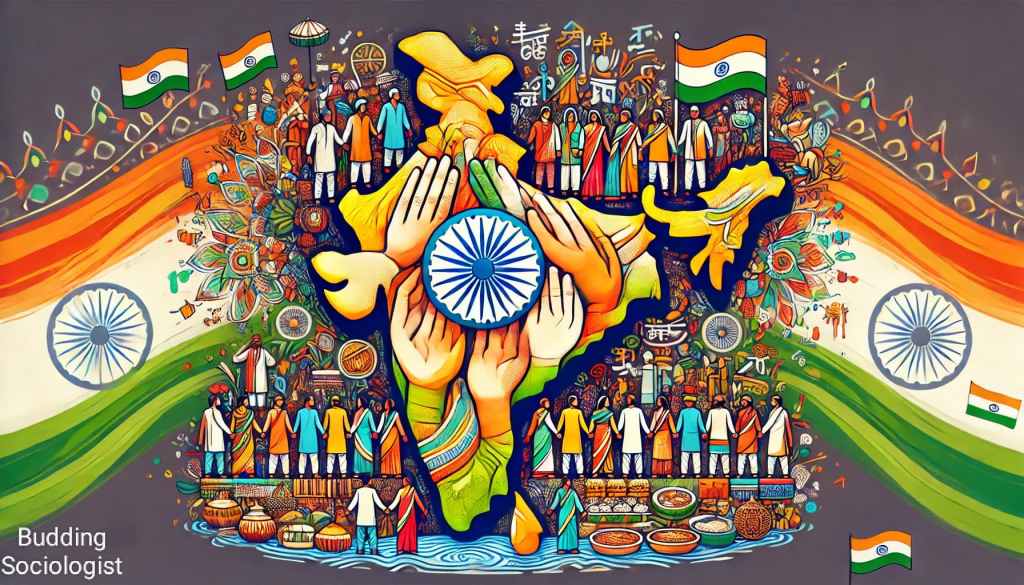
In simple terms, diversity refers to a range of differences. However, when discussing diversity within a society, it encompasses distinctions that set one group apart from others. These variances can be biological, such as race, religion, language, or other factors that differentiate one group from another. Therefore, in societal context, diversity signifies collective distinctions and stands in contrast to uniformity, which denotes similarity. When individuals share common traits like religion or language, it leads to religious or linguistic uniformity among them. It’s important to acknowledge that like diversity, uniformity is also a collective trait.
Unity denotes integration or solidarity within a society. It signifies the coming together and the sense of belonging or “we-feeling” among its members. Unlike uniformity, which implies similarity, unity doesn’t necessitate uniformity. India, often described as “Unity in diversity,” exemplifies this concept through its diverse geographical features like towering mountain ranges, expansive seas, fertile lands nourished by rivers, dense forests, and arid deserts. Within its populace, there exists a multitude of races, castes, religions, and languages, showcasing the richness of diversity within unity.
Meaning of Unity in Diversity
The concept of “unity in diversity” embodies a state of cohesion amid significant diversity, where differences in physical attributes, cultural practices, religious beliefs and other aspects are not viewed as sources of conflict but rather as enriching variations. It represents harmony and solidarity among different individuals or groups, emphasizing unity without uniformity and diversity without fragmentation. This nuanced understanding acknowledges that diversity enhances human interaction.
In India, fostering national unity is crucial, particularly in times marked by extremism and terrorism. Mahatma Gandhi exemplified this commitment to communal harmony through his sacrifice. Despite the presence of diverse communities like Bengalis, Gujaratis, Punjabis, Maharashtrians, and Tamils, India has a long history of coexistence, transcending divisions of caste and religion. Although Hindus and Muslims may differ in culture, ideology, and rituals, they cohabit peacefully and hold mutual respect. This is evident in the exchange of greetings between Hindus and Muslims during each other’s festivals such as Eid, Muharram, Diwali, and Durga Puja. Such exchanges epitomize the unity between these communities in India, reflecting the country’s rich diversity. To fully comprehend the intricate facets of Indian culture, it’s essential to delve into its diverse elements and recognize the enduring unity that binds them together—a defining feature of Indian society.
Types of Diversity
Following are the types of diversity in India:
1. Physical Diversity: India’s geography bestows upon it a myriad of physical diversities ingrained in its landscape. Varied soil compositions and extensive territorial boundaries define its five distinct geographical regions: the Himalayan Mountains, the Northern plains, the Deccan plateau, the Eastern Coastal Plains, and the Western Coastal Plains and Islands.
These diverse geographic entities vividly illustrate India’s rich tapestry of physical features encompassing mountains, plains, rivers, deserts, and coastal areas, earning it the designation of a peninsular continent. The Himalayan region, characterized by its snow-clad peaks and frigid climate, significantly influences the northern and north-eastern states. Conversely, the southern states typically experience tropical climates, while temperate climates prevail in other regions, showcasing a remarkable array of climatic zones within the country.
These climatic variations profoundly impact the region’s surface characteristics. While the extreme north boasts barren and rocky terrain, starkly contrasting with the lush fertility of the Gangetic Plain and Malabar regions, the diversity of India’s landscapes stands as a testament to its geographical richness.
2. Racial Diversity: In the 21st century, India stands as the world’s second most populous nation. Its populace encompasses a diverse array of races, embodying the rich tapestry of human ethnography. G.S. Guha has categorized India’s races into the following types:
2.1. The Negrito: These individuals are recognized as the earliest inhabitants originating from India, the indigenous population. They are identified by their dark complexion, petite stature, and curly hair, which can vary in length. Their heads may exhibit various shapes – small, medium, long, or broad – often with a prominent forehead. Typically, they have broad, flat noses and thick, protruding lips. Representative examples of this group include the Kadars, Irulas, Puniyans, and others found in South India.
2.2. The Proto-Australoid: This demographic is recognized as one of India’s ancient ethnic groups, distinguished by a long-headed structure, a broad, flattened nose that slopes downward at the base, and varying skin tones ranging from deep brown to near-black. They typically have shorter stature and often exhibit wavy or curly hair. Prominent supraorbital ridges are also common among them. These distinctive physical traits are prevalent among numerous tribes across Central and Southern India.
2.3. The Mongoloid: This demographic typically exhibits limited facial and body hair, with eyes that are slanted and often display an epicanthic fold. Their facial structure tends to be flat, with prominent cheekbones, and their hair is typically straight. These individuals primarily reside in the sub-Himalayan region, with notable concentrations found particularly in Assam and the Burma Frontier.
2.4. The Mediterranean: This type of individual typically possesses distinct features such as a elongated head with a gently curved forehead, a slender nose, moderate stature, and a light complexion. Their jawline is notably pronounced, their hair tends to be dark, and their eyes range from shades of brown to deep hues. Additionally, they tend to have abundant facial and body hair. Populations exhibiting these characteristics are found predominantly in regions like Uttar Pradesh, Bombay, Bengal, Malabar, among others. It’s conceivable that this particular group might have played a significant role in the construction and development of the Indus Valley Civilization.
2.5. The Western Brachycephals: This particular phenotype displays a distinctively broad head shape. Their noses are notably elongated, often with a convex curvature. Their facial structure tends to be elongated, and individuals typically possess a tall stature. Their skin tone tends to be dark, with similarly dark eyes and hair. Populations with these characteristics are commonly found in regions such as Bengal, Orissa, and Coorg. Additionally, similar features have been observed historically in regions like the Indus Valley, Tinnevalley, and Hyderabad.
2.6. The Nordics: Individuals exhibit distinctive features such as a prolonged cranial shape and a gently arched forehead. Their noses are straight and possess a prominent bridge. Typically, they are of tall stature, boasting robust jawlines and sturdy physiques. Eye hues tend towards blue or grey, while their complexion is fair with a reddish tint. This particular phenotype is prevalent across Northern India, notably in regions like Punjab and Rajputana. The Nordics are believed to have originated from northern territories, likely originating from southeastern Russia and southwestern Siberia before migrating through Central Asia into India.
3. Linguistic Diversity: India’s rich tapestry of linguistic variation mirrors its diverse racial makeup. With a staggering array of 22 recognized languages, 121 major languages, and a remarkable 19,500 dialects and mother tongues, India stands as a testament to linguistic diversity. These languages and dialects are spoken across different regions inhabited by people of various races. The linguistic landscape of India encompasses several language families, including the Indo-Aryan, Dravidian, Austric, and Sino-Tibetan.
Among the Indo-Aryan languages are Hindi, Urdu, Punjabi, Assamese, Bengali, Oriya, Gujarati, Marathi, and Kashmiri. The Dravidian language family boasts prominent members such as Tamil, Telugu, Kannada, and Malayalam, primarily spoken in southern regions. Meanwhile, the Austric languages are spoken by tribes in central India, and the Sino-Tibetan languages find their home among the tribal communities of north-eastern India.
4. Scriptural and Literary Diversity: India’s linguistic diversity fosters a rich tapestry of scripts and literary traditions. With numerous languages spoken across the nation, it’s natural that various scripts have evolved. This linguistic plurality has given rise to a plethora of literature, spanning diverse languages and dialects, enriching the pan-Indian literary landscape, including Sanskrit classics. The script diversity is evident, with notable scripts such as Brahmi, Kharosthi, Devanagari, Persian, Roman, and Olchiki in use.
Similarly, India boasts a vast array of literary traditions, encompassing Indian literature, Oriya literature, Bengali literature, Tamil literature, and more. Each language’s literature exhibits unique characteristics, setting it apart from others.
5. Socio-Cultural Diversity: Variations in physical attributes, ethnic composition, and linguistic diversity have led to notable distinctions in human attire, culinary preferences, societal norms, and belief systems. Across India, significant disparities in social practices and cultural norms are evident from region to region. For instance, the dressing customs in Rajasthan, known for its scorching temperatures, starkly contrast those in Kashmir, where the climate is bitterly cold. Each region, including the North East with its distinct traditional attire and tribal communities with their unique clothing, exhibits its own sartorial identity. Even the manner of draping a dhoti or sari varies from Uttar Pradesh to Bengal, Tamil Nadu, Maharashtra, and Gujarat.
Dietary habits and lifestyle choices also showcase considerable diversity among Indians. While wheat dominates the diet in the northwest, rice and fish form the staple foods in the east. In the southern regions, a penchant for spicy cuisine prevails. Despite a significant portion of the population adhering to vegetarianism, there is a substantial non-vegetarian demographic as well.
Within Hindu society, a hierarchical caste system comprising Brahmins, Kshatriyas, Vaisyas, and Sudras has traditionally delineated social strata. This system evolved from the social organization of the indigenous Aryans and subsequent waves of settlers. Regional variations further manifest in the traditions, customs, and rituals observed across India. The spectrum of social rituals, festivals, and ceremonies reflects the amalgamation of divergent societal structures and lifestyles, contributing to the intricate tapestry of India’s cultural richness.
6. Religious Diversity: India is renowned for its religious diversity, encompassing a multitude of faiths from around the globe. Among them are Hinduism, Buddhism, Jainism, Christianity, Islam, Sikhism, Zoroastrianism, and more. This diverse landscape is populated by adherents of various religious beliefs, fostering an environment where different faiths coexist. Notably, India holds distinction as the birthplace of four major world religions: Hinduism, Jainism, Buddhism and Sikhism. The nation reverberates with the festivities and rituals unique to each religion, celebrated with fervour and joy. Throughout history, spiritual leaders from different faiths have imparted their teachings, enriching the cultural fabric of the country. Rather than being dominated by any single religion, India embraces its role as a haven for religious pluralism, promoting peaceful cohabitation among diverse communities. Thus, India stands as a testament to the rich tapestry of religious traditions, both ancient and contemporary.
7. Political Diversity: India’s vast expanse, diverse geography, and multitude of cultures, languages, and beliefs all contributed to its complex political landscape. Throughout history, regionalism and local identities have played pivotal roles in maintaining unity, even as external forces attempted to assert control. Despite numerous attempts by rulers from ancient times like Chandragupta Maurya and Ashoka to medieval figures such as Alauddin Khilji and Akbar, and even during the colonial period, India never presented a unified front against foreign invasions.
Various regions, such as those in the extreme south, often remained autonomous under local dynasties, resisting subjugation from the north. While there were sporadic efforts to achieve political unity, they were hindered by internal weaknesses, strong regionalism, and separatist tendencies. Even notable resistance movements against British rule, led by groups like the Marathas, Rajputs, and Sikhs, were fragmented and lacked a cohesive national strategy.
The absence of a widespread sense of nationalism until the 1800s can be attributed to the prevalent barriers of race, language, religion, caste, and geography. Natural features and physical barriers further isolated kingdoms, fostering a sense of independence akin to separate countries. This emphasis on localism impeded the political development of a unified Indian state, thwarting attempts to establish a cohesive United Kingdom of India.
Unity in Diversity
The concept of unity in diversity encapsulates the idea of solidarity among individuals despite their inherent differences. These disparities may stem from cultural, linguistic, ideological, religious, or national distinctions, among others. Throughout history, this notion has been embraced by various political and social entities to epitomize the cohesion among diverse individuals or communities. A prime example of unity in diversity is the peaceful coexistence of people from myriad cultures, religious beliefs and social strata, fostering harmony and tranquility. It serves as a beacon for promoting tolerance and understanding among disparate groups, advocating for the recognition that diversity enriches human interaction.
India stands as a shining illustration of unity in diversity. Within its borders, individuals representing diverse religions, castes, dialects, and cultures peacefully cohabit. The nation’s struggle for independence serves as a poignant testament to this unity, with Indians from all walks of life joining forces to secure freedom. India boasts a rich tapestry of religions, including Hinduism, Buddhism, Islam, Sikhism, Jainism, Christianity, and Zoroastrianism, all grounded in the shared principles of dharma and karma. Despite these religious differences, people commemorate their respective festivals harmoniously, without infringing upon the beliefs of others. While Hindi serves as the predominant language, India’s linguistic landscape is adorned with a multitude of dialects and languages spoken across various regions, including English, Urdu, Sanskrit, Bhojpuri, Punjabi, Marathi, Bengali, Odia, Gujarati, Malayalam, Kashmiri, and more. This diversity underscores India’s commitment to fostering an inclusive and harmonious society, where unity prevails amidst differences.
Types of Unity in India
Here are several perspectives advocating for unity amidst diversity within Indian culture:
1. Geographical Unity: The coherence of a society is greatly influenced by its geographical setting, which dictates the expansion of civilization. Whether in Egypt, Greece, China, or India, the landscape surrounding major rivers has been pivotal in shaping the culture and historical trajectory of civilizations. In India, the notion of geographical cohesion has roots in antiquity, with the concept of “Bharatavarsha” symbolizing unity from the Himalayas to Cape Comorin. This idea finds expression in the Vishnu Purana, which vividly describes Bharatavarsha’s geographical boundaries as a unified entity.
“उत्तरं यत् समुद्रस्यहिमाद्रिश्चैव दक्षिणंवर्षं तद् भारतं नामभारती यात्रा सन्ततिःयोजनानं सहस्रं तुद्रोपोयं दक्षिणोत्तरत,पूर्वे किरातस पश्चिमेयवनस्थितः”
(The region situated to the north of the sea and south of the Himalayas is referred to as Bharata, inhabited by the descendants of King Bharat. This vast expanse spans thousands of miles from the Himalayas to the sea. Its eastern border is populated by the Kiratas, while the Yavanas reside in the west.)
Nature has endowed Bharata with clear geographical boundaries. Surrounded by seas and oceans on three sides, and protected by the Himalayas from the northeast to the northwest, the land is effectively isolated from the rest of the world. The Bay of Bengal to the east, the Indian Ocean to the south, and the Arabian Sea to the west form natural barriers, contributing to Bharata’s cohesive geographical identity.
This geographical unity is further reinforced by cultural and historical factors. The name “Bharatavarsha” carries profound historical significance, symbolizing a sense of unity among its people. References in epics and Puranas, as well as patriotic expressions like “Bharata Mata” and “Vande Mataram,” underscore this unity.
Additionally, the national anthem “Jana Gana Mana” encapsulates the diversity and unity of Bharata by mentioning various regions such as Punjab, Sindh, Gujarat, Maratha, Dravida, Utkala, Banga, Vindhya, Himachal, Yamuna and Ganga. Over time, the geographical features of Bharata, including its forests, mountains and rivers, have fostered a collective awareness of unity among its inhabitants.
2. Political Unity: The coherence of Indian culture owes much to the political climate prevailing in different epochs. Throughout Indian history, numerous rulers endeavoured to consolidate the nation under a singular administrative umbrella. Noteworthy figures include Ashoka and Samudragupta from ancient times, who asserted dominion over the entire subcontinent. In medieval India, Chhatrapati Shahu Maharaj and Aurangzeb made strides in unifying the nation, albeit partially, through centralizing governance systems. Standardized official titles, laws, customs and currency further solidified this political cohesion.
Even during British rule, India was demarcated into British India and Princely States. Independence brought about the unification of the entire nation, although the Indian subcontinent was partitioned into India and Pakistan. Despite achieving independence, challenges to political unity persisted, exemplified by conflicts such as Kashmir, Chinese territorial disputes and conflicts in the northeast. Over time, many of these issues have been addressed, though some remain unresolved. As these lingering challenges are overcome, India will truly attain a unified state.
3. Religious Unity: India stands as a nation where diverse religions coexist peacefully and freely. The rich tapestry of religious practices in India encompasses major world religions. What’s striking is the seamless harmony prevailing among these diverse faiths. The constitutional principle of “secularism” ensures equal treatment of all religions, fostering an environment where people of varied beliefs thrive. With Hinduism being the predominant religion, its influence profoundly shapes Indian society, serving as a unifying force. Its philosophical underpinnings, such as karma, rebirth, and monotheism, resonate across religious lines, uniting people in shared values. Throughout history, saints, sages, and spiritual leaders have advocated for the unity of all religions. Figures like Kabir, Nanak, and Sri Chaitanya bridged the North-South divide with their inclusive teachings, while Sufi saints like Nizam-ud-din-Aulia and Moin-ud-din-Chisti propagated messages of brotherhood and tolerance. This interplay of religious unity, spanning beliefs, practices, and traditions, forms a vital component of India’s cultural heritage.
4. Cultural Unity: India’s rich cultural tapestry remains resilient despite its vast diversity. Rooted in the ancient Vedic period, Indian culture has evolved and spread across the nation, shaping its literature, philosophy, customs, and traditions. This cultural foundation manifests in uniform social ceremonies, religious practices, holidays, and lifestyle choices throughout the country. Shared values such as family reverence, adherence to caste traditions, and rites of passage like Upanayana and Namakarana are embraced across communities. While regional festivals add colour and variety, national celebrations like Dussehra, Holi, and Diwali unify the entire nation in joyous observance.
5. Scriptural, Linguistic and Literary Unity: India boasts a rich diversity of languages, dialects, scripts, and literary traditions, yet there exists a pervasive sense of unity among them. Brahmi stands as the oldest known Indian script, shaping the foundations of modern Indian writing. Conversely, Kharosthi, another script, saw limited usage. Presently, the Indian Constitution designates Devanagari as the script for the national language. Hinduism’s influence is deeply rooted in Sanskrit, serving as the official language of Indian rulers for millennia. Prior to the Common Era, Prakrit served as the language of the populace, with Buddhist teachings recorded in this tongue. Following the decline of the Mauryan dynasty, Pali and Sanskrit supplanted Prakrit. Despite regional linguistic variations, Hindi and English serve as lingua franca throughout India. During British colonial rule, English emerged as the official language, unifying Indians under a single linguistic banner. Post-independence, Hindi assumed the role of Rashtrabhasa or national language, fostering linguistic amalgamation. As languages strive to uphold national unity, the literature of various regions reflects this cohesive national identity. Sanskrit literature serves as a profound reservoir of inspiration for modern Indian writers, poets, and dramatists, with works like the Vedas, Upanishads, and those of Kalidasa and Jayadeva enriching regional literary traditions. Figures such as Tulsidas, Iqbal, and Tagore are revered nationwide for their portrayal of the quintessential “Indian character” in their scholarly endeavours.
6. Socio-Economic Unity: The fabric of Indian society reflects a rich tapestry of social diversity, albeit with underlying threads of traditional unity. While varying in attire, cuisine, and customs, there exists a cohesive cultural core. Take, for instance, the enduring presence of traditional Indian garments like the Dhoti and Saree, transcending regional attire distinctions. Similarly, dietary disparities notwithstanding, a common culinary thread unites the nation, embracing both vegetarians and non-vegetarians. Core values such as reverence for elders, familial ties, the gesture of joining hands in greeting, and the sanctity of marriage rituals resonate universally, transcending regional diversity.
Likewise, the Indian economy mirrors a landscape of visible economic inequality yet remains fundamentally rooted in agriculture. Agriculture serves as the bedrock, shaping livelihoods from the humble cultivator to landowners. This connection to the land influences lifestyles and economic pursuits. Moreover, India boasts a significant presence of agro-based industries, a testament to its agrarian dependence.
7. Physical Uniformity: Throughout history, India has witnessed the influx of various foreign groups such as Aryans, Sakas, Huns, Scythians, among others, who arrived, settled, and integrated with the indigenous population, embracing local customs. Over time, Muslims also arrived during the medieval period, seamlessly blending into the fabric of Indian society. This continual convergence of different ethnicities and cultures contributed to a physical unity, shaping the collective identity and character of India. This unity, rooted in the deep connection between the people and the land, gave rise to a sense of nationalism that permeated Indian consciousness. Despite the diverse array of cultures and beliefs, India has maintained a remarkable cohesion, with religion, language, and societal structures serving as pillars of unity amidst diversity. Foreign influences have been assimilated into the vast tapestry of Indian culture, reflecting its resilience and adaptability. This cultural assimilation is exemplified in the ancient epic Ramayana, where Lord Rama emphasizes the importance of one’s motherland over material wealth, symbolizing India’s reverence for its homeland. Throughout history, India has revered the motherland as a sacred entity, fostering a sense of unity that transcends differences.
Conclusion: In India, fostering national unity serves as the cornerstone for a robust, cohesive, and prosperous nation, particularly amidst the challenges posed by extremism and terrorism. Mahatma Gandhi epitomized this ideal through his unwavering commitment to communal harmony. Despite the diverse array of ethnicities such as Bengalis, Gujaratis, Punjabis, Maharashtrians, Tamils, and more, India has a rich history of coexistence transcending caste and religious boundaries over millennia. The adage “United we stand, divided we fall” resonates profoundly, underscoring the pivotal role of unity in our collective strength. Drawing inspiration from timeless wisdom, exemplified by the parable of the Elder who united his quarrelsome sons to showcase the power of unity, we can navigate contemporary challenges with a unified approach.
India’s unity acts as a formidable shield, deterring potential aggressors and safeguarding against external threats, as evidenced by minimal instances of foreign aggression. The Indian Armed Forces stand as one of the world’s largest standing armies, a testament to our collective defence capability. Furthermore, the nation’s economic progress owes much to the spirit of unity that pervades every Indian. Today, India stands as a prominent economic force, ranking among the top 10 economies globally in both purchasing power parity (PPP) and estimated GDP, underscoring the dividends of unity in propelling national development.