- Introduction
- Origin of Westernization
- Characteristics of Westernisation
- Carriers of Westernisation
- Westernization in India
- Impact of Westernization
Introduction
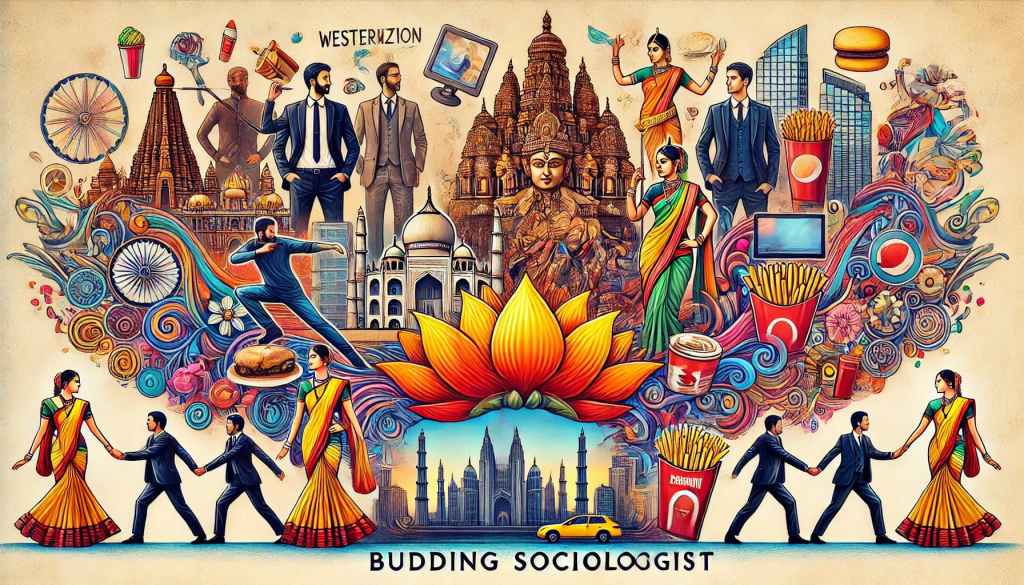
Similar to the concept of Sanskritization, the notion of westernisation is utilized to assess social transformations in rural India and other parts of the nation. M.N. Srinivas introduced this concept to elucidate the process of social and cultural mobility within India’s traditional social framework, drawing from his research on the Coorgs of southern India.
Srinivas described westernisation as the changes induced in Indian society and culture due to over 150 years of British colonial rule. Westernisation manifests across various domains such as technology, institutions, ideology, and values. Importantly, the term ‘westernisation’ is value-neutral, devoid of inherent moral judgment.
Srinivas particularly highlighted the humanitarian and rational aspects within the spectrum of westernisation. Yogendra Singh (1994) further expands on the multifaceted nature of westernisation, emphasizing its broader dimensions.
The promotion of humanitarian values and rational thinking, characteristic of Western influence, has catalyzed a wave of institutional and social reforms across India. This wave has ushered in the establishment of scientific, technological, and educational institutions, fostered nationalist sentiments, spurred the emergence of new political norms and leadership, and left a lasting imprint on the country.
Srinivas posits that rather than hindering it, the rapid pace of Westernization often coincides with and even accelerates the process of Sanskritization. Indeed, instances exist where the advancement of Westernization actively contributes to Sanskritization. This influence is evident in the modernization of Sanskritic institutions such as pilgrimage sites and caste associations, facilitated by improvements in communication and transportation infrastructure.
A noticeable trend over the past few decades is the emergence of new religious festivities and the revitalization of previously obscure deities, now embraced by popular celebrations. Concurrently, caste associations have undergone significant reorganization. Empirical evidence suggests that alongside the rise of Westernization, Sanskritic bonds have also experienced a strengthening of solidarity.
Origin of Westernization
MN Srinivas introduced the concept of westernization, tracing its roots back to the era of British rule in India. He contends that the colonial regime not only facilitated exploitation and oppression of the masses, both rural and urban, but also catalyzed significant transformations in Indian society and culture. This period ushered in new technologies, institutions, knowledge systems, beliefs, and values.
Under colonial governance, various segments of Indian society were assimilated, marking the genesis of India as a modern state. Land surveys, revenue settlements, bureaucratic structures, and the establishment of military, police, and judicial institutions characterized this period. Additionally, the British administration fostered advancements in communication through the introduction of railways, postal services, and telegraphs, alongside the founding of educational institutions. Srinivas delineates these changes as follows:
One evident consequence was that through the proliferation of books, journals, and schools, modern as well as traditional knowledge became accessible to a larger segment of the Indian population, breaking the exclusive hold previously maintained by a few hereditary groups. Concurrently, newspapers played a crucial role in fostering a sense of commonality among people across the vast expanse of the country, highlighting shared experiences and the global events that impacted their lives.
The influence of British rule also saw the emergence of Christian missionaries who actively engaged with marginalized communities such as the backward, tribals, and untouchables, integrating them into mainstream society with a closer alignment to Western values. This process of Westernization has brought significant transformations to rural India, facilitated by initiatives like the five-year plans, which have connected village communities to broader networks of communication and modernization. Additionally, the establishment of democratic institutions such as Panchayati Raj and the widespread dissemination of education have further accelerated the process of Westernization, bringing villagers closer to contemporary societal norms and practices.
Characteristics
Below, are some key attributes of Westernization as outlined by Srinivas:
1. Humanitarianism: Westernization carries with it particular sets of value preferences. According to Srinivas, one of the central values, encompassing several others, is what can broadly be termed as humanitarianism. This denotes a proactive regard for the well-being of all individuals, regardless of factors such as caste, economic status, religion, age, or gender. Srinivas suggests that the term ‘humanitarianism’ encompasses a wide range of values, with paramount importance placed on the welfare of all.
2. Equalitarianism: The concept of Westernization encompasses the principle of egalitarianism, which holds significant democratic ideals. It aims to reduce inequality, eradicate poverty, and secure liberty for all individuals. Utilizing Westernization as a foundational pillar for a socialist society in the future could prove beneficial.
3. Secularisation: Throughout both the British colonial period and into independent India, the Constitution of India introduced the principle of secularism, envisioning a rational and bureaucratic society. Consequently, the state is mandated to uphold respect for all religions within society, including the principles of scientific ethics.
4. Start of Social Reforms: The concept of westernization exerted significant influence in eradicating social injustices. British legislation abolished specific inequalities entrenched in Hindu and Islamic legal systems. Institutions promoting practices like sati, untouchability, and purdah were dismantled due to the propagation of ideals such as egalitarianism and secularism.
5. Dominance of Science and Technology: British colonialism facilitated the introduction of science and technology into Indian society, including the implementation of railways, steam engines, and other technological advancements. Consequently, India began transitioning towards industrialization. However, this technological advancement posed challenges to traditional village industries and local crafts, as industrial growth surged. Urbanization gained momentum due to this industrialization, leading to increased migration from rural areas to urban centers. This migration brought about significant changes in rural society and introduced new societal values. Additionally, traditional institutions such as untouchability and caste underwent reinterpretation in response to these shifts.
Conclusion: Based on the preceding description, it can be inferred that the process of westernization entails the transformation of Indian society, a phenomenon that commenced during the British rule in India and persists to this day. This process is inclusive, capable of assimilating diverse external influences. Moreover, it is intricate, involving multiple facets such as behavioural norms and knowledge systems, operating across various strata of society. There is a notable emphasis on values rooted in humanitarianism and rationality, primarily targeting cultural shifts. Westernization often leads to the replacement of traditional institutions with new ones imbued with contemporary values.
Carriers of Westernisation
The process of westernization in India during British rule entailed a significant cultural transformation rooted in rational values. It involved the emulation of Western cultural norms and practices, leading to notable shifts in various aspects of Indian society. Identifying the precise carriers of westernization proves challenging due to its multifaceted nature, influenced by numerous factors. Nonetheless, several key elements contribute to this process:
- British colonial influence played a pivotal role in driving the westernization process within India.
- Coined by Srinivas, westernization permeated Indian society across diverse realms such as technology, institutions, ideologies, and values.
- Westernization facilitated the spread and advocacy of education, rationalism, and humanism throughout the nation.
- Traditional practices like child marriage, untouchability, pollution, and purity underwent cessation, marking profound societal changes across India.
Types of Westernization
Westernization occurred in two phases based on its impact on both the little and great traditions. The influence on the great tradition has been referred to as Secondary Westernization.
1. Primary Westernization: Prof. Yogindera Singh describes primary westernization as the transformation influenced by Western impact on Indian local traditions. This transformation manifests in two distinct forms:
- Initially, there’s the development of westernized sub-cultural patterns, which are confined to specific groups of Indians in regions where initial contact with Western culture occurred.
- Additionally, primary westernization encompasses the broader diffusion of Western cultural elements. This includes the adoption of new technologies, attire, cuisine, language, and alterations in lifestyle habits. Such changes are typically attributed to cultural interactions with the British.
2. Secondary Westernization: Secondary Westernization emerged during the late 19th and early 20th centuries, denoting a series of transformations that fostered the proliferation of diverse cultural frameworks across the nation. This encompassed advancements in education, law, science, technology, as well as improvements in transportation and communication networks.
The transition from traditional to modern values was evident during this period, spurred by industrialization and urbanization, which introduced novel societal norms. Traditional institutions such as untouchability and caste underwent reinterpretation. Essentially, Westernization denotes the societal changes that occurred in India during the British colonial period and gained momentum in the post-independence era, as India engaged with other nations on a global scale.
Impact of Westernization
In a more expansive view, the effects of westernization on Indian society can be observed as follows:
1. Caste System: The intertwining of industrialization and urbanization is intricately linked to the phenomenon of westernization. In India, the entrenched caste system, with its stringent occupational and social constraints, has gradually eroded under the influence of westernization. This cultural shift has been propelled by the rapid expansion of industry, which has created fresh opportunities for collaboration across caste lines. Consequently, workplaces have become melting pots where individuals from diverse castes converge, thereby undermining the traditional barriers enforced by the caste system.
2. Family: The dynamics of family relationships have experienced significant shifts due to the influence of Westernization. Emphasizing individualism has impacted the traditional collective mindset of the joint family system. Nowadays, family members prioritize personal freedom in their marital lives, and brides are increasingly hesitant to live under the authority of their in-laws. This transformation reflects the integration of new democratic values into household dynamics.
3. Marriage: The process of Westernization has instigated notable shifts in matrimonial dynamics. Presently, marriage is perceived not as an alliance between two families, but as a bond primarily between husband and wife. This evolution has fostered a paradigm where spouses regard each other akin to friends or companions, prioritizing love and personal fulfillment over religious considerations.
4. Religion: Reason-based science and Western education have significantly reshaped our understanding of religion, leading to a shift from traditional religious concepts to more logical interpretations. Consequently, the societal significance of religion has diminished.
5. Education: Prior to British colonization, education in the country followed a philosophical and metaphysical approach. It was limited to the upper castes or the twice-born castes, excluding those from lower castes. However, under British rule, a modern educational system emerged, characterized by its scientific and liberal ethos. This system was inclusive, welcoming individuals regardless of their caste, creed, or religion.
6. Food Habits: The historical dietary practices of Indian culture vastly contrast with contemporary habits. In the past, it was customary for Hindus to enjoy their meals seated on the floor, whereas today, there’s a prevalent preference for dining at tables akin to Western customs. Additionally, there’s a noticeable surge in the popularity of non-vegetarian fare and fast food, overshadowing the traditional emphasis on vegetarian cuisine.
7. Dress Pattern: Due to the pervasive influence of Western culture, even rural residents are now choosing factory-made clothing such as nylon, terylene, terrycloth, and cotton over traditional garments. The classic attire of yesteryears has given way to contemporary styles, with ready-to-wear clothing gaining significant popularity, especially among the younger demographic.
8. Status of Women: Contemporary Western education has significantly contributed to advancing women’s roles in society. Through the acquisition of knowledge in various disciplines such as arts and sciences, women have made strides alongside men. They are actively engaged in competition with men across political, social, economic, and educational domains. Moreover, Western education has empowered women to advocate for equality and strive for parity in all aspects of life.
9. Transport and Communication: During the British colonial period, India witnessed the establishment of a comprehensive transportation and communication infrastructure. This included the introduction of railways, postal services, telegraph lines, printing presses, and newspapers. Consequently, Indian society experienced a notable increase in both physical and psychological mobility compared to previous eras.
Conclusion: Based on the preceding description, it is evident that in our interconnected global environment with increasingly porous borders, both goods and cultural influences traverse the globe. India’s current ascendance in the global economy has led to a blending of cultural norms, often resulting in the adoption of Western values. Over its millennia-old history, Indian culture has continuously absorbed and integrated elements from various foreign cultures.
The rich tapestry of Indian culture, spanning over 6000 years, continues to evolve as it assimilates and adapts to new influences. Each new cultural facet imported from the West or other regions contributes a unique flavour and dimension to our societal fabric. Undesirable customs and cultural traits, whether indigenous or foreign, are being cast aside, while cherished ones are retained and fortified. This evolutionary process promises to enrich and enliven the Indian experience, fostering a deeper sense of cultural diversity and resilience.